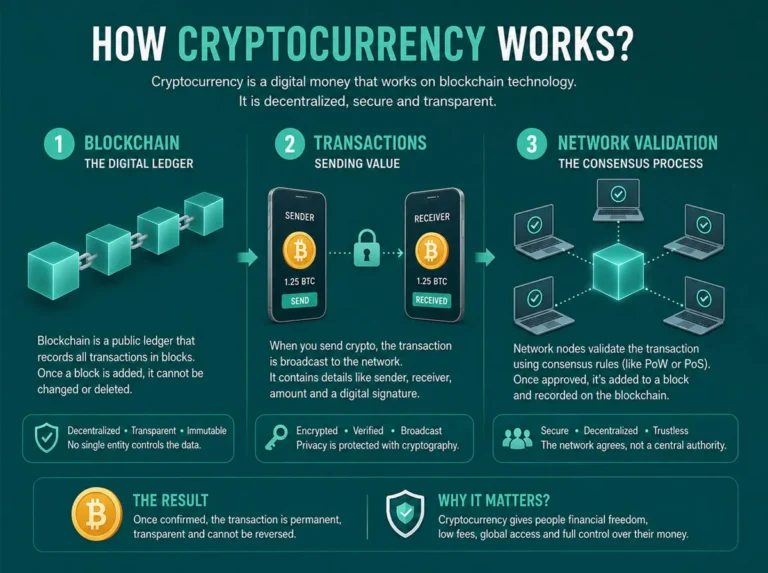
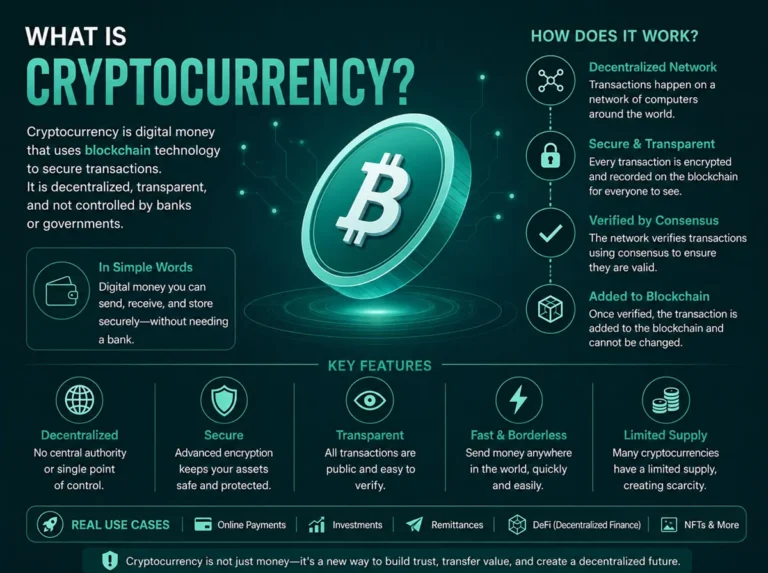
Types of Cryptocurrency: Coins, Tokens, Stablecoins and Utility Tokens Explained

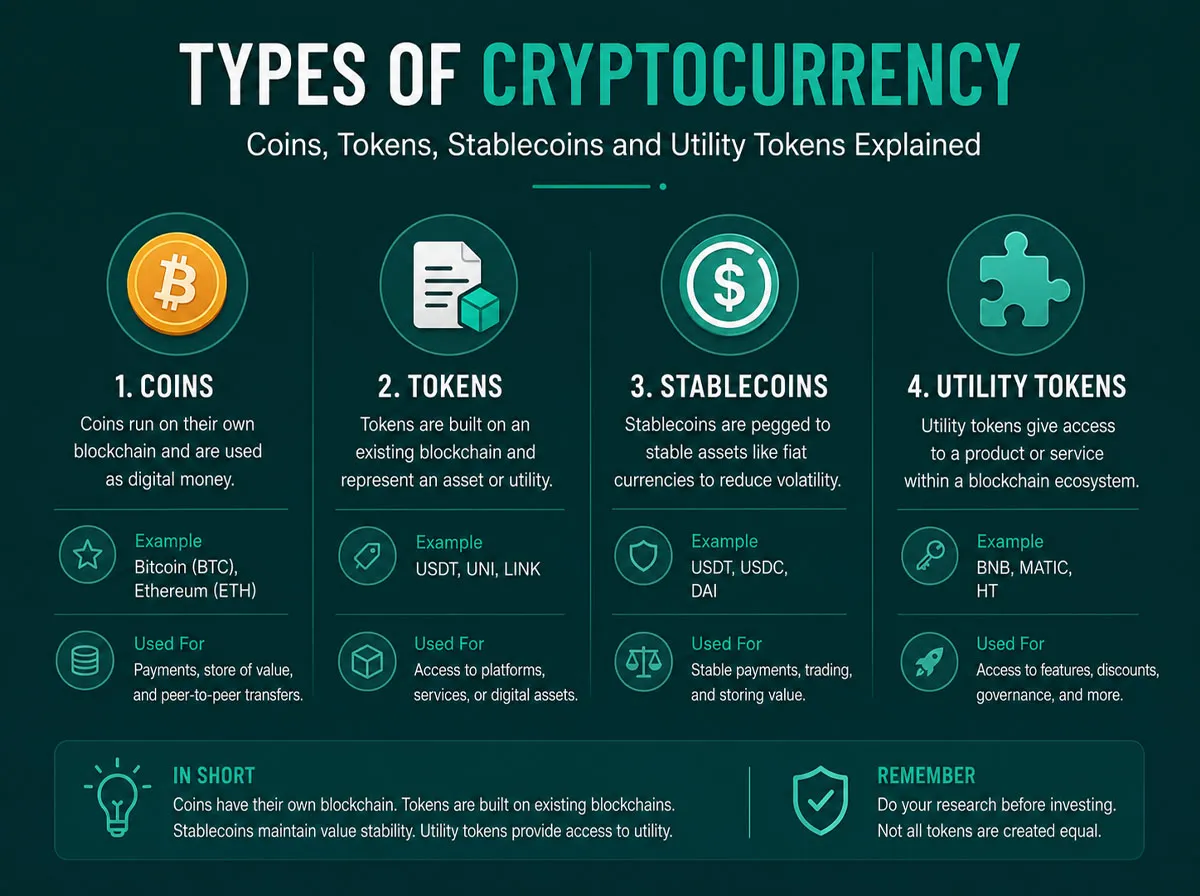
What are the types of cryptocurrency?
The phrase types of cryptocurrency is used broadly because crypto assets can be classified in more than one way. Classification may be based on the asset’s technology, purpose, value mechanism, ownership structure, or rights attached to it.
For example, a digital asset may be:
- A native coin used by its own blockchain.
- A token issued through a smart contract on another blockchain.
- A stablecoin designed to track a reference value.
- A utility token used to access a product or service.
- A governance token that may support voting within a protocol.
- A non-fungible token representing a unique digital or physical item.
These categories can overlap. A token might be both a utility token and a governance token, while a native coin may also be used for payments and network fees.
The National Institute of Standards and Technology explains that blockchain-based tokens can represent existing assets or create new digital assets. It identifies fungible and non-fungible tokens as two broad token categories and notes that tokens may be native to a blockchain or deployed through smart-contract logic on an existing blockchain.
Education-only disclaimer: This article is for general educational purposes only. It is not investment, financial, tax, or legal advice. Crypto assets can be highly volatile and may involve significant technology, custody, fraud, platform, liquidity, and regulatory risks. Do not treat any category or example discussed here as a recommendation.
Coins and native cryptocurrencies
A coin is generally a crypto asset native to its own blockchain. It is created and managed according to the rules of that network rather than through a smart contract hosted on another blockchain.
What are coins used for?
Native coins may be used to:
- Pay network transaction fees.
- Reward miners or validators.
- Transfer value between users.
- Support the security of a blockchain.
- Participate in network governance.
- Serve as a unit of account within an ecosystem.
For example, a blockchain may require its native coin to pay the fee for transferring another token or interacting with a smart contract on that network.
The word “coin” does not mean that the asset is a physical object. Like other crypto assets, it exists digitally and is controlled through cryptographic keys and network rules.
Coin examples
Bitcoin is commonly described as a native coin because it operates on the Bitcoin blockchain. Ether is the native asset of the Ethereum network and is used for transaction fees and other network functions.
These examples illustrate one of the most important differences between coins vs tokens: a coin is usually native to its own blockchain, while a token is typically issued on an existing blockchain.
Tokens and blockchain-based assets
A token is generally a digital asset created on top of an existing blockchain. Tokens are often issued using smart contracts, which are programmes that apply predefined rules to transactions and asset management.
Tokens can represent:
- Access to a service.
- Voting or governance rights.
- A digital collectible.
- A claim or representation linked to another asset.
- In-app items.
- Rewards or loyalty benefits.
- A unit used in decentralised applications.
NIST describes token systems as a way to manage digital ownership and exchange verifiable data through blockchain networks. Its framework considers token design, wallets, transactions, user interfaces, and the underlying protocol.
Coins vs tokens
| Feature | Coins | Tokens |
|---|---|---|
| Blockchain | Usually native to their own blockchain | Usually issued on an existing blockchain |
| Main purpose | Network operation, fees, payments, or security | Access, governance, representation, rewards, or applications |
| Creation | Requires development or operation of a blockchain protocol | Often created through a smart contract |
| Examples | Bitcoin and Ether | Utility, governance, stablecoin, and NFT assets |
| Main technical risk | Network security and protocol changes | Smart-contract, issuer, liquidity, and network risks |
The distinction is useful but not absolute. Some projects use the terms differently, and an asset’s classification may change as its network develops.
Stablecoins
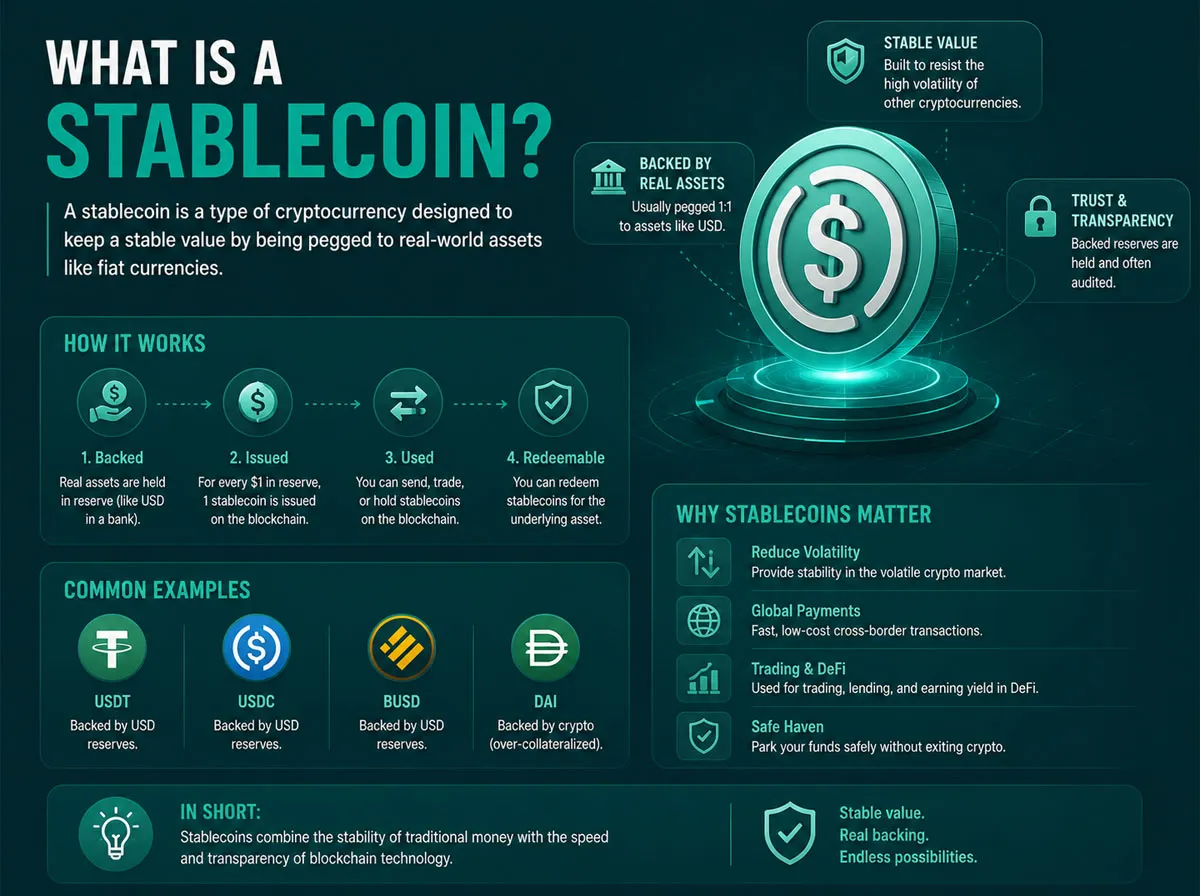
Stablecoins are crypto assets designed to maintain a relatively stable value compared with a reference asset or mechanism. The reference may be a fiat currency, a basket of assets, a commodity, or another calculation method.
Stablecoins are among the most discussed types of cryptocurrency because they are often used for trading, transfers, settlement, and activity within blockchain applications.
How stablecoins attempt to maintain value
Different stablecoin models use different mechanisms:
- Fiat-backed stablecoins: Seek to maintain reserves such as cash or short-term financial instruments.
- Crypto-collateralised stablecoins: Use other crypto assets as collateral.
- Algorithmic or mechanism-based stablecoins: Use software rules, incentives, or supply adjustments to target a reference value.
- Commodity-linked digital assets: Attempt to track the value of commodities or other external assets.
The word “stable” describes the intended price mechanism, not a guarantee. A stablecoin may face reserve, redemption, liquidity, counterparty, smart-contract, governance, or regulatory risks.
Uses of stablecoins
Stablecoins may be used for:
- Moving value between crypto platforms.
- Quoting trading pairs.
- Reducing the need to convert between crypto and traditional currencies.
- Settling blockchain-based transactions.
- Supporting decentralised applications.
- Holding a digital asset intended to have lower short-term price volatility than some other crypto assets.
However, lower price volatility does not eliminate all risks. A stablecoin can lose its reference value, become difficult to redeem, or experience restrictions during market stress.
Utility tokens
A utility token is generally designed to provide access to a product, service, network feature, or application. For example, a project may require users to hold or spend a token to access certain functions.
Possible utility-token functions include:
- Paying for services inside an application.
- Receiving discounts or access privileges.
- Purchasing digital goods.
- Paying network or platform fees.
- Unlocking features in a blockchain-based system.
- Supporting user participation within an ecosystem.
The practical value of a utility token depends on whether the underlying service exists, whether users need the token, how the token is distributed, and whether the network can function effectively.
A token described as a “utility token” should not automatically be assumed to be safe, valuable, or exempt from regulation. Legal treatment depends on the asset’s structure, promotion, rights, use, and the jurisdiction involved. The CFTC has discussed utility-token design in the context of digital-asset market analysis, including whether an asset provides an immediately available consumptive use.
Governance tokens
Governance tokens are designed to support participation in decisions about a protocol, decentralised application, or blockchain-based organisation.
Depending on the project, governance may involve proposals and voting on:
- Protocol upgrades.
- Fee structures.
- Treasury spending.
- Collateral requirements.
- Supported assets.
- Risk parameters.
- Changes to application functionality.
Holding a governance token does not necessarily provide ownership of a company or a guaranteed right to receive income. The actual voting power may depend on token holdings, delegation, lock-up rules, quorum requirements, or other protocol conditions.
Governance systems can also be affected by concentrated ownership. If a small number of wallets control a large share of the supply, the voting process may not reflect broad participation.
Fungible and non-fungible tokens
Another way to understand the types of cryptocurrency is to classify tokens as fungible or non-fungible.
Fungible tokens
Fungible tokens are interchangeable units. One unit is generally equivalent to another unit of the same token under the relevant system.
For example, one unit of a fungible token may be treated as equal to another unit of that token. This structure is suitable for:
- Payments.
- Rewards.
- Stablecoins.
- Governance units.
- In-app currencies.
- Fractionalised digital assets.
Fungibility does not mean the token has stable value. A fungible token can still be highly volatile or illiquid.
Non-fungible tokens
Non-fungible tokens, commonly called NFTs, are designed to represent unique or distinguishable items. Each token may have its own identifier, metadata, ownership history, or associated rights.
NFTs may represent:
- Digital artwork.
- Collectibles.
- Event tickets.
- Membership credentials.
- In-game items.
- Certificates.
- Claims connected to physical or digital assets.
NIST describes an NFT as an owned, transferable, and indivisible data record representing a linked physical or virtual asset, generally managed by a smart contract on a blockchain.
Owning an NFT does not automatically mean owning the copyright, physical item, commercial rights, or every benefit associated with the image or project. Buyers should read the relevant terms carefully.
Payment and settlement crypto assets
Some crypto assets are designed primarily to support digital transfers or payments. A payment-oriented asset may aim to provide:
- Peer-to-peer transfers.
- Cross-border settlement.
- Lower-cost transactions.
- Faster movement of value.
- Digital payment functionality without traditional intermediaries.
Practical usefulness depends on network capacity, fees, confirmation times, merchant acceptance, price volatility, legal treatment, and user experience.
A cryptocurrency may be technically suitable for payments but still be inconvenient in everyday use if its value changes rapidly or if transactions are slow or expensive.
Asset-backed and tokenised assets
Some blockchain-based tokens are designed to represent an interest in or claim related to another asset. This may include financial instruments, commodities, real-world assets, or ownership records.
Tokenisation can improve the way ownership records are issued, transferred, or tracked, but the token’s rights depend on its legal structure and issuer arrangements.
Investor.gov distinguishes tokenised securities from other digital-asset categories and notes that a tokenised security may represent a stock, bond, fund interest, or other financial instrument recorded on a blockchain.
A token’s name or technical design does not by itself determine its legal classification. Readers should check official documents and applicable local rules rather than relying only on marketing language.
How to compare cryptocurrency types
When comparing cryptocurrency types, look beyond the label. Consider the following questions:
What is the asset designed to do?
Read the project’s technical documentation and determine whether the asset is intended for payments, network fees, governance, access, collateral, collectibles, or another function.
Where does it operate?
Identify whether the asset is native to its own blockchain or issued on another network. Also check whether it depends on a specific smart contract.
How is supply managed?
Review whether supply is fixed, inflationary, algorithmically adjusted, or controlled through governance. Supply rules can affect incentives and market behaviour.
Who controls key decisions?
Consider the role of developers, validators, token holders, issuers, custodians, and other participants. Centralised control may create different risks from a widely distributed network.
How liquid is the asset?
An asset may be easy to buy but difficult to sell during stressed market conditions. Check trading volume, available markets, spreads, withdrawal conditions, and platform reliability.
What rights does ownership provide?
Do not assume that holding a token gives ownership of a company, revenue, intellectual property, reserves, or physical property. The rights must be clearly defined in the governing documents.
Risks across crypto asset types
All major types of cryptocurrency can involve risk, although the specific risks differ.
- Coins: Network security, protocol changes, volatility, mining or staking concentration, and adoption risk.
- Tokens: Smart-contract vulnerabilities, issuer risk, poor liquidity, incorrect contract addresses, and dependency on another blockchain.
- Stablecoins: Reserve, redemption, de-pegging, counterparty, governance, and regulatory risks.
- Utility tokens: Low adoption, weak demand, project failure, and uncertainty about the promised service.
- Governance tokens: Concentrated voting power, proposal manipulation, low participation, and uncertain rights.
- NFTs: Illiquidity, copyright confusion, metadata loss, marketplace dependence, and highly speculative pricing.
- Tokenised assets: Legal enforceability, issuer obligations, custody, settlement, and jurisdiction-specific regulatory requirements.
Investor.gov warns that crypto-related products can involve volatility, illiquidity, platform failure, hacking, fraud, technical problems, and changing regulation. Crypto assets held through certain products may not receive the same protections as bank deposits.
Beginner checklist
Before using or trading any crypto asset, ask:
- What problem or function is the asset supposed to address?
- Is it a coin, token, stablecoin, utility token, governance token, or NFT?
- Which blockchain and smart contract does it use?
- Who controls the project and its upgrades?
- How is the supply created and distributed?
- What happens if the platform, issuer, or blockchain experiences an outage?
- Can the asset be withdrawn and transferred on the network you intend to use?
- What security and custody risks apply?
- What tax and regulatory rules apply in your jurisdiction?
Do not buy an asset merely because it belongs to a popular category. A classification explains what an asset is designed to do; it does not predict its future price or guarantee that the project will succeed.
Key takeaways
- The main types of cryptocurrency include native coins, tokens, stablecoins, utility tokens, governance tokens, and non-fungible tokens.
- A coin generally operates on its own blockchain, while a token is usually created on an existing blockchain.
- Stablecoins aim to maintain a relatively stable value but are not automatically risk-free or fully protected.
- Utility and governance tokens may provide access or participation rights, but their usefulness depends on the underlying project and network.
- Fungible tokens are interchangeable, while non-fungible tokens are designed to represent unique digital or physical items.
- A crypto asset’s category does not prove its quality, legality, value, liquidity, or suitability for a particular person.
– Frequently Asked Questions (FAQs)
There is no single universal answer because “common” can refer to market value, usage, trading volume, payments, or number of projects. Native coins, platform tokens, stablecoins, and utility tokens are all widely used for different purposes.
No. A coin is generally native to its own blockchain, while a token is usually issued on an existing blockchain. In everyday conversation, however, people sometimes use the terms interchangeably.
No. Stablecoins aim to track a reference value but may face reserve, redemption, liquidity, smart-contract, counterparty, governance, and regulatory risks. A stablecoin can lose its intended peg.
A utility token may provide access to a product or service, but its economic and legal characteristics vary. Do not assume that the word “utility” guarantees value, safety, or a particular regulatory treatment.
Fungible tokens are generally interchangeable with other units of the same token. NFTs are designed to be unique or distinguishable and may represent digital or physical items.
Yes. A token may be both a utility token and a governance token, while a stablecoin may also be fungible. Categories describe different characteristics and are not always mutually exclusive.