Types of Trading: 5 Popular Trading Styles Explained

Types of Trading Explained
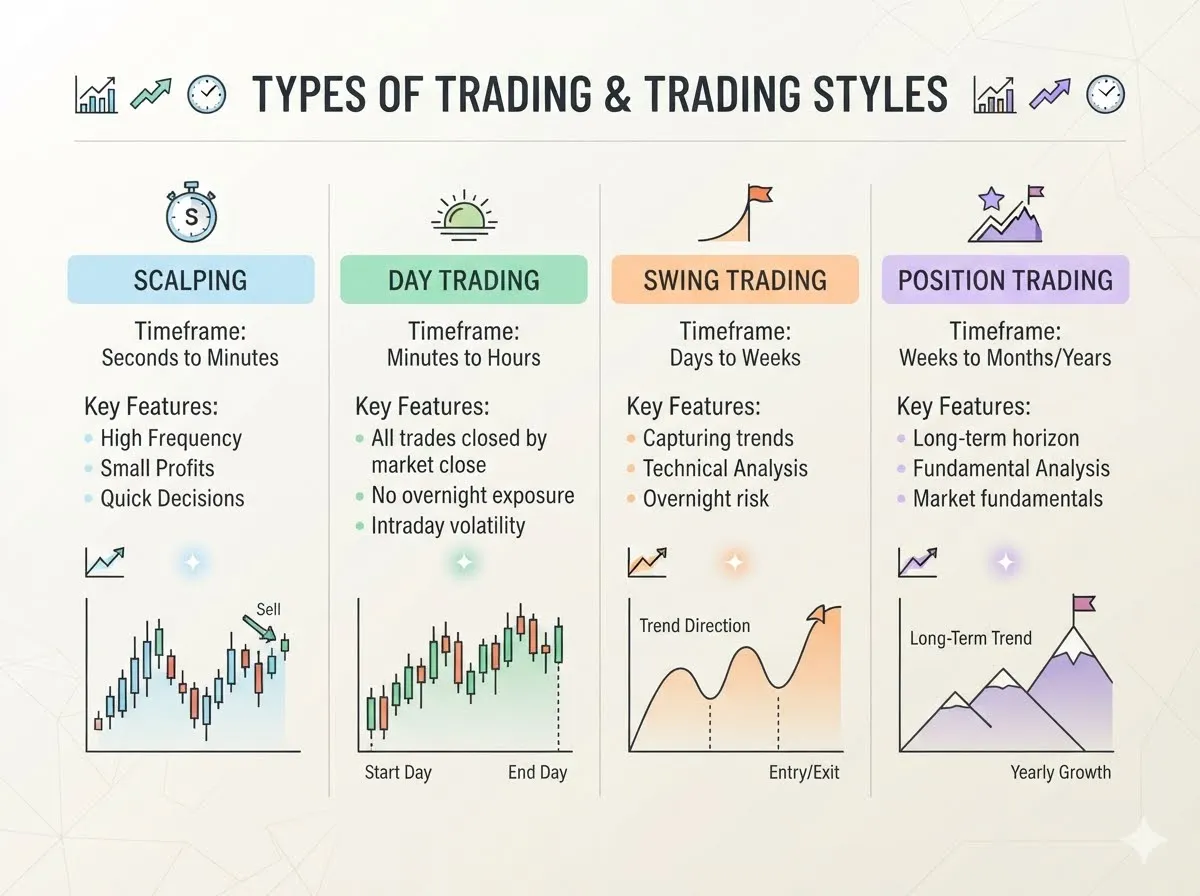
The main types of trading differ by how long a position is held, how frequently trades are taken, how much market monitoring is required, and how risk is managed. The most common trading styles are scalping, intraday trading, swing trading, positional trading, and algorithmic trading.
There is no universally best approach. A trading method that suits a full-time market professional may be impractical for someone with a job, studies, or limited time during market hours. Before choosing among the different types of trading, understand the time commitment, costs, market conditions, and psychological demands involved.
For beginners, the goal should not be to find the fastest route to profit. It should be to select one repeatable process, understand its risks, practise it safely, and keep position sizes small while learning.
How Trading Styles Differ
The most useful way to compare the types of trading is by holding period, decision speed, screen time, and exposure to overnight risk. Shorter-term approaches may offer more frequent opportunities, but they also demand faster execution and can create more costs through spreads, brokerage, slippage, and taxes.
| Trading style | Typical holding period | Screen time | Main focus | Key risk |
|---|---|---|---|---|
| Scalping | Seconds to minutes | Very high | Small, frequent price moves | Costs and execution errors |
| Intraday trading | Minutes to one session | High | Same-day price movement | Fast volatility and emotional decisions |
| Swing trading | Days to weeks | Moderate | Short- to medium-term price swings | Overnight and weekend gaps |
| Positional trading | Weeks to months | Lower | Larger directional trends | Broad market reversals |
| Algorithmic trading | Strategy-dependent | Setup and monitoring required | Rule-based execution | Code, data and operational failures |
These trading styles can be used in stocks, indices, commodities, currencies, derivatives, and crypto assets. However, the product you choose matters. A leveraged futures position, for example, can behave very differently from an unleveraged cash-equity position.
SEBI notes that derivatives can multiply both profits and losses because the amount paid or deposited can be small compared with the value of the underlying asset.
Scalping
Scalping is one of the fastest types of trading. A scalper attempts to capture small price movements, often entering and exiting positions within seconds or minutes. The objective is generally to take many tightly managed trades rather than hold one large directional position for a long time.
Scalpers often watch short time-frame charts, live order-book data, bid-ask spread behaviour, volume, and immediate support or resistance levels. They need a liquid market because entering and exiting quickly becomes difficult when there are too few active buyers and sellers.
How scalping may work
A trader may see a liquid stock repeatedly hold a support area during the first hour of trading. They might enter only if price, volume, and order flow support a defined setup. If the market moves in their favour, they exit quickly; if it fails, they exit according to a predefined stop-loss rule.
The key point is that a scalper is not trying to predict an entire day’s move. They are trying to execute a small, controlled setup repeatedly.
Who scalping may suit
Scalping may suit experienced traders who can:
- Watch the market continuously.
- Make decisions quickly without abandoning rules.
- Understand market orders, limit orders, spreads, and slippage.
- Accept that transaction costs can materially affect results.
- Maintain emotional control after consecutive wins or losses.
Scalping is not automatically more profitable because it produces more trades. More trades also mean more opportunities for mistakes, costs, fatigue, and impulsive decisions.
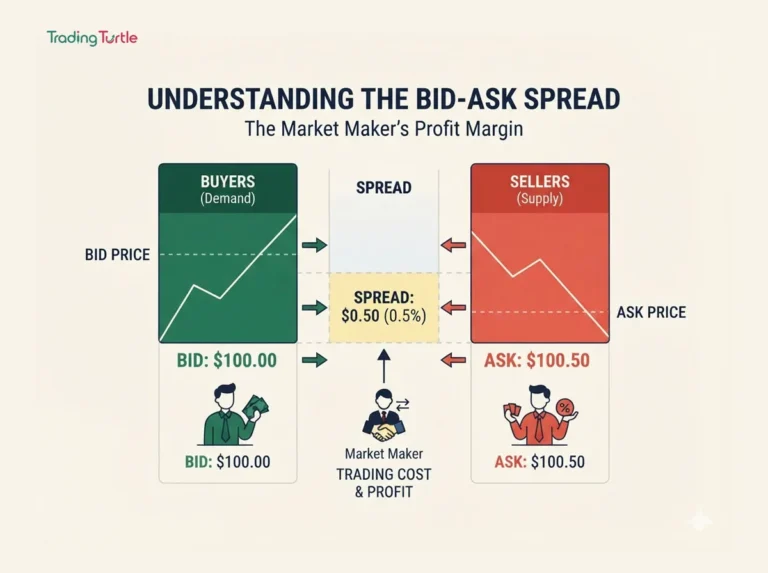
Read Bid-Ask Spread Explained before considering fast trading methods, because a wide spread can consume a large part of a small intended profit.
Intraday Trading
Intraday trading, also called day trading, means opening and closing positions during the same trading session. Among the most recognised types of trading, it appeals to people who do not want to carry open positions overnight.
An intraday trader may buy a stock after a breakout, sell an index derivative when a support level breaks, or trade a mean-reversion setup after a sharp move. The position is normally closed before the market session ends, subject to the broker’s policies and the instrument’s rules.
Why people choose intraday trading
The main attraction is the absence of overnight exposure. News released after the market closes can create a gap up or gap down in the next session, affecting traders who hold positions overnight. Intraday traders avoid that specific risk by closing before the session ends.
However, avoiding overnight risk does not make intraday trading low risk. Daytime volatility, sudden news, poor execution, leverage, and overtrading can still cause significant losses.
Intraday trading example
Suppose a trader identifies a stock trading above an important morning range with higher-than-usual volume. Their plan could be:
- Enter only after a clear breakout condition is met.
- Place a stop-loss below the breakout level or recent swing low.
- Use a small position size based on the planned loss if the stop is hit.
- Exit part of the position at a predefined level, if that is part of the strategy.
- Close the trade if the setup fails or the session ends.
The outcome is uncertain. A breakout can continue, fail immediately, or reverse after an apparently strong move. The purpose of a plan is to control loss when the market does not confirm the idea.
Swing Trading
Swing trading involves holding positions for several days to several weeks. Of all the types of trading, swing trading often provides a middle ground between the intensity of intraday trading and the patience required for longer-term positional trading.
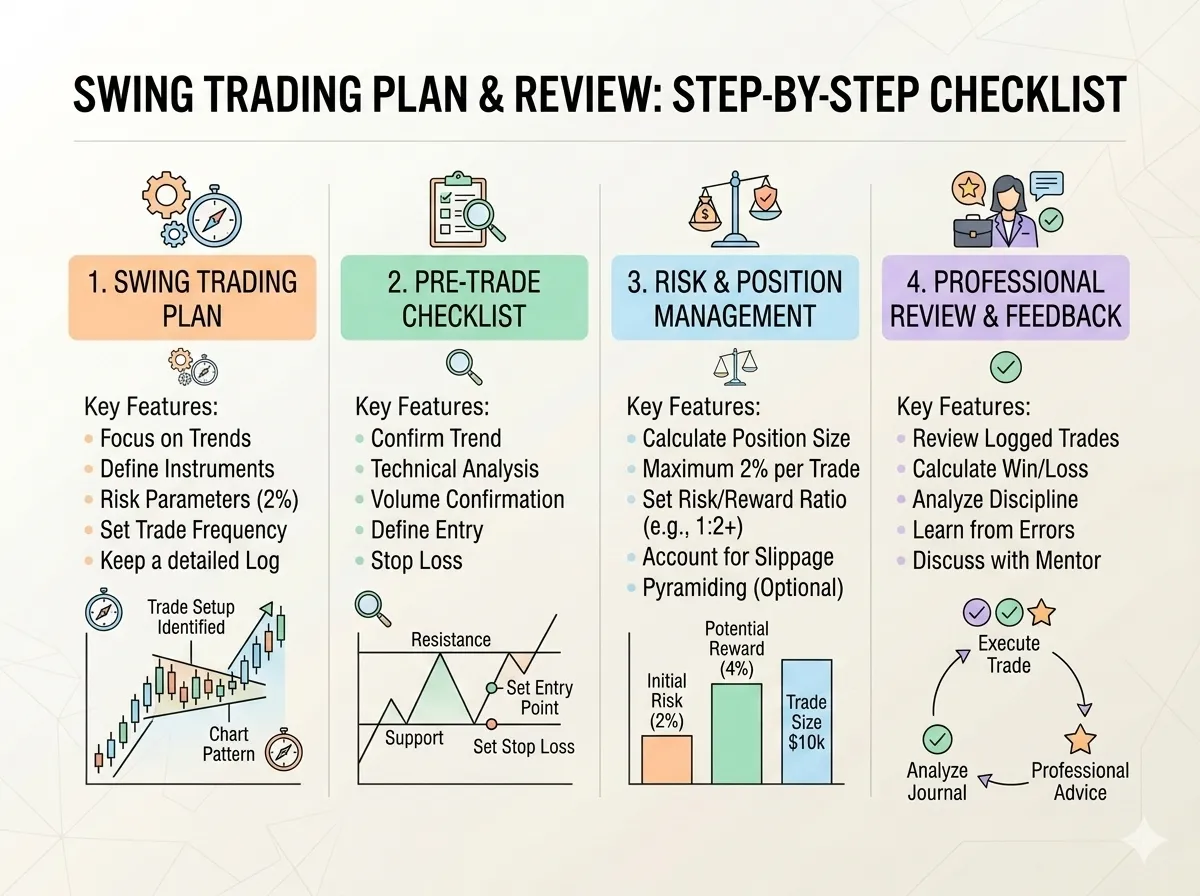
Swing traders look for price “swings” within broader trends or ranges. They may use daily and four-hour charts, support and resistance, moving averages, volume, momentum, price patterns, and event risk to build a trade plan.
Typical swing-trading approach
A trader may identify a stock in an established uptrend that has temporarily pulled back to a prior support zone. Instead of buying immediately, they may wait for confirmation such as a bullish reversal candle, reclaim of a key level, or improvement in volume.
They then define:
- The entry condition.
- The point where the trade idea is invalid.
- A stop-loss level.
- The maximum amount to risk.
- A target or trailing-exit method.
- The company or economic events that could affect the position.
Swing trading reduces the need to watch screens all day, but it introduces overnight and weekend risk. Earnings announcements, global market moves, policy developments, geopolitical news, or unexpected events can cause price gaps beyond a planned exit level.
Risk reminder: A stop-loss is a risk-management instruction, not a promise of execution at one exact price. When an asset gaps sharply, an exit can occur at a worse price than expected. This risk matters particularly for swing, positional, derivative, and crypto trades.
Positional Trading
Positional trading involves holding a position for weeks, months, or sometimes longer, with the aim of participating in a broader market trend. It remains one of the most patient trading styles, but it is still distinct from purely long-term investing because the position is usually entered and exited using a defined market thesis and risk plan.
A positional trader may study weekly and daily charts, sector trends, macroeconomic conditions, earnings cycles, relative strength, and larger support or resistance zones. They generally make fewer trades than scalpers or day traders.
What positional traders look for
Common positional setups include:
- A breakout from a long consolidation range.
- A major trend continuation after a controlled pullback.
- Relative strength in a sector or index.
- A broad market reversal supported by multiple signals.
- A long-term support level with defined invalidation.
The slower pace can make positional trading easier to manage alongside work or education. But fewer decisions do not remove risk. A position held through major news, results, central-bank decisions, or global instability can experience large price moves.
Positional traders need patience and the ability to tolerate normal market fluctuations without exiting a valid plan too early. At the same time, patience should never become denial: if the original thesis is invalidated, risk rules must take priority.
Algorithmic Trading
Algorithmic trading, also known as trading bots, uses computer programs to identify signals, calculate position size, place orders, manage exits, or monitor markets according to predefined rules. It is one of the most technical types of trading, but automation does not remove market risk.
A basic automated system may scan a list of stocks for moving-average crossovers. A more advanced system might combine price action, volatility filters, order-book conditions, risk limits, execution logic, and portfolio-level exposure controls.
What an algorithmic strategy needs
A responsible algorithmic workflow includes more than writing code:
- Define clear, testable entry and exit rules.
- Use clean historical data and account for missing or incorrect data.
- Test for transaction costs, spreads, slippage, and realistic fills.
- Separate in-sample development from out-of-sample validation.
- Use paper trading or controlled deployment before real capital.
- Set maximum position, daily-loss, and system-failure limits.
- Monitor APIs, connectivity, exchange notices, logs, and live execution.
A backtest can look excellent because it assumes ideal fills, ignores fees, uses biased data, or overfits rules to historical patterns. Live performance can differ sharply from simulation.
NSE offers real-time data across multiple levels and segments, illustrating why data availability and market-data quality are important considerations for systems that depend on timely pricing.
For a safer starting point, use our Paper Trading to understand simulation limitations and practical testing rules.
How to Choose a Trading Style
Choosing between the different types of trading should begin with your real-life constraints, not with social-media claims or a single profitable screenshot.
Ask yourself the following questions:
- How much time can I reliably give markets? Scalping and intraday trading need much more attention than swing or positional approaches.
- Can I monitor markets during trading hours? If not, a style that requires instant decisions is unlikely to be sustainable.
- How do I handle fast losses? Short-term trading can produce quick feedback and emotional pressure.
- Am I comfortable carrying positions overnight? Swing and positional trading require you to account for gap risk.
- Do I understand leverage? If not, avoid treating derivatives as a shortcut to trade with less capital.
- Can I follow a written process? Every trading style requires rules, review, and loss limits.
- What market am I trading? Liquidity, trading hours, volatility, regulation, and available products vary across markets.
For many learners, a simple daily-chart swing-trading exercise in a paper account is easier to review than a rapid scalping strategy. It creates fewer decisions and leaves more time for journaling and structured learning.
Risks Across All Styles
The types of trading may vary, but certain risks appear in every approach.
Leverage risk
Leverage can make small price changes produce disproportionately large gains or losses. It is especially important in futures, options, margin products, and perpetual crypto contracts.
SEBI’s investor education material warns that derivatives can multiply outcomes and that a wrong speculative decision can potentially wipe out net worth.
Cost risk
Brokerage, exchange charges, taxes, bid-ask spread, slippage, and funding costs can materially reduce returns. High-frequency methods may be particularly sensitive to small execution costs.
Liquidity risk
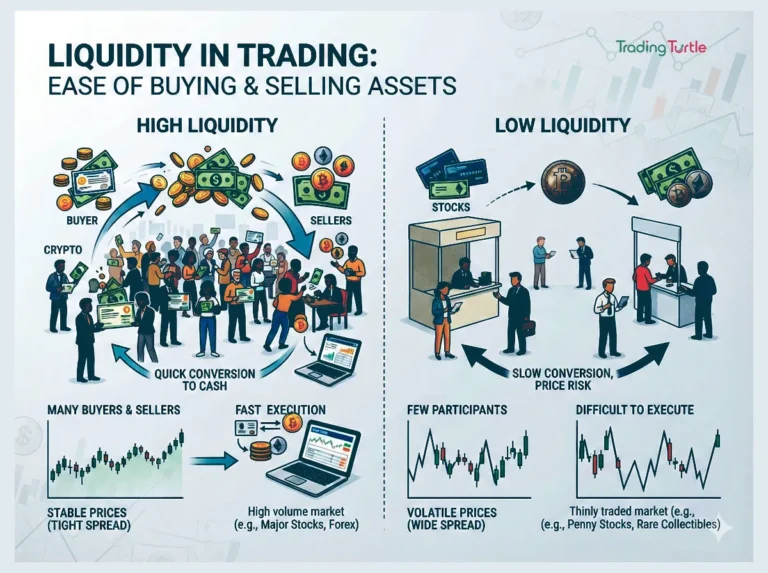
Illiquid instruments can have wider spreads and fewer counterparties. That can make it difficult to enter or exit at the price you expect.
Strategy risk
A strategy can stop working when volatility, market structure, regulations, liquidity, or participant behaviour changes. Historical profitability is not proof of future performance.
Behavioural risk
Fear, greed, boredom, overconfidence, and revenge trading can damage any style. A sophisticated strategy cannot protect a trader who repeatedly ignores its risk rules.
SEBI reported that 93% of individual traders in equity futures and options incurred losses between FY22 and FY24, underscoring why leveraged trading should not be approached casually.
Beginner Mistakes
Avoid these common errors when exploring the types of trading:
- Switching from scalping to swing trading after every losing trade.
- Using leverage before learning position sizing and margin risk.
- Entering trades based only on tips, influencers, or social-media posts.
- Copying an algorithmic strategy without understanding the logic or execution assumptions.
- Ignoring brokerage, spread, slippage, taxes, and funding costs.
- Treating paper-trading performance as guaranteed live performance.
- Trading too many markets, assets, or time frames at once.
- Failing to document entries, exits, reasons, and emotional state.
- Increasing position size to recover a loss.
- Continuing to trade after reaching a predefined daily loss limit.
Start with one market and one structured setup. Your first objective should be process consistency not a specific income target.
Key Takeaways
- The most common types of trading are scalping, intraday trading, swing trading, positional trading, and algorithmic trading.
- Each approach has different holding periods, screen-time needs, costs, and risks.
- Scalping and intraday trading require fast execution and close monitoring.
- Swing and positional trading allow more time for analysis but expose traders to overnight and event-driven gaps.
- Algorithmic trading can improve consistency of execution, but it introduces data, coding, system, and monitoring risks.
- The best trading styles are those you can manage with a realistic schedule, clear risk limits, and disciplined execution.
- Start with education, paper testing, position sizing, and a trading journal before committing meaningful capital.
Educational disclaimer: This article is for educational purposes only and is not investment, trading, tax, or legal advice. Trading involves substantial risk, and you can lose some or all of your capital. Never trade with money you cannot afford to lose.
– Frequently Asked Questions (FAQs)
The main types of trading are scalping, intraday trading, swing trading, positional trading, and algorithmic trading. They differ mainly in holding period, trading frequency, required screen time, and risk exposure.
There is no universally best style. Many beginners find a slower, structured approach easier to study and review than rapid scalping. The right choice depends on your schedule, market knowledge, risk tolerance, and ability to follow a written plan.
Not necessarily. Intraday trading avoids overnight gaps but can involve rapid decisions, frequent trades, high volatility, and potentially leverage. Swing trading allows more time for analysis but carries overnight and weekend risk.
Scalping can be profitable for some experienced traders, but it is highly demanding and sensitive to spreads, slippage, fees, execution speed, and emotional discipline. It is not a guaranteed or easy way to earn money.
You can learn algorithmic trading as a beginner, especially through research and paper trading. However, do not deploy real money until you understand data quality, backtesting limitations, risk controls, system monitoring, and realistic transaction costs.
Futures and options can be used across several styles, but they have additional complexity and leverage risk. Learn contract specifications, margin, settlement, payoff structures, and possible losses before trading them.