How Long Should You Paper Trade Before Going Live? A Milestone Checklist

If you have been paper trading for a while, you have probably asked yourself this question at least once:
How long should You paper trade before switching to a live trading account?
The reality is that there is no fixed number of days or months that suits every trader.
Going live should not be based on the calendar alone. It should be based on whether your trading process has become consistent enough to handle real capital responsibly.
A useful paper trading platform can help you track metrics such as your virtual balance, profit and loss, win rate, drawdown, and trading history. These numbers can give you a clearer picture of how consistently you are following your strategy before real money is involved.
This guide walks through a practical milestone checklist to help you judge whether you may be ready to move from paper trading to live trading — rather than making the decision simply because enough time has passed.
Educational disclaimer: This article is for educational purposes only. It does not provide investment advice, stock recommendations, trading signals or personalised financial guidance. Investing and trading involve risk, including the possibility of losing capital.
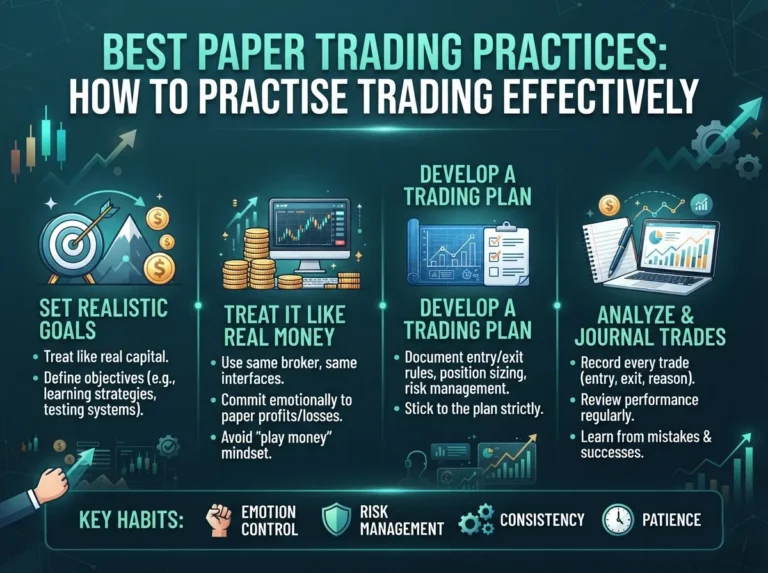
Why Paper Trading Matters Before You Risk Real Money
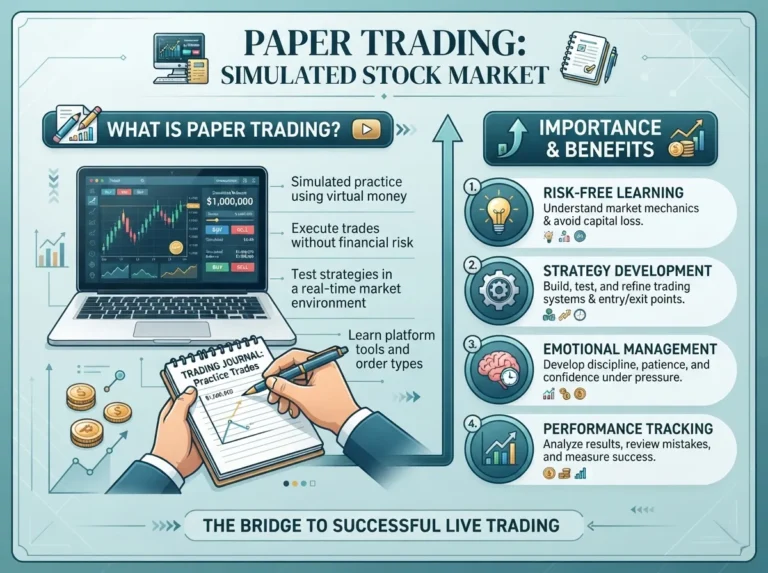
Paper trading allows you to practise a trading strategy using virtual capital without putting real money at risk.
A simulated account can help you practise:
- Entries and exits
- Position sizing
- Stop-loss placement
- Risk management
- Order execution
- Following a predefined trading plan
The biggest advantage is that you can test your process in live or simulated market conditions without the financial consequences of a real trade.
However, the important question is not simply how long you have been paper trading.
What matters more is what you have learned and whether your results show that you can follow a repeatable trading process.
What Paper Trading Teaches You That Theory Can’t
Learning trading concepts is one thing.
Applying them consistently while prices are moving is another.
Paper trading gives you an opportunity to practise:
- Staying disciplined when a trade moves against you
- Making decisions using your trading plan rather than impulse
- Following predefined entry and exit rules
- Managing position size and risk
- Building confidence in a strategy through repetition
You can learn these concepts from books, videos, or educational articles, but repetition is what helps turn theory into a process you can actually follow.
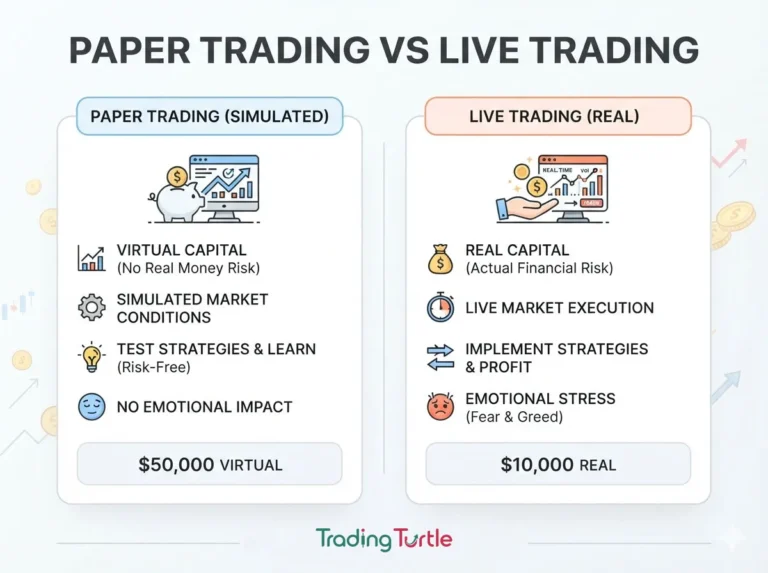
At the same time, remember that paper trading cannot fully replicate the psychological pressure of risking real money.
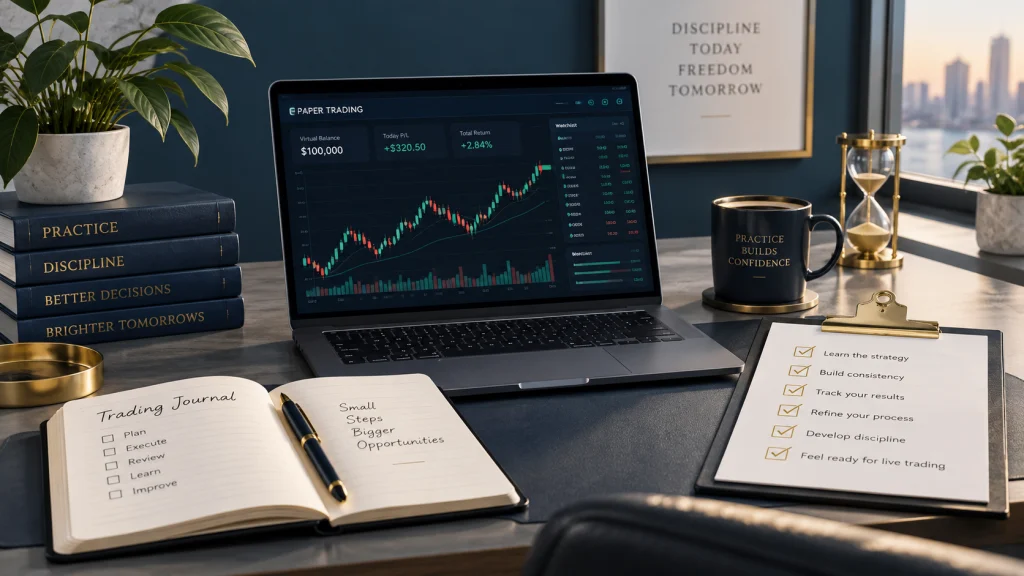
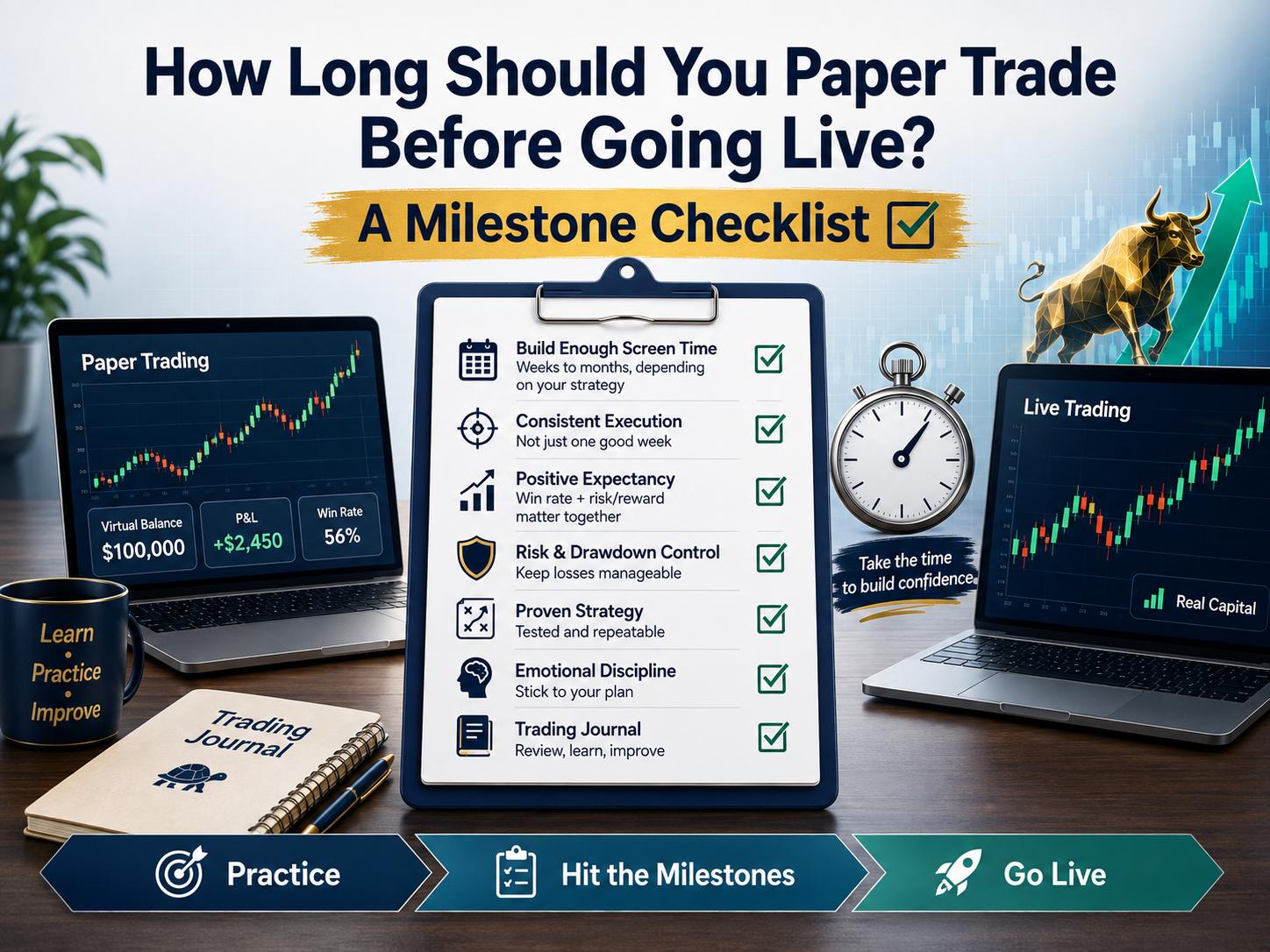
How Long Should You Paper Trade: The Milestone Checklist
Instead of counting weeks or months alone, use the following milestones to evaluate your progress.
These are not universal rules or guarantees of profitability. They are practical benchmarks that can help you assess whether your trading process is becoming more consistent.
1. Build Enough Paper Trading Experience
Some traders may need a few weeks of active practice, while others may require several months.
The amount of time depends heavily on:
- Your trading style
- How frequently your setups appear
- The number of trades you can realistically evaluate
- The market conditions you have experienced
A day trader may generate a larger sample of trades relatively quickly, while a swing or position trader may need considerably more time because valid setups occur less frequently.
The goal is not to reach a specific number of months.
The goal is to build enough experience to evaluate your strategy across a meaningful sample of trades.
2. Show Consistency — Not Just One Profitable Period
A single profitable week or month does not necessarily prove that a strategy has an edge.
Short-term results can be influenced by favourable market conditions, a small sample size, or simple variance.
What matters more is whether your strategy continues to perform reasonably over a larger number of trades and different market environments.
Look for consistency in:
- Strategy execution
- Risk per trade
- Entry selection
- Exit discipline
- Overall expectancy
Several consistently executed periods are generally more informative than one unusually profitable month.
3. Understand Your Win Rate in Context
Win rate is useful, but it should never be evaluated on its own.
A strategy that wins 40% of its trades can still be profitable if the average winning trade is significantly larger than the average losing trade.
Similarly, a strategy with a high win rate can still lose money if losses are much larger than wins.
Instead of aiming for an arbitrary win-rate target, evaluate:
Win rate + average reward-to-risk + trading costs + overall expectancy
together.
The goal is not to achieve the highest possible win rate.
It is to determine whether the strategy has a repeatable positive expectancy when executed correctly.
4. Keep Risk and Drawdown Under Control
Drawdown tells you how much your account declines from a previous peak.
It is one of the most important numbers to monitor during paper trading because it helps reveal whether your strategy and position sizing are exposing the account to excessive risk.
Instead of treating a particular drawdown percentage as a universal limit, define a maximum drawdown that fits your own risk tolerance and trading plan.
More importantly, determine why the drawdown happened.
Was it caused by:
- Normal losing trades within the strategy?
- Oversized positions?
- Revenge trading?
- Ignoring stop losses?
- Trading outside the strategy?
- A market regime in which the strategy performs poorly?
If your paper account experiences large uncontrolled swings, that is something to address before real capital is involved.
5. Follow a Tested and Repeatable Strategy
Your trading plan should be based on clear rules rather than decisions invented during each trade.
At minimum, you should understand:
- What qualifies as an entry
- Where your trade becomes invalid
- How position size is determined
- When profits are taken
- Which market conditions suit the strategy
- When you should avoid taking a trade
Historical testing can help you understand how a strategy behaved in previous market conditions, while paper trading helps you evaluate whether you can execute those rules consistently in real time.
Neither guarantees future profitability, but both are considerably better than trading without a defined process.
6. Demonstrate Emotional Discipline
Paper trading removes the fear of losing real money, but it can still reveal important behavioural habits.
Ask yourself:
Do you move your stop because you hope the market will reverse?
Do you immediately take another trade after a loss?
Do you enter trades that do not meet your setup criteria?
Do you increase position size after a winning streak?
Do you abandon your strategy when a few trades fail?
If you struggle to follow your rules when virtual money is involved, adding real financial pressure is unlikely to make discipline easier.
The purpose of paper trading is not only to test the strategy.
It is also to practise following it.
7. Maintain a Detailed Trading Journal
Every meaningful paper trade should be recorded.
Your journal can include:
- Entry price
- Exit price
- Stop loss
- Profit target
- Position size
- Reason for entering
- Market conditions
- Result
- Whether you followed your plan
- What you learned from the trade
A trading journal turns paper trading from random practice into something measurable.
Over time, it can help you identify repeated mistakes, strong setups, weak setups, and areas where your execution needs improvement.
Choosing a Paper Trading Platform to Track Your Progress
Not every paper trading platform provides the same level of tracking and analysis.
A useful simulator should ideally give you more than just a virtual account balance.
Look for tools that help you understand how you are trading, not simply whether the virtual balance went up or down.
One option you can explore is PaperTradingApp, which provides a paper trading environment for practising without putting real capital at risk.
As with any trading platform, compare its available features with your own needs before choosing where to practise.

Features to Look for Before You Pick a Paper Trading Platform
Useful features may include:
- Market prices that reflect real or near-real market conditions
- Profit and loss tracking
- Win-rate statistics
- Drawdown monitoring
- Trade-history records
- Trading journal functionality
- Realistic order types
- The ability to review completed trades
The goal is not to find the platform with the most features.
It is to find one that gives you enough information to evaluate your strategy and trading behaviour properly.
Practice → Hit the Milestones → Go Live Gradually
The transition from paper trading to real trading can be viewed as a simple progression:
Practice → Evaluate Your Process → Trade Small With Real Capital
Use paper trading to practise your strategy and collect meaningful data.
Review your consistency, risk management, trading journal, drawdowns, and ability to follow your rules.
Once those areas become reasonably stable, you may consider moving to live trading with a small amount of capital rather than immediately trading at full size.
This is important because live trading introduces something paper trading cannot fully reproduce:
real financial and emotional pressure.
Your first live trades should therefore be another stage of learning, not proof that you have mastered trading.
Final Thoughts — Trade With a Process, Not Just Time
Do not decide to go live simply because you have spent a certain number of months paper trading.
Time matters, but your process matters more.
Before risking meaningful capital, you should understand your strategy, know how much you are willing to lose on a trade, be able to follow predefined rules, review your results honestly, and maintain disciplined position sizing.
Paper trading can help you develop these habits without risking real money.
But remember that success in a simulated environment does not guarantee success in live markets.
When you eventually make the transition, starting small allows you to experience the psychological difference of trading real capital without exposing yourself to unnecessary risk.
The objective is not to move from paper trading to live trading as quickly as possible.
It is to make the transition when your preparation gives you a reasonable foundation to manage real risk responsibly.
Frequently Asked Questions (FAQs)
There is no universal minimum. Some traders may build enough experience within a few months, while others may need longer.
Rather than focusing only on time, look at your number of completed trades, consistency, risk management, strategy execution, and ability to follow your trading plan.
There is no single win rate that makes a trading strategy good. Win rate should always be considered together with average profit, average loss, reward-to-risk ratio, trading costs, and overall expectancy.
A lower-win-rate strategy can still be profitable if its winning trades are significantly larger than its losing trades.
ook for features that help you evaluate both performance and execution, such as:
- Realistic market prices
- P&L tracking
- Trade history
- Drawdown statistics
- Position-sizing tools
- Journaling
- Suitable order types
A useful simulator should help you understand your process, not simply display a virtual balance.
Possibly, but the number of months alone does not determine readiness.
Three months may provide meaningful information for a high-frequency strategy, while it may produce too few trades to evaluate a slower swing or position-trading strategy. The quality and size of your trading sample matter more than the calendar alone.
Technically, yes.
But moving to live trading simply because it is available is different from being prepared for it.
Before switching, make sure you understand your strategy, position sizing, maximum acceptable loss, and trading rules.When you do move to live trading, consider starting with much smaller position sizes.
Paper trading is useful for practising strategy execution, order placement, risk management, and trade review.
However, it cannot fully reproduce the emotional pressure associated with gaining or losing real money. That is why the transition from simulation to live trading should generally be treated as another learning stage rather than an abrupt switch to full-size positions.
You can verify a broker through SEBI’s official recognised-intermediary database, which lists registered equity-segment stock brokers and their registration details.