How Cryptocurrency Works: Blockchain, Transactions and Validation Explained

Cryptocurrency in brief
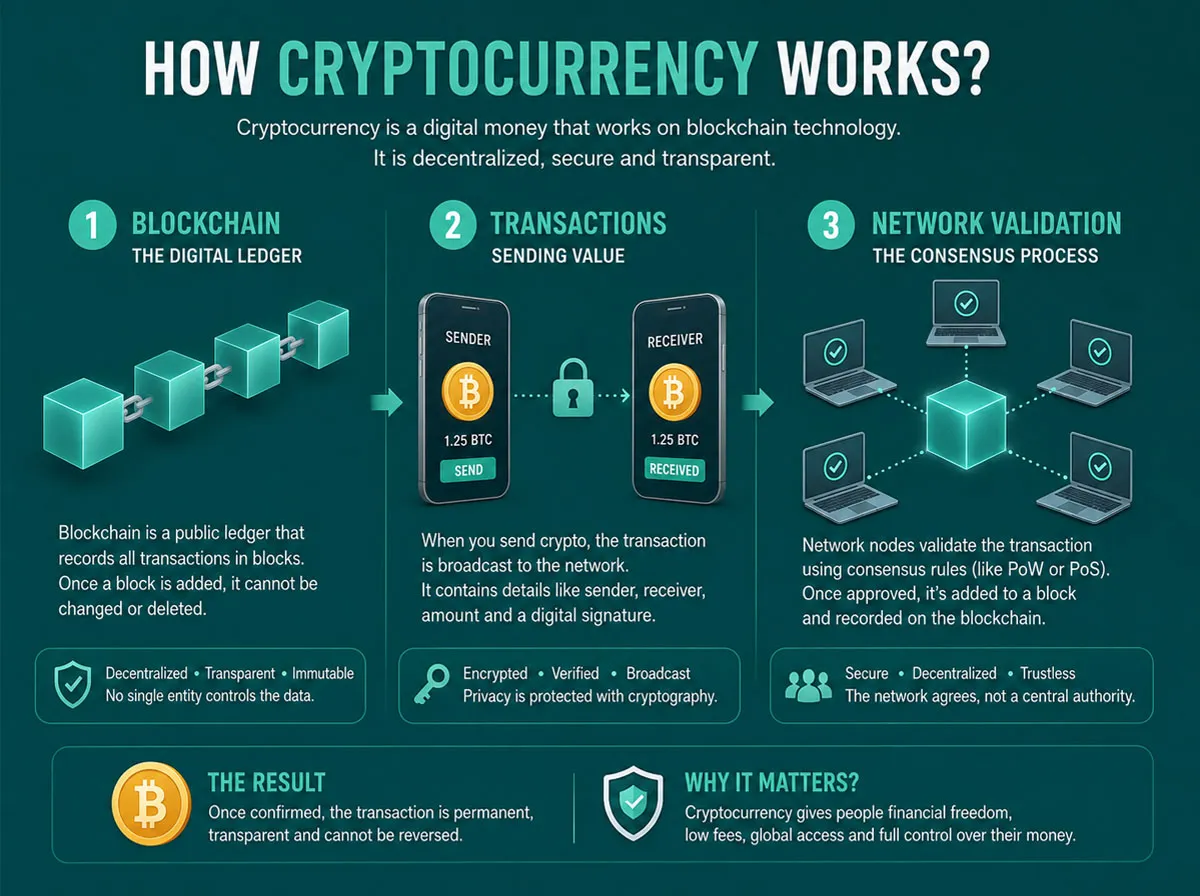
Many cryptocurrencies use a shared ledger rather than a bank’s private database. A wallet signs a transfer, the network checks it against its rules, and an accepted transaction becomes part of that ledger. The details vary by network, but keeping private keys secure matters in every case.
Education-only disclaimer: This article is for educational purposes only and is not investment, legal, tax, or financial advice. Crypto assets involve substantial market, security, custody, platform, and regulatory risks. Do not use money you cannot afford to lose.
How cryptocurrency works in simple terms
To understand how cryptocurrency works, think of it as a digital recordkeeping system with built-in rules for authorising transfers.
Instead of a bank updating one private database, many cryptocurrency networks maintain copies of a shared ledger across participating computers. When someone sends crypto, the network checks whether the sender is authorised to make that transfer and whether the transaction follows the protocol’s rules.
A cryptocurrency is therefore not usually a file that moves from one phone to another. It is better understood as a record of control on a network. The network records that a particular address is now entitled to control a specified amount of a digital asset.
The National Institute of Standards and Technology describes cryptocurrency as a digital asset or unit that can be cryptographically transferred between blockchain-network users. These transfers use digital signatures based on asymmetric key pairs.
At a high level, how cryptocurrency works can be broken into five stages:
- A user creates a transaction through a wallet or platform.
- The transaction is cryptographically authorised.
- It is broadcast to the relevant blockchain network.
- Network participants validate it under the network’s rules.
- The accepted transaction becomes part of the shared ledger.
The details differ between blockchains, but this broad process is central to how cryptocurrency works across many networks.
The building blocks of a crypto network
Several components work together to make a crypto network function.
| Component | Role in the network |
|---|---|
| Blockchain or ledger | Stores a shared history of accepted transactions |
| Wallet | Helps users view addresses and sign or request transactions |
| Public address | A destination that can receive crypto assets |
| Private key | A secret credential used to authorise transactions |
| Nodes | Computers running the network software and verifying rules |
| Validators or miners | Participants that help confirm transactions and add records |
| Consensus mechanism | The process used to agree on valid ledger updates |
| Transaction fee | A network payment that may help prioritise processing |
These components help explain how cryptocurrency works without relying on a single central database. The system combines cryptography, software rules, distributed recordkeeping, and economic incentives.
How does a crypto transaction work?
A crypto transaction is an instruction submitted to a blockchain network. It normally requests that control of a specified amount of an asset be assigned to another address.
1. The sender enters the transaction details
The sender uses a wallet or platform to enter information such as:
- The recipient’s address.
- The amount to transfer.
- The blockchain network.
- The transaction fee or processing preference, where applicable.
The sender should carefully check the address and network before approving the transaction. Using the wrong network or sending funds to an incorrect address can cause a permanent loss.
2. The wallet creates a digital signature
In a self-custody wallet, the private key is used to create a digital signature for the transaction. The signature demonstrates that the person controlling the relevant key has authorised the request.
The private key itself should remain secret. Network participants can verify the signature using the corresponding public information without receiving the private key.
This is a central part of how cryptocurrency works: the network verifies authorisation mathematically rather than asking a bank employee to approve the payment.
3. The transaction is broadcast
After signing, the transaction is broadcast to nodes on the cryptocurrency network. Nodes receive the request and place it into a pool of transactions waiting for validation or inclusion in a block.
A transaction shown as “pending” is not necessarily final. It may be delayed by network congestion, rejected because it does not satisfy the rules, or waiting for enough confirmations.
4. The network validates the transaction
Nodes examine the transaction and may check:
- Whether the digital signature is valid.
- Whether the sender has sufficient funds.
- Whether the transaction uses the correct format.
- Whether the same funds are being spent more than once.
- Whether the required transaction fee is included.
- Whether the transaction follows smart-contract conditions.
The validation process is one reason a cryptocurrency network can operate without a conventional central payment administrator.
5. The transaction is included in a block
Valid transactions are grouped together and included in a new block or ledger update. A miner or validator proposes the block according to the network’s consensus mechanism.
Once the network accepts the block, the transaction is recorded in the blockchain. Additional blocks may then be added after it, creating further confirmations.
What is blockchain validation?
Blockchain validation is the process of checking whether a proposed transaction or block follows the rules of a particular network.
A blockchain is a distributed digital ledger in which cryptographically signed transactions are grouped into blocks. Each block is linked to the previous block, creating a chronological record that is difficult to alter under normal network operation.
The validation process helps maintain consistency between different copies of the ledger. A node does not simply accept every transaction it receives; it checks whether the transaction is properly signed, whether the funds are available, and whether other protocol conditions have been met.
Blockchain validation can confirm that a transaction is technically valid. It does not confirm that:
- The sender was not deceived.
- The recipient is trustworthy.
- The asset will retain its value.
- The associated project is legitimate.
- The transaction is legally or tax compliant in a particular jurisdiction.
This distinction is important. A blockchain can process a valid transaction even when the user made a poor decision before signing it.
Nodes and consensus mechanisms
A node is a computer that runs blockchain software and participates in the network. Depending on the network and node type, it may store ledger data, receive transactions, validate blocks, and share information with other nodes.
Because transactions can reach different nodes at different times, the network needs a way to agree on the order and validity of ledger updates. This coordination process is called consensus.
NIST explains that copies of a blockchain ledger are maintained across network nodes and that new blocks are added according to established validation and consensus rules.
Proof of work
Proof of work uses computational effort to help determine which participant can propose the next block. Participants commonly called miners compete to solve a computational challenge.
The design makes certain forms of manipulation expensive, but it does not make the related cryptocurrency safe, profitable, or suitable for every user.
Proof of stake
Proof of stake allows eligible participants, commonly called validators, to help confirm transactions by committing or staking assets under the network’s rules.
The exact design differs between networks. Requirements, rewards, penalties, lock-up periods, and technical risks can vary considerably.
Why consensus matters
Consensus helps a cryptocurrency network maintain an agreed version of its ledger without requiring one central authority. It can help prevent double-spending and coordinate the order in which transactions are recorded.
Consensus is only one part of how cryptocurrency works. Users must also consider wallet security, platform reliability, smart-contract risks, market volatility, and the quality of the asset itself.
Transaction fees and confirmations
Most public blockchains charge transaction fees. Depending on the network, fees may compensate miners or validators and may help prioritise transactions when demand is high.
Transaction fees can vary because of:
- Network congestion.
- The size or complexity of the transaction.
- The user’s selected processing speed.
- The blockchain’s fee model.
- Smart-contract computations.
- Demand for limited block space.
A transaction may be technically valid but remain pending if the fee is low compared with competing transactions or if the network is busy.
Confirmation time also varies. A receiving platform may wait for several blocks before crediting a deposit because additional confirmations can reduce the risk of a temporary chain reorganisation.
The CFTC has noted that some blockchain systems rely on fees paid in virtual currency to support network activity and underlying transactions.
Wallets, private keys, and custody
A wallet does not normally store cryptocurrency in the same way that a physical wallet stores banknotes. Instead, it helps users manage addresses and the credentials needed to control assets recorded on a blockchain.
Self-custody
With self-custody, the user controls the private keys or recovery phrase. This can provide direct control but also creates direct responsibility.
If the recovery phrase is lost, exposed, or entered into a malicious website, the assets may become permanently inaccessible or may be transferred by an attacker.
Custodial services
With custodial access, an exchange, broker, or other platform may control the private keys or maintain the user’s balance through its own internal system.
This can be convenient, but it introduces counterparty risk. The user depends on the platform’s security, withdrawal processes, solvency, account controls, and operational systems.
The CFTC warns that digital wallets can be vulnerable to hacking and that loss of a private key may result in limited or no recourse. It also advises users to verify destination addresses carefully before transferring virtual currency.
Common risks and mistakes
Understanding how cryptocurrency works can help reduce operational errors, but it cannot eliminate the risks of using crypto assets.
Common mistakes include:
- Sending an asset through the wrong blockchain network.
- Entering an incorrect or manipulated wallet address.
- Confusing a token name with its verified contract address.
- Sharing a private key or seed phrase with a fake support representative.
- Approving an unfamiliar smart-contract transaction.
- Assuming a pending transaction can always be cancelled.
- Using leverage without understanding liquidation and margin risk.
- Treating online hype, price increases, or guaranteed-return claims as evidence of quality.
- Keeping all assets in one wallet or on one platform without considering custody risk.
The CFTC identifies cybersecurity, fraud, manipulation, operational, and speculative risks in virtual-currency markets. Its consumer material also warns about phishing, lost private keys, hacking, and the difficulty of reversing blockchain transactions.
Beginner safety checklist
Before making a crypto transfer, confirm the following:
- The asset and blockchain network are correct.
- The recipient address has been checked carefully.
- The transaction fee is acceptable.
- The wallet or platform application came from an official source.
- Multi-factor authentication is enabled where available.
- The private key and recovery phrase are stored securely and offline.
- You understand that confirmed transactions may not be reversible.
- You are not risking money needed for essential expenses.
If you are learning cryptocurrency trading, consider starting with a written plan, defined risk limits, and paper trading. Learn about position sizing, stop-loss planning, and volatility before using live capital.
Key takeaways
- Understanding how cryptocurrency works starts with digital signatures, wallet addresses, and network rules.
- A cryptocurrency transaction usually moves control of an asset from one address to another; it does not involve physically sending coins.
- Blockchain networks maintain shared transaction records across multiple nodes and use validation and consensus rules to decide which transactions are accepted.
- Private keys and recovery phrases control access in self-custody arrangements; losing or sharing them can result in permanent loss.
- Transaction fees, confirmation times, network congestion, and security practices can affect the cost and outcome of crypto transfers.
– Frequently Asked Questions (FAQs)
Not always. A transaction may be broadcast quickly, but confirmation depends on the network, fee level, congestion, and the receiving platform’s requirements.
On many public blockchains, transaction details and wallet addresses are publicly visible. An address may not automatically display a person’s real name, but blockchain activity can sometimes be connected to an individual through platform records and other information.
The transaction may be irreversible. Recovery may be impossible unless the address belongs to a platform or person who can and will return the assets.
It depends on the custody arrangement. In self-custody, the user controls the private keys. In a custodial arrangement, a third party may hold the keys or process withdrawals on the user’s behalf.
No. Blockchain is a type of distributed ledger technology. Cryptocurrency is a digital asset that may use a blockchain network for recording ownership and transactions.