Swing Trading Strategy for Beginners: How to Plan and Manage Short-Term Stock Trades

What Is a Swing Trading Strategy?
A swing trading strategy is a structured method for attempting to capture short- to medium-term price movements in stocks. A swing trader may hold a position for several trading sessions or a few weeks, depending on the setup, market conditions and exit rules.
Unlike intraday trading, swing trading usually involves holding positions overnight. Unlike long-term investing, a swing trading strategy focuses more heavily on price structure, technical conditions, trade timing and predefined exits.
The objective is not to predict every market movement. Instead, a swing trader looks for a specific opportunity, defines the conditions that would prove the idea wrong and controls the amount of capital exposed to the trade.
The National Stock Exchange describes swing trading as a style in which positions may be held for more than one trading session and generally for a period ranging from several days to several weeks or months.
Education-only disclaimer: This article is for educational purposes only. It is not personalised investment advice, a recommendation to buy or sell any stock, or a promise of profit. Stock trading involves risk, and you may lose part or all of your trading capital.
Swing trading versus other approaches
| Trading approach | Typical holding period | Primary focus | Common risks |
|---|---|---|---|
| Intraday trading | Minutes to one session | Very short-term price movements | Fast decisions, slippage and overtrading |
| Swing trading | Several days to several weeks | Capturing defined price swings | Overnight gaps and short-term volatility |
| Position trading | Weeks to months | Larger market trends | Extended drawdowns and changing conditions |
| Long-term investing | Months to years | Business performance and long-term value | Market cycles and company-specific risk |
A swing trading strategy is not automatically safer because trades are held for a shorter period. Overnight announcements, weak liquidity, unexpected volatility and poor position sizing can still produce substantial losses.
How Swing Trading Works
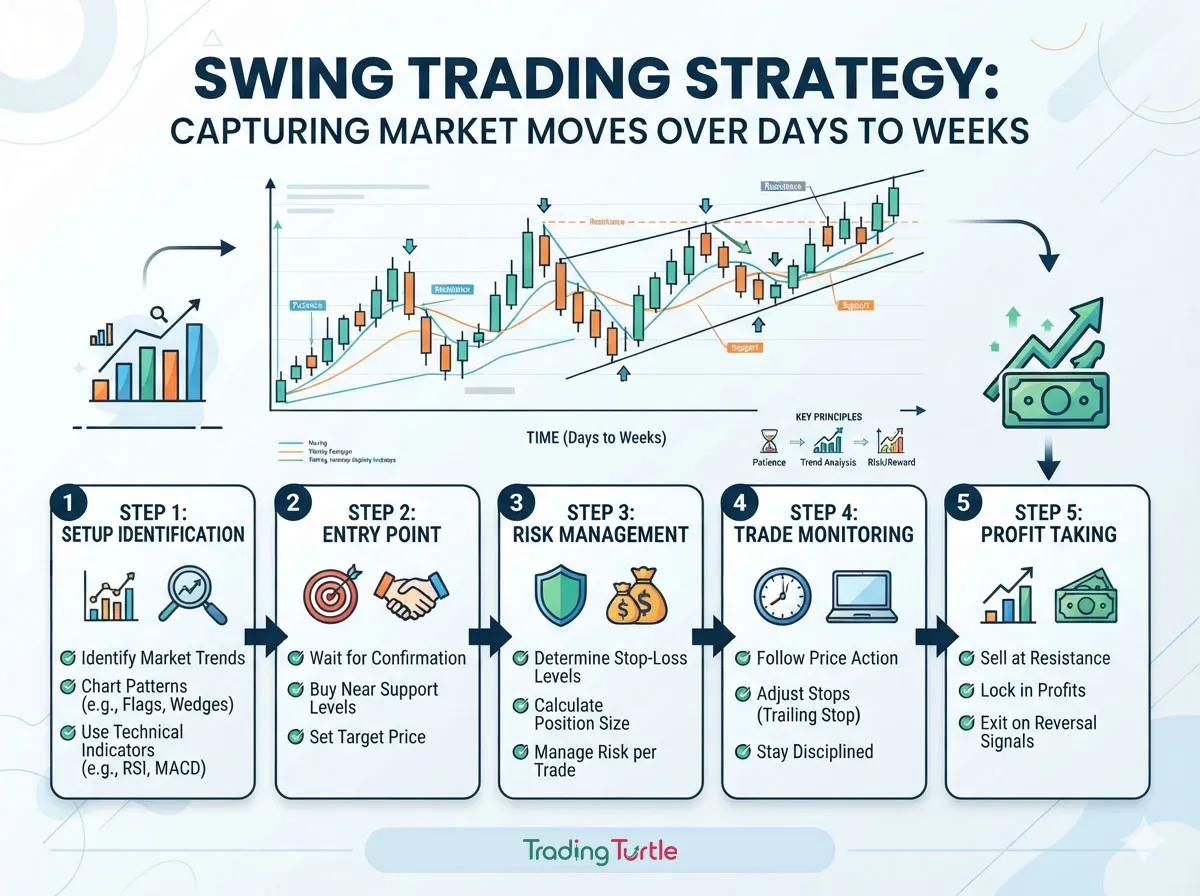
A swing trading strategy normally combines five elements:
- Market and sector analysis.
- Stock selection.
- A clearly defined setup.
- Entry and exit rules.
- Risk and position management.
Technical analysis may be used to study support, resistance, trend structure, price patterns, volume, momentum and volatility. These tools can help organise a decision-making process, but they cannot guarantee the next price movement.
A practical swing trading strategy should answer the following questions before a trade is placed:
- What market condition is suitable for the strategy?
- What must happen before entering?
- Where is the trade idea invalidated?
- Where will profits be taken or protected?
- How much money can be lost if the trade fails?
- What will cause the trade to be cancelled?
If these questions cannot be answered clearly, the setup may not be ready for execution.
The importance of time frames
Many traders use more than one time frame when applying a swing trading strategy.
For example:
- The weekly chart may provide broad market context.
- The daily chart may show the main trading setup.
- A lower time frame may help refine the entry.
The higher time frame can show whether a stock is trending, ranging or approaching a major level. The lower time frame may help with execution, but it can also create additional noise and false signals.
A trader should not select time frames simply because they produce attractive historical results. The time frames must match the intended holding period and the practical limits of the trader’s schedule.
A Practical Swing Trading Strategy Framework
The following framework can help beginners turn a general idea into a repeatable process. It is an educational model, not a guaranteed trading system.
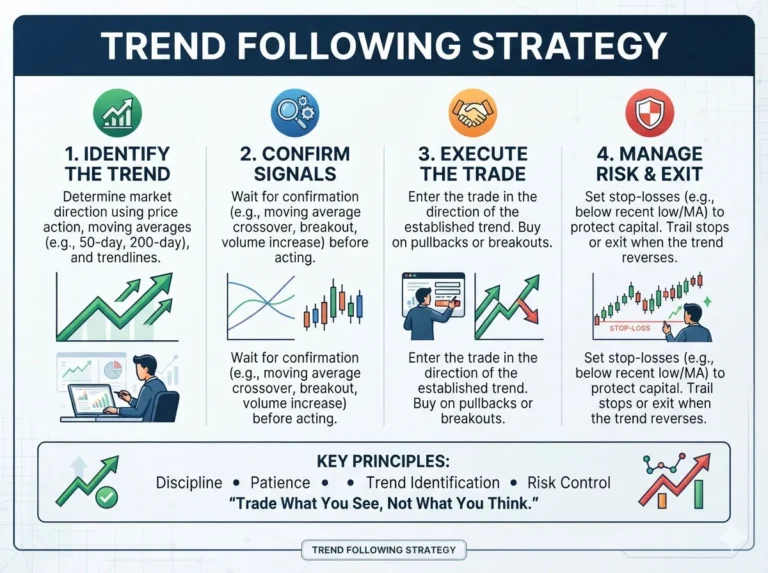
1. Identify the market condition
Begin by determining whether the broader market is:
- Trending upward.
- Trending downward.
- Moving sideways in a range.
- Experiencing unusually high volatility.
- Reacting to significant economic or company-specific news.
A swing trading strategy designed for an established trend may struggle during sideways price action. A range-based setup may also fail when the market begins a strong breakout.
Review the relevant market index and sector before analysing an individual stock. A stock can show a promising chart while the broader sector is under pressure.
2. Build a focused watchlist
A watchlist should include stocks that meet predefined criteria. Possible filters include:
- Adequate trading volume.
- Reasonably consistent price movement.
- A manageable bid-ask spread.
- Clear support and resistance areas.
- Sufficient historical data for analysis.
- No obvious execution difficulties.
Liquidity is important because a trader may not receive the expected price in a thinly traded stock. SEBI identifies liquidity risk as the possibility that an investment may not be bought or sold promptly, while volatility risk refers to significant price fluctuations.
A watchlist is not a list of stocks that must be traded. It is a research list. If no stock satisfies the rules of the swing trading strategy, the correct decision may be to wait.
3. Define the setup
The setup describes the conditions that may create a trade opportunity. A swing trading strategy might focus on:
- A pullback toward support.
- A breakout from consolidation.
- A breakout followed by a retest.
- A reversal near a major price zone.
- A continuation pattern after a temporary pause.
The setup should be specific enough to identify consistently. For example, “the stock looks strong” is too vague. A more structured condition might be: “The stock is above a rising moving average, pulls back toward prior support and forms a bullish confirmation candle.”
4. Wait for a trigger
The setup and the trigger are not always the same thing. A setup creates interest, while a trigger provides the reason to enter.
Possible triggers include:
- A daily close above resistance.
- A bullish rejection from support.
- A break above the high of a confirmation candle.
- A higher high after a pullback.
- A successful retest of a former resistance area.
Waiting for a trigger may mean entering later than the earliest possible price. However, entering too early can expose the trade to a setup that has not yet confirmed.
5. Define invalidation
Every swing trading strategy should specify where the trade idea becomes invalid. This level is often placed beyond a meaningful support or resistance zone, swing point or pattern boundary.
A stop-loss should not be placed only to create a preferred reward-to-risk ratio. It should be positioned where the underlying trade thesis no longer makes sense.
If the stop is too close, normal market noise may close the trade prematurely. If it is too far away, the position size may need to be reduced to keep the loss within the planned limit.
6. Select the exit method
A swing trading strategy may use one or more of the following exit methods:
- A fixed profit target.
- A trailing stop.
- A close below a higher low.
- A break of a moving average.
- A time-based exit.
- A partial exit followed by a trailing stop.
The exit method should match the setup. A breakout trade may require more room to develop, while a short-term reversal may need faster confirmation.
Common Swing Trading Setups
These setups are widely used as research frameworks. They should be tested through historical analysis and paper trading before being considered for real-money use.
Pullback trading near support
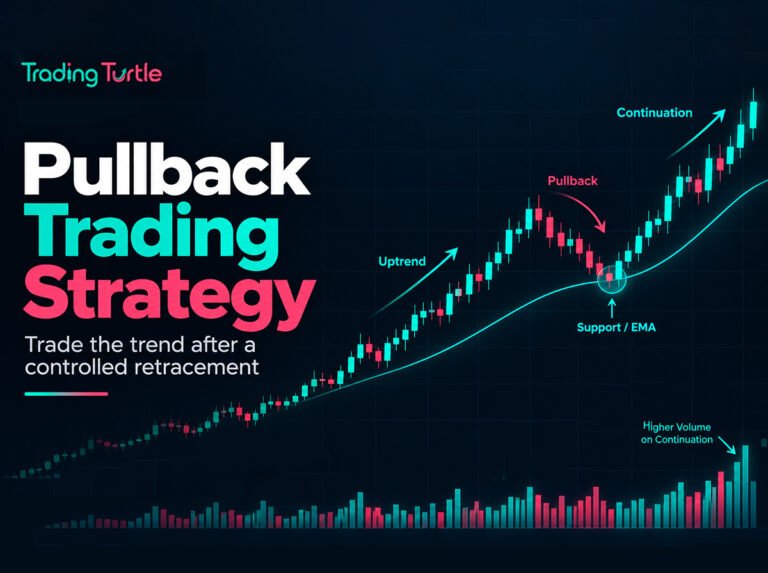
A pullback occurs when a stock temporarily moves against its recent direction. In a bullish environment, a trader may look for a decline toward a previous support zone or a widely observed moving average.
A possible bullish pullback setup may include:
- A prior upward price structure.
- A controlled decline rather than a sharp collapse.
- A pullback toward a known support area.
- Evidence that selling pressure is weakening.
- A bullish confirmation candle or break of a short-term high.
The primary danger is assuming that every decline is a healthy pullback. The price may instead be beginning a larger reversal. A clear invalidation level is therefore essential.
Range-based swing trading
A range forms when price repeatedly moves between support and resistance. A range-based swing trading strategy may look for a potential long setup near support or a potential short setup near resistance, depending on the market and product being traded.
Before using a range setup, the boundaries should be reasonably clear. The trader should also consider whether the expected movement is large enough to justify the risk and transaction costs.
Range trading becomes dangerous when price breaks decisively beyond the established boundary. A stop-loss can help limit the damage if the market enters a new trend.
Breakout and retest
A breakout occurs when price moves beyond a significant support or resistance zone. Some traders wait for a retest before entering because the former resistance may become support in a bullish setup, or former support may become resistance in a bearish setup.
A possible bullish sequence is:
- Price consolidates below resistance.
- Price closes above the resistance zone.
- Price returns toward the breakout area.
- The former resistance holds as support.
- Price resumes its upward movement.
A brief move beyond resistance is not automatically a reliable breakout. False breakouts can occur when price crosses a level and quickly returns inside the previous range.
Volume, closing behaviour and broader market context may help evaluate the breakout, but they do not remove the possibility of failure.
Reversal near a major level
A reversal setup attempts to capture a change in direction near an important support or resistance zone. Traders may study price rejection, momentum behaviour, candlestick structure or a break of a short-term swing point.
This type of swing trading strategy can offer a clearly defined invalidation point. However, entering too early is a common mistake. A stock may remain near a support zone for some time or break through it before a reversal begins.
A level is an area of interest, not an automatic buy or sell signal.
How to Plan a Swing Trade
A written plan can make a swing trading strategy more consistent and easier to evaluate.
Step 1: Analyse the broader context
Review the relevant index, sector and stock time frames. Ask:
- Is the stock moving with or against its sector?
- Is the market trending or ranging?
- Is the stock approaching a major level?
- Is volatility unusually high?
- Are important events scheduled?
This does not predict the outcome. It helps the trader understand the environment in which the setup is developing.
Step 2: Mark important price zones
Mark:
- Previous swing highs.
- Previous swing lows.
- Support and resistance zones.
- Consolidation boundaries.
- Breakout and retest areas.
Treat support and resistance as zones rather than perfectly precise lines. Market reactions can occur across a range of prices.
Step 3: Define the entry condition
Write the entry condition in observable terms. Examples include:
- Enter only after a daily close above resistance.
- Enter only after price rejects support and breaks the confirmation candle high.
- Enter after a retest holds above the breakout zone.
- Avoid entry if the stock opens significantly beyond the planned risk level.
A written trigger prevents emotional decisions based only on fear of missing out.
Step 4: Set the stop-loss
Place the stop-loss at a logical location where the swing trading strategy is no longer valid. The stop should reflect the price structure and normal volatility of the stock.
A stop-loss does not guarantee an exact exit price. If the stock opens below the planned stop after an overnight event, the actual exit may be worse than expected.
Step 5: Calculate position size
A basic position-sizing formula is:
Suppose a hypothetical trader considers an entry at ₹500 and a stop-loss at ₹480. The risk per share is ₹20. If the maximum planned loss is ₹1,000:
This calculation excludes brokerage, taxes, slippage and potential overnight gaps. Those factors should be considered before trading with real money.
Position sizing does not turn an unprofitable strategy into a profitable one. It helps limit the account impact of an individual trade.
Step 6: Define the trade management rules
Before entering, decide:
- Whether the stop-loss can be moved.
- When profits may be partially booked.
- Whether the position will be closed before a major event.
- What happens if the stock does not move within a set number of sessions.
- Whether the trade will be exited if the broader market changes.
A trade should not remain open merely because the trader hopes the original idea will eventually work.
Swing Trading Risk Management
Risk management is the most important part of a swing trading strategy. SEBI highlights market, liquidity and volatility risks and explains that diversification across companies and asset classes can help reduce concentration risk.
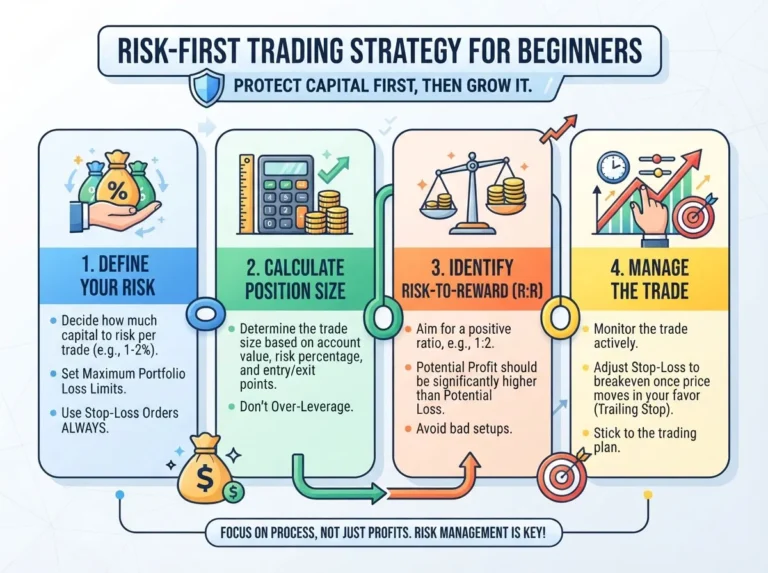
Limit the risk per trade
Many traders choose a predefined portion of their trading capital as the maximum amount they are willing to lose on one trade. The appropriate amount depends on the trader’s financial situation, experience and risk tolerance.
There is no universal percentage that is correct for everyone. The important principle is that the amount should be decided before entering and applied consistently.
Monitor total open risk
A trader may have several positions, each with a small individual risk. If all positions are concentrated in the same sector or respond to the same market event, the combined risk may be much larger than it appears.
Review the total amount that could be lost if multiple stops are triggered during the same market move.
Account for overnight gaps
Overnight risk is a major consideration in stock swing trading. Prices may react to:
- Earnings announcements.
- Corporate actions.
- Regulatory decisions.
- Company news.
- Economic data.
- Global market movements.
- Sector-specific developments.
A planned stop-loss may not be executed at the exact level if the stock opens beyond it.
Avoid excessive leverage
Leverage increases market exposure relative to the trader’s capital. It can magnify both gains and losses, and it may increase the risk of forced liquidation in margin-based products.
A beginner should understand margin requirements, interest or funding costs, liquidation rules and gap risk before using leverage.
Use diversification carefully
Diversification can reduce concentration risk, but holding several highly correlated stocks may not provide meaningful protection. Five stocks from the same industry may react to the same news at the same time.
Diversification should be considered alongside position size, correlation, sector exposure and total account risk.
Maintain a trading journal
A useful journal records:
- Date and time.
- Stock and market condition.
- Setup type.
- Entry and stop-loss.
- Planned target or exit.
- Position size.
- Reason for the trade.
- Execution quality.
- Final result.
- Whether the rules were followed.
A losing trade that followed the rules is different from a profitable trade that ignored the rules. Evaluating process helps determine whether a swing trading strategy is genuinely repeatable.
Example of a Hypothetical Swing Trade
Assume a stock has been moving upward and then pulls back toward a previously identified support zone.
A hypothetical trading plan might be:
- Entry: above ₹505 after bullish confirmation.
- Stop-loss: ₹480 below the support zone.
- Target area: ₹555 near prior resistance.
- Risk per share: ₹25.
- Maximum planned loss: ₹1,000.
- Theoretical position size: 40 shares.
The potential reward per share is ₹50, while the planned risk per share is ₹25. This creates a hypothetical 2:1 reward-to-risk relationship before costs and slippage.
The ratio does not make the trade automatically attractive. The support zone may fail, the stock may gap below the stop or the target may never be reached. This example illustrates the structure of a trading plan; it is not a stock recommendation.
Common Swing Trading Mistakes
Entering because a price has fallen
A declining price is not automatically a bargain. It may be experiencing a temporary pullback, or it may be showing a deeper deterioration in price structure.
A swing trading strategy should require a defined setup and trigger rather than relying on the belief that the stock “must” recover.
Using too many indicators
Adding more indicators can create conflicting signals and reduce clarity. Each tool should answer a specific question, such as:
- What is the broader trend?
- Where are the important levels?
- Is momentum improving?
- Is volatility expanding?
- Is the setup supported by volume?
A simple process is easier to test than a chart filled with overlapping indicators.
Moving the stop-loss farther away
Moving a stop-loss to avoid accepting a loss changes the original trade plan. Repeatedly doing this can turn a controlled loss into a large account drawdown.
If the original setup fails, the trader should accept the planned outcome and review the trade later.
Ignoring liquidity
A stock may appear attractive on a chart while offering poor execution. Wide spreads, low volume and sudden price movements can increase slippage and make exits difficult.
Liquidity should be part of stock selection, not an afterthought.
Treating every breakout as genuine
False breakouts are common. A trader may wait for a closing confirmation, retest or additional price evidence, but no confirmation method eliminates risk entirely.
Trading too frequently
A swing trading strategy does not require a new trade every day. If the market does not offer a valid setup, staying out can be a disciplined decision.
SEBI investor education material advises investors to conduct thorough research and avoid relying on unsolicited stock tips or informal recommendations.
Ignoring the broader market
An individual stock may show a bullish pattern while its sector and broader index are weakening. Context does not determine the result, but ignoring it may lead to lower-quality trades.
How to Test a Swing Trading Strategy
Testing is necessary before relying on a swing trading strategy with real capital.
Historical testing
Historical testing involves reviewing past charts to determine how the rules would have performed. The rules should be written before reviewing results to reduce hindsight bias.
Record:
- Number of trades.
- Winning and losing trades.
- Average win.
- Average loss.
- Largest losing streak.
- Maximum drawdown.
- Average holding period.
- Results by market condition.
Historical results do not guarantee future performance. Market behaviour can change, and manually selected historical examples may produce overly optimistic conclusions.
Paper trading
Paper trading allows a trader to practise execution without immediately risking real money. It can help reveal whether the rules are clear enough to follow in real time.
Paper trading should still include realistic assumptions for:
- Brokerage and taxes.
- Slippage.
- Entry delays.
- Partial fills.
- Overnight gaps.
- Position size.
- Emotional decision-making.
Live trading with reduced risk
After historical testing and paper trading, a trader may still need a period of very small live exposure to understand real execution and psychological pressure. A strategy that appears easy on paper may become difficult to follow when money is at risk.
The goal is not to prove that every trade will be profitable. The goal is to determine whether the process can be executed consistently and whether its risks are acceptable.
Key Takeaways
- A swing trading strategy seeks to capture short- to medium-term price movements, usually over several days or weeks.
- A complete plan includes market context, stock selection, setup, entry trigger, stop-loss, position size and exit rules.
- Pullbacks, breakouts, retests, range trades and reversals are common swing trading frameworks.
- Overnight gaps, low liquidity, excessive leverage and sector concentration can increase losses.
- Position sizing should be calculated before entering the trade.
- A good reward-to-risk ratio does not guarantee that a trade will succeed.
- Historical testing, paper trading and journaling can help evaluate a strategy.
- Staying out of the market is a valid decision when no setup meets the rules.
– Frequently Asked Questions (FAQs)
Beginners may study swing trading because it generally provides more time for analysis than fast intraday trading. However, it still involves overnight exposure, short-term volatility and the possibility of losing money. Beginners should learn the basics, practise with historical data and consider paper trading before using real capital.
Swing trades may last from several days to several weeks. The holding period depends on the setup, market conditions, volatility and exit rules. A position should not be held longer simply to avoid accepting a planned loss.
There is no single best swing trading strategy for every market or trader. Pullbacks, breakouts, range trades and reversals can all work under some conditions and fail under others. The most useful strategy is one with clear rules that the trader understands, tests and can follow consistently.
Moving averages, RSI, MACD, volume and support-and-resistance analysis are commonly used. No indicator is universally superior, and indicators should support a defined process rather than replace analysis.
Yes. Overnight holding is common in swing trading. It also creates gap risk because company news, economic announcements or global market movements can change the opening price.
There is no universal minimum amount that makes swing trading appropriate. The required capital depends on the stock price, position size, transaction costs, account risk limits and applicable broker rules. A trader should not risk money needed for essential expenses.
A learner can write clear rules, review historical charts, paper trade the setup and maintain a detailed journal. Performance should be evaluated using drawdown, average loss, holding period and rule-following quality, not only total profit.