What Is Paper Trading? A Beginner’s Guide to Simulated Trading

What Is Paper Trading?
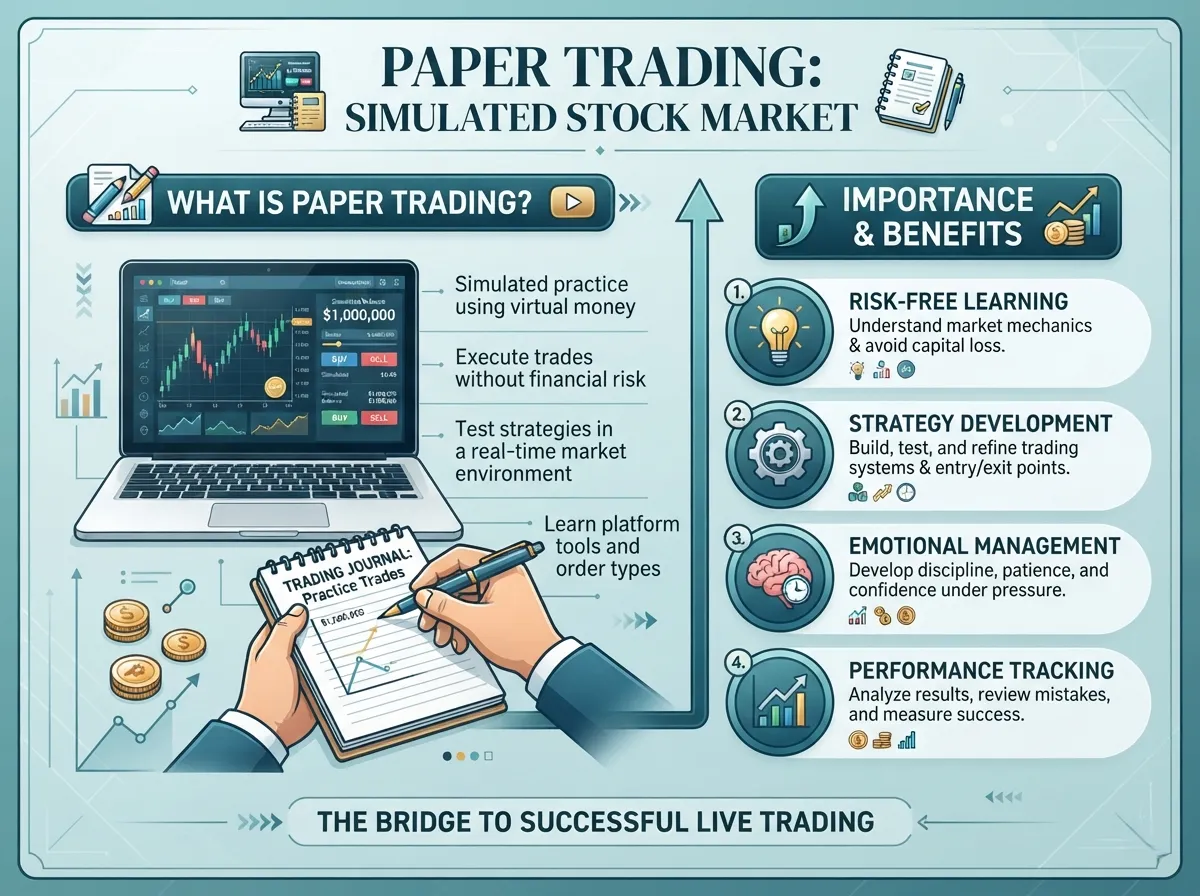
Paper trading is the practice of buying and selling financial instruments in a simulated environment without using real money. It is designed to help beginners learn how markets work, test trading ideas, and practise order execution before moving to live trading.
A good paper trading setup can help a new trader understand entries, exits, stop-loss placement, and position sizing in a low-pressure setting. At the same time, paper trading is not the same as live trading, because simulated performance does not fully capture slippage, emotional pressure, fees, liquidity constraints, or the real consequences of loss.
This guide explains what paper trading means, how it works, where it is useful, where it falls short, and how beginners can use it more effectively across stocks, ETFs, and crypto markets.
Education-only disclaimer: This article is for educational purposes only and does not provide personalised investment advice, trading advice, or a recommendation to buy or sell any security, currency, or crypto asset.
What paper trading means
Paper trading is a method of simulated trading in which a trader records or places mock trades using virtual money instead of real capital. The name comes from the old habit of writing hypothetical trades on paper to track what would have happened if the trades had been taken in the real market.
Today, paper trading usually happens through a paper trading simulator offered by a broker, exchange, charting platform, or educational app. These tools often show live or delayed market prices and allow traders to practise placing market orders, limit orders, stop-loss orders, and sometimes more advanced order types.
The main purpose of paper trading is practice, not proof of profitability. It is best used as a structured learning tool rather than a shortcut for deciding that a strategy is already safe or ready for full-size live deployment.
How paper trading works
A paper trading platform gives the user a virtual account balance and a simulated interface for placing trades. The user can usually choose an asset, enter a quantity, select an order type, and track open and closed positions as if the trades were real.
In many cases, the platform also shows unrealised profit and loss, realised profit and loss, portfolio balance, and trade history. Some platforms include charting, watchlists, alerts, and risk-management tools, which makes paper trading useful for building execution habits as well as strategy discipline.
The exact experience depends on the platform. Some paper trading simulators are relatively realistic, while others simplify fills, ignore partial execution, or treat liquidity as if the market were always deep and smooth.
Why beginners use paper trading
Paper trading is popular with beginners because it lowers the cost of learning. A new trader can make mistakes, test ideas, and practise basic mechanics without losing real money while learning how trading platforms behave.
Used properly, paper trading can help with several early-stage skills:
- Learning how to place market, limit, and stop-loss orders.
- Understanding how position size affects trade risk.
- Building a repeatable routine for entry, exit, and journaling.
- Testing whether a strategy has rules clear enough to follow consistently.
- Getting used to tracking profit, loss, and drawdown over a sequence of trades.
For readers in India, this stage can also be helpful before using a live broker account or derivatives platform. For basic investor education and market familiarisation, SEBI’s investor education resources and the SEBI Investor portal can be useful starting points.
What paper trading can teach you
Paper trading is most helpful when the trader treats it as a serious rehearsal instead of a game. It can teach mechanics, process, and discipline better than random experimentation with real money.
Order execution basics
A beginner can learn the practical difference between order types by using a simulator repeatedly. Before paper trading learn about Market Order vs Limit Order and What Is a Stop-Loss Order? Types, Examples and Common Mistakes every beginner should know.
Strategy structure
Paper trading can reveal whether a strategy is clearly defined. If a trader cannot explain the entry, stop-loss, target, invalidation point, and position size in a simulated environment, the strategy is probably not yet ready for live risk.
Position sizing and risk habits
A simulator can help beginners practise the connection between account size, risk per trade, and stop-loss distance. This is especially useful when paired with structured risk rules from Risk Management in Trading and Position Sizing in Trading: How to Calculate Trade Risk.
Record-keeping
Good paper trading often includes a journal. Traders can note why a setup was taken, whether the plan was followed, and what happened after entry, which helps identify repeated mistakes and improve consistency over time.
What paper trading cannot teach you fully
Paper trading has real value, but it also has hard limits. The biggest problem is that simulated results often look cleaner than live results.
Emotional pressure
When no real money is at risk, it is easier to follow rules calmly. In live trading, fear, greed, hesitation, revenge trading, and overconfidence can all affect decisions in ways that a paper trading simulator cannot fully reproduce.
Slippage and liquidity
In real markets, orders do not always fill at the exact expected price. Fast-moving or thinly traded markets can create slippage, wider spreads, and partial fills, which means the live outcome may be worse than the paper result.
Fees and friction
Some simulators simplify or understate brokerage charges, exchange fees, taxes, funding costs, borrow costs, or other execution frictions. A strategy that looks attractive before costs can become far less attractive after realistic trading expenses are included.
False confidence
A short streak of simulated wins can lead traders to increase size too quickly in live markets. That is one reason many regulators and investor-education sources emphasise caution around active trading, leverage, and speculative products.
For example, the SEC’s investor bulletin on day trading risks warns that active trading can involve severe financial losses and high costs. In crypto markets, the CFTC’s advisory on virtual currency trading risks also highlights volatility, platform risks, and the fact that there is no guaranteed trading strategy.
Paper trading vs live trading
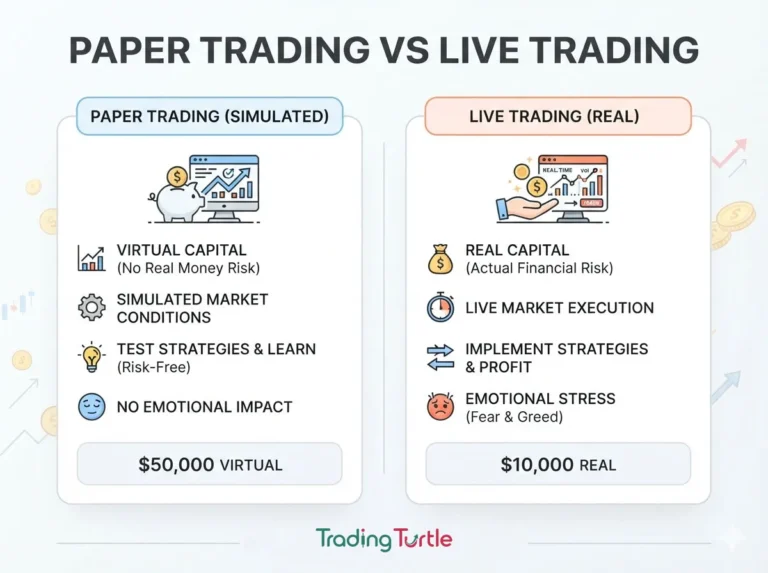
Paper trading and live trading may look similar on a screen, but they are not psychologically or operationally identical. The table below shows the most important differences.
| Area | Paper trading | Live trading |
|---|---|---|
| Capital at risk | Virtual money only | Real money is at risk |
| Emotional pressure | Usually low | Often much higher |
| Execution realism | Can be simplified | Depends on actual market conditions |
| Slippage and spread impact | Sometimes understated | Fully real and often unavoidable |
| Learning value | High for practice and structure | High for real decision-making and discipline |
| Cost of mistakes | Low financially | Can be significant |
A balanced approach is to use paper trading for practice and process-building, then move to very small live size before scaling up. That transition is often more informative than staying in simulation for too long.
How to paper trade properly
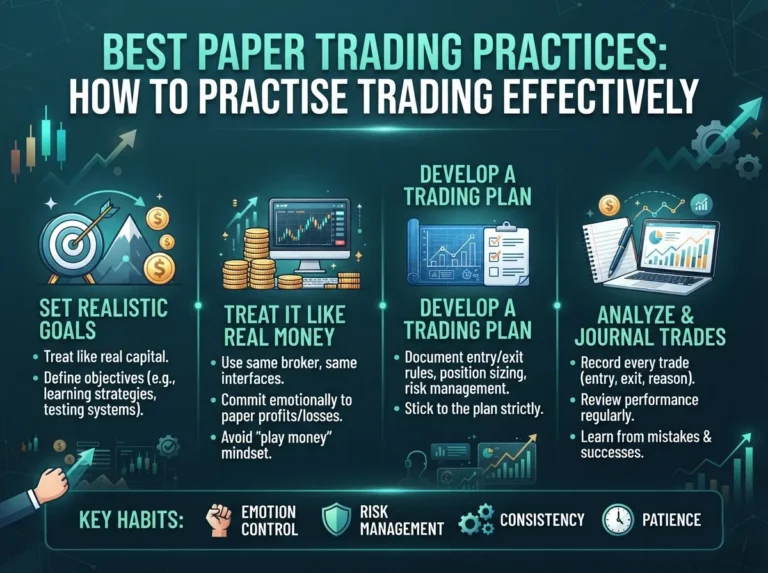
Many beginners use paper trading casually, but it works best when treated like a real training phase. A structured process makes the results far more useful.
1. Choose one market and one style first
Do not start by simulating everything at once. It is usually better to focus on one market, such as large-cap stocks, ETFs, or a few liquid crypto pairs, and one style, such as swing trading or intraday trading.
2. Define clear trade rules
Every paper trade should have a reason for entry, a stop-loss level, a profit-taking plan, and a position size. Vague decisions produce vague data.
3. Use realistic account assumptions
If the future live account will be ₹50,000, do not paper trade as if the account were ₹10,00,000. The simulator should mirror expected capital, typical instrument choice, and realistic risk per trade.
4. Track costs and execution assumptions
Even if the simulator does not model everything perfectly, the trader can still record estimated fees, spreads, and slippage manually. This creates a more honest view of whether the strategy might survive real-world friction.
5. Journal every trade
A useful journal can include entry reason, stop-loss, target, position size, time frame, outcome, and whether the plan was followed. Over time, this matters more than a few individual winning or losing trades.
6. Review a meaningful sample
Do not judge a strategy after five trades. A more useful review looks at a larger sample and examines consistency, average risk, drawdowns, and whether execution rules were followed.
A simple paper trading example
Suppose a beginner wants to practice swing trading in a stock or ETF using a virtual account of ₹1,00,000. The trader decides to risk 1% per trade, so the maximum planned loss is ₹1,000.
A trade is planned at ₹250 with a stop-loss at ₹240. The per-share risk is ₹10, which means the position size would be 100 shares if the trader wants to keep the planned loss near ₹1,000 before costs.
The educational value here is not just whether the trade wins or loses. It is whether the trader follows the plan, sizes the position correctly, and reviews the outcome honestly afterward.
The same logic can be applied to crypto. A trader practising on a paper trading simulator for BTC or ETH can still define an entry, stop-loss, and risk limit, but should remember that real crypto execution may be more volatile, especially in leveraged products.
Common mistakes in paper trading
Paper trading becomes less useful when traders treat it like entertainment instead of training. Several mistakes appear again and again.
Taking random trades
Without a defined setup, paper trading turns into clicking around a platform rather than learning. This creates data, but not useful data.
Ignoring position sizing
Some beginners focus only on whether a trade idea was “right.” In reality, a strategy also depends on position size, risk per trade, and how losses are controlled.
Using unrealistic account size
Simulating trades with far more capital than will be used in real life can create false expectations. The goal is to practise the same decisions that will eventually matter in the live account.
Not tracking mistakes
A trader who never reviews errors may repeat them when moving to live trading. Journaling is often the difference between paper trading that feels productive and trading that actually improves decision-making.
Staying in simulation too long
Paper trading is useful, but it should not become a permanent substitute for all real-market experience. At some point, traders who are ready may learn more from very small live positions than from endless simulation.
Is paper trading enough before going live
Paper trading is a strong starting point, but it is usually not enough by itself. It can help a trader learn mechanics and build a process, but it cannot fully prepare someone for real execution pressure and real financial consequences.
A more balanced path is often:
- Learn the basics of markets, order types, and risk management.
- Paper trade with realistic rules and proper journaling.
- Review a meaningful sample of trades.
- Move to very small live size only after the process becomes consistent.
- Scale gradually instead of jumping from simulation to full risk.
That path is slower, but it is usually more educational and less emotionally disruptive for beginners.
Key takeaways
- Paper trading is simulated trading that uses virtual money instead of real capital.
- It is useful for learning market mechanics, order types, journaling, and basic risk management.
- A paper trading simulator can help test process and discipline, but it cannot fully replicate live execution or live emotions.
- Simulated success does not guarantee live success.
- Beginners usually get the most value by paper trading seriously, reviewing results honestly, and moving to small live size gradually.
– Frequently Asked Questions (FAQs)
Paper trading means practising trades without using real money. It lets beginners simulate buying and selling so they can learn how markets and trading platforms work.
Yes, paper trading is often useful for beginners because it can reduce the cost of early mistakes while helping them practise execution, planning, and journaling. Its value is highest when it is done with realistic rules rather than random clicking.
Paper trading can help improve process and discipline, but it does not guarantee profitability in live markets. Real-money trading adds pressure, friction, and execution challenges that are often softer or absent in simulation.
No. The platform may look similar, but the experience is different because live trading involves real money, real losses, real fees, and real emotional pressure.
Many crypto beginners can benefit from paper trading, especially while learning order types, volatility, and risk control. The same caution applies, however: simulated crypto results may not reflect the full reality of live spreads, slippage, leverage, funding, and liquidation risk.