Trend Following Strategy for Beginners: Complete Guide to Trading With the Trend

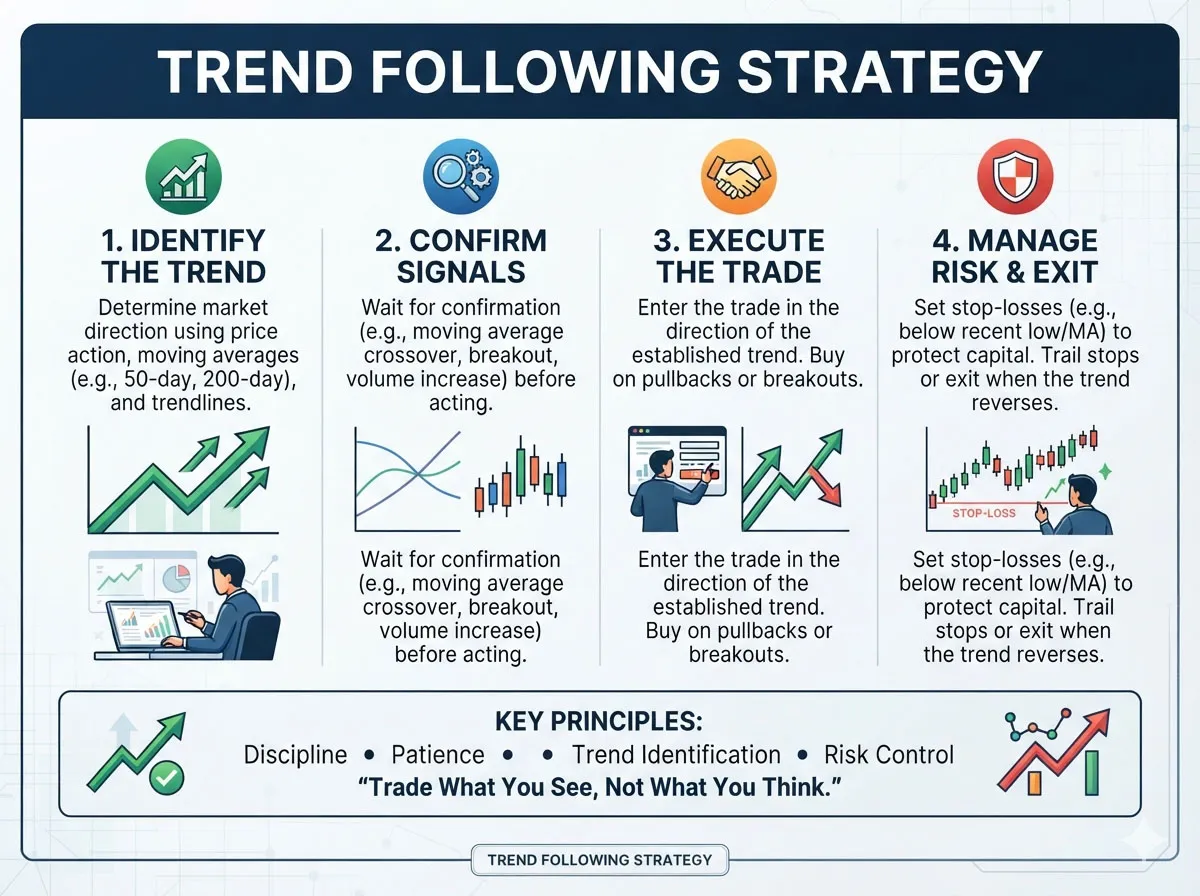
A trend following strategy waits for an established price direction, then looks for trades in that direction with a defined exit and risk limit. For example, a trader may wait for a stock to form higher highs and higher lows before considering a buy, instead of trying to guess the bottom. A trend can stall or reverse, so this approach can still lose money.
Instead of trying to predict where the market will reverse, many successful traders follow a much simpler philosophy:
Trade in the direction the market is already moving.
This is the foundation of the Trend Following Strategy.
Trend following is one of the oldest and most widely used trading approaches across stocks, cryptocurrencies, forex, commodities, and indices. Rather than forecasting future prices, trend followers react to confirmed price movement, aiming to participate in sustained trends while accepting that they won’t capture every turning point.
Whether you’re trading Indian stocks, global equities, Bitcoin, Ethereum, or other digital assets, understanding trend following can help you develop a more disciplined and structured trading process.
In this guide, you’ll learn how trend following works, why it remains popular, the tools traders commonly use, and how to apply the strategy responsibly as a beginner.
Educational Purpose Only:
This article is intended solely for educational and informational purposes. It does not constitute financial, investment, legal, or tax advice. Trading stocks, cryptocurrencies, derivatives, and other financial instruments involves substantial risk, including the possible loss of capital. Always conduct your own research and consider consulting a qualified financial professional before making investment decisions.
What Is a Trend Following Strategy?
A Trend Following Strategy is a trading approach that aims to identify an established market trend and open trades in the same direction.
The core idea is simple:
- Buy when the market is in an established uptrend.
- Sell or short (where permitted) when the market is in an established downtrend.
- Avoid trading when prices are moving sideways without a clear direction.
Unlike prediction-based trading, trend followers wait for the market to reveal its direction before taking action. This means they often enter after a trend has already begun and exit when evidence suggests the trend is weakening or reversing.
The Basic Philosophy
Trend followers believe that:
- Markets often move in sustained directions.
- Strong trends can continue longer than many people expect.
- It’s more reliable to react to price action than to predict turning points.
- Protecting capital through disciplined risk management is more important than being right on every trade.
This philosophy is often summarized by the saying:
“The trend is your friend—until it ends.”
While the phrase is well known, successful trend following depends on having clear rules for identifying trends, entering trades, managing risk, and exiting positions—not simply assuming every price move will continue.
Why Trend Following Works
Financial markets are driven by millions of participants making decisions based on news, earnings, economic data, sentiment, liquidity, and expectations.
When buying pressure consistently outweighs selling pressure, prices often continue moving upward. Likewise, persistent selling pressure can create extended downward trends.
Trend following attempts to benefit from these sustained directional moves rather than reacting to every short-term fluctuation.
Several factors contribute to the effectiveness of trend-following approaches:
1. Institutional Participation
Large institutions, mutual funds, pension funds, hedge funds, and exchange-traded funds typically build or unwind positions over time rather than through a single transaction.
This gradual activity can support trends that develop over weeks or months.
2. Market Psychology
Human emotions influence markets.
When prices rise:
- Optimism grows.
- More buyers enter.
- Existing investors become confident.
- Momentum attracts additional participants.
During declines, fear can produce the opposite effect, reinforcing downward trends.
3. Momentum
Assets showing strength often continue performing well for a period, while weak assets may remain weak. Trend following seeks to participate in this momentum without assuming it will last forever.
The Psychology Behind Trend Following
One reason many beginners struggle with trend following is that it often feels counterintuitive.
People naturally want to:
- Buy after prices have fallen.
- Sell after prices have risen.
- Believe they can identify market tops and bottoms.
Trend followers take a different approach.
Instead of trying to be first, they prioritize confirmation. They accept entering after a move has started if the probability of a sustained trend appears higher.
This mindset requires patience and discipline because trend-following trading strategies typically experience:
- Many small losses.
- Fewer but potentially larger winning trades.
- Periods of inactivity while waiting for suitable conditions.
Accepting this trade-off is an important psychological component of the strategy.
Types of Market Trends
Before applying any trend following strategy, it’s essential to understand the three primary market conditions.
Uptrend
An uptrend occurs when prices consistently form:
- Higher highs
- Higher lows
This indicates that buyers remain in control and demand continues to exceed supply.
Characteristics include:
- Rising moving averages
- Strong bullish momentum
- Buying pressure during pullbacks
- Positive market sentiment
Trend following traders generally look for buying opportunities during established uptrends rather than chasing every new high.
Downtrend
A downtrend develops when prices create:
- Lower highs
- Lower lows
Here, sellers dominate the market.
Characteristics include:
- Falling moving averages
- Persistent selling pressure
- Weak recovery attempts
- Negative market sentiment
In markets that allow short selling or derivatives trading, some traders may look for opportunities aligned with the downward trend. Beginners should fully understand the additional risks before considering such strategies.
Sideways (Range-Bound) Market
Not every market trends.
Sometimes prices move within a relatively narrow range without establishing higher highs or lower lows.
Characteristics include:
- Frequent reversals
- Lack of momentum
- Conflicting signals
- Increased likelihood of false breakouts
Trend following strategies generally perform less effectively during these conditions because there is no sustained directional movement to follow. Many experienced traders wait for a confirmed breakout before applying trend-following techniques.
How Trend Following Differs From Other Trading Styles
Understanding how trend following compares with other approaches helps beginners choose a strategy that matches their goals and personality.
| Strategy | Primary Goal | Typical Holding Period |
|---|---|---|
| Trend Following | Capture sustained market moves | Days to months |
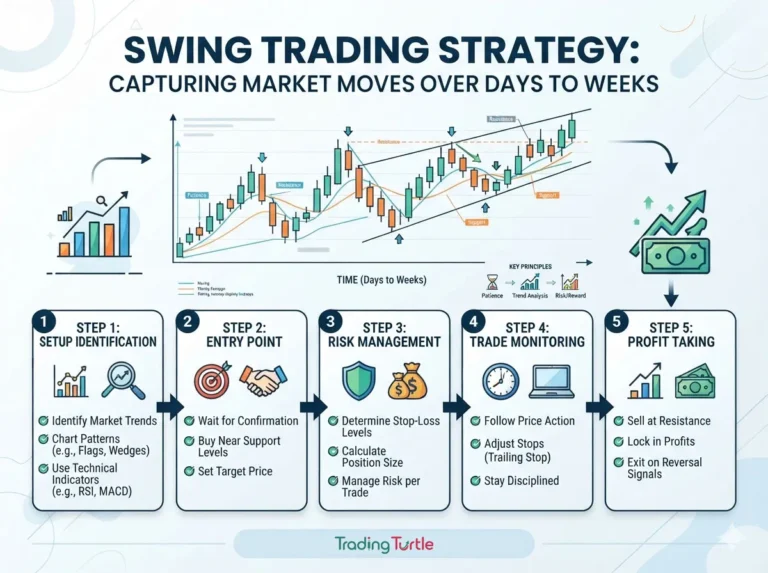
| Swing Trading | Profit from shorter price swings | Several days to weeks |
| Scalping | Capture very small intraday movements | Seconds to minutes |
| Mean Reversion | Trade expecting prices to return toward an average | Varies |
| Position Trading | Hold long-term directional positions | Weeks to years |
Trend following does not attempt to predict exact market reversals. Instead, it focuses on participating in established trends while managing downside risk through predefined trading rules.
Core Principles of Trend Following
Every successful trend following strategy is built around a few timeless principles. While traders may use different indicators or trading systems, the underlying philosophy remains largely the same.
1. Trade With the Trend, Not Against It
The first rule is simple: always trade in the direction of the prevailing trend.
If the market is making higher highs and higher lows, look for buying opportunities. If it is making lower highs and lower lows, avoid long positions and, where appropriate and permitted, consider bearish setups instead.
Many beginners lose money because they constantly try to predict reversals. Trend followers accept that they may not buy at the lowest price or sell at the highest price. Instead, they aim to capture the middle portion of a sustained trend, where probabilities may be more favorable.
2. Let Winners Run
One defining characteristic of trend following is allowing profitable trades enough room to develop.
Many traders close winning trades too early because they fear giving back profits. However, trend-following strategies often rely on a relatively small number of large winning trades to offset numerous smaller losing trades.
3. Cut Losses Quickly
No trading strategy wins every trade.
Trend followers accept that losses are a normal cost of doing business.
Instead of hoping the market reverses, they typically define their exit before entering a trade and respect their stop-loss if the setup becomes invalid.
4. Follow Rules, Not Emotions
Consistency is more important than finding the “perfect” indicator.
Successful traders follow predefined rules for:
- Trend identification
- Entry
- Position sizing
- Stop-loss placement
- Profit management
- Trade exit
Discipline often matters more than prediction.
How to Identify a Trend
Identifying a trend correctly is one of the most important skills a trader can develop.
Most traders combine multiple forms of confirmation rather than relying on a single indicator.
1. Market Structure
Price action should always come first.
Uptrend
Look for:
- Higher highs
- Higher lows
Example:
High → Higher High

Low → Higher Low

Trend = Bullish
Downtrend
Look for:
- Lower highs
- Lower lows
Example:
Lower High

Lower Low

Trend = Bearish
This simple method works across stocks, cryptocurrencies, indices, and many other financial markets.
2. Moving Averages
Moving averages are among the most widely used trend-following tools.
Common combinations include:
- 20 EMA
- 50 EMA
- 100 EMA
- 200 EMA
Generally:
- Price above rising moving averages suggests bullish conditions.
- Price below falling moving averages suggests bearish conditions.
Long-term investors often monitor the 50-day and 200-day moving averages, while shorter-term traders may prefer faster averages.
3. ADX (Average Directional Index)
Unlike many indicators, the ADX measures trend strength, not direction.
A stronger ADX reading generally indicates a stronger trend, while lower readings often reflect sideways or range-bound conditions. Because it doesn’t indicate whether the trend is up or down, traders usually combine it with price structure or moving averages.
4. Trendlines
Trendlines connect important swing highs or swing lows.
They help traders:
- Visualize trend direction
- Identify potential support
- Spot possible resistance
- Monitor trend continuation
Trendlines should complement—not replace—price structure.
Popular Trend Following Indicators
No indicator guarantees success.
Each has strengths and limitations.
Moving Average
Best for:
- Identifying trend direction
- Dynamic support and resistance
- Trend confirmation
Advantages:
- Easy to understand
- Works across timeframes
- Suitable for beginners
Limitations:
- Lagging indicator
- Delayed entries during fast reversals
MACD
The Moving Average Convergence Divergence (MACD) combines trend direction with momentum.
Traders often use it to:
- Confirm trend continuation
- Spot momentum shifts
- Identify potential changes in market strength
Like all indicators, MACD works best alongside price action rather than in isolation.
Supertrend
The Supertrend indicator uses volatility (ATR) to identify likely trend direction and can also provide dynamic stop-loss guidance.
It tends to perform better in trending markets than in sideways conditions.
A Simple Trend Following Workflow
Rather than copying someone else’s indicator settings, beginners should develop a repeatable decision-making process.
A typical workflow might look like this:
- Identify the higher-timeframe trend.
- Confirm market structure.
- Check whether the trend appears strong.
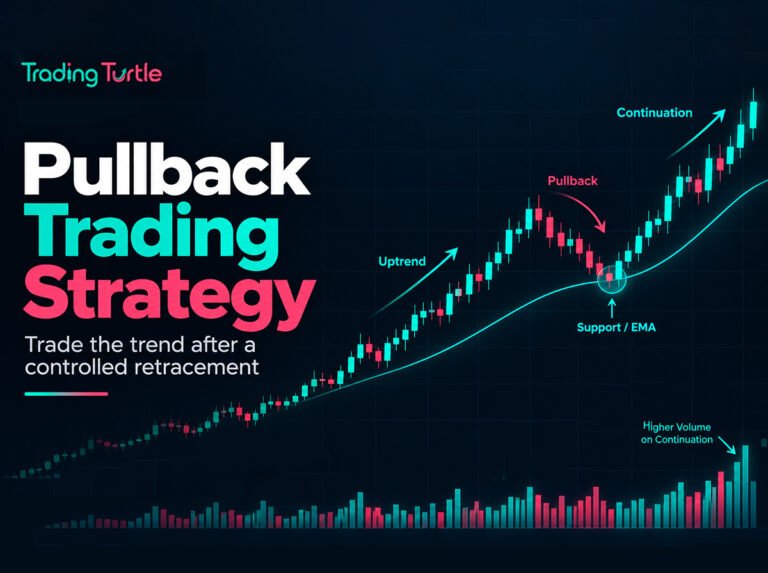
- Wait for a pullback instead of chasing price.
- Enter only after confirmation.
- Define stop-loss before entering.
- Manage the trade according to predefined rules.
Many educational resources recommend separating the process into trend direction, trend quality, and trade management rather than relying on a single indicator.
Example 1: Trend Following in Stocks
Imagine a company whose share price has been rising steadily.
Observations:
- Higher highs
- Higher lows
- Price remains above the 50-day moving average
- Pullbacks are relatively shallow
Instead of buying after several consecutive bullish candles, a trend follower might wait for a controlled pullback and then look for signs that buyers are returning.
Example 2: Trend Following in Cryptocurrency
Bitcoin often experiences extended trending phases.
During a sustained uptrend:
- Price remains above key moving averages.
- Pullbacks respect previous support areas.
- Buying interest returns after temporary declines.
Trend followers attempt to participate during these continuation phases rather than trying to predict every market reversal.
Risk Management
Risk management is essential.
Even the strongest trend-following system will experience losing trades.
Consider the following principles:
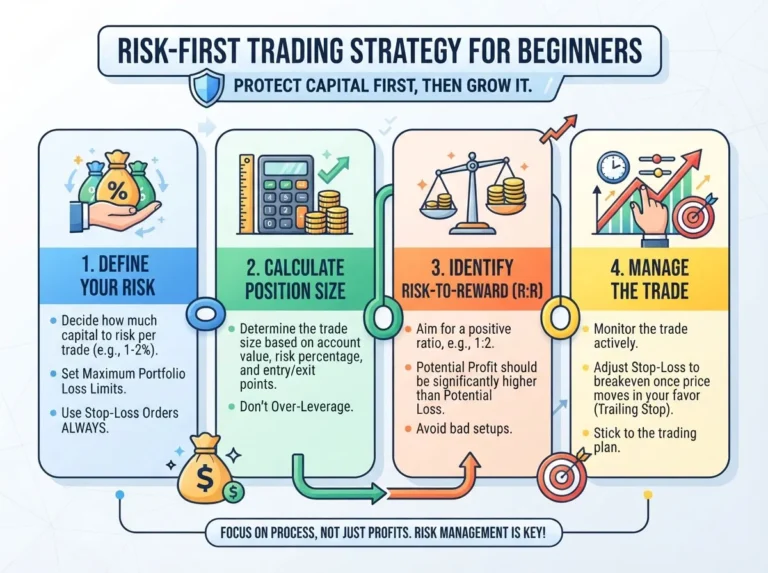
- Risk only a small percentage of trading capital on a single position.
- Decide your exit level before entering.
- Avoid increasing position size simply because a trade is moving against you.
- Review every completed trade to identify areas for improvement.
Common Mistakes
Chasing Breakouts
Entering after a large price surge can expose traders to poor risk-to-reward ratios.
Trading Sideways Markets
Trend following strategies generally struggle when prices lack clear direction.
Ignoring Higher Timeframes
A bullish signal on a short timeframe may conflict with a bearish higher-timeframe trend.
Looking at multiple timeframes can provide better context.
Moving Stop-Losses
Changing stop-loss levels to avoid taking a loss often increases overall risk.
Overtrading
Not every chart presents a quality trend following opportunity.
Waiting patiently is often part of the strategy.
Is Trend Following Suitable for Beginners?
Yes—provided beginners understand that:
- No strategy wins every trade.
- Losses are inevitable.
- Risk management is essential.
- Consistency matters more than excitement.
Trend following encourages disciplined decision-making rather than emotional reactions.
Key Takeaways
- Trend following focuses on trading in the direction of established market movement.
- The strategy reacts to price action rather than predicting reversals.
- Market structure should remain the primary guide, with indicators providing confirmation.
- Moving averages, ADX, MACD, and Supertrend are commonly used supporting tools.
- Trend following approaches generally perform better in directional markets than in range-bound conditions.
- Effective risk management and disciplined execution are just as important as identifying the trend itself.
– Frequently Asked Questions (FAQs)
Yes. Its rule-based nature makes it one of the easier trading approaches to understand, provided risk management is emphasized.
Yes. Because cryptocurrencies can experience strong directional moves, trend-following methods are widely used, though volatility is often higher than in many traditional markets.
There is no universally best indicator. Moving averages, ADX, MACD, and Supertrend are among the most commonly used, but they work best when combined with price action and sound risk management.
No. Like every trading strategy, trend following involves risk and can produce losing trades.
Yes. Trend following can be adapted to different trading styles, including intraday, swing, position, and long-term investing. The core principle remains the same—identify the prevailing trend, trade in its direction, and manage risk using predefined rules. The choice of timeframe depends on your trading goals, available time, and risk tolerance rather than the strategy itself.