NIFTY 50 vs SENSEX: Key Differences Every Beginner Should Understand

What Are NIFTY 50 and SENSEX?
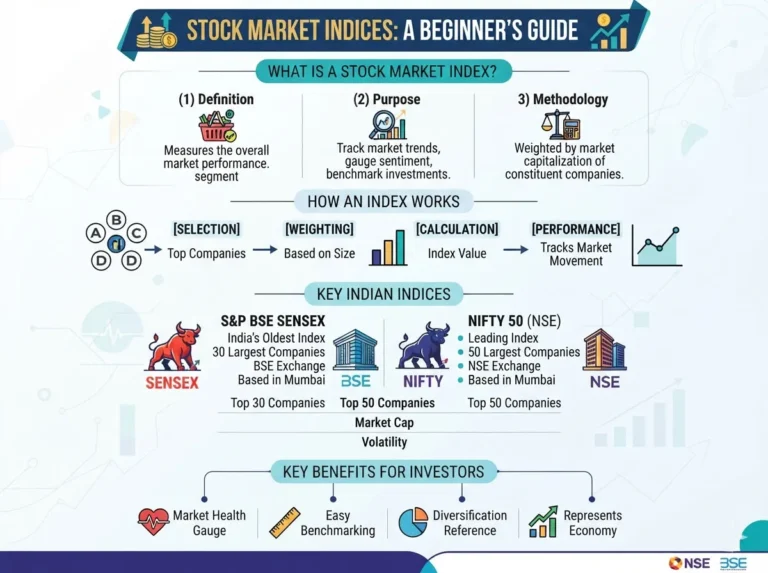
NIFTY 50 and SENSEX are two of the most widely followed Indian stock market indices. They are designed to represent the performance of a selected group of large and liquid companies listed in India.
When financial news reports that “the market rose” or “the market fell,” the report is often referring to the movement of one or both of these indices. However, neither index represents every listed company or every sector equally.
The simplest explanation of NIFTY 50 vs SENSEX is:
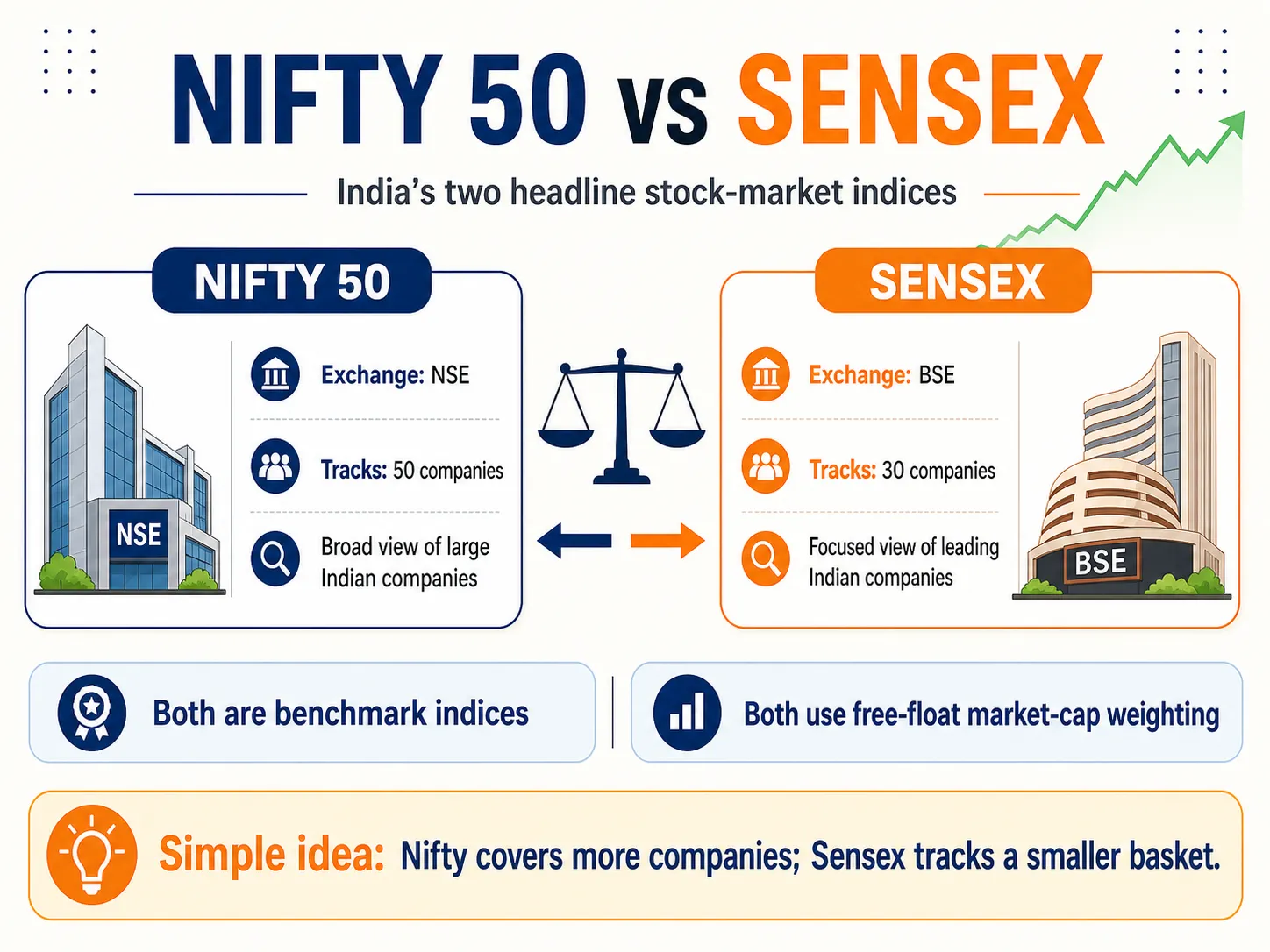
- NIFTY 50 tracks 50 companies associated with the National Stock Exchange of India.
- SENSEX tracks 30 large and liquid companies associated with BSE.
Both indices use a free-float market-capitalisation-based approach, but they have different constituent-selection rules, index histories, exchange associations and portfolio compositions.
The NIFTY 50 is described by NSE as its flagship index, designed to represent a portfolio of large, liquid Indian securities. The BSE SENSEX is designed to measure the performance of 30 large and liquid companies listed on BSE.nsearchives.nseindia+1
Education-only disclaimer: This article is for educational purposes only. It is not personalised investment advice, a recommendation to buy or sell securities, or a promise of returns. Market indices can rise or fall, and investments linked to them involve risk.
NIFTY 50 vs SENSEX at a Glance
| Feature | NIFTY 50 | SENSEX |
|---|---|---|
| Associated exchange | National Stock Exchange of India | BSE |
| Number of constituents | 50 | 30 |
| Broad purpose | Represents large and liquid Indian companies | Represents large and liquid Indian companies |
| Weighting approach | Free-float market capitalisation | Free-float market capitalisation |
| Common use | Market benchmark, index funds, ETFs and derivatives | Market benchmark, index funds, ETFs and derivatives |
| Coverage | Broader basket of large companies | More concentrated basket of large companies |
| Common symbol | NIFTY 50 or NIFTY | SENSEX |
| Ownership of index | NSE Indices | BSE-linked index structure |
The NIFTY 50 vs SENSEX comparison should not be reduced to which index has the higher numerical value. Index points are based on different base values and methodologies, so the point levels cannot be compared directly.
What Is the NIFTY 50?
The NIFTY 50 is the flagship index of NSE. It tracks a basket of 50 large and liquid companies selected according to index eligibility and methodology rules.
The index is calculated using a free-float market-capitalisation-weighted method. This means companies with a larger value of shares available for public trading generally receive a larger influence on the index, subject to the applicable methodology and limits.
The NIFTY 50 methodology also accounts for constituent changes and corporate actions such as stock splits and rights issues so that these events do not create an artificial change in the index level.
What the NIFTY 50 represents
The NIFTY 50 is commonly used as:
- A broad benchmark for Indian large-cap equities.
- A reference point for comparing portfolio performance.
- An underlying index for ETFs and index funds.
- A basis for futures and options contracts.
- A general indicator of market sentiment.
Although the NIFTY 50 contains 50 stocks, it does not give every constituent an equal weight. A few larger companies can have a significant influence on the index’s daily movement.
This means the NIFTY 50 can rise even when many smaller constituents fall, provided the stocks with larger index weights perform strongly.
What Is the SENSEX?
The SENSEX is a major benchmark index associated with BSE. It is designed to represent 30 large and liquid companies and is one of the most recognised indicators of Indian equity-market performance.
Like the NIFTY 50, the SENSEX uses a free-float market-capitalisation methodology. Its smaller number of constituents means that each company can have a comparatively larger influence on the index, although the actual impact depends on its weight.
What the SENSEX represents
The SENSEX is commonly used as:
- A benchmark for large-company equity performance.
- A reference for financial news and market commentary.
- A comparison tool for investment portfolios.
- An underlying reference for certain financial products.
- A broad indicator of investor sentiment.
The SENSEX is not a complete representation of the entire Indian stock market. It reflects the performance of a selected group of companies that satisfy the index methodology.
NIFTY 50 vs SENSEX: Main Differences
Number of companies
The most visible difference in NIFTY 50 vs SENSEX is the number of constituents.
- NIFTY 50 includes 50 companies.
- SENSEX includes 30 companies.
The larger NIFTY 50 basket may provide somewhat broader large-cap representation. The SENSEX, with fewer constituents, is more concentrated.
Neither index is automatically better because of its size. The relevant question is whether the index suits the purpose for which it is being used.
Exchange association
The NIFTY 50 is associated with NSE, while the SENSEX is associated with BSE.
This does not mean that a company included in one index can never be listed or traded on the other exchange. Indian companies may have trading availability on both exchanges, subject to applicable listing and market rules.
The exchange association identifies the index provider and the framework under which the index is maintained.
Portfolio composition
The two indices may include many large companies from similar sectors, but their constituent lists and weights are not identical.
As a result, one index may perform better than the other over a particular period if:
- A sector has a higher weight in one index.
- A major constituent performs differently.
- A company is added to or removed from one index.
- The two indices react differently to corporate or sector-specific news.
This is an important part of the NIFTY 50 vs SENSEX comparison. Similar overall direction does not mean identical daily returns.
Concentration
The SENSEX has fewer constituents, so it may be more concentrated in its largest companies. The NIFTY 50 has more constituents, although it can also be significantly influenced by its largest members.
Investors should examine constituent weights rather than assuming that the number of companies alone determines diversification.
Index history and brand recognition
The SENSEX has a long history and is one of the most familiar names in Indian financial media. The NIFTY 50 is widely used as a benchmark for products linked to NSE and is extensively followed by traders, investors and institutions.
Historical importance does not make one index more suitable for every portfolio. The choice depends on the benchmark, product and investment objective.
Derivatives and financial products
Both NIFTY 50 and SENSEX may be used as reference indices for financial products, including derivatives. However, the contract specifications, lot sizes, expiry structure, margin requirements and settlement rules can differ.
Anyone considering index derivatives should review the latest exchange documentation rather than relying on general comparisons. Derivatives can create losses that are larger than the initial amount paid or deposited, depending on the product and position.
How the Two Indices Are Calculated
Understanding calculation methods is central to the NIFTY 50 vs SENSEX discussion.
Free-float market capitalisation
Both indices use a free-float market-capitalisation-based approach. In simple terms, the methodology considers:
- The market price of each company.
- The number of shares issued.
- The proportion of shares available for public trading.
- The company’s weight within the index.
Shares held by promoters, controlling shareholders, governments or other strategic holders may not be treated in the same way as shares freely available to public investors.
The index value is then calculated using a methodology that maintains continuity when companies undergo corporate actions or when index constituents change.
Why market-capitalisation weighting matters
A market-capitalisation-weighted index gives more influence to larger companies. If a company has a high weight and its price moves sharply, the index may respond noticeably even if many smaller constituents move in the opposite direction.
This means that the daily movement of the index is not equivalent to the average movement of all its constituents.
Index points are not stock prices
The numerical level of NIFTY 50 cannot be compared directly with the numerical level of SENSEX. The two indices have different base dates, base values and calculation structures.
For example, saying that one index is “cheaper” because its point value is lower would be incorrect. Index points do not work like the price of an individual share.
The meaningful comparisons are usually:
- Percentage return.
- Total-return performance.
- Volatility.
- Drawdown.
- Sector exposure.
- Investment-product tracking quality.
Why NIFTY 50 and SENSEX Can Move Differently
The NIFTY 50 vs SENSEX relationship is usually positive because both indices represent major Indian companies. However, their returns can differ over a particular day, month or year.
Different constituent weights
If a large-weight company rises sharply, the index containing that company at a higher weight may outperform the other index.
Sector concentration
One index may have greater exposure to a sector such as banking, information technology, energy, automobiles or consumer businesses. Sector-specific news can therefore affect the indices differently.
Different constituent changes
Index providers periodically review their indices. Companies may be added, removed or have their weights adjusted according to the relevant methodology.
A change in composition can alter the way an index responds to future market movements.
Corporate actions
Stock splits, rights issues, mergers and other corporate actions can affect index calculations. Index methodologies are designed to account for such events and maintain continuity.
Market liquidity and trading activity
Differences in trading activity, order flow and derivatives positioning may contribute to short-term variations. These effects can be more visible during volatile sessions.
Which Index Is Better for Beginners?
There is no universal answer to which is better in the NIFTY 50 vs SENSEX comparison.
A beginner might select NIFTY 50 as a benchmark because it contains more constituents and is widely used for large-cap market analysis. Another investor may prefer SENSEX because it is a familiar benchmark with a concentrated basket of major companies.
The decision should depend on:
- The index used by the selected fund or ETF.
- The benchmark used to evaluate a portfolio.
- The product’s tracking difference and costs.
- The investor’s desired exposure.
- The intended investment horizon.
- The level of concentration the investor understands and accepts.
The choice of index does not remove market risk. Both indices can decline during broad market stress.
Index level versus index return
Beginners should compare percentage returns rather than point levels. A move of 1,000 points does not have the same meaning for every index because the starting levels are different.
For example:
Percentage returns provide a more meaningful basis for comparison, although investors should also consider whether they are comparing price-return or total-return versions of an index.
How Traders and Investors Use These Indices
Market benchmarking
An investor can compare a portfolio’s performance with an appropriate benchmark. If a large-cap portfolio consistently underperforms its benchmark, the investor may review costs, holdings, strategy and risk.
Benchmarking does not mean that every portfolio should match the index. A portfolio with a different risk profile may reasonably produce different returns.
Market-context analysis
Traders may study the NIFTY 50 and SENSEX to understand broader market conditions before analysing individual stocks.
Questions may include:
- Is the broader market trending or ranging?
- Are large-cap stocks showing strength?
- Is volatility increasing?
- Are several sectors moving together?
- Is an individual stock outperforming or underperforming its benchmark?
An index can provide context, but it does not predict the next move of every stock.
Passive investment products
Some mutual funds and exchange-traded funds attempt to track major indices. Investors should review the product’s costs, tracking difference, taxation, liquidity, structure and risk before making a decision.
An index fund can provide diversified exposure to its selected basket, but it still falls when the underlying index falls.
Index derivatives
NIFTY 50 and SENSEX may be used in futures and options markets. These products are complex and can involve margin requirements, time decay, leverage, volatility risk and rapid losses.
A beginner should understand the contract specifications and risk disclosures before considering derivatives. Reading an index level does not mean that trading an index derivative is simple.
Common Mistakes to Avoid
Comparing point values
The numerical level of NIFTY 50 cannot be compared directly with the numerical level of SENSEX. Use percentage returns and comparable data instead.
Assuming both indices are identical
Both indices reflect large Indian companies, but their constituents, weights and methodologies differ. Their returns can therefore diverge.
Believing an index represents every stock
The NIFTY 50 and SENSEX are selected benchmarks. They do not represent every listed company, small-cap stocks or every sector equally.
Ignoring concentration
A basket with many companies may still be dominated by a few large constituents. Review weights and sector exposure before drawing conclusions about diversification.
Treating index movement as a trade signal
A rising index does not mean every stock is a buy. A falling index does not mean every stock must be sold. An index is a market indicator, not personalised trading advice.
Forgetting total-return data
A price index generally reflects changes in constituent prices. A total-return version may also account for dividends being reinvested. Use the correct version when evaluating long-term performance.
Using outdated constituent information
Index constituents and weights can change. Always verify the latest information on the official index-provider websites before publishing analysis or making a decision.
Key Takeaways
- NIFTY 50 and SENSEX are major Indian stock market indices.
- NIFTY 50 contains 50 companies, while SENSEX contains 30.
- NIFTY 50 is associated with NSE, and SENSEX is associated with BSE.
- Both indices use free-float market-capitalisation-based methodologies.
- Their point values cannot be compared directly because their bases and methodologies differ.
- Different constituents, weights and sector exposure can cause different returns.
- Neither index represents the entire Indian stock market.
- Index funds and ETFs can provide exposure, but they still carry market risk.
- Index derivatives involve leverage and additional risks that beginners should understand before trading.
– Frequently Asked Questions (FAQs)
The main difference is that NIFTY 50 contains 50 companies associated with NSE, while SENSEX contains 30 companies associated with BSE. Both are major Indian large-cap indices and use free-float market-capitalisation-based methodologies.
Neither index is universally better. NIFTY 50 offers a larger basket, while SENSEX has a more concentrated group of 30 companies. The more suitable benchmark depends on the investment product, objective, costs and desired exposure.
Yes, although they often move in the same broad direction. Different constituent weights, sector exposure and company-specific events can cause them to move differently during a trading session.
An index itself is a calculation and cannot be purchased like an individual share. Investors may obtain exposure through products such as index funds or ETFs, subject to the product’s structure, costs and risks. Index derivatives are separate instruments and involve additional complexity.
They provide widely followed benchmarks for Indian large-cap equities. They are used in market reporting, portfolio comparison, passive investment products and derivative markets.
A beginner can track either or both to understand broad market direction. The important point is to understand what each index represents and not mistake index movement for a guaranteed signal on an individual stock.
Some companies may appear in both indices, but the two indices do not have identical constituent lists. Their selection rules and weights differ.