Types of Stock Market Indices in India: Broad Market, Sectoral, Thematic and Strategy Indices

What Is a Stock Market Index?
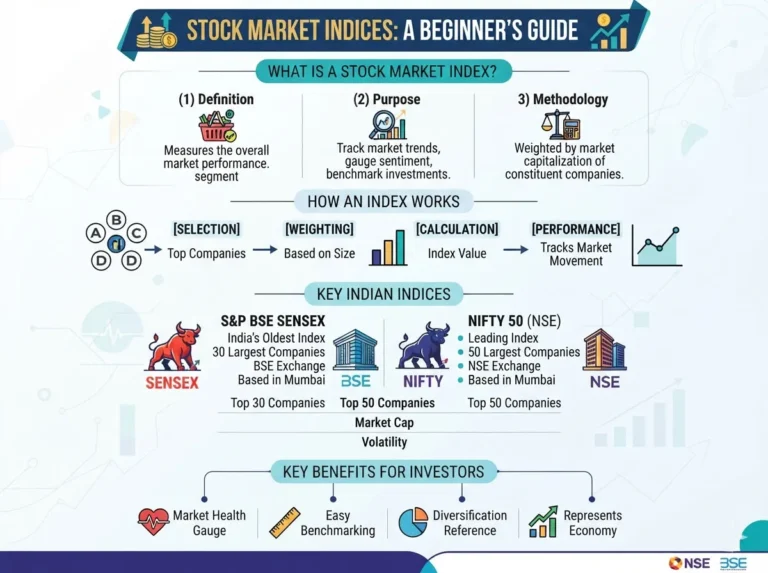
A stock market index measures the combined performance of a selected group of stocks. Instead of following hundreds or thousands of listed companies individually, readers can use an index to understand how a defined part of the market is performing.
The types of stock market indices in India differ according to the companies and rules used to construct them. Some track large companies across several sectors, while others focus on a single sector, investment theme, market-capitalisation segment or rules-based strategy.
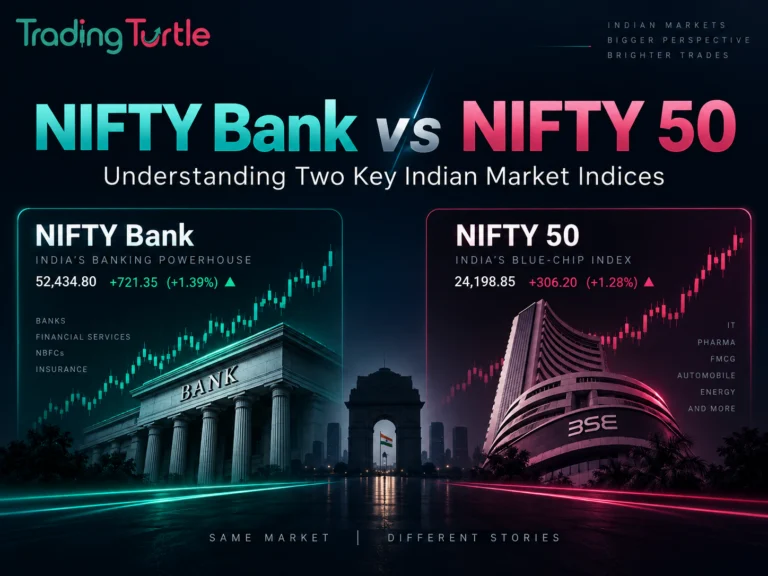
For example, the NIFTY 50 tracks a selected basket of large and liquid companies, while a banking index tracks companies from the banking industry. Neither type tells the complete story of the Indian equity market, but each can provide useful context for a specific purpose.
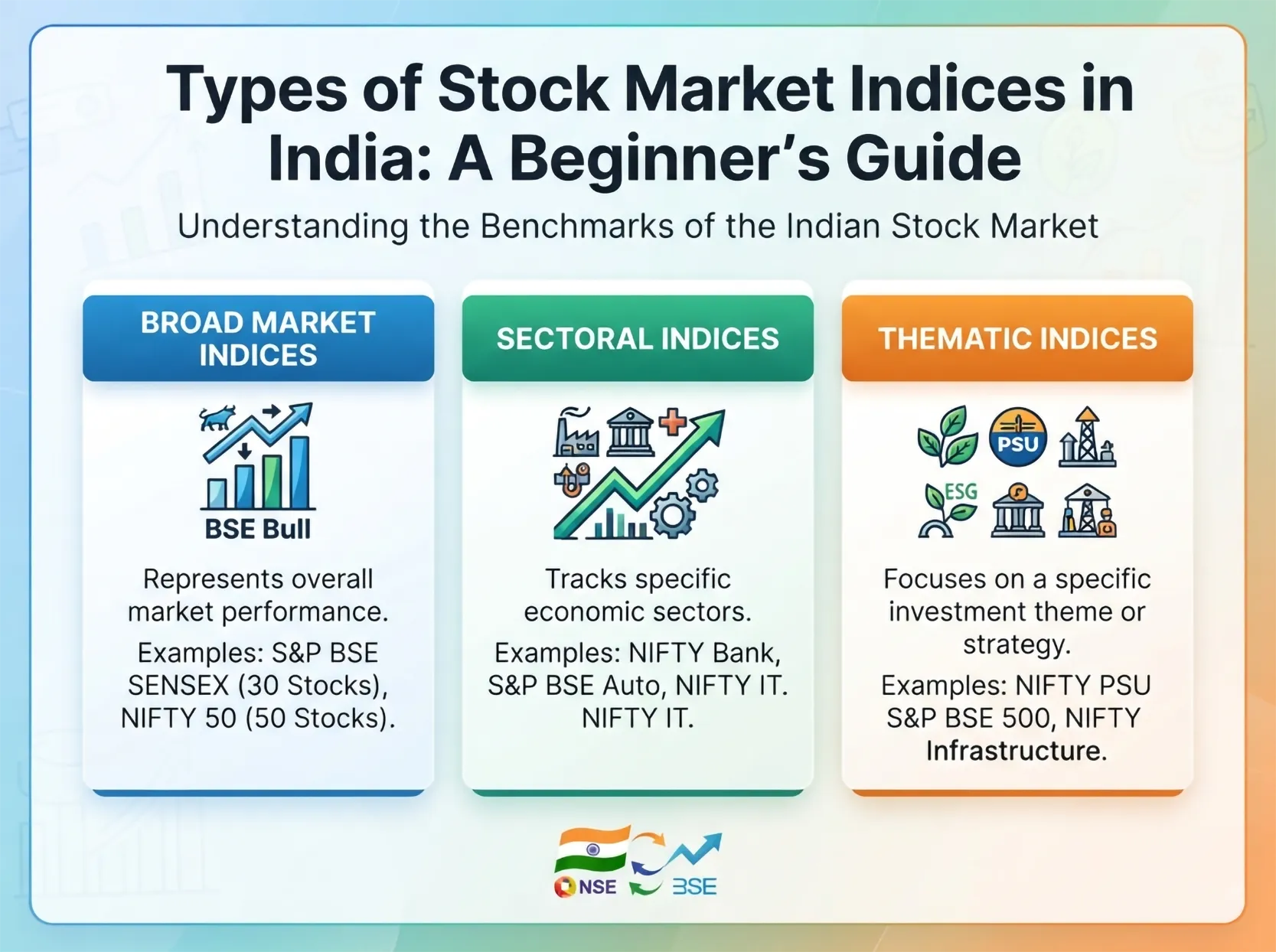
NSE Indices classifies its equity indices into broad-based benchmark indices, sectoral indices, thematic indices, strategy indices and customised indices.
Education-only disclaimer: This article is for educational purposes only. It is not personalised investment advice, a recommendation to buy or sell securities, or a promise of returns. Index-linked investments and index derivatives can lose value.
An index is not a share
An index is a calculation, not a company share that can be purchased directly. It reflects the movement of its underlying constituent stocks according to a published methodology.
Investors may seek index exposure through products such as index mutual funds and exchange-traded funds (ETFs). These products aim to track an underlying index, but their returns can differ because of costs, cash holdings, taxes and tracking difference.
Why Different Types of Indices Exist
The main reason there are several types of stock market indices in India is that one index cannot accurately represent every investment style, company size, sector or market theme.
A broad market index may help someone assess general market conditions. A sectoral index can show how a particular industry is performing. A thematic index may track companies connected to a structural idea such as consumption, infrastructure or digital activity.
Different indices can therefore be useful for:
- Understanding market direction.
- Comparing portfolio performance with a relevant benchmark.
- Researching sector strength or weakness.
- Studying the performance of large-cap, mid-cap or small-cap shares.
- Constructing passive investment products.
- Providing underlying references for derivatives and structured products.
However, an index should be treated as a research tool and benchmark, not as an automatic trading signal.
Broad Market Indices
Broad market indices track companies across multiple industries. They are designed to provide a wider view of the equity market or of a particular market-capitalisation segment.
Among the types of stock market indices in India, broad market indices are usually the most familiar to beginners because they are commonly mentioned in news coverage and used as benchmarks by funds and portfolio managers.
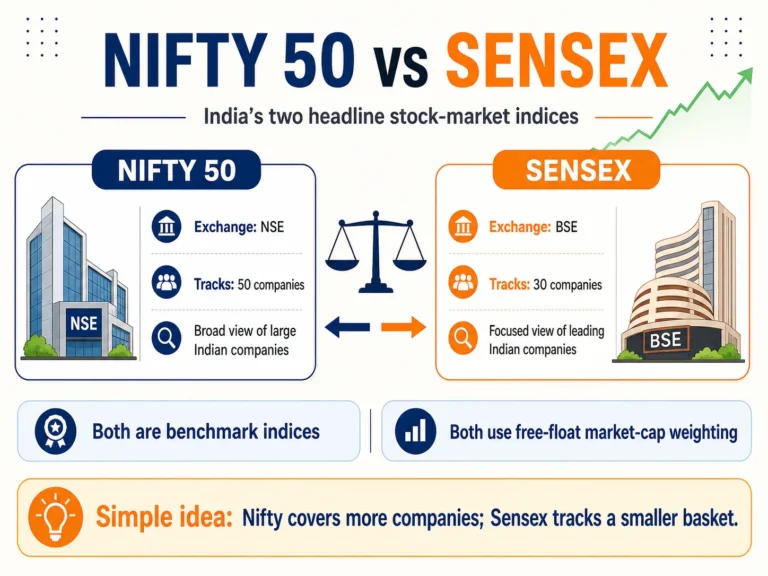
NSE lists broad market indices that include the NIFTY 50, NIFTY Next 50, NIFTY 100, NIFTY 200, NIFTY 500, NIFTY Midcap 150 and NIFTY Smallcap 250, among others.
Large-cap indices
Large-cap indices generally track bigger, more established listed companies. These companies may have higher market capitalisation, more trading activity and broader institutional participation than smaller companies.
Common examples include:
- NIFTY 50.
- SENSEX.
- NIFTY 100.
- NIFTY Next 50.
A large-cap index can still be affected heavily by a small number of companies with large index weights. More constituents do not automatically mean that each company has equal influence.
Mid-cap indices
Mid-cap indices track companies that are generally smaller than large-cap leaders but larger than small-cap companies. They can offer exposure to businesses that may be earlier in their growth cycle or operate in more specialised areas.
Examples include:
- NIFTY Midcap 50.
- NIFTY Midcap 100.
- NIFTY Midcap 150.
Mid-cap indices can be more volatile than large-cap indices. During market stress, their constituents may experience sharper price movements or lower liquidity than the largest companies.
Small-cap indices
Small-cap indices represent smaller listed companies. These businesses can offer exposure to a wider part of the economy, but their shares may carry greater volatility, lower liquidity and higher company-specific risk.
Examples include:
- NIFTY Smallcap 50.
- NIFTY Smallcap 100.
- NIFTY Smallcap 250.
A small-cap index should not be interpreted as a low-risk alternative simply because it contains many companies. Individual constituents can react sharply to earnings, governance concerns, business setbacks or changes in market liquidity.
Total-market and multi-cap indices
Some broad market indices are designed to cover a larger segment of the listed market across company sizes. These can include large-cap, mid-cap and small-cap companies.
Examples include:
- NIFTY Total Market Index.
- NIFTY 500.
- NIFTY LargeMidcap 250.
- NIFTY MidSmallcap 400.
These types of stock market indices in India can be useful when the goal is to observe a wider equity-market universe instead of only the biggest companies.
Sectoral Indices
Sectoral indices measure the performance of companies operating in a specific industry or closely related group of industries. They can help readers identify whether a sector is outperforming or underperforming the broader market.
NSE describes sectoral indices as indices representing the collective performance of stocks in their respective sectors.
Common sectoral-index examples include:
- NIFTY Bank.
- NIFTY Financial Services.
- NIFTY IT.
- NIFTY Pharma.
- NIFTY Auto.
- NIFTY FMCG.
- NIFTY Metal.
- NIFTY Realty.
- NIFTY Media.
How sectoral indices are used
A sectoral index may help a trader or investor ask better research questions:
- Is the banking sector stronger or weaker than the broader market?
- Are information-technology stocks reacting to global developments?
- Is a stock rising because of company-specific strength or because the entire sector is advancing?
- Is sector risk creating concentration in a portfolio?
For example, an investor holding multiple banking shares may monitor a banking index to understand common sector exposure. This does not mean the index will predict the next move in each individual bank stock.
Sectoral-index risk
Sectoral indices are less diversified than broad market indices because all constituents are affected by similar economic forces.
A banking index may react to interest-rate expectations, credit conditions and banking regulation. An IT index may be influenced by global demand, currency movements and technology spending. A pharma index can be sensitive to regulatory developments, product approvals and export-market conditions.
SEBI notes that market participants face risks including market risk, liquidity risk and volatility risk. Diversification can help reduce concentration risk, but it cannot eliminate all market risk.
Thematic Indices
Thematic indices group companies around a broader economic theme rather than a traditional sector. A theme can include businesses from different industries that are connected by a common market opportunity, policy direction, consumer trend or structural change.
Among the types of stock market indices in India, thematic indices can appear diversified because they may contain companies from several sectors. However, they can still be highly concentrated around one underlying idea.
Possible themes may include:
- Infrastructure.
- Consumption.
- Manufacturing.
- Digital activity.
- Public-sector enterprises.
- Healthcare.
- Tourism.
- Energy transition.
NSE Indices groups its equity indices into broad-market, sectoral, thematic and strategy categories.
The difference between sectoral and thematic indices
A sectoral index usually follows one defined industry, such as banking or information technology.
A thematic index may include companies from multiple industries if they are connected to the same theme. For example, an infrastructure theme could include construction, engineering, cement, capital-goods and logistics-related companies.
This difference is important when assessing risk. A thematic index may have a wider variety of businesses than a sectoral index, but its companies can still be affected by the same policy, demand or economic trend.
Why thematic indices require extra research
Themes can become popular when their recent performance is strong. That can lead readers to assume that the trend will continue indefinitely.
Before using thematic products as part of a portfolio, research:
- The index methodology.
- Number of constituents.
- Company weights.
- Rebalancing frequency.
- Sector overlap.
- Volatility history.
- Product costs and tracking difference.
- Whether the theme fits the intended time horizon.
A strong narrative is not the same as a low-risk investment case.
Strategy Indices
Strategy indices follow predefined rules intended to capture a particular factor, investment style or portfolio approach. Rather than simply selecting the largest companies, these indices apply a rules-based process.
Examples of possible strategy styles include:
- Momentum.
- Value.
- Quality.
- Low volatility.
- Dividend yield.
- Alpha-based approaches.
- Equal-weight approaches.
Strategy indices are often described as smart-beta or factor-based indices. Their methodology may select, weight or rebalance stocks differently from a traditional market-capitalisation-weighted index.
How strategy indices differ from broad indices
A broad market index may give larger weights to companies with greater free-float market capitalisation. A strategy index may instead weight companies based on a chosen factor or apply limits to reduce concentration.
For example:
- A momentum index may favour stocks showing stronger recent price performance.
- A low-volatility index may apply rules that seek relatively lower price volatility.
- A value index may use valuation-related measures.
- An equal-weight index may reduce the dominance of the largest companies.
No factor works in every market environment. A strategy index can underperform a broad market index for long periods, particularly when market leadership changes.
Methodology matters
Two funds with similar names may track different indices and use different rules. Always read the official factsheet and methodology rather than relying only on the product label.
NIFTY Indices publishes factsheets and methodology resources for broad market, sectoral, thematic and strategy index categories.
Market-Capitalisation-Based Indices
Another useful way to understand the types of stock market indices in India is by the size of companies represented.
Large-cap index liquidity and concentration
Large-cap indices focus on the biggest listed companies. They may be more liquid than smaller-company indices, but they remain exposed to market declines and can be concentrated in a few heavily weighted stocks.
Mid-cap index exposure and volatility
Mid-cap indices represent companies between the largest and smallest market-capitalisation groups. They may offer different growth and business exposure, with potentially greater volatility.
Small-cap index liquidity and company risk
Small-cap indices track smaller listed companies. They can be more sensitive to changes in liquidity, risk appetite and company-specific information.
Multi-cap indices
Multi-cap or broad-market indices combine companies across more than one market-cap segment. They may offer wider representation of the equity market, but their actual exposure depends on the methodology and constituent weights.
The labels large-cap, mid-cap and small-cap describe market-capitalisation categories; they do not guarantee a particular return, safety level or investment outcome.
How to Use Indian Stock Market Indices
The types of stock market indices in India can be useful when used for research and comparison rather than prediction.
Understand market context
An index can help explain the broader environment around an individual stock.
For instance, if a stock falls while its relevant sectoral index is also falling, the move may be partly connected to sector-wide pressure. If the stock declines while both the sector and broad market are strong, company-specific factors may deserve more research.
This is context, not a conclusion. A sector index cannot tell a trader exactly what an individual stock will do next.
Compare portfolio performance
A portfolio should be compared with an appropriate benchmark.
- A large-cap portfolio may use a broad large-cap index.
- A banking-focused portfolio may use a banking-sector index for additional context.
- A mid-cap strategy may need a mid-cap benchmark rather than NIFTY 50.
Benchmarking should also account for risk, transaction costs, taxes and the portfolio’s actual investment style.
Research diversification
Indices can reveal hidden concentration. A person may own several stocks but still have most of their exposure in one sector, one market-cap segment or one theme.
Reviewing broad market, sectoral and thematic indices can make those overlaps more visible.
Avoid using indices as direct trade calls
A rising NIFTY 50 does not mean every stock should be bought. A falling sectoral index does not mean every company in that sector should be sold.
Price movement must be interpreted alongside company information, valuation, liquidity, time horizon, risk capacity and a defined process.
Index Funds, ETFs and Index Derivatives
An index cannot be bought directly, but financial products may attempt to track it.
Index funds
An index fund is a mutual-fund scheme designed to replicate or track an underlying index. The fund may hold the same securities in roughly similar weights, depending on its approach.
NISM explains that an index fund is a passive diversified equity fund invested in the same stocks and weightings as an equity-market index.
A fund’s actual performance may differ from the index because of expenses, cash balances, taxes, rebalancing and tracking difference.
Exchange-traded funds
An ETF is a fund that trades on an exchange during market hours. SEBI explains that ETFs can track indices such as Sensex and Nifty, and that buying ETF units means buying units of a portfolio designed to track the index.
ETF buyers should also consider:
- Expense ratio.
- Tracking difference.
- Trading volume.
- Bid-ask spread.
- Premium or discount to net asset value.
- Brokerage and other transaction costs.
Index derivatives
Futures and options may use indices as their underlying reference. These instruments can involve leverage, margin, time decay and rapid losses.
Index derivatives are not the same as investing through an index fund or ETF. Beginners should understand contract specifications, margin requirements and risk disclosures before considering them.
Common Mistakes to Avoid
Assuming all indices are equally diversified
A broad market index generally covers more of the market than a sectoral index, but the constituent count alone does not reveal concentration. Check company weights and sector exposure.
Chasing recent performance
A sector, theme or strategy index may perform strongly for a period and then reverse. Recent returns do not guarantee future returns.
Ignoring methodology
An index name can sound familiar while its selection rules, weighting approach and rebalancing schedule are very different from another index. Read the methodology.
Comparing index points directly
Index levels have different base dates, base values and calculation methods. Compare percentage returns, volatility, drawdown and relevant total-return data rather than comparing raw point values.
Overlooking product costs
An index-linked fund or ETF may not match the index exactly. Expenses, trading costs and tracking difference can affect investor returns.
Treating a sector index as a complete portfolio
A sectoral or thematic index can be concentrated. It should not automatically be treated as a substitute for diversified market exposure.
Using derivatives without understanding risk
Index options and futures can magnify losses. Knowing that an index exists is not sufficient preparation for trading derivative contracts linked to it.
Key Takeaways
- The main types of stock market indices in India include broad market, sectoral, thematic and strategy indices.
- Broad market indices track companies across multiple industries and may cover large-cap, mid-cap, small-cap or multi-cap segments.
- Sectoral indices focus on one industry, while thematic indices follow a wider economic or structural theme.
- Strategy indices apply predefined rules, such as momentum, value, quality or low-volatility selection.
- An index is a benchmark and calculation; it is not a share that can be purchased directly.
- Index funds and ETFs can seek to track an index, but costs and tracking difference can affect returns.
- Sectoral and thematic indices can create concentration risk.
- Review the official index methodology, constituent weights and product details before relying on an index for analysis or investment decisions.
– Frequently Asked Questions (FAQs)
The main types of stock market indices in India include broad market indices, sectoral indices, thematic indices and strategy indices. They can also be grouped by market-capitalisation coverage, such as large-cap, mid-cap, small-cap and multi-cap indices.
A broad market index tracks companies from multiple sectors and is designed to provide a wider picture of the market or a market-capitalisation segment. NIFTY 50, NIFTY 100 and NIFTY 500 are examples of broad market indices.
A sectoral index tracks companies in one industry, such as banking or IT. A thematic index groups companies connected to a broader idea that may involve multiple industries, such as infrastructure or consumption.
Sectoral indices can carry greater concentration risk because their constituents are exposed to similar economic, regulatory and industry-specific conditions. Their risk should be evaluated alongside the investor’s total portfolio exposure.
No. An index is a calculation, not a security. Investors may seek exposure through index funds, ETFs or other financial products linked to the index, each with its own structure, costs and risks.
Different indices contain different companies, weights, sectors and selection rules. Even indices that move broadly in the same direction can produce different returns over a day, month or longer period.
No. NIFTY 50 is generally considered a broad market large-cap index because it includes selected companies across multiple sectors. It is not limited to a single industry.