Stock Market Basics: A Beginner’s Guide to How It Works

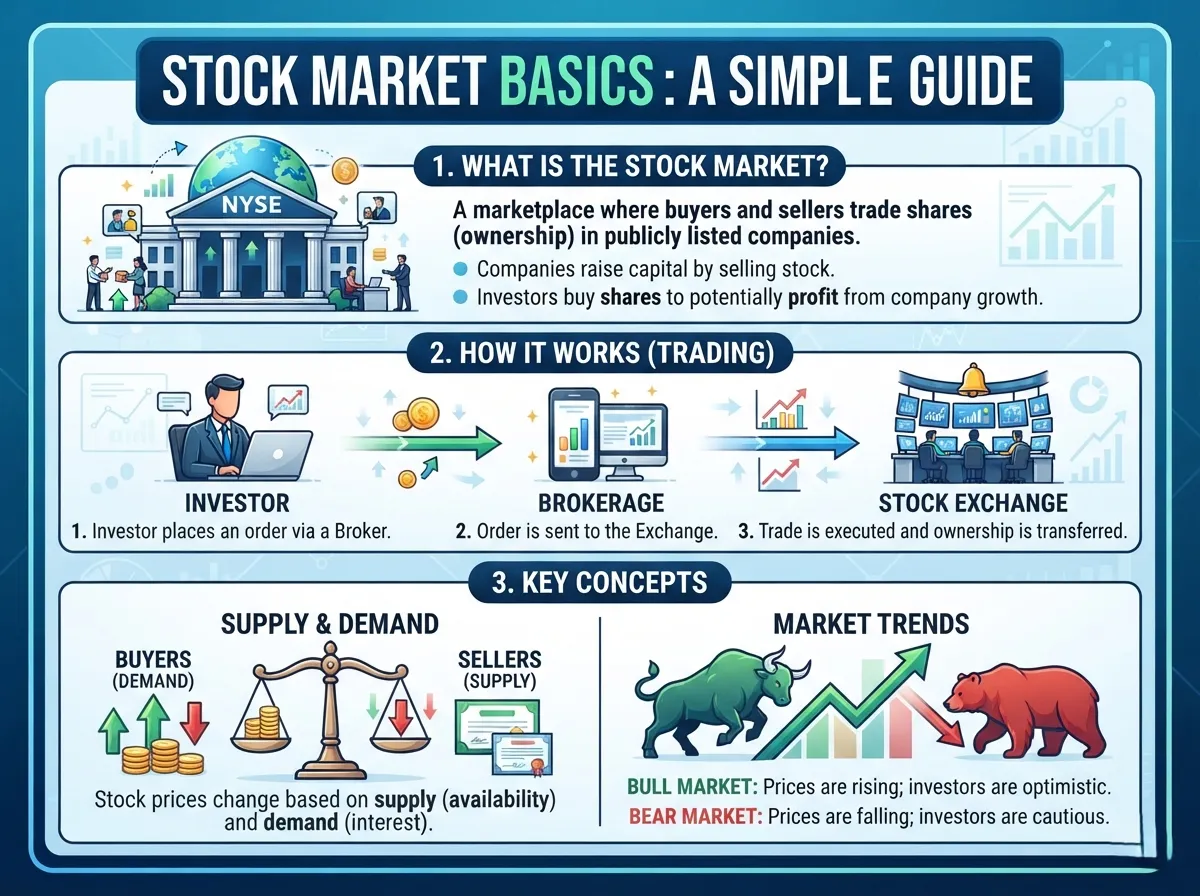
Stock market basics begin with a simple idea: companies can raise money by issuing shares, and investors can buy or sell those shares through regulated market infrastructure. A share represents a small ownership interest in a company, but its market price can change continuously as participants respond to business results, economic conditions, expectations and supply and demand.
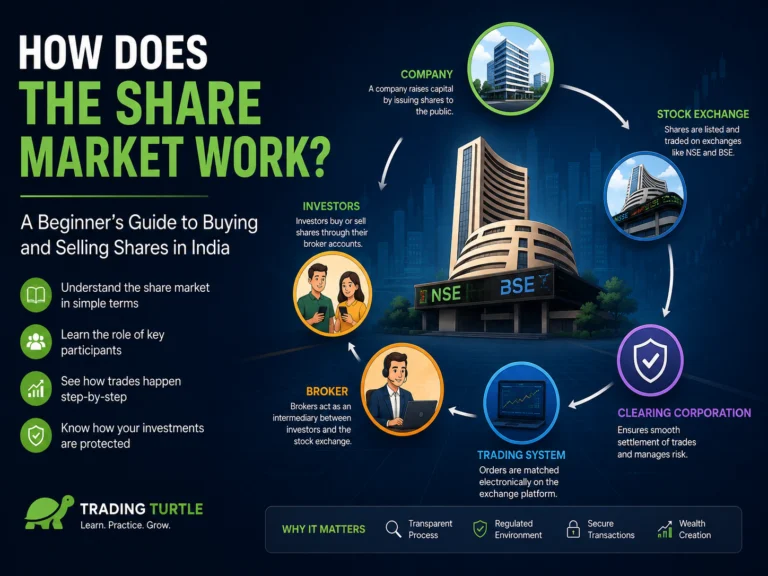
For beginners, the stock market can seem like a stream of prices, news and unfamiliar terms. In practice, it is a system of companies, investors, brokers, exchanges, clearing institutions and regulators. Understanding how these parts fit together is more useful than chasing a ticker symbol or treating every price movement as a trading opportunity.
This guide explains the core stock market basics for Indian readers while keeping the concepts useful across global markets.
Education-only disclaimer: This article is for educational purposes only. It is not personalised investment advice, a recommendation to buy or sell a security, or a promise of returns. Investing and trading in securities involve risk, and prices can fall as well as rise.
What is the stock market?
The stock market is a broad term for the system in which securities are issued, bought and sold. Securities can include shares, bonds, exchange-traded funds and other market instruments. In everyday use, “stock market” often refers specifically to the market for shares of publicly listed companies.
What a share represents
A share is a unit of ownership in a company. If a company has issued shares to the public, shareholders may have economic rights connected to the company, such as a possible claim on dividends if the board declares them. The precise rights depend on the type of share and applicable law.
Owning a share does not mean an investor can control the company’s day-to-day decisions. It means the investor owns a small proportional interest in the business. The value of that interest can rise or fall, and dividends are not guaranteed.
What “listed” means
A company is generally described as listed when its shares are admitted for trading on a recognised stock exchange. Listing gives market participants a venue to trade the company’s shares, subject to the exchange’s rules and regulatory framework.
In India, securities-market information for investors is available through the SEBI Investor portal. SEBI’s educational material describes the securities market as a place where issuers can raise capital and where investors can buy or sell listed securities.
Why companies issue shares
Companies may issue shares to raise capital for purposes such as expansion, new projects, debt reduction, acquisitions or general business needs. Instead of borrowing all required funds, a company can offer ownership interests to investors.
Equity financing and borrowing
When a business borrows money, it typically takes on a repayment obligation and interest cost. When it raises money by issuing equity, it gives investors ownership interests instead. Each route has different implications for the company, existing shareholders and financial risk.
Equity financing does not make a company automatically successful. The funds must still be used effectively, and a company’s performance can be affected by competition, management decisions, demand, regulations and broader economic conditions.
Public offerings
An initial public offering, commonly called an IPO, is one way a private company can offer shares to the public for the first time. In India, the primary market is where companies issue new securities to investors, while trading in already issued and listed securities generally happens in the secondary market.
The NSE’s first-time investor material explains this distinction: securities are initially created in the primary market, while investors typically trade already owned shares in the secondary market.
Primary market and secondary market
The distinction between primary and secondary markets is central to stock market basics. They perform different functions even though both relate to securities.
Primary market
The primary market is where a company or other issuer offers new securities to investors and receives the capital raised. IPOs, follow-on offerings and certain rights issues are examples of primary-market activity.
The price in a primary issue is set using the applicable offering process. The company receives the issue proceeds, subject to costs and the terms of the offering.
Secondary market
The secondary market is where investors buy and sell securities that have already been issued. When one investor sells a listed share to another investor through an exchange, the company itself is usually not a direct party to that individual trade.
Secondary-market trading provides liquidity: it gives holders a potential way to sell their securities and allows new participants to purchase them. The SEBI securities-market booklet notes that listed securities are bought and sold through stock exchanges after issuance.
How stock exchanges work
A stock exchange provides the organised infrastructure through which eligible securities can be traded. It brings buy and sell orders together under defined rules and works with other market institutions to support trading, clearing and settlement.
Major Indian exchanges
The National Stock Exchange of India (NSE) and BSE are the two principal recognised equity exchanges commonly followed by Indian investors. Both provide trading venues for listed securities and publish market information, corporate announcements and investor resources.
A share may be listed on one or more exchanges, and prices can reflect trading activity on the relevant venue. Investors should use reliable, official sources when checking exchange information, company filings or market notices.
Clearing and settlement
Trading is only one part of a transaction. After an order is executed, the trade must be cleared and settled: the buyer receives the securities and the seller receives the funds through the market’s settlement process.
This infrastructure reduces counterparty and operational risk compared with informal, unstructured transactions. The practical details, including settlement timelines and rules, can change, so investors should check current information from their broker and the relevant exchange.
Who participates in the stock market
The stock market is not made up only of individual investors. Different participants have different objectives, resources and time horizons.
Retail investors
Retail investors are individuals investing or trading for their own accounts. They may invest regularly for long-term goals, trade more actively, or use a mix of approaches.
New participants should understand their objective, time horizon and capacity to bear losses before choosing a product or strategy. The SEBI guide to investing in securities outlines the range of securities-market products and basic steps for investors.
Institutional investors
Institutions such as mutual funds, pension funds, insurance companies, banks and foreign portfolio investors can transact in significant size. Their activity can influence supply, demand and liquidity, but it does not make price movements predictable.
Brokers, depositories and regulators
A stockbroker provides access to the market and executes orders on a client’s behalf. Depositories hold securities in electronic form through a demat account framework, while depository participants provide services connected to those accounts.
In India, SEBI regulates the securities market and sets rules for registered intermediaries. Investors should verify the registration and status of any broker or adviser before using their services.
How share prices move
A share price is the price at which market participants are willing to transact at a given moment. It changes when new buy and sell orders arrive, when expectations change, or when available liquidity shifts.
Supply and demand
If buyers are willing to pay more than current sellers are asking, transactions can occur at higher prices. If sellers are more urgent or buyers reduce the prices they are willing to pay, transactions can occur lower.
Supply and demand are influenced by many factors, including company performance, earnings expectations, sector conditions, interest rates, inflation, economic data, policy announcements and investor sentiment.
Business and market information
Company earnings, management guidance, dividends, mergers, product developments and governance issues can affect how investors value a company. Broader events—such as changes in interest rates, currency moves or geopolitical developments—can affect entire sectors or the wider market.
No single headline or indicator explains every movement. Prices can also move before news becomes widely discussed, because markets respond to expectations rather than only to confirmed events.
Liquidity and volatility
Liquidity refers to how easily an asset can be bought or sold without causing a large change in price. Highly liquid shares often have narrower bid-ask spreads and more regular trading activity than thinly traded shares.
Volatility describes how sharply and frequently prices move. A volatile share can experience large price changes in a short period, which increases the importance of understanding risk and avoiding position sizes that are too large for the account.
How investors buy and sell shares
For most retail participants, buying or selling shares involves opening the required accounts with a registered intermediary, funding the account and placing an order through the broker’s platform or service.
Trading and demat accounts
In India, a trading account is generally used to place orders, while a demat account holds eligible securities electronically. Account-opening requirements, charges and features vary by broker, so they should be reviewed carefully before proceeding.
The BSE investor education presentation on buying and selling shares describes the role of a broker in the order-placement process and encourages review of company and market information.
Market orders and limit orders
A market order aims to execute as soon as possible at the best available price. A limit order specifies the highest price a buyer is willing to pay or the lowest price a seller is willing to accept.
Neither order type is universally best. A market order prioritises execution, while a limit order prioritises price control but may remain unfilled. Before using either, beginners should understand the bid-ask spread, available liquidity and the possibility of price movement during execution.
Investing versus speculation
Buying a share is not automatically investing in a thoughtful sense. A disciplined approach generally involves understanding the product, the reason for the purchase, the risks and how the position fits within a broader financial plan.
Speculation involves taking risk based primarily on an expectation of price movement. It can be especially hazardous when based on tips, social-media hype or borrowed money rather than a clear understanding of risk.
Stock market indices explained
A stock market index measures the performance of a selected group of shares. It helps people observe broad market or sector movement without looking at every listed company individually.
NIFTY 50 and SENSEX
The NIFTY 50 is a widely followed index associated with the NSE, while the S&P BSE SENSEX is a widely followed index associated with BSE. Each tracks a selected set of major listed companies using its own published methodology.
An index level is not the same as a share price, and an index’s performance does not mean that every stock inside it moved by the same amount. Index construction, weights, rebalancing and methodology all matter.
Why indices matter
Indices are commonly used as market indicators, benchmarks for funds and reference points for investors. They can help show broad market direction, but they do not provide a personal buy or sell signal.
Beginners should avoid assuming that a rising index means every company is attractive or that a falling index makes every company cheap. Individual businesses can perform very differently from the index.
Stocks, investing and trading
Investing and trading are related but distinct approaches to market participation. The suitable approach depends on goals, time horizon, knowledge, available time and tolerance for losses.
Long-term investing
Long-term investors generally focus on business quality, valuation, diversification, financial goals and a multi-year horizon. Short-term price movement may still be uncomfortable, but it is not necessarily the primary reason for every decision.
Active trading
Active traders may hold positions for days, hours or minutes and rely on a defined process for entries, exits and risk control. This approach requires time, discipline, realistic cost assumptions and an understanding that frequent trading can amplify mistakes.
The SEC’s investor publication on day-trading risks cautions that active trading can involve substantial losses and costs. Its U.S.-specific regulatory context does not replace Indian rules, but the general risk message is relevant: short-term market activity and leverage can be hazardous.
Diversification
Diversification means spreading exposure across investments rather than concentrating all capital in one company, sector or theme. It cannot eliminate market risk, but it may reduce the impact of one investment performing badly.
Diversification should be considered in the context of personal financial goals and risk tolerance. It is not a guarantee against loss.
Risks beginners should understand
A basic understanding of risk is more important than a quick list of “best stocks.” The market can produce losses even when a company, sector or economy appears strong.
Market risk
Market risk is the possibility that broad conditions cause securities prices to decline. Interest-rate changes, recessions, inflation, policy decisions or unexpected events can affect many shares at the same time.
Company-specific risk
Company results can be affected by weak earnings, rising costs, debt, competition, management errors, legal disputes or changes in demand. A diversified index may be less exposed to one company than a concentrated individual-stock position.
Liquidity risk
In a thinly traded share, it may be difficult to buy or sell at the expected price. Wider spreads and limited order-book depth can make exits more expensive than anticipated.
Leverage and derivatives risk
Borrowing funds or using derivatives can magnify gains and losses. These products are not suitable simply because they appear to require less upfront cash. Before considering derivatives, understand margin, contract terms, time decay where relevant, and the risk of rapid losses.
SEBI’s securities-market booklet notes that exchanges have cash and derivatives segments and encourages investors to transact through registered brokers or authorised persons.
Fraud and misinformation risk
Unverified tips, impersonation, fake apps, unrealistic return promises and social-media promotions can put investors at risk. Be particularly sceptical of claims of guaranteed profits, “sure-shot” calls or requests to send money outside recognised broker and banking channels.
For investor-awareness material and current resources, consult the SEBI Investor Education page and verify any intermediary through official channels.
A practical beginner learning path
Learning stock market basics does not require rushing into a trade. A measured process can reduce avoidable operational and behavioural mistakes.
Learn the essential terms
Start with shares, stock exchanges, market capitalisation, indices, order types, demat accounts, settlement, liquidity and diversification. Understanding the words makes later decisions easier to assess.
Define a goal and time horizon
Decide whether the goal is long-term wealth building, learning market structure, short-term speculation or something else. The answer affects the suitable products, research process and risk limits.
Understand costs and accounts
Review broker charges, account features, customer support, order types and security processes. Read the terms and disclosures instead of choosing only on the basis of low advertised charges or promotions.
Practise with research and record-keeping
Before buying, learn to review company disclosures, financial statements, corporate announcements and basic valuation concepts. Paper trading can help someone practise order mechanics, but simulated results do not guarantee success with real money.
Start cautiously
If a person chooses to participate after doing their research, starting with a size they can afford to lose may be more educational than taking large, concentrated or leveraged positions. This is a general risk-awareness principle, not personalised investment advice.
Stock Market Investing vs Gambling
Buying shares involves uncertainty, but uncertainty alone does not make investing the same as gambling. A share represents an ownership interest in a business. A disciplined investor can study the company’s finances, industry, management, valuation and risks before deciding whether the expected return justifies the price. The outcome is never guaranteed, yet the decision can be based on evidence and a long-term economic claim.
Behaviour can still turn the stock market into a gambling-like activity. Borrowing heavily, chasing tips, placing oversized bets, trading products that are not understood or expecting quick recovery after a loss removes much of the discipline that separates investing from speculation. The important distinction is not the app or exchange being used; it is the process, time horizon, risk and basis for the decision.
Beginners can reduce avoidable risk by using regulated intermediaries, diversifying appropriately, checking costs, reading company disclosures and investing only money that suits the intended time horizon. Even a carefully researched investment can lose value, so analysis should guide position size rather than create false certainty.
Common Stock Market Myths
- “You need a large amount of money to begin.” The practical starting amount depends on share prices, brokerage rules and the product used. Starting small can be useful while learning costs and order handling.
- “A low-priced share is automatically cheap.” Share price alone says little about valuation. The number of shares, business quality, debt, earnings and future expectations also matter.
- “A famous company is always a safe investment.” Strong businesses can still be poor investments when the price already assumes unrealistic growth or when risks are overlooked.
- “More activity produces better returns.” Frequent buying and selling can increase costs, taxes, mistakes and emotional decisions. Activity should serve a plan, not replace one.
- “Past winners will continue to lead.” Historical returns describe what happened; they do not guarantee how a company, sector or index will perform next.
- “Diversification prevents losses.” Diversification can reduce exposure to one company or theme, but it cannot remove broad market risk or guarantee a positive result.
Myths are appealing because they reduce complex decisions to a simple rule. A better habit is to ask what evidence would make the claim true, what could make it fail and whether the conclusion still holds after fees, taxes and risk are considered.
Essential Stock Market Terms
- Market capitalisation: the market value of a company’s outstanding shares, usually calculated as share price multiplied by shares outstanding.
- Dividend: a distribution a company may pay to shareholders from available profits or reserves. Dividends are not guaranteed.
- Earnings per share (EPS): a measure that relates profit available to ordinary shareholders to the weighted number of shares.
- Price-to-earnings ratio (P/E): the share price relative to earnings per share. It needs context because growth, risk and accounting differences affect comparisons.
- Volatility: the size and frequency of price movements. Higher volatility can increase both opportunity and risk.
- Liquidity: how readily an asset can be traded without causing a large price change. Low liquidity can lead to wider spreads and difficult exits.
- Bid, ask and spread: the highest displayed buying price, the lowest displayed selling price and the difference between them.
- Market order and limit order: a market order prioritises execution, while a limit order sets the worst acceptable price but may not fill.
- Bull market and bear market: broad descriptions for sustained rising or falling market conditions, not precise timing signals.
- Portfolio: the collection of investments held by a person or institution. Portfolio risk depends on how the holdings behave together, not only on the number of holdings.
These terms are a starting vocabulary, not a substitute for research. Their meaning becomes clearer when you connect them to a real company, an order ticket and a portfolio decision.
A Simple Stock-Investing Example
Assume an investor has ₹20,000 available for a long-term goal and is considering a company whose shares trade at ₹500. Buying 20 shares would cost ₹10,000 before brokerage, taxes and other charges. The remaining money stays uncommitted, so the investor is not forced to place the entire amount into one company.
If the share price later rises to ₹575, the market value of the 20 shares becomes ₹11,500. The unrealised gain is ₹1,500 before costs and taxes. If the price falls to ₹425, the position is worth ₹8,500 and the unrealised loss is ₹1,500. The same percentage movement produces opposite outcomes; the investor’s analysis does not control the market price.
The example also shows why position size matters. Investing all ₹20,000 would double both the gain and the loss from the same price movement. A sensible decision therefore considers the company, valuation and time horizon alongside the amount that can be exposed without disrupting essential savings or near-term needs.
Dividends, corporate actions, additional purchases and taxes can change the final calculation. Real orders may also fill at a different price from the last traded price. Beginners should review the contract note and portfolio statement rather than relying only on the number displayed beside a position.
Key takeaways
- The stock market is a system where companies raise capital and investors trade securities.
- A share represents a small ownership interest in a company, but its price can rise or fall.
- The primary market is for new security issuance; the secondary market is where existing securities are traded.
- Stock exchanges, brokers, depositories, clearing institutions and regulators all play different roles.
- Share prices move because of supply, demand, expectations, business results and broader market conditions.
- Stock market participation involves risk, including market, company, liquidity, leverage and fraud risk.
- Beginners benefit from learning terminology, understanding costs and using regulated intermediaries before making decisions.
– Frequently Asked Questions (FAQs)
Stock market basics are the core concepts needed to understand how shares are issued and traded, including stock exchanges, brokers, primary and secondary markets, order types, indices and investment risk.
Adults who meet the applicable account and verification requirements can generally access securities markets through registered intermediaries. Before participating, beginners should understand products, charges, risks and the role of trading and demat accounts.
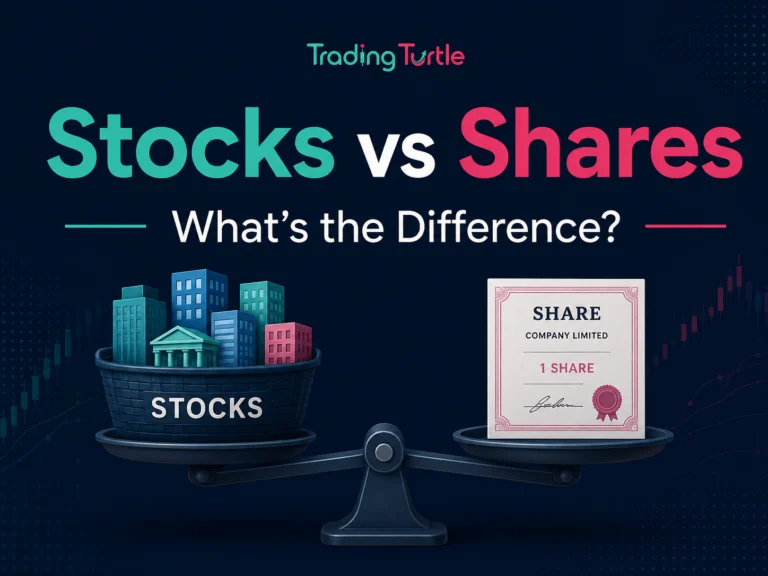
“Stock” is often used as a broad term for ownership in companies, while a “share” is a specific unit of ownership in a particular company. In everyday conversation, the words are frequently used interchangeably.
Stock-market participation involves uncertainty and losses are possible, but investing or trading based on research, defined risk and a clear process is different from games of chance. Speculative behaviour, unverified tips and oversized leverage can make market participation resemble gambling-like risk-taking.
NSE and BSE are major recognised stock exchanges in India. They provide trading venues for listed securities and publish market information and investor resources.
Yes. Share prices can fall, companies can underperform, and selling costs or poor execution can affect returns. No investment or trading approach can eliminate risk completely.