What Is Blockchain? A Beginner’s Guide to Distributed Ledger Technology

What is blockchain in simple terms?
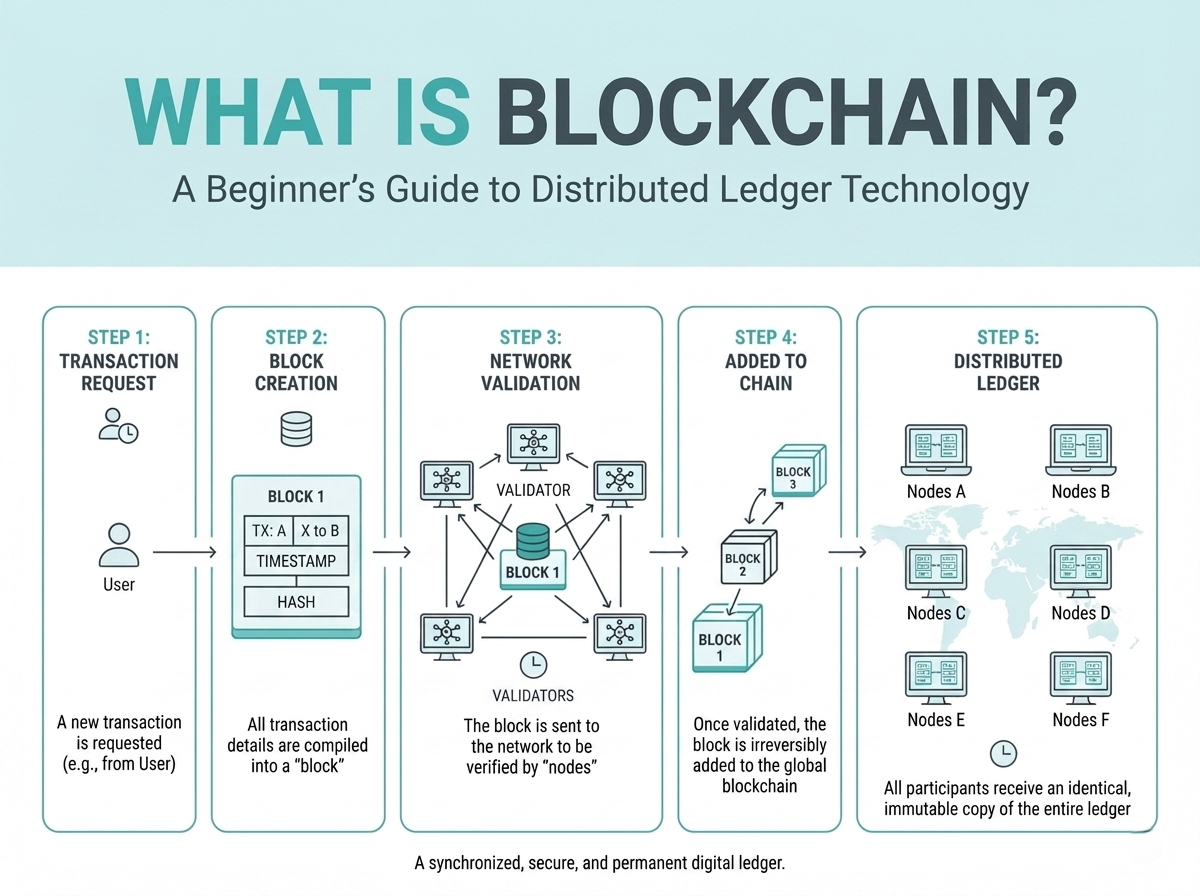
What is blockchain? At its simplest, blockchain is a shared digital record that stores information in a sequence of connected blocks.
Instead of relying on one central database controlled by a single organisation, a blockchain network may distribute copies of the record across many participating computers. These computers use agreed rules to check new information and determine which updates should be accepted.
A blockchain can record:
- Cryptocurrency transactions.
- Token ownership.
- Smart-contract activity.
- Digital certificates.
- Supply-chain events.
- Identity credentials.
- Asset transfers.
- Other forms of digital data.
NIST defines blockchain as a distributed digital ledger of cryptographically signed transactions grouped into blocks. Each block is linked to the previous block, and new blocks are added after validation and a consensus decision.
The word “blockchain” combines two ideas:
- A block is a group of records or transactions.
- A chain is the cryptographic link connecting one block to the next.
This structure creates a chronological record that is designed to be tamper-evident and resistant to unauthorised alteration.
Education-only disclaimer: This article is for general educational purposes only. It is intended for general education and is not investment, financial, legal, tax, technology-procurement, or cybersecurity advice. Blockchain projects and digital assets involve technical, operational, financial, and regulatory risks.
How does blockchain technology work?
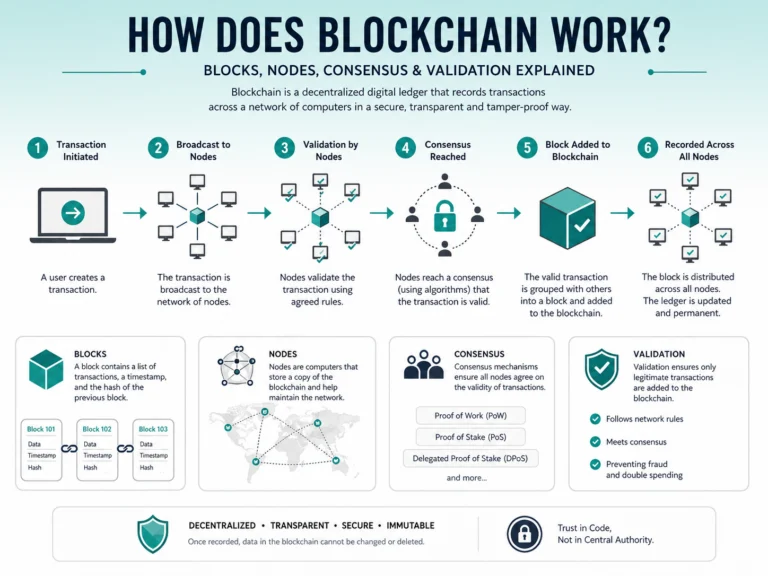
To understand what is blockchain, it helps to follow a simplified transaction from beginning to end.
A user creates a transaction
A transaction may represent a transfer of cryptocurrency, the creation of a token, or an interaction with a smart contract.
The user’s wallet or application prepares the transaction and may include details such as:
- Sender or initiating address.
- Recipient or contract address.
- Asset and amount.
- Network fee.
- Additional instructions.
- Digital signature.
The transaction is signed
The user authorises the transaction with a private key or another approved cryptographic method. A digital signature allows the network to verify that the transaction was authorised without exposing the private key itself.
The security of the private key is therefore essential. If an attacker obtains it, the attacker may be able to authorise transactions from the associated address.
The transaction is broadcast
The signed transaction is sent to nodes on the relevant blockchain network. Nodes receive the transaction and check whether it follows the network’s rules.
A transaction may be rejected if:
- The signature is invalid.
- The sender does not have sufficient funds.
- The format is incorrect.
- The transaction attempts to spend the same funds twice.
- Required fees or conditions are missing.
- A smart contract rejects the request.
Valid transactions are grouped into a block
Transactions that pass the initial checks may be grouped into a proposed block. The network then uses its consensus process to determine whether the block should be accepted.
The precise process differs between networks. Some use proof of work, some use proof of stake, and others use different forms of validator or authority-based coordination.
The block is added to the chain
After consensus, the accepted block is added to the existing blockchain. A cryptographic link connects it to the previous block.
As additional blocks are added, the historical record becomes increasingly difficult to change without detection or without controlling a significant part of the relevant network process.
The main parts of a blockchain
A blockchain system usually contains several technical components.
| Component | Role |
|---|---|
| Transaction | A signed instruction or record submitted to the network |
| Block | A group of accepted transactions or data |
| Hash | A unique-looking digital output created from data |
| Ledger | The recorded history maintained by the network |
| Node | A computer that stores data and checks network rules |
| Validator or miner | A participant involved in confirming and publishing blocks |
| Consensus mechanism | The process used to agree on valid ledger updates |
| Wallet | Software or hardware used to manage keys and sign transactions |
| Smart contract | Code deployed to a blockchain that executes according to defined rules |
These components explain what is blockchain from a technical perspective. Blockchain is not one single product or database. It is a combination of software, cryptography, network participants, data structures, and governance rules.
What is a block?
A block is a group of records added to a blockchain at a particular point in the network’s history.
A block may contain:
- Transactions.
- A timestamp or time-related field.
- A reference to the previous block.
- A block hash.
- Data related to the consensus mechanism.
- Network-specific metadata.
What is a hash?
A hash is the output of a mathematical function applied to data. A small change in the input may produce a different hash.
When blocks include references to earlier blocks, changing an old transaction can affect the hash of that block and the links to later blocks. This does not make alteration mathematically impossible, but it makes unauthorised changes easier to detect and potentially more difficult to complete.
A hash does not prove that the underlying information is true. It helps show whether the recorded data has changed.
For example, if a blockchain records that a shipment was approved, the blockchain can help preserve that record. It cannot independently confirm that the shipment physically existed unless reliable information was entered into the system in the first place.
What is a blockchain network?
A blockchain network is the collection of computers, software, users, validators, miners, applications, and governance processes that maintain and use a particular blockchain.
Different networks can have very different designs. They may differ in:
- Transaction speed.
- Fees.
- Privacy.
- Energy use.
- Validator requirements.
- Governance.
- Block size.
- Finality model.
- Smart-contract functionality.
- Degree of decentralisation.
- Recovery and upgrade procedures.
NIST explains that a blockchain network maintains copies of the ledger across nodes and adds new blocks according to established validation and consensus rules.
This means there is no single definition of a “blockchain network” that applies equally to every project. The network’s rules determine how transactions are processed and how changes are approved.
Mainnet and testnet
A mainnet is the operational network where real assets and transactions are recorded.
A testnet is an environment used for experimentation, development, or testing. Testnet assets generally do not have the same economic value as mainnet assets.
Beginners should confirm which network they are using before sending assets. Sending a token through the wrong network can result in delays, unsupported deposits, or permanent loss.
Nodes, validation, and consensus
What are nodes?
A node is a computer running the software needed to participate in a blockchain network. The role of a node depends on the network and node type.
A node may:
- Receive transactions.
- Verify signatures.
- Check balances and rules.
- Store a copy of the ledger.
- Relay information to other nodes.
- Validate proposed blocks.
- Help applications query blockchain data.
A full node may store a substantial history of the blockchain and independently verify transactions according to the protocol.
What is consensus?
Consensus is the process through which network participants agree on which transactions and blocks should be accepted.
Without consensus, different nodes could maintain conflicting records. A consensus mechanism helps establish the order of transactions and the current state of the ledger.
Proof of work
Proof of work uses computational effort to help select which participant can propose the next block. Miners compete according to the network’s rules, and the process may require significant electricity and specialised hardware.
Proof of stake
Proof of stake uses validators who commit or stake assets according to the network’s rules. Validators may be selected to propose or confirm blocks, and the protocol may impose rewards or penalties.
Proof of authority and other models
Some networks rely on approved validators or organisations. Other systems use delegated, federated, or hybrid approaches.
The choice of consensus model affects security assumptions, participation, governance, speed, cost, and decentralisation. One model is not automatically best for every application.
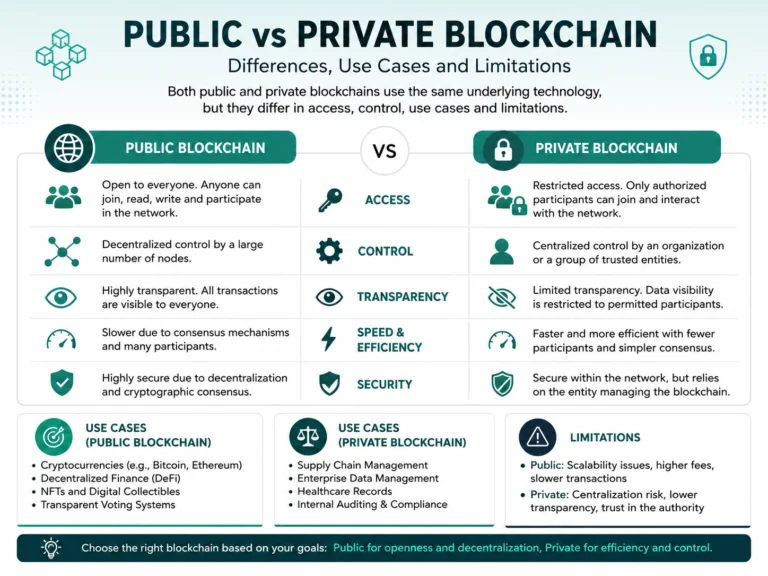
Public and private blockchains
A major way to classify blockchain technology is by who can participate and who can view or validate data.
Public blockchains
A public blockchain generally allows broad participation. Depending on the network, users may be able to inspect transactions, run nodes, submit transactions, or participate in validation.
Public networks can provide transparency and open access, but they may face:
- Scaling limitations.
- Variable transaction fees.
- Privacy challenges.
- Governance disputes.
- Regulatory uncertainty.
- Congestion during high demand.
Private blockchains
A private blockchain restricts participation to approved organisations or users. A central operator or consortium may control access, validation, and governance.
Private systems may provide:
- Greater control over participants.
- More predictable performance.
- Selective data access.
- Easier governance.
- Integration with existing business systems.
However, a private blockchain may provide fewer decentralisation benefits because a smaller group controls the network.
Permissioned and permissionless networks
A permissionless blockchain generally allows users to participate without receiving approval from a central administrator, subject to software rules.
A permissioned blockchain requires approval for certain activities, such as validating blocks or accessing records.
The labels can overlap. A network may be public for reading data but permissioned for validation.
Blockchain and cryptocurrency
Blockchain and cryptocurrency are related but not identical.
Cryptocurrency is a type of digital asset that can use blockchain technology to record transactions and control. Blockchain is the broader technology that supports distributed records and programmable data.
A blockchain can support:
- Cryptocurrency.
- Stablecoins.
- Utility tokens.
- Governance tokens.
- Non-fungible tokens.
- Smart contracts.
- Digital identity.
- Supply-chain records.
- Asset-tokenisation systems.
Similarly, not every digital asset has exactly the same technical or legal structure. Some assets may use distributed ledger technology without operating as an independent cryptocurrency.
The CFTC describes digital assets as a broad category that can use distributed ledger technology and support different applications, including ownership, transaction tracking, identity management, and smart contracts.
Smart contracts and blockchain applications
A smart contract is code deployed on a blockchain that can execute according to defined rules. It may hold assets, verify conditions, calculate outcomes, or interact with other contracts.
Examples of smart-contract functions include:
- Exchanging tokens.
- Issuing digital assets.
- Managing lending or collateral rules.
- Recording ownership.
- Distributing rewards.
- Supporting decentralised applications.
- Automating settlement conditions.
A smart contract is not necessarily an intelligent or legally enforceable contract. It is software that performs programmed actions when the network processes the relevant instructions.
The CFTC describes smart contracts as code that can be stored and executed on a distributed ledger maintained across network nodes.
Smart-contract risks
Smart-contract applications may contain:
- Coding errors.
- Exploitable logic.
- Faulty price oracles.
- Privilege controls.
- Upgrade risks.
- Governance weaknesses.
- Unintended interactions with other contracts.
Blockchain validation can confirm that a contract call followed the code. It cannot prove that the code is safe, fair, or suitable for every user.
Benefits and limitations of blockchain
Potential benefits
Blockchain systems may provide:
- Shared records between multiple participants.
- Transparent transaction histories.
- Reduced dependence on a central database.
- Programmable asset transfers.
- Automated settlement rules.
- Auditability of recorded events.
- Resistance to unauthorised record changes.
- Digital ownership and tokenisation mechanisms.
The usefulness depends on the problem being solved. Adding blockchain to a process does not automatically make it cheaper, faster, more private, or more secure.
Important limitations
Blockchain systems can also involve:
- Network congestion.
- Variable fees.
- Limited throughput.
- Irreversible transactions.
- Key-management risk.
- Smart-contract vulnerabilities.
- Privacy concerns.
- Governance disputes.
- Dependence on external data.
- Regulatory and legal uncertainty.
- Difficulty correcting inaccurate information.
A blockchain may be tamper-evident without being error-proof. If incorrect information is entered, the system may preserve the error effectively.
How blockchain differs from a traditional database
A traditional database is often controlled by one organisation that can update, correct, delete, or restrict records according to its policies.
A blockchain generally distributes records across network participants and applies protocol rules to transaction validation and updates.
| Feature | Traditional database | Blockchain |
|---|---|---|
| Control | Often centralised | Distributed or shared, depending on design |
| Record updates | Administrator or authorised users | Network rules and consensus |
| Data changes | May be edited or deleted | Often designed to be tamper-evident |
| Transparency | Controlled by the operator | May be publicly or selectively visible |
| Performance | Often highly efficient | Can involve consensus and network overhead |
| Recovery | Central administrator may restore data | Recovery depends on keys, backups, and protocol design |
Neither model is automatically superior. The choice depends on the application, participants, trust assumptions, performance requirements, and regulatory environment.
Key takeaways
- What is blockchain? Blockchain is a distributed digital ledger that records cryptographically signed data in linked blocks.
- Copies of the ledger may be maintained across multiple network nodes rather than in one central database.
- Hashes, digital signatures, validation, and consensus work together to make blockchain records tamper-evident.
- Blockchain is broader than cryptocurrency; it can support digital assets, smart contracts, identity systems, records, and other applications.
- A blockchain can preserve a record accurately, but it cannot guarantee that the recorded information is truthful or that a project is safe.
- Different blockchain networks vary in governance, speed, privacy, cost, security, decentralisation, and use cases.
– Frequently Asked Questions (FAQs)
Blockchain can be used for cryptocurrency transactions, token issuance, smart contracts, digital identity, supply-chain records, asset tracking, certificates, and other applications requiring shared or programmable records.
Not always. The degree of decentralisation depends on who operates nodes, validates transactions, controls upgrades, holds voting power, and manages infrastructure.
No. A hardware wallet may reduce some online threats, but it cannot prevent seed-phrase theft, phishing, malicious transaction approval, physical loss, or incorrect transfers.
Blockchain records are generally designed to be tamper-evident and resistant to unauthorised changes. However, network reorganisations, governance decisions, upgrades, vulnerabilities, or administrative controls can affect how records are handled.
Not necessarily. Many public blockchains make transaction data visible to anyone who can inspect the ledger. An address may not directly display a person’s name, but activity may be analysed or linked to identity through other information.
No. Blockchain can help preserve data after it is recorded, but it cannot independently verify whether the original information was truthful or complete.
Blockchain technology has useful security properties, but safety depends on the network design, code, governance, key management, applications, and users. Wallet theft, smart-contract bugs, fraud, and operational failures remain possible.