How Does Blockchain Work? Blocks, Nodes, Consensus and Validation Explained

How blockchain works in simple terms
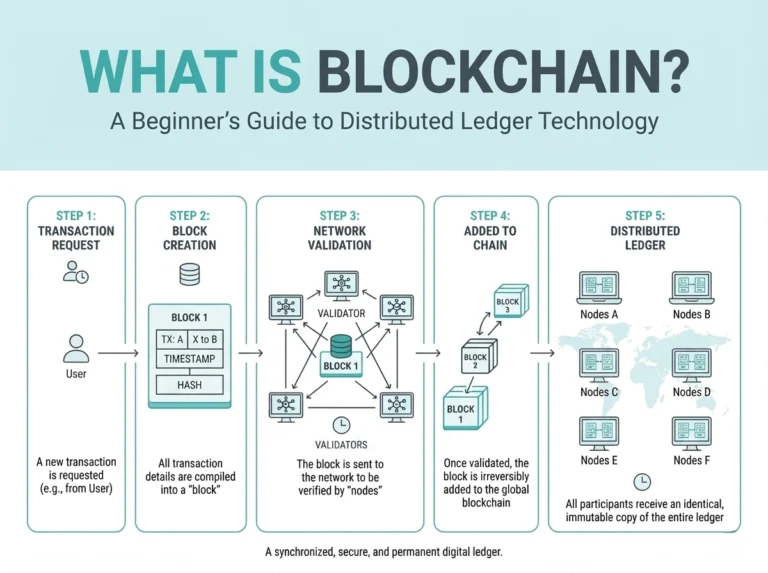
To understand how blockchain works, imagine a shared digital ledger that is copied across a network of computers.
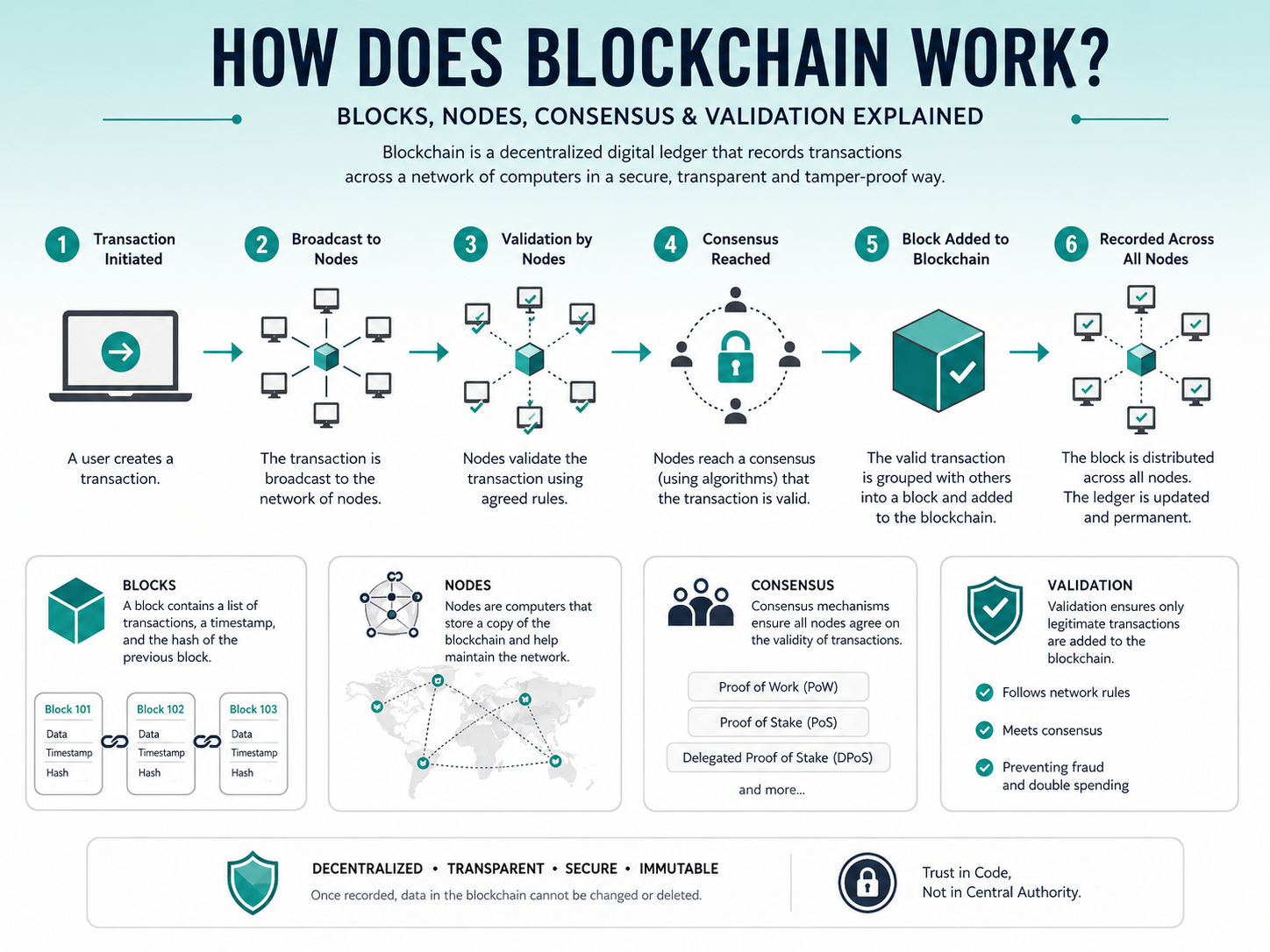
When a user submits a transaction, the network does not immediately treat it as final. The transaction is first broadcast to participating nodes. Those nodes check whether it follows the rules, including whether the digital signature is valid and whether the sender has the necessary balance or authority.
Valid transactions are then grouped into a block. A miner, validator, or other authorised participant proposes the block according to the network’s design. The network’s consensus mechanism determines whether the block should be accepted.
Once accepted, the block is added to the chain of earlier blocks. Copies of the updated ledger are then distributed or synchronised across participating nodes.
NIST describes a blockchain as a sequence of cryptographically linked records, together with validity conditions, block-creation procedures, and consensus algorithms for resolving conflicts.
In simplified form, how blockchain works involves:
- A user creates a transaction.
- The transaction is digitally signed.
- Nodes receive and check the transaction.
- Valid transactions are grouped into a block.
- A consensus process selects or approves the block.
- The block is linked to previous blocks.
- The updated ledger is replicated across the network.
The details vary between blockchains, but this general flow applies to many distributed ledger systems.
Education-only disclaimer: This article is for general educational purposes only. It is intended for general education and is not investment, financial, legal, tax, technology-procurement, or cybersecurity advice. Blockchain networks and digital assets involve technical, operational, financial, and regulatory risks.
The main components of a blockchain
Transactions
A transaction is a signed instruction or record submitted to a blockchain. It may transfer crypto assets, create a token, call a smart contract, or update a digital record.
Blocks
A block is a group of transactions or other data accepted by the network. Blocks usually contain information that connects them to the preceding block.
Hashes
A hash is a digital output produced from input data. If the input changes, the resulting hash usually changes as well. Blockchains use hashes to connect records and detect unauthorised changes.
Nodes
Nodes are computers that run blockchain software. They may store ledger data, validate transactions, relay information, and verify proposed blocks.
Miners and validators
Miners or validators are network participants involved in proposing or confirming blocks. Their role depends on the consensus model.
Consensus mechanism
A consensus mechanism helps participating nodes agree on the accepted state of the ledger. It defines who can propose blocks, how blocks are confirmed, and how conflicts are resolved.
Wallets and private keys
Wallets manage the private keys used to sign transactions. The blockchain records the transaction, while the wallet helps the user authorise it.
How a blockchain transaction moves through the network
The following example explains how blockchain works when a user sends a crypto asset.
Step 1: The user creates a transaction
The sender enters the recipient address, asset amount, network, and any required fee through a wallet or application.
The user must confirm that the address and network are correct. A blockchain generally cannot determine whether the recipient is the person the sender intended to contact.
Step 2: The transaction is digitally signed
The wallet uses the sender’s private key to create a digital signature. The signature proves that the transaction was authorised by the holder of the relevant key without exposing the private key.
A valid signature does not prove that the transaction is wise, fair, or free from fraud. It only helps demonstrate cryptographic authorisation.
Step 3: The transaction is broadcast
The signed transaction is sent to nodes on the blockchain network. Nodes may relay it to other nodes so that the network can process it.
At this stage, the transaction may be described as pending or unconfirmed.
Step 4: Nodes validate the transaction
Nodes check whether the transaction complies with the network’s rules. Depending on the blockchain, they may verify:
- The digital signature.
- The sender’s available balance.
- The transaction format.
- The network fee.
- Whether the same funds have already been spent.
- Smart-contract conditions.
- Any timing or sequence requirements.
If the transaction fails validation, nodes may reject it and decline to include it in a block.
Step 5: The transaction enters a waiting pool
Valid transactions may wait in a pool until a miner, validator, or authorised block producer includes them in a block.
The waiting time depends on network congestion, fee levels, block capacity, and the blockchain’s design.
Step 6: A block is proposed
A block producer selects transactions and creates a proposed block. The block usually contains a reference to the previous block and a summary of the transactions it includes.
Step 7: The network reaches consensus
The consensus process determines whether the proposed block meets the network’s requirements. If accepted, nodes add the block to their local copy of the ledger.
Step 8: The block receives confirmations
As subsequent blocks are added, the transaction receives additional confirmations. The practical meaning of finality depends on the blockchain’s consensus model and the policy of the receiving platform.
How blocks are created
A block is not simply a folder into which someone can insert any information. It must satisfy the blockchain’s structural and validation rules.
A typical block may contain:
- A list of transactions.
- A reference to the previous block.
- A timestamp or time-related value.
- A block hash.
- A transaction summary or Merkle root.
- Consensus-related information.
- Other network-specific metadata.
Hash-linked records
Each block contains a cryptographic reference to the previous block. If a past transaction is altered, the hash of that block changes. That change affects the references linking later blocks.
NIST explains that when data in an earlier block changes, the cryptographic link also changes, making the alteration detectable in later blocks. As more blocks are added, older records become more difficult to modify.
This is one of the central principles of how blockchain works: the chain structure creates evidence of tampering.
Merkle trees
Many blockchains summarise the transactions in a block using a Merkle tree. A Merkle tree combines transaction hashes into a single root value.
This structure allows a system to verify that a particular transaction belongs to a block without requiring every transaction to be transmitted for every verification request.
The exact implementation varies, but the general purpose is efficient integrity checking.
How blockchain validation works
Blockchain validation occurs at multiple levels.
Transaction validation
At the transaction level, nodes check whether the instruction is authorised and technically valid.
For example, a blockchain may reject a transaction if the signature is incorrect or the sender does not control enough funds.
Block validation
At the block level, nodes check whether:
- The block was proposed by an eligible participant.
- The transactions inside it are valid.
- The block references the correct previous block.
- The block follows size and formatting rules.
- Consensus-related conditions are satisfied.
- The block does not violate the network’s protocol.
State validation
Some blockchains maintain a current state that includes balances, smart-contract data, or account information. Nodes validate whether a new block correctly changes that state.
NIST notes that token transactions can be validated, placed into blocks, and published to the ledger by blockchain nodes.
Validation is not the same as human review. The network checks whether the transaction follows code-based rules. It does not determine whether the user was deceived or whether an application is legitimate.
What consensus mechanisms do
Consensus mechanisms are the rules and procedures used to agree on the accepted ledger state.
A blockchain may have many nodes operating independently. They may receive transactions at different times or temporarily see different proposed blocks. Consensus helps the network resolve those differences.
A consensus mechanism may determine:
- Who can propose a block.
- How a block is selected.
- How other nodes confirm it.
- What happens if two blocks compete.
- How dishonest behaviour is discouraged.
- When a transaction is considered final.
NIST identifies consensus as a way to resolve conflicts among blockchain nodes and establish agreement about the network’s state.
Consensus does not mean every participant personally agrees with every transaction. It means the network follows a defined process for determining which valid record becomes part of the accepted ledger.
Proof of work and proof of stake
Proof of work
Proof of work uses computational effort to select or authorise block production. Miners compete according to the network’s rules, and the winning participant may receive a reward.
The security model depends partly on the cost of performing the required computation and the difficulty of rewriting accepted history.
Proof of work may involve:
- Mining hardware.
- Electricity consumption.
- Block rewards.
- Transaction fees.
- Difficulty adjustments.
- Competition among miners.
The presence of proof of work does not guarantee that the asset associated with the blockchain will increase in value or that users will avoid losses.
Proof of stake
Proof of stake uses validators who commit or stake assets according to the network’s rules. The protocol may select validators to propose and confirm blocks.
Proof-of-stake systems may include:
- Validator deposits.
- Delegation.
- Staking rewards.
- Penalties for certain behaviour.
- Slashing or loss of stake.
- Validator-performance requirements.
The exact rules differ significantly between networks. Some use additional committees, random selection, voting, or finality mechanisms.
Comparing the two
| Feature | Proof of work | Proof of stake |
|---|---|---|
| Main participant | Miner | Validator |
| Primary resource | Computational work and energy | Staked or committed assets |
| Block selection | Based on protocol-specific computational competition | Based on protocol-specific validator selection |
| Main security assumption | Cost and distribution of computational power | Distribution and behaviour of staked participation |
| Potential concerns | Energy use, hardware concentration, mining concentration | Stake concentration, governance, validator coordination |
Neither method is universally superior. The appropriate design depends on the network’s objectives, participants, security assumptions, and governance.
Confirmations and finality
A transaction is often described as confirmed when it is included in an accepted block. Additional blocks may provide further confirmations.
The relationship between confirmations and finality depends on the network.
Probabilistic finality
In some systems, the chance of a transaction being reversed decreases as more blocks are added. The transaction becomes increasingly difficult to replace or reorganise.
Deterministic or economic finality
Other systems use a consensus process that provides stronger finality after validators reach a specified agreement. The precise definition depends on the protocol.
Users should not assume that one confirmation has the same meaning across every blockchain. Exchanges, wallets, and payment providers may require different numbers of confirmations before crediting a deposit.
Smart contracts and blockchain applications
Smart contracts are programmes stored or executed on a blockchain. They can apply predefined rules when users or other contracts submit transactions.
A smart contract may:
- Transfer tokens.
- Manage lending conditions.
- Issue NFTs.
- Operate an automated exchange.
- Record voting results.
- Hold collateral.
- Control access to an application.
Understanding how blockchain works also requires understanding that smart contracts depend on the network’s execution environment. A contract’s outcome may be deterministic according to its code, but the code can contain errors or unintended behaviour.
Smart-contract risks may include:
- Coding vulnerabilities.
- Faulty permissions.
- Incorrect price data.
- Upgrade controls.
- Admin-key compromise.
- Congestion and high fees.
- Interactions with unsafe contracts.
A blockchain confirms that the code executed according to the network’s rules. It does not certify that the code was written correctly.
Blockchain network upgrades and governance
Blockchain networks are software systems. Their rules may change through upgrades, proposals, validator decisions, token-holder voting, or decisions by a development team or consortium.
Governance can affect:
- Transaction fees.
- Block parameters.
- Validator requirements.
- Smart-contract standards.
- Monetary supply.
- Network compatibility.
- Emergency responses.
- Privacy and compliance features.
The more centralised the development or validation process, the more influence a smaller group may have over changes. The more open the process, the more difficult coordination and upgrades may become.
A user evaluating a blockchain should therefore study not only its technical architecture but also who can change the rules.
Limitations and common misconceptions
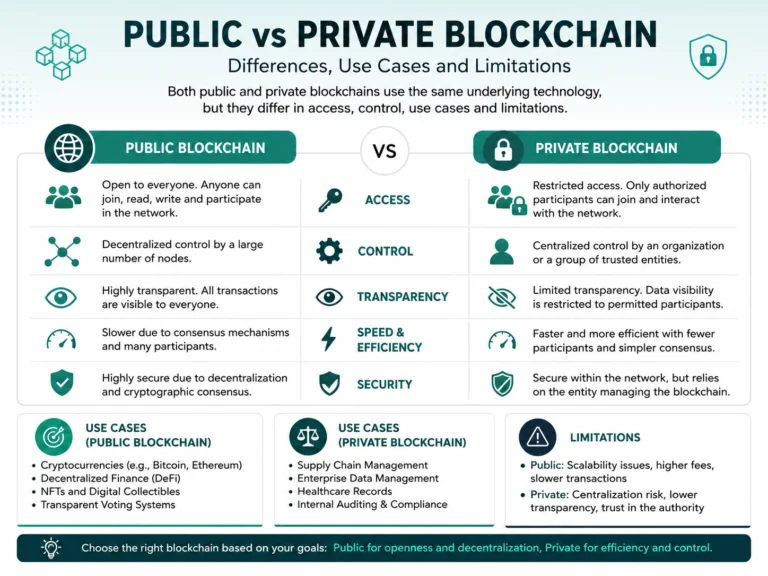
Blockchain is not automatically decentralised
A blockchain can use distributed technology while still relying heavily on a small group of developers, validators, cloud providers, or token holders.
Blockchain is not automatically private
Many public blockchains make transaction data visible. Addresses may not display names directly, but activity can sometimes be linked to individuals or organisations.
Blockchain is not automatically immutable
“Immutable” is often used as shorthand for tamper resistance. In practice, records may be affected by reorganisations, upgrades, governance decisions, bugs, or administrative controls.
Blockchain does not verify the real world
If incorrect information enters the ledger, blockchain may preserve it accurately. External data requires trusted input systems, often called oracles.
Blockchain does not eliminate intermediaries in every case
Users may still rely on exchanges, custodians, wallet providers, validators, bridge operators, oracle providers, and application developers.
Key takeaways
- How blockchain works can be understood through five core processes: transaction creation, verification, block formation, consensus, and ledger replication.
- A blockchain groups records into blocks and links those blocks using cryptographic references.
- Nodes verify transactions and blocks according to the rules of a particular blockchain network.
- Consensus mechanisms help network participants agree on the accepted version of the ledger.
- Proof of work and proof of stake are different approaches to block production and network coordination.
- Blockchain records are designed to be tamper-evident, but blockchain does not guarantee that recorded information is accurate or that an application is safe.
– Frequently Asked Questions (FAQs)
Blockchain works by allowing a network to validate signed records, group them into linked blocks, reach consensus about accepted updates, and replicate the ledger across participating nodes.
Nodes verify transactions according to the rules of the relevant blockchain. Miners, validators, or other block producers then participate in adding valid transactions to the ledger.
A confirmed transaction is generally designed to be difficult to alter, but the exact level of resistance depends on the network’s consensus model, distribution, governance, and security.
The blockchain’s consensus and chain-selection rules determine which block becomes part of the accepted history. The competing block may become stale or be rejected according to the network’s design.
Neither is automatically safer for every use case. Each model has different security assumptions, economic incentives, centralisation concerns, and technical risks.
No. Some blockchain networks use native crypto assets to pay fees or secure the network, but distributed ledger systems can also be designed for enterprise, identity, recordkeeping, or permissioned applications.