What Are Stocks? Meaning, How They Work, Types and Risks

What Are Stocks?
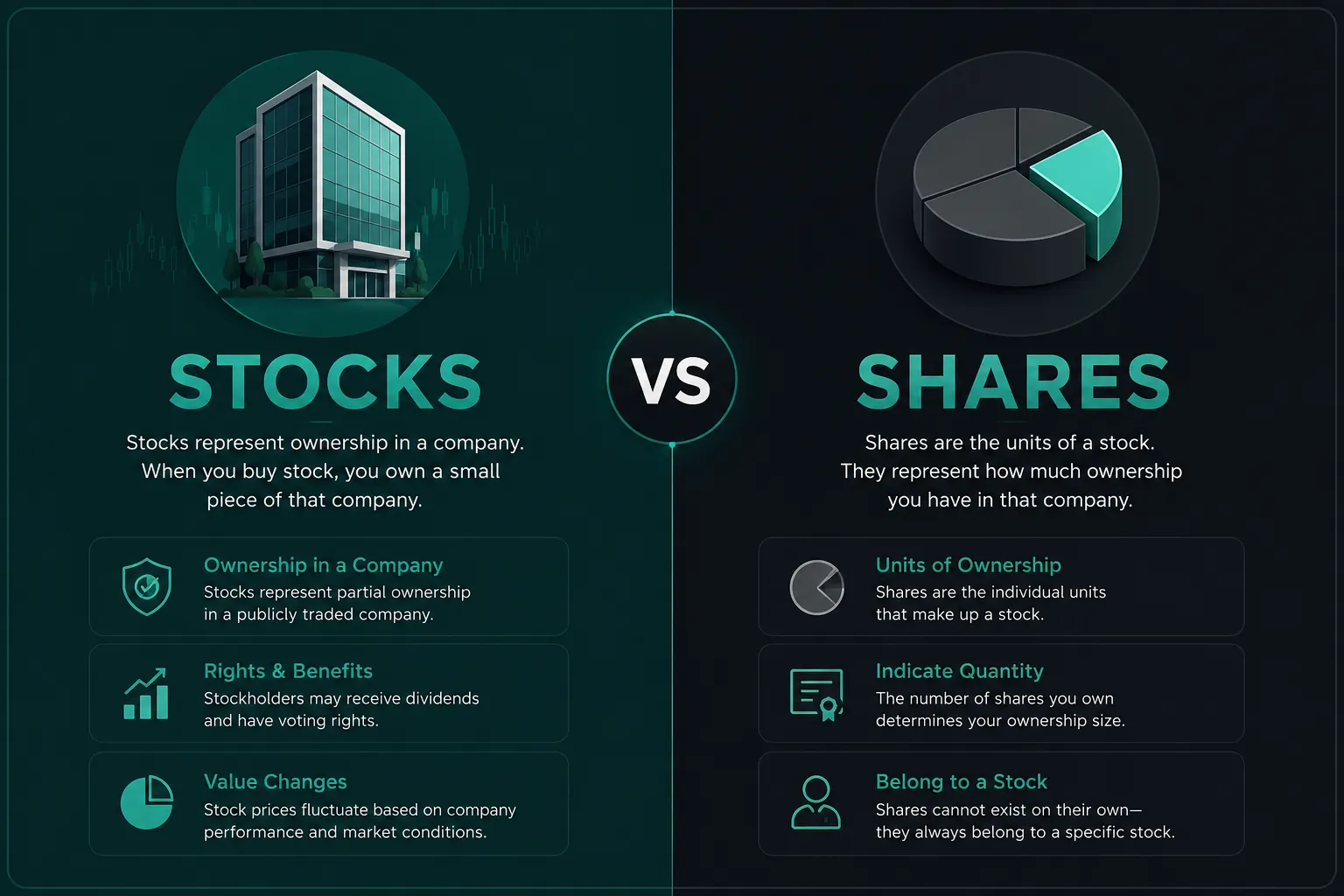
Stocks are units of ownership in a company. When you buy a stock, you buy a small ownership stake in that business, which is also called a share.
For example, if a company has 10 lakh total shares and you own 1,000 shares, you own a small percentage of that company. Your ownership does not mean you control daily business decisions, but it may give you certain shareholder rights depending on the type of stock.
The simple shares meaning is this: a share represents a portion of a company’s ownership. Companies issue shares to raise capital for activities such as expanding operations, developing products, repaying debt, or entering new markets. SEBI describes shares as instruments issued by companies to raise funds from investors for business activity.
A stock can increase or decrease in value based on company performance, investor expectations, economic conditions, industry trends, interest rates, and broader market sentiment. That is why stocks can create opportunities for long-term wealth creation but also carry real financial risk.
Educational disclaimer: This article is for educational purposes only and is not investment advice. Stock prices can rise or fall, and past performance does not guarantee future results.
How Do Stocks Work?
To understand what are stocks, think of a business as a large pizza.
A company can divide that pizza into millions or billions of small pieces. Each piece is a share. When you buy one or more shares, you own a very small part of the company.
If the company grows, earns more money, launches successful products, or attracts more investors, demand for its shares may increase. Higher demand can push the share price higher. If the company performs poorly or investors expect weaker future results, the share price may fall.
| Company event | Possible effect on stock price |
|---|---|
| Revenue and profit growth | May support investor confidence |
| Strong product launch | May increase growth expectations |
| Rising debt or weak earnings | May reduce investor confidence |
| Industry slowdown | May put pressure on valuations |
| Broad market decline | May affect even fundamentally strong companies |
| Dividend announcement | May attract income-focused investors |
Stock prices are not based only on current profits. They also reflect what investors believe a company may earn in the future. This is why a profitable company can still see its stock price fall after results if investors expected even stronger performance.
Example: Ownership Through Shares
Imagine a fictional company called Turtle Technologies.
- Total shares issued: 10,00,000
- Shares you buy: 1,000
- Your ownership: 0.1%
Your ownership percentage is calculated as:
In this example:
10,00,0001,000×100=0.1%
Even though 0.1% is a small stake, you are still a shareholder. Depending on the share class and applicable company rules, you may receive voting rights and may be eligible for dividends if the company declares them.
Learn ore BAout Share: SEBI Investor: Understanding Shares
Why Do Companies Issue Stocks?
Companies issue stocks primarily to raise money from investors.
Instead of borrowing all capital through loans, a company may sell ownership stakes to the public. This lets it obtain funds without creating the same repayment obligation as a conventional loan.
A company may use the money raised from stock issuance to:
- Build new factories or offices.
- Expand into new cities or countries.
- Hire employees.
- Develop technology or products.
- Acquire another business.
- Reduce existing debt.
- Strengthen working capital.
The first time a company offers shares to public investors is commonly known as an initial public offering, or IPO. After the IPO, investors can buy and sell those shares in the secondary market through stock exchanges.
SEBI distinguishes between the primary market, where new securities are offered to investors, and the secondary market, where investors trade securities with one another rather than directly with the issuing company.
Quick tip: Buying shares in an IPO generally sends money to the issuing company, while buying a listed share from another investor in the secondary market does not directly fund the company.
How Can Investors Earn From Stocks?
There are two main ways stock investors may potentially earn returns: capital appreciation and dividends.
Capital Appreciation
Capital appreciation occurs when you sell a stock for more than you paid.
Suppose you buy 10 shares at Rs. 100 each:
- Purchase amount: Rs. 1,000
- Later sale price: Rs. 130 per share
- Sale value: Rs. 1,300
- Gross gain before charges and taxes: Rs. 300
However, the reverse is equally possible. If the share price falls to Rs. 80, the value of your 10 shares becomes Rs. 800, creating an unrealized loss of Rs. 200 before charges and taxes.
Dividends
A dividend is a portion of company profits that a company may choose to distribute to shareholders.
Not every company pays dividends. A company can reduce, suspend, or avoid dividends altogether, even if it was paying them earlier. SEBI notes that dividends are not guaranteed and that the amount and timing of dividend payments can vary.
Companies focused on rapid growth may retain profits to reinvest in the business. More mature companies may distribute a portion of earnings as dividends, but this varies by business model, financial health, management decisions, and applicable regulations.
Types of Stocks
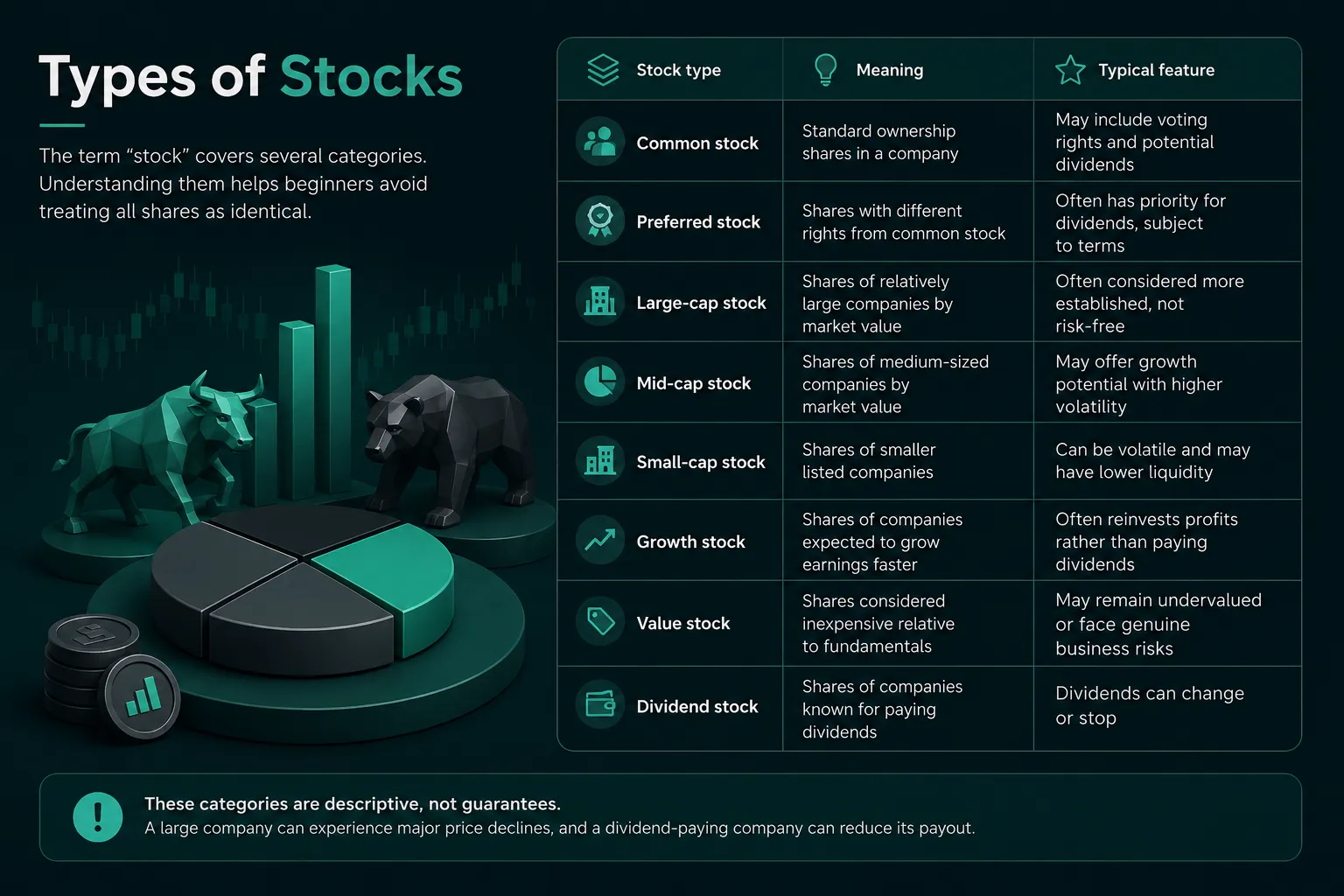
The term “stock” covers several categories. Understanding them helps beginners avoid treating all shares as identical.
| Stock type | Meaning | Typical feature |
|---|---|---|
| Common stock | Standard ownership shares in a company | May include voting rights and potential dividends |
| Preferred stock | Shares with different rights from common stock | Often has priority for dividends, subject to terms |
| Large-cap stock | Shares of relatively large companies by market value | Often considered more established, not risk-free |
| Mid-cap stock | Shares of medium-sized companies by market value | May offer growth potential with higher volatility |
| Small-cap stock | Shares of smaller listed companies | Can be volatile and may have lower liquidity |
| Growth stock | Shares of companies expected to grow earnings faster | Often reinvests profits rather than paying dividends |
| Value stock | Shares considered inexpensive relative to fundamentals | May remain undervalued or face genuine business risks |
| Dividend stock | Shares of companies known for paying dividends | Dividends can change or stop |
These categories are descriptive, not guarantees. A large company can experience major price declines, and a dividend-paying company can reduce its payout.
What Is the Difference Between Stocks and Shares?
People often use “stocks” and “shares” interchangeably, and in everyday investing conversations that is usually fine.
The practical difference is small:
- Stock often refers to ownership in one or more companies generally.
- Share usually refers to a specific unit of ownership in one company.
For example:
- “I invest in stocks” means you invest in the equity market.
- “I own 20 shares of Company A” means you own 20 units in that particular company.
The basic shares meaning remains the same: each share represents a fractional ownership interest in a company.
How Are Stock Prices Decided?
Stock prices are determined by buyers and sellers in the market.
If more investors want to buy a stock than sell it at a particular price, buyers may offer higher prices. If more investors want to sell than buy, sellers may need to accept lower prices.
This price discovery process is influenced by many factors:
- Company earnings and financial statements.
- Revenue growth and profit margins.
- Management guidance and future plans.
- Interest rates and inflation.
- Industry competition.
- Government policy and regulation.
- Global events.
- Investor sentiment.
- Liquidity and trading volume.
A stock price is therefore not a permanent label of business quality. It is a constantly changing market estimate shaped by available information and investor expectations.
How to Buy Stocks in India
To buy listed stocks in India, you generally need a demat account, a trading account, and a bank account.
| Requirement | Purpose |
|---|---|
| Demat account | Holds securities in electronic form |
| Trading account | Lets you place buy and sell orders |
| Bank account | Transfers money for trades and receives sale proceeds |
| KYC completion | Verifies identity under applicable regulations |
| SEBI-registered broker | Provides access to recognised exchanges |
SEBI explains that a demat account holds securities electronically, while a trading or broking account is used to buy and sell securities on stock exchanges. It also states that investors should use a SEBI-registered stock broker and maintain a bank account for payments and receipts related to securities transactions.
Before buying any stock, understand the company, the product you are buying, relevant charges, and your own risk tolerance. Avoid buying simply because of social-media tips, Telegram calls, viral videos, or a recent price rally.
Risks of Owning Stocks
Stocks can be useful for long-term investing, but they are not guaranteed-return products.
Market Risk
A broad market decline can affect many companies at once. Economic slowdowns, interest-rate changes, geopolitical events, or investor panic can cause prices to fall.
Company Risk
A single company may struggle because of lower sales, higher costs, debt problems, management issues, litigation, competition, or product failure.
Volatility Risk
Some shares move sharply in short periods. Small-cap stocks, low-liquidity shares, speculative stocks, and highly hyped themes can be especially volatile.
Liquidity Risk
A stock with low trading activity may be harder to sell quickly at a fair price. You may need to accept a lower price than expected when exiting.
Concentration Risk
Putting most of your money into one company or sector increases the damage if that investment performs poorly.
Risk reminder: Do not invest money in stocks that you may need soon for emergency expenses, rent, debt repayments, education, or essential family needs.
SEBI advises investors to understand risks before investing, understand applicable charges, keep account statements, and avoid sharing critical account information such as login credentials and passwords.
Common Beginner Mistakes
Buying Based Only on Tips
A “hot tip” does not replace research. The person giving the tip may have different financial goals, a different risk tolerance, incomplete information, or a conflict of interest.
Confusing Price With Value
A low-priced share is not automatically cheap. A Rs. 20 stock can be more expensive relative to its business fundamentals than a Rs. 2,000 stock.
Ignoring Charges and Taxes
Brokerage, exchange charges, statutory charges, taxes, and other costs can affect net returns. Understand the complete cost before trading frequently.
Investing Without Diversification
Buying shares in only one company or one sector exposes you to concentrated risk. Diversification does not remove risk, but it can reduce dependence on one investment outcome.
Using Borrowed Money to Buy Stocks
Borrowing to invest can increase pressure and magnify losses. Avoid using money meant for essential expenses or high-interest debt repayment.
Treating Stocks Like a Guaranteed Income Source
Stocks can generate gains, dividends, or losses. They should be part of a considered financial plan, not a shortcut to guaranteed wealth.
How Beginners Can Evaluate a Stock
Before buying shares, start with basic questions:
- What does the company sell or provide?
- How does it make money?
- Is its revenue growing, stable, or declining?
- Is the company profitable?
- Does it carry significant debt?
- Who are its competitors?
- What risks could hurt the business?
- Is the stock liquid enough for your needs?
- Does the investment fit your time horizon and risk tolerance?
- Have you checked official company filings and reliable sources?
You do not need to become an expert overnight. The goal is to avoid making decisions without understanding what you own.
Key Takeaways
- Stocks represent ownership in a company.
- A share is a unit of that ownership.
- Investors may earn through price appreciation or dividends, but neither is guaranteed.
- Stock prices move because of company performance, expectations, market conditions, and buyer-seller demand.
- Companies issue shares to raise capital for business activities.
- Stocks involve market, company, liquidity, volatility, and concentration risks.
- In India, investors generally need a demat account, trading account, bank account, and a SEBI-registered broker to buy listed securities.
- Research, diversification, risk management, and patience matter more than tips or hype.
– Frequently Asked Questions (FAQs)
Stocks are small ownership portions of a company. When you buy a stock, you become a shareholder in that business.
Yes. A stock can lose substantial value, and in extreme cases an investor can lose most or all of the amount invested in a company. Diversification and risk management can help reduce concentration risk but cannot eliminate market risk.
No. Dividends are optional. A company may pay, reduce, suspend, or avoid dividends depending on its finances and management decisions.
In normal conversation, yes. “Stock” commonly refers to company ownership generally, while “share” usually means a specific unit of ownership in one company.
Beginners can learn about stocks and invest only after understanding the risks, account requirements, fees, investment objectives, and suitable level of risk. Start with education and avoid acting on unverified tips.
Generally, yes. A demat account holds securities electronically, while a trading account is used to place buy and sell orders through a registered broker.