Stocks vs Shares: What’s the Difference? A Beginner’s Guide

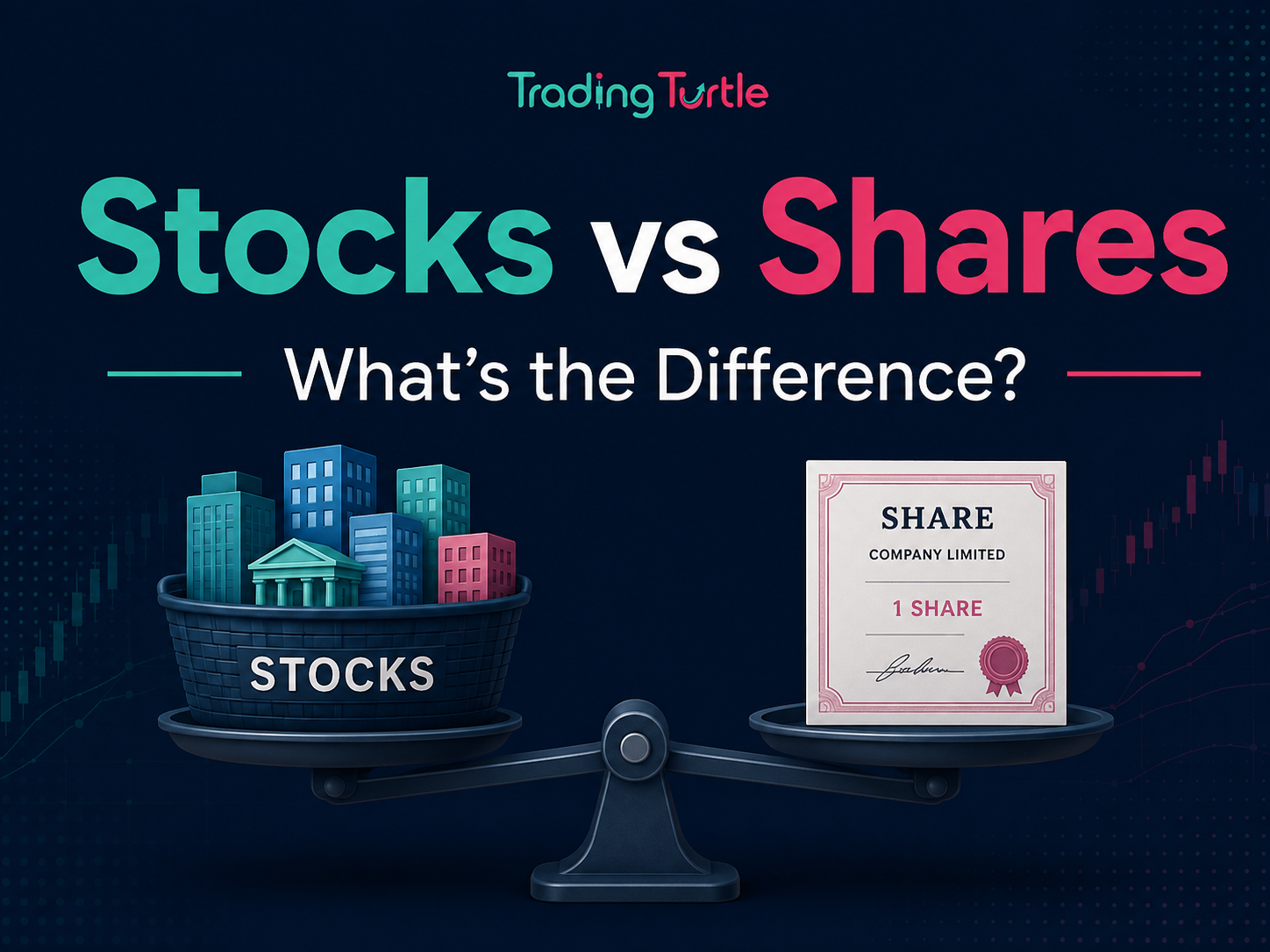
If you are new to the market, the difference between stocks vs shares can seem more complicated than it really is. Financial news may say an investor “owns stocks,” while a broker statement shows that the same investor holds 25 shares of a particular company.
Both expressions can be correct.
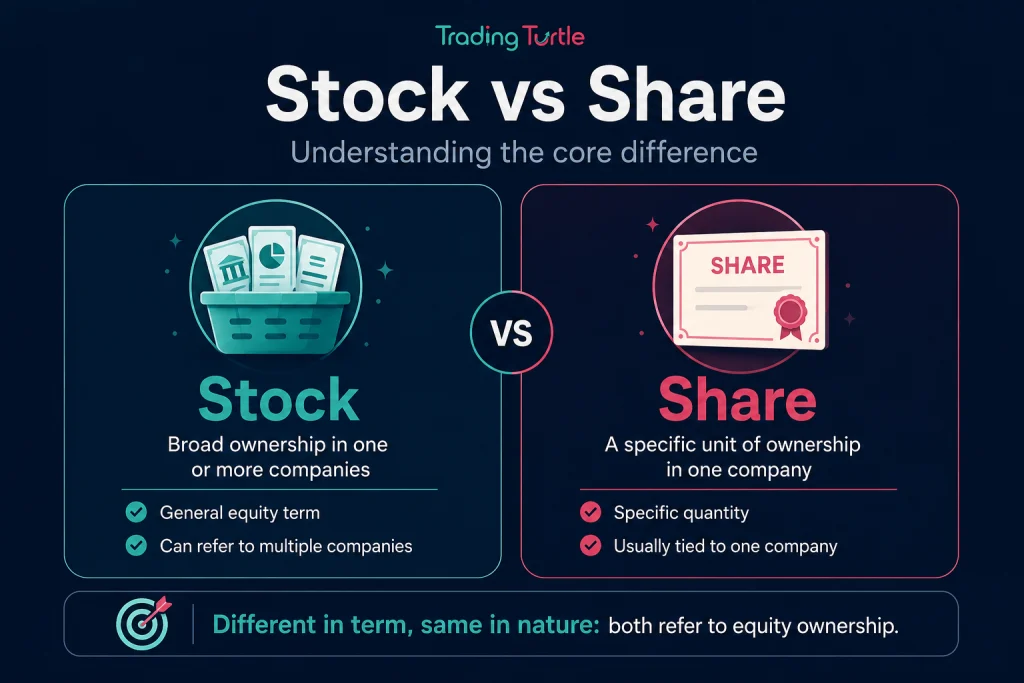
In everyday use, stock is the broader term for equity ownership, while a share is a specific unit of ownership in a particular company. In India, the two words are also used quite freely, so you will often hear “stock market,” “share market,” “stock price” and “share price” describing closely related ideas.
The useful part of understanding stocks vs shares is not memorising a textbook distinction. The value of learning stocks vs shares is that it clarifies what you actually own, how ownership is measured, and why the number of shares alone says very little about the size or risk of an investment.
Educational disclaimer: This article is for educational purposes only and does not provide investment advice, stock recommendations, trading signals or personalised financial guidance. Investing and trading involve risk, including the possibility of losing capital.
Stocks vs Shares at a Glance
The simplest way to remember the distinction is:
Stock describes equity ownership broadly.
Share describes a specific unit of that ownership.
For example, someone might say, “I invest in stocks,” when talking about several companies. The same person might say, “I own 20 shares of ABC Ltd.” when referring to one holding.
That is the core idea behind stocks vs shares. For beginners, stocks vs shares is best understood as a difference in precision rather than a difference in the underlying asset. The words overlap, but “share” is usually the more precise term when quantity matters.
| Term | Simple meaning | Example |
|---|---|---|
| Stock | Broad term for equity ownership | “I invest in stocks.” |
| Share | A specific unit of ownership | “I own 20 shares of ABC Ltd.” |
What Is a Stock?
A stock represents equity ownership in a company or in companies generally. The word is commonly used as a broad category rather than as a precise count.
If someone says, “My portfolio contains banking and technology stocks,” they are describing the kinds of companies they own. They are not telling you the exact number of units held in each business.
That broader use is one side of the stocks vs shares distinction.
Stocks are also different from many other financial assets because equity ownership gives the investor an economic interest in the company. SEBI’s investor-education material describes equity shares as representing ownership in a company and notes that listed shares can be traded on stock exchanges, where buyers and sellers contribute to liquidity and price discovery.
What Is a Share?
A share is one unit of a company’s equity.
Suppose a hypothetical company has 10 lakh shares outstanding. If an investor owns 100 of those shares, the investor owns a small fraction of the company’s equity.
This is where stocks vs shares becomes practical. “Stock” tells you the type of asset; “shares” can tell you how much of a particular company is held.
A share can rise or fall in market value, and owning one does not guarantee a dividend or a profit. NSE’s first-time investor guidance is explicit that stock-market returns are not guaranteed and that a company’s shares can lose substantial value.
Why Do People Use Stock and Share Interchangeably?
Because in normal conversation, the difference rarely changes what the speaker means.
An investor may say:
- “I bought a stock yesterday.”
- “I bought 10 shares yesterday.”
- “The stock price is rising.”
- “The share price is rising.”
All four sentences can make sense in context.
The distinction in stocks vs shares matters most when precision is useful. “Shares” is usually better when you are talking about a specific quantity, ownership percentage or transaction. “Stock” works naturally when speaking about equity investing more broadly.
This is also why share market and stock market are commonly used interchangeably in India. The terminology changes more than the underlying market.
Is the Share Market Different From the Stock Market?
For most beginner-level discussions, no. Both terms generally refer to the organised market where eligible company shares are bought and sold.
What matters is understanding how the share market works: investors typically access the market through a broker, orders are routed to an exchange, compatible buy and sell orders are matched, and completed transactions move through clearing and settlement.
NSE explains that its normal-market matching process pairs the best buy order with the best sell order using price-time priority.
So when you see “stock market” in one article and “share market” in another, do not assume they describe separate systems.
Does Owning a Share Mean You Own Part of the Company?
Yes. An equity share represents an ownership interest in the company, although the percentage can be extremely small.
Imagine a company has 1,00,000 outstanding shares and you own 100.
Your simplified ownership percentage would be:
100 ÷ 1,00,000 = 0.1%
If the company had 10 crore outstanding shares instead, the same 100-share holding would represent a far smaller percentage.
This is an important lesson behind stocks vs shares: the number of shares you own only has meaning when you also know how many shares the company has outstanding.
Does One Share Always Represent the Same Amount of Ownership?
No.
One share of Company A and one share of Company B can represent very different fractions of their respective companies because their total numbers of outstanding shares may be completely different.
Consider two hypothetical businesses:
| Company | Shares outstanding | Your holding | Approx. ownership |
|---|---|---|---|
| Company A | 1,00,000 | 100 shares | 0.1% |
| Company B | 1,00,00,000 | 100 shares | 0.001% |
The quantity “100 shares” is the same, but the ownership percentage is not.
That is why stocks vs shares should lead naturally to another question: how much of the business do those shares actually represent?
Share Price vs Company Size
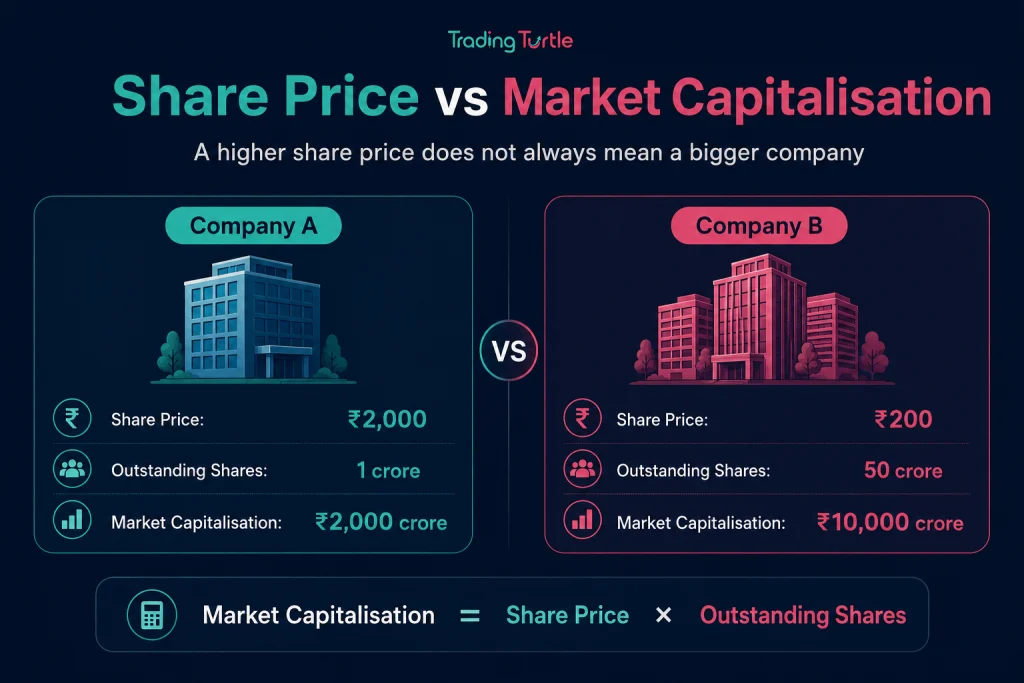
A high share price does not automatically mean a company is larger, better or more valuable than a company with a lower share price.
Consider this simplified example.
Company A
- Share price: ₹2,000
- Outstanding shares: 1 crore
Company B
- Share price: ₹200
- Outstanding shares: 50 crore
Company A’s market capitalisation would be:
₹2,000 × 1 crore = ₹2,000 crore
Company B’s would be:
₹200 × 50 crore = ₹10,000 crore
Company B has a much lower price per share, yet its market capitalisation is five times larger in this example.
This is one of the most useful practical lessons in stocks vs shares. Looking at stocks vs shares through market capitalisation also prevents a common mistake: assuming a lower per-share price means a smaller or cheaper business.
A ₹200 share is not automatically “cheaper” than a ₹2,000 share in valuation terms.
What Is Market Capitalisation?
Market capitalisation, commonly called market cap, is the market value of a company’s outstanding equity based on its current share price.
The basic formula is:
Market Capitalisation = Share Price × Outstanding Shares
Market cap is useful for understanding the relative market size of companies, but it is not the same as:
- revenue,
- profit,
- cash held by the company,
- or intrinsic value.
For a beginner, this distinction matters because looking only at share price can create a false impression of affordability.
Does Buying More Shares Mean You Invested More Money?
Not necessarily.
Suppose two investors buy different stocks.
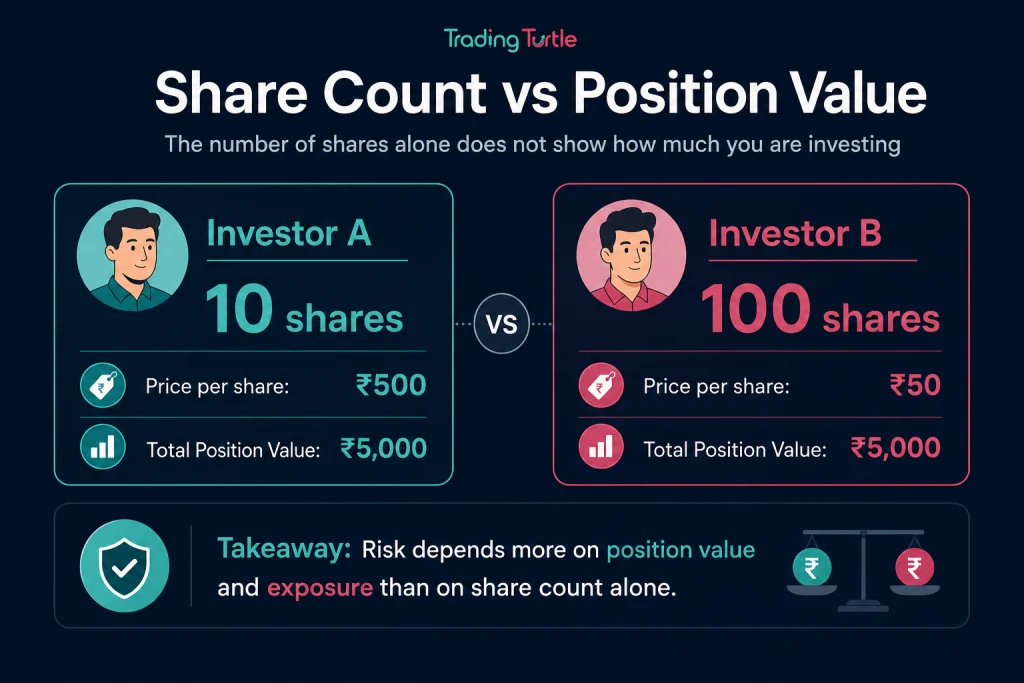
Investor A
- 10 shares
- ₹500 per share
- Position value: ₹5,000
Investor B
- 100 shares
- ₹50 per share
- Position value: ₹5,000
Investor B owns ten times as many shares, but both investors have committed the same amount of money.
This is another reason stocks vs shares should not become a numbers game. Share count does not tell you the size of a position unless you also know the price.
Does Owning More Shares Mean More Risk?
Not by itself.
Risk depends on more than quantity. Position value, volatility, liquidity, concentration and the investor’s total capital all matter.
A trader with 1,000 shares of a ₹10 stock has a ₹10,000 position. Another trader with 10 shares of a ₹1,000 stock also has a ₹10,000 position.
Their share counts are completely different, but their initial monetary exposure is the same.
Their actual risks may still differ because the two stocks can behave very differently. This is why position sizing is more meaningful than simply counting shares when evaluating trading risk.
What Happens When You Buy Shares?
When you buy shares of an already-listed company in the secondary market, you are generally buying them from another market participant rather than directly from the company.
SEBI’s financial-education material distinguishes the primary market, where investors can receive newly issued securities from a company, from the secondary market, where investors buy securities from existing holders through stock brokers.
For a normal exchange transaction, the process can be simplified as:
Investor → broker → stock exchange → matched seller → trade → settlement
The precise mechanics are more useful than the language debate around stocks vs shares, because they explain what actually happens after you press Buy.
Trading Account vs Demat Account
A trading account and Demat account are often mentioned together, but they perform different jobs.
The trading account is used to place buy and sell orders.
The Demat account holds eligible securities electronically.
SEBI’s investor material identifies a bank account, a trading account with a SEBI-registered broker and a Demat account with a recognised Depository Participant as the basic account structure for investing in equity shares.
NSDL explains that dematerialisation replaces physical certificates with electronic entries representing the number of securities held.
When your account shows that you hold 25 shares of a company, the word “shares” is useful because it describes an actual quantity of securities. In that practical account context, the distinction in stocks vs shares becomes easier to see.
Stock vs Security: Are They the Same?
No.
“Security” is a broader financial term. Equity shares are one type of security, but not every security is a stock.
Depending on the market and context, securities can include instruments such as bonds, certain derivatives and other regulated financial products.
A simple way to understand the hierarchy is:
Security → broad financial category
Stock/equity → ownership category
Share → unit of that ownership
That is more useful than treating every financial term as interchangeable.
Equity vs Shares
Equity refers broadly to ownership value in a business. Shares are units through which corporate equity can be divided.
For a listed company, an investor typically holds equity through shares.
So while stocks vs shares is mainly a distinction between broad and specific language, equity vs shares is more about the ownership concept and the units used to represent it.
Common Shares and Preference Shares
Not every share necessarily carries identical rights.
Ordinary equity shares are what most retail investors generally mean when discussing shares of listed companies. Preference shares can have different economic or voting characteristics depending on their terms.
A beginner does not need to master every share class immediately, but it is worth understanding that the word “share” does not automatically describe identical rights in every situation.
The actual security being purchased matters.
Stocks vs Shares in Everyday Indian Usage
In India, “share” appears frequently in expressions such as:
- share market
- share price
- shareholding
- equity shares
- shares allotted
- shares credited
At the same time, “stock” is equally familiar in phrases such as:
- stock market
- stock broker
- stock exchange
- stock trading
- stock portfolio
That is why stocks vs shares is best understood as a language distinction rather than a choice between two completely different investments.
If someone says, “I bought stocks,” context usually makes the meaning clear. If they say, “I bought 30 shares of XYZ Ltd.,” they are simply being more precise.
Do You Buy Stocks or Shares?
Both expressions are acceptable in normal conversation.
You might say:
“I bought stock in ABC Ltd.”
or:
“I bought 10 shares of ABC Ltd.”
The second version gives more information because it identifies the quantity.
In an actual order, quantity matters. You are not simply telling the exchange that you want “some stock”; you are specifying a security, whether you want to buy or sell it, the quantity and the order instruction.
That is where the practical difference in stocks vs shares becomes useful rather than academic.
Can a Low-Priced Share Be Expensive?
Yes.
A low nominal share price can still belong to a richly valued company, while a higher-priced share can belong to a company whose valuation is more modest relative to its earnings, assets or other measures.
Share price alone is therefore not enough to decide whether a stock is “cheap.”
This is an important beginner mistake to avoid because low-priced shares can psychologically appear more affordable even when the underlying company valuation tells a very different story.
Does a Stock Split Change the Value of Your Investment?
A stock split can change the number of shares and the price per share without automatically changing the economic value of the holding at the moment of the split.
For a simplified illustration, imagine an investor owns:
10 shares × ₹1,000 = ₹10,000
After a hypothetical 2-for-1 split, the investor might instead hold:
20 shares × ₹500 = ₹10,000
The number of shares doubles and the theoretical per-share price halves in this simplified example, while the total position value remains ₹10,000 at that point.
This is a useful example of why stocks vs shares should not be understood only through share count.
More shares do not automatically mean more wealth.
What Should Beginners Focus on Instead of Share Count?
A beginner will learn much more by asking:
- What does the company actually do?
- How much capital am I committing?
- What is the company’s market capitalisation?
- How liquid is the stock?
- How volatile is it?
- What are the important risks to the business?
- Why am I buying it?
- How does this position fit with the rest of my portfolio?
Those questions matter far more than whether one investment gives you five shares and another gives you 500.
Understanding market liquidity, order execution and position value also helps explain why two investments with the same rupee amount can behave very differently.
Common Mistakes When Learning Stocks vs Shares
Treating Stocks and Shares as Completely Different Investments
They are not. Both relate to equity ownership; “share” is simply more specific when referring to units.
Assuming a Lower Share Price Means a Cheaper Company
It does not. Outstanding share count and valuation also matter.
Comparing Investments Only by Number of Shares
A larger share count can still represent the same—or even a smaller—monetary position.
Assuming Every Share Carries Identical Rights
Different classes of shares can have different terms.
Ignoring Risk Because the Price per Share Looks Small
A low share price does not limit the percentage loss an investor can experience.
These mistakes are why a clear understanding of stocks vs shares should lead into broader market concepts rather than stop at vocabulary. Used properly, stocks vs shares is simply a starting point for understanding ownership, valuation and risk.
Key Takeaways
The difference between stocks vs shares becomes straightforward once you separate the broad concept from the specific unit.
Stock is commonly used as a broad term for equity ownership.
Share refers to a particular unit of ownership in a company.
So:
“I invest in stocks” is broad.
“I own 25 shares of ABC Ltd.” is specific.
In everyday Indian financial language, the terms are frequently used interchangeably, and the difference usually does not change the underlying investment.
More important than the terminology is understanding what those shares represent, how much money is invested, how large the company is and how much risk the position creates.
A ₹50 share is not automatically cheaper than a ₹500 share. Owning 100 shares is not automatically a larger investment than owning 10.
Market capitalisation, position value, liquidity and risk provide much more useful context.
Once stocks vs shares is clear, the next step is understanding how buying and selling actually works, how orders are matched and how securities are held after settlement. That is where terminology becomes practical market knowledge.
– Frequently Asked Questions (FAQs)
The main difference is that stock is generally a broad term for equity ownership, while a share refers to a specific unit of ownership in a particular company.
In everyday conversation, they are often used interchangeably. Technically, “stock” is broader while “share” is more specific.
For most everyday Indian usage, stock market and share market refer to substantially the same broader market where company shares are traded.
Both expressions are commonly used. “Buying stocks” is a broad way to describe investing in company equity, while “buying shares” refers to purchasing a specific number of units in a particular company.
No. The ownership percentage represented by one share depends on the company’s total number of outstanding shares.
The underlying distinction is broadly the same. In India, the term share is particularly common in phrases such as share market, share price and shareholding, while “stock” is also widely used.
Not necessarily. Share price alone does not determine valuation. Market capitalisation and other business and financial measures provide more context.
Understanding stocks vs shares helps you read broker statements, company announcements and financial news more accurately. More importantly, it leads naturally to concepts such as ownership percentage, market capitalisation and position value.