Share Market Terms for Beginners: 30 Essential Stock Market Terms Explained


The share market becomes far less intimidating once you understand its language.
A new investor might open a trading app and immediately encounter words such as Demat account, market order, bid, ask, liquidity, market capitalisation, dividend, index, volatility and stop-loss. None of these ideas is especially difficult on its own, but seeing all of them together can make the market feel more complicated than it really is.
That is why learning the most important share market terms for beginners is one of the best places to start.
You do not need to memorise an entire financial dictionary. What matters is understanding the words that explain how shares are issued, how trades happen, how prices move and how risk affects your money.
This guide explains the essential share market terms for beginners using simple definitions and practical examples, while linking deeper concepts to Trading Turtle’s dedicated guides where appropriate.
If you have not yet learned the overall process, start with our guide explaining how the share market works in India. Once that foundation is clear, the terminology below becomes much easier to connect.
Educational disclaimer: This article is for educational purposes only. It does not provide investment advice, stock recommendations, trading signals or personalised financial guidance. Investing and trading involve risk, including the possibility of losing capital.
Share Market Terms for Beginners: Quick Overview
Before going deeper, here are the four groups of terminology you will encounter most often.
Market structure
Share, stock exchange, broker, IPO, trading account, Demat account and depository.
Buying and selling
Market order, limit order, bid, ask, bid-ask spread and volume.
Company and market measurement
Market capitalisation, dividend, index, bull market, bear market and volatility.
Risk and trading
Liquidity, slippage, stop-loss, position size, support, resistance and diversification.
Instead of memorising share market terms for beginners alphabetically, understanding these groups helps you see how the concepts work together.
1. Share
A share represents a unit of ownership in a company.
If a business divides its ownership into many shares and you purchase some of them, you own a small economic interest in that company.
Your ownership percentage may be tiny, but the underlying principle is important: buying an equity share is not the same as simply betting on a price on a screen.
For example, suppose a hypothetical company has 10 lakh shares outstanding and an investor owns 100 shares. The investor owns a small fraction of the company’s equity.
The value of those shares can rise or fall depending on company performance, market expectations and many other factors.
Among all share market terms for beginners, this is the most fundamental: understand what you are buying before learning how to trade it.
2. Stock
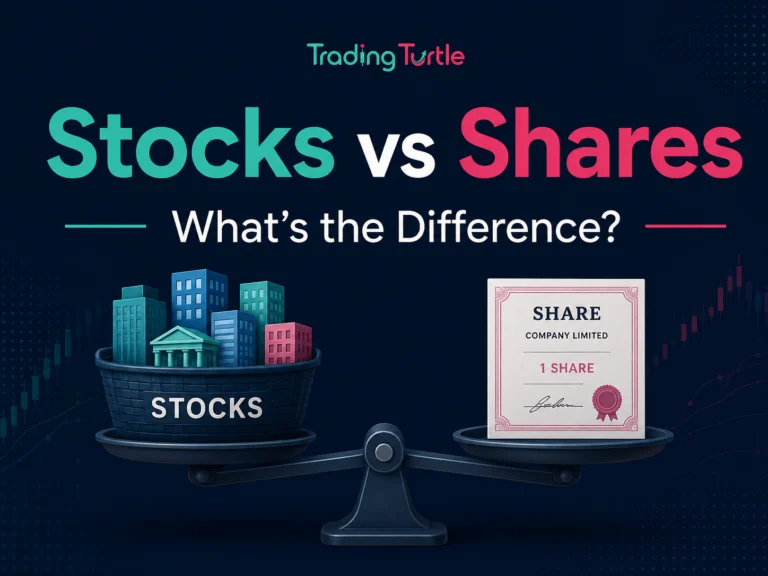
The terms stock and share are often used interchangeably in everyday conversation, but they can have slightly different meanings.
A share generally refers to a specific unit of ownership in a particular company.
“Stock” is often used more broadly to describe equity ownership.
For example:
“I own stocks” may refer to ownership across several companies.
“I own 20 shares of Company ABC” refers to a specific quantity.
For most beginners, the distinction is less important than understanding that both terms refer to equity ownership.
3. Share Market
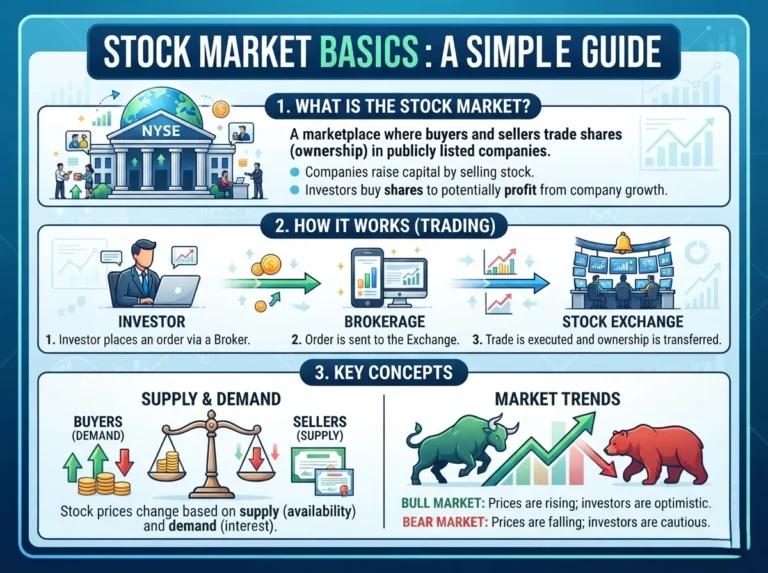
The share market is the broader system where company shares are issued and traded.
In India, share market and stock market are commonly used to describe substantially the same marketplace.
The system includes:
- companies,
- investors,
- brokers,
- stock exchanges,
- clearing corporations,
- depositories,
- and regulators.
Understanding the share market itself gives context to the remaining share market terms for beginners.
4. Stock Exchange
A stock exchange is an organised marketplace where eligible securities can be traded.
Two major exchanges in India are:
The exchange provides electronic market infrastructure that brings buy and sell orders together.
It does not simply own a warehouse full of shares and decide what price they should have.
Instead, market prices emerge as buyers and sellers submit competing orders.
5. Listed Company
A listed company is a company whose eligible securities have been admitted for trading on a recognised stock exchange.
Listing allows public investors to trade those securities through the applicable market infrastructure.
A listed company must also comply with relevant disclosure and regulatory requirements.
A company being listed does not mean its share price will rise or that the investment is automatically safe.
6. IPO
IPO stands for Initial Public Offering.
It is a process through which a company offers securities to the public as part of becoming publicly listed.
An IPO belongs to the primary market, where securities are issued.
After shares are listed and investors begin trading existing shares among themselves, that activity generally occurs in the secondary market.
This primary-versus-secondary distinction is one of the most useful share market terms for beginners to understand early.
7. Primary Market
The primary market is where new securities are issued.
In simplified form:
Company → new securities → investors
The company is raising capital through the issuance.
An IPO is a common example, although the primary market includes other types of security issuance as well.
8. Secondary Market
The secondary market is where already-issued securities are traded between market participants.
In simplified form:
Investor → exchange → another investor
This is where most everyday buying and selling of listed shares occurs.
When you buy shares of an existing listed company through the normal exchange market, your purchase money generally is not being paid directly to the company as new capital.
That distinction makes several other share market terms for beginners easier to understand.
9. Stock Broker
A stock broker is an intermediary that gives investors access to the securities market.
Through a broker, investors can generally:
- view market prices,
- place buy and sell orders,
- monitor trades,
- track holdings,
- and manage market-related account activity.
Beginners should not assume that every trading app or financial website is an authorised broker.
SEBI’s current recognised-intermediary database lists registered stock brokers and other regulated participants; as of 27 August 2026, it showed 4,990 equity-segment stock-broker records.
The practical lesson is simple: verify an intermediary’s registration instead of relying on advertising or popularity.
10. Trading Account
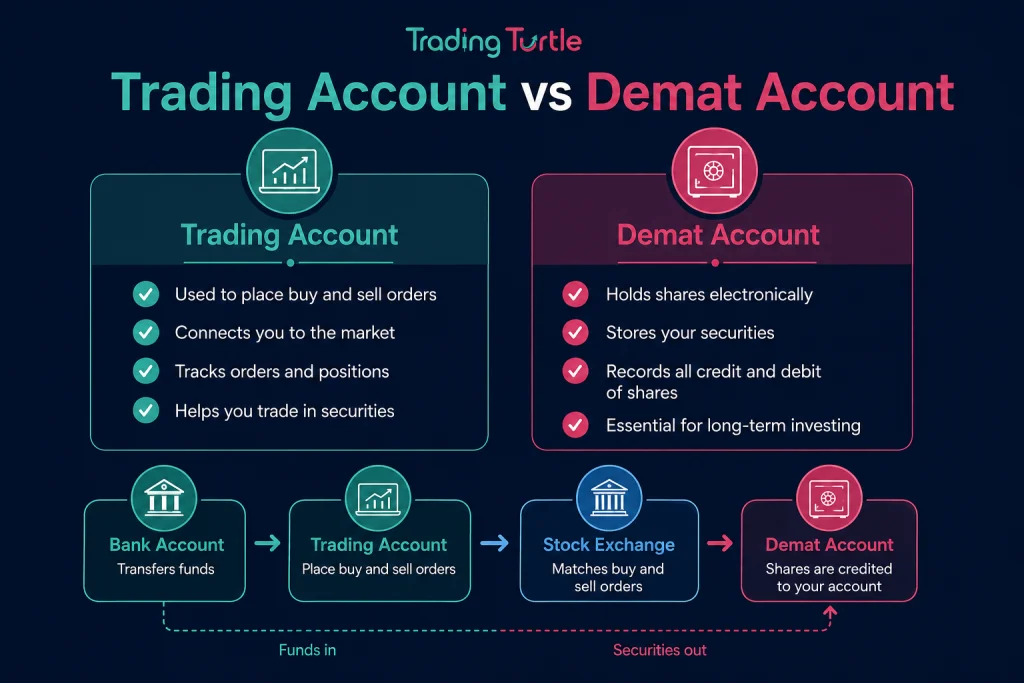
A trading account is used to place buy and sell orders.
Think of it as the transactional part of your market access.
When you select a stock and submit an order through a broker, the trading account is involved in that process.
It should not be confused with a Demat account.
That distinction is particularly important among share market terms for beginners because both accounts are often mentioned together.
11. Demat Account
A Demat account holds eligible securities electronically.
The word “Demat” comes from dematerialisation, referring to securities being maintained electronically rather than relying on physical share certificates.
A simple way to remember the difference:
| Account | Main purpose |
|---|---|
| Trading account | Places buy and sell orders |
| Demat account | Holds securities electronically |
| Bank account | Handles funds |
Your trading account helps you transact.
Your Demat account helps maintain your securities holdings.
12. Depository
A depository is part of the infrastructure that enables securities to be held and transferred electronically.
India has two depositories:
- NSDL
- CDSL
Retail investors generally interact with this system through a Depository Participant (DP).
Understanding the role of a depository helps beginners avoid the common misconception that their stock exchange or trading app simply “stores” their shares.
13. Market Order
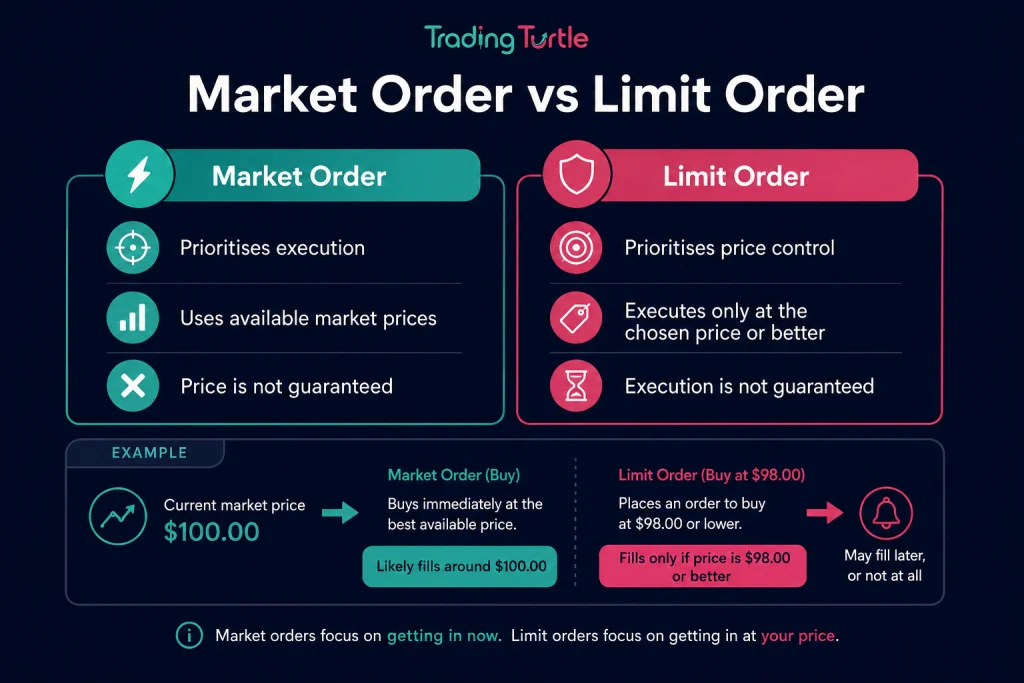
A market order instructs the market to buy or sell using the best available prices at that time.
The priority is generally execution rather than exact price.
Suppose a share appears near ₹500.
If you submit a market buy order, you might expect approximately ₹500, but the final execution price can differ depending on available sellers, liquidity and market movement.
Therefore:
Market order ≠ guaranteed displayed price
Our guide to market orders vs limit orders explains this concept in greater detail.
This is one of the most practical share market terms for beginners, especially before placing a first trade.
14. Limit Order
A limit order allows a trader or investor to specify a price condition.
For example:
A share trades around ₹500.
You only want to buy it at ₹490 or lower.
You could place a buy limit order at ₹490.
The advantage is greater control over the acceptable price.
The disadvantage is that the order may never execute if sellers are not available at that level.
A beginner-friendly comparison between market order vs limit order:
| Market Order | Limit Order |
|---|---|
| Prioritises execution | Prioritises price |
| Exact price not guaranteed | Execution not guaranteed |
| Uses available market prices | Executes only within price condition |
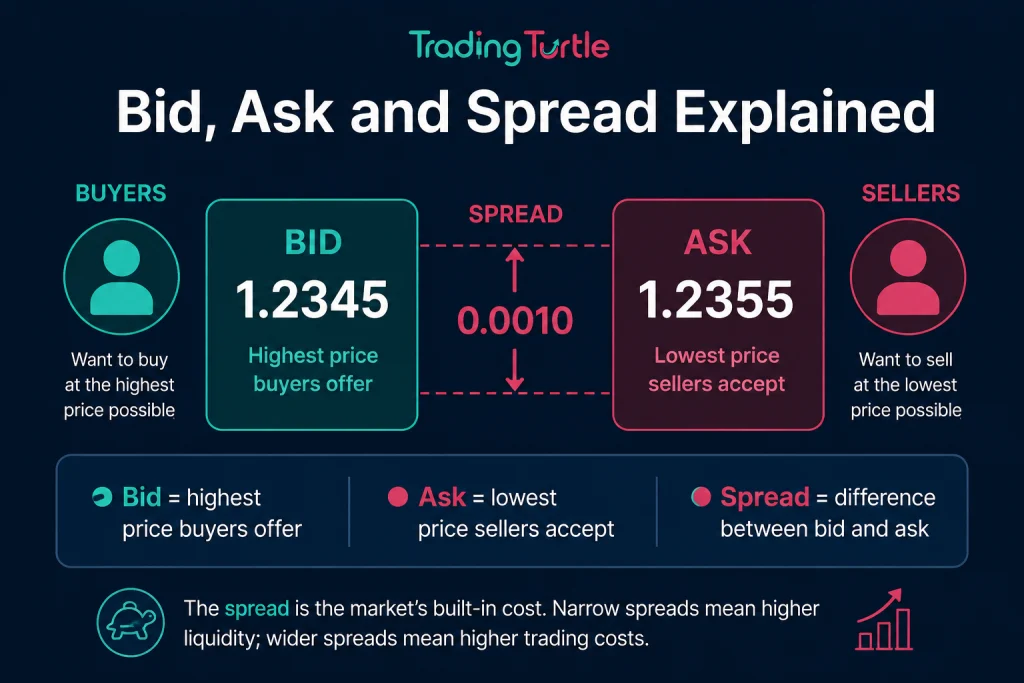
15. Bid Price
The bid price is the highest price a buyer is currently willing to offer.
Imagine:
Highest buyer: ₹99.90
That ₹99.90 represents the best bid in this simplified example.
The bid therefore represents buying interest.
16. Ask Price
The ask price, sometimes called the offer price, is the lowest price at which a seller is currently willing to sell.
For example:
Best bid: ₹99.90
Best ask: ₹100.00
The seller at ₹100 is offering the lowest currently available selling price in this simplified market.
Bid and ask are two share market terms for beginners that make much more sense when considered together.
17. Bid-Ask Spread
The bid-ask spread is the difference between the best bid and the best ask.
Using our example:
Ask = ₹100.00
Bid = ₹99.90
Spread = ₹0.10
A narrow spread often appears in more actively traded markets, while wider spreads can occur where liquidity is lower.
However, spread alone is not a complete measure of liquidity.
Our dedicated bid-ask spread guide explains the mechanics and trading implications more fully.
18. Liquidity
Liquidity describes how easily an asset can generally be bought or sold without causing a large impact on its market price.
A highly liquid stock may have:
- many buyers,
- many sellers,
- substantial trading activity,
- tighter spreads,
- and greater depth.
A less-liquid stock may have:
- fewer orders,
- wider spreads,
- more price impact,
- and greater execution difficulty.
Liquidity is one of the share market terms for beginners that directly affects real-world execution.
A stock might show a price of ₹100, but that does not necessarily mean an investor can instantly buy or sell any quantity at exactly ₹100.
Our guide to liquidity in trading explains why.
19. Slippage
Slippage is the difference between the execution price you expected and the price at which the trade actually executes.
Suppose you see a share around ₹500 and place a large market buy order.
Available sellers might be offering:
- 20 shares at ₹500.00
- 30 shares at ₹500.10
- 50 shares at ₹500.25
If your order is large enough to consume several price levels, the average execution price can be higher than ₹500.
That difference is an example of slippage.
20. Trading Volume
Trading volume describes how much of an asset has traded during a particular period.
In shares, volume is generally represented by the number of shares traded.
High volume means high activity.
It does not automatically mean:
- the stock is good,
- the price will rise,
- or traders should buy.
Volume provides information about participation, not guaranteed future direction.
That distinction is important when learning share market terms for beginners because many technical indicators use volume without explaining what it actually measures.
21. Market Capitalisation
Market capitalisation, or market cap, is the market value of a company’s outstanding equity shares.
The basic formula is:
Market Capitalisation = Current Share Price × Outstanding Shares
For example:
A hypothetical company has:
- 10 crore shares outstanding
- current share price of ₹200
Its market capitalisation would be approximately:
10 crore × ₹200 = ₹2,000 crore
Market capitalisation helps compare the relative market size of companies.
But remember:
Market cap is not the same as revenue.
Market cap is not profit.
Market cap is not cash in the bank.
Those are separate financial measures.
22. Large-Cap, Mid-Cap and Small-Cap
These terms describe companies grouped by market capitalisation according to the relevant classification methodology.
At a beginner level, the important idea is:
- large-cap refers to relatively larger listed companies,
- mid-cap refers to the middle segment,
- small-cap refers to relatively smaller listed companies.
Do not rely on permanently fixed rupee-value definitions because classifications and market values change.
These are useful share market terms for beginners, but the category alone does not determine whether a company is safe or a good investment.
23. Dividend
A dividend is a distribution a company may make to eligible shareholders.
Not every company pays dividends.
A company may instead retain earnings to:
- invest in expansion,
- reduce debt,
- acquire businesses,
- develop products,
- or strengthen its balance sheet.
A high dividend also does not automatically mean a stock is attractive.
Investors need to consider the company’s broader financial condition and the sustainability of payments.
24. Capital Gain and Capital Loss
A capital gain occurs when an asset is sold for more than its purchase price, before accounting for relevant costs and taxes in this simplified explanation.
Example:
Buy at ₹500
Sell at ₹550
Difference:
₹50 gain per share
A capital loss occurs when the asset is sold for less than its purchase price.
Buy at ₹500
Sell at ₹450
Difference:
₹50 loss per share
These are basic share market terms for beginners, but real investment results can also be affected by brokerage, charges, taxes and other transaction costs.
25. Stock Market Index
A stock market index measures the performance of a selected group of securities according to a defined methodology.
Two widely followed Indian benchmarks are:
- NIFTY 50
- SENSEX
An index provides a broad snapshot of a particular market segment.
But if an index rises, that does not mean every stock in the market has risen.
Different companies and sectors can move in different directions.
Our guide to NIFTY 50 vs SENSEX explains the differences between these two major Indian benchmarks.
26. Bull Market
A bull market generally refers to a prolonged environment of rising prices and relatively optimistic market sentiment.
It does not mean every stock rises every day.
Even during strong markets, investors may experience:
- corrections,
- sector weakness,
- company-specific declines,
- and periods of volatility.
Among share market terms for beginners, “bullish” is often overused as though it means guaranteed profits. It does not.
27. Bear Market
A bear market broadly describes a prolonged environment of falling prices and weaker sentiment.
Again, this refers to broader market conditions.
Individual securities can behave differently from the overall market.
A bear market also does not mean prices will fall continuously without rallies.
Markets rarely move in perfectly straight lines.
28. Volatility
Volatility describes the degree of price fluctuation.
Consider two hypothetical ₹100 stocks.
Stock A
Usually moves between ₹99 and ₹101.
Stock B
Frequently moves between ₹90 and ₹110.
Stock B shows much greater price variation.
Volatility matters because larger price swings can increase:
- potential gains,
- potential losses,
- stop-loss distance,
- emotional pressure,
- and position-sizing requirements.
This is one of the risk-related share market terms for beginners that should be understood before active trading.
29. Stop-Loss
A stop-loss is an order mechanism commonly used to help manage risk by triggering an action when the market reaches a specified level, depending on the particular stop-order type.
Suppose a trader buys at ₹500 and has determined that their trade idea is invalid below a particular level.
They may use a stop-loss instruction as part of their risk plan.
However, a stop-loss does not guarantee the exact exit price.
Gaps, volatility and poor liquidity can cause execution at a different price.
Our separate article on stop-loss orders explains the available concepts and limitations.
30. Position Size
Position size is the amount of an asset included in a trade or investment.
This is one of the most important share market terms for beginners because position size directly affects financial exposure.
Suppose two traders buy the same stock at the same price.
Trader A
Buys ₹10,000 worth.
Trader B
Buys ₹5,00,000 worth.
The stock may be identical, but the monetary exposure is dramatically different.
That is why experienced risk planning considers:
- account size,
- amount at risk,
- entry price,
- invalidation or stop distance,
- and position size.
Our dedicated position sizing in trading guide explains this relationship in detail.
Bonus Term: Support
Support refers to an area where buying interest has previously been strong enough to slow or reverse a decline.
It should be treated as an area of market interest, not an unbreakable floor.
Price can move below support.
Bonus Term: Resistance
Resistance refers to an area where selling pressure has previously slowed or reversed an advance.
Resistance is also not guaranteed to hold.
Markets can break through previously important levels.
Our guide to support and resistance explains how traders identify and interpret these areas.
Bonus Term: Diversification
Diversification means spreading exposure across different investments instead of concentrating everything in one position.
The principle is simple:
If one investment performs badly, a diversified portfolio may avoid having its entire result depend on that single company.
Diversification does not eliminate market risk or guarantee positive returns.
But it can reduce concentration risk.
How These Share Market Terms for Beginners Fit Together
The easiest way to learn share market terms for beginners is not to memorise 30 isolated definitions.
Follow a trade.
A listed company has shares.
Those shares can trade on a stock exchange.
An investor accesses the exchange through a stock broker and uses a trading account to place an order.
The investor might choose a market order or a limit order.
Buyers submit bids.
Sellers submit asks.
The difference between the best bid and ask is the bid-ask spread.
How easily shares can be traded relates to liquidity.
The amount being traded contributes to volume.
If the available prices change while an order is being filled, the investor can experience slippage.
Once securities are owned, they are held electronically through the Demat infrastructure.
Meanwhile, investors may evaluate companies using ideas such as market capitalisation, while broader market performance can be represented using an index.
Active traders may additionally consider volatility, support, resistance, stop-losses and position sizing.
Seen this way, the key share market terms for beginners form one connected system.
Common Share Market Terminology Mistakes
Understanding definitions is useful. Avoiding common misunderstandings is even more valuable.
Mistake 1: Assuming a ₹2,000 Stock Is “More Expensive” Than a ₹200 Stock
Share price alone does not tell you the total market value of the company.
The number of shares outstanding matters.
That is why market capitalisation exists.
Mistake 2: Assuming Market Orders Guarantee the Screen Price
They do not.
A market order generally interacts with available liquidity.
The actual execution price can change.
Mistake 3: Believing High Volume Means the Price Must Rise
Volume measures activity.
Buyers and sellers can create high volume in both rising and falling markets.
Mistake 4: Treating Support as a Guaranteed Floor
Support is a market reference area.
It can fail.
The same applies to resistance.
Mistake 5: Assuming Stop-Loss Means No Risk
A stop-loss is a risk-management mechanism, not insurance.
Execution can differ from the intended trigger or expected price depending on market conditions.
Mistake 6: Confusing Trading Account and Demat Account
The trading account helps place transactions.
The Demat account holds securities electronically.
They perform different functions.
Mistake 7: Ignoring Position Size
A ₹5 move in a stock can be insignificant or financially painful depending on how large the position is.
That is why position sizing belongs among the essential share market terms for beginners, not just advanced trading concepts.
Share Market Terms for Beginners: Quick Cheat Sheet
| Term | Simple meaning |
|---|---|
| Share | Unit of company ownership |
| Stock | General term for equity ownership |
| Share market | System for issuing and trading shares |
| Stock exchange | Organised marketplace |
| Listed company | Company with securities admitted to exchange trading |
| IPO | Initial public offering |
| Primary market | New securities are issued |
| Secondary market | Existing securities trade between investors |
| Broker | Provides market access |
| Trading account | Places orders |
| Demat account | Holds securities electronically |
| Depository | Electronic securities infrastructure |
| Market order | Prioritises execution |
| Limit order | Controls acceptable price |
| Bid | Buyer’s offered price |
| Ask | Seller’s offered price |
| Spread | Difference between best bid and ask |
| Liquidity | Ease of trading |
| Slippage | Difference between expected and execution price |
| Volume | Quantity traded |
| Market cap | Share price × outstanding shares |
| Dividend | Distribution to shareholders |
| Index | Measures a selected market group |
| Bull market | Broad rising environment |
| Bear market | Broad falling environment |
| Volatility | Degree of price fluctuation |
| Stop-loss | Risk-management order mechanism |
| Position size | Amount committed to a position |
| Support | Area of previous buying interest |
| Resistance | Area of previous selling interest |
Which Share Market Terms Should Beginners Learn First?
You do not need all 30 on your first day.
Start with these share market terms for beginners in this order.
1. Start with shares
Understand what you actually own.
2. Broker and stock exchange
Understand how you reach the market.
3. Trading account and Demat account
Understand the difference between trading and holding.
4. Bid, ask and spread
Understand how buyers and sellers interact.
5. Market order and limit order
Understand how orders are placed.
6. Liquidity and slippage
Understand why execution may differ from expectation.
7. Market capitalisation and index
Understand how companies and markets are measured.
8. Volatility, stop-loss and position size
Understand risk before trying to make money.
This sequence turns share market terms for beginners into a practical learning path rather than a vocabulary test.
Key Takeaways
The most important share market terms for beginners fall into three broad categories.
Ownership and market access
Shares, brokers, exchanges, Demat accounts, IPOs and depositories explain where securities come from and how the market operates.
Trading mechanics
Market orders, limit orders, bid, ask, spread, liquidity, volume and slippage explain how shares are actually bought and sold.
Analysis and risk
Market cap, indices, volatility, support, resistance, stop-loss and position size explain how investors evaluate markets and control exposure.
You do not need to memorise every term immediately.
Instead, understand how they connect.
Once you know what a share represents, how a broker connects you to an exchange, how buy and sell orders interact, and why liquidity and position size matter, most other share market terms for beginners become much easier to understand.
For a beginner, learning the language of the market should come before trying to predict which stock will rise next.
– Frequently Asked Questions (FAQs)
The most useful share market terms for beginners include share, stock exchange, broker, trading account, Demat account, market order, limit order, bid, ask, spread, liquidity, volume, market capitalisation, index, volatility, stop-loss and position size.
The share market is the organised system where eligible shares of companies can be issued and traded. Buyers and sellers generally access exchange markets through registered intermediaries such as stock brokers.
A Demat account holds eligible securities electronically. It should not be confused with a trading account, which is used to place buy and sell orders.
A market order generally prioritises execution using available market prices. A limit order places a price condition on execution and may remain unfilled.
Liquidity describes how easily an asset can generally be bought or sold without significantly affecting its price. It is one of the most practical share market terms for beginners because liquidity can influence spreads and execution quality.
Market capitalisation is calculated by multiplying a company’s current share price by its number of outstanding shares. It is commonly used to describe the company’s relative market size.
You can verify a broker through SEBI’s official recognised-intermediary database, which lists registered equity-segment stock brokers and their registration details.