What Is Cryptocurrency? A Beginner’s Guide to Digital Assets

What is cryptocurrency?
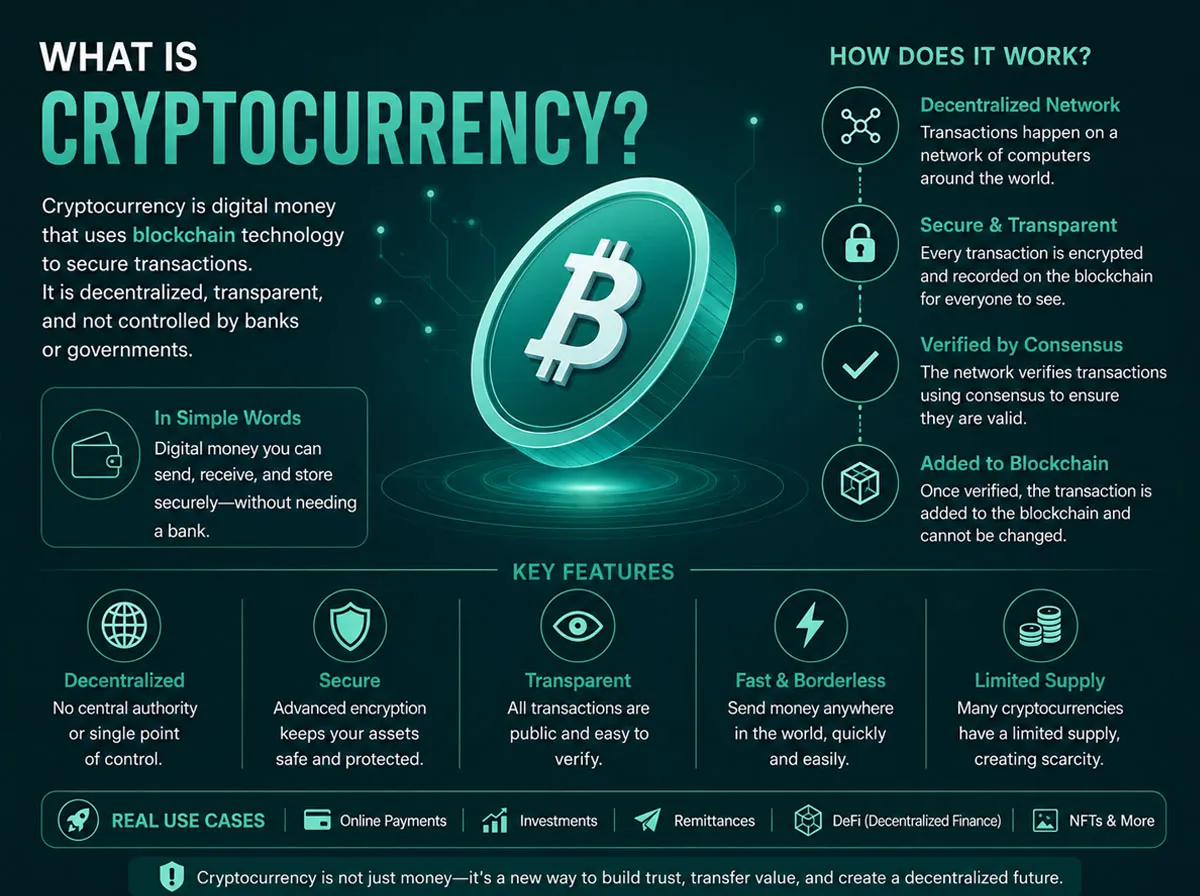
Cryptocurrency is a digital asset that uses cryptography—special mathematical techniques for security—to support transfers and record ownership on a digital network. Unlike physical notes and coins, cryptocurrency exists electronically and is accessed through software, wallets, or online platforms.
A simple way to understand cryptocurrency is to separate three connected ideas:
- The asset: A unit of value represented digitally, such as a coin or token.
- The network: The system that processes transactions and maintains records.
- The cryptography: The security methods used to verify transfers and control access.
The U.S. National Institute of Standards and Technology describes cryptocurrency as a digital asset or unit within a system that can be cryptographically transferred between blockchain-network users. These transfers are generally authorised using digital signatures linked to cryptographic key pairs.
Cryptocurrency is often associated with Bitcoin because Bitcoin was the first widely adopted blockchain-based cryptocurrency. Today, however, the broader crypto market includes many different assets and networks, each designed with different technical rules, supply models, use cases, and risk profiles.
Education-only disclaimer: This article is for general educational purposes only. It is not investment, tax, legal, or financial advice. Cryptocurrency prices can be highly volatile, and you can lose some or all of the money you use to buy, trade, or hold crypto assets.
Key takeaways
- Cryptocurrency is a type of digital asset that can be transferred electronically using cryptographic systems.
- Many cryptocurrencies operate through blockchain networks, which maintain shared records of transactions.
- Cryptocurrency is not the same as cash in a bank account, a guaranteed investment, or a universally accepted payment method.
- Crypto assets can be useful for digital transfers and programmable applications, but they also carry substantial price, custody, security, fraud, and regulatory risks.
- Beginners should understand wallets, private keys, transaction fees, volatility, and platform risk before using cryptocurrency.
How does cryptocurrency work?
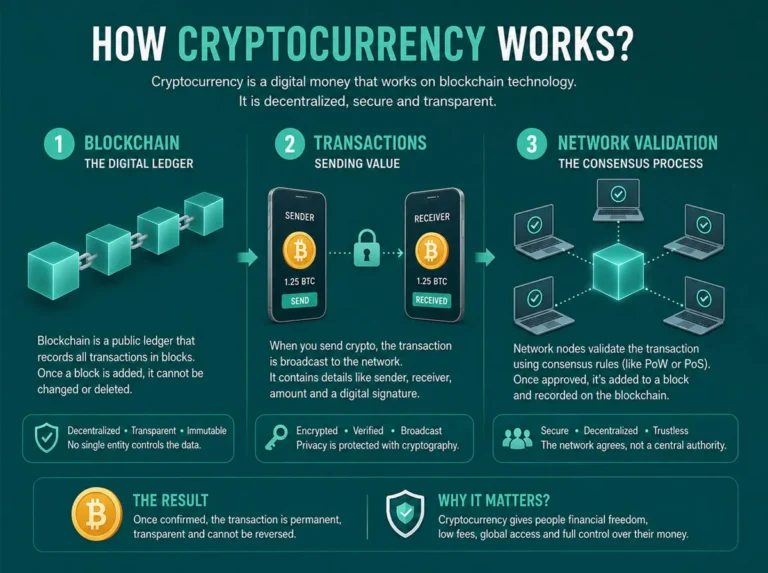
Most cryptocurrencies work through a distributed network rather than a single bank or company maintaining one central ledger. Network participants use agreed technical rules to validate transactions and update a shared record.
A simplified transaction example
Imagine that one person wants to send a cryptocurrency asset to another person:
- The sender creates a transaction in a wallet application.
- The wallet uses the sender’s private key to generate a digital signature authorising the transaction.
- The transaction is broadcast to the network.
- Network participants verify that the transaction follows the network’s rules.
- Once validated and recorded, the recipient can see the transferred asset in their wallet address.
The exact process differs by network. Some blockchains use mining, while others use alternative consensus mechanisms such as proof of stake. The important beginner concept is that a cryptocurrency transfer is usually not approved by a traditional bank; it is verified according to the rules of its underlying network.
Wallet addresses and private keys
A wallet address is similar to a public receiving address. It can be shared with someone who needs to send you crypto.
A private key is different: it is a secret cryptographic credential that authorises access to assets associated with a wallet address. Anyone with access to the private key—or, in many wallet designs, the recovery or seed phrase—may be able to control the associated crypto assets.
For this reason, never share a private key or seed phrase with anyone. Investor.gov warns that lost, stolen, damaged, or hacked wallets can result in permanent loss of access, and that private keys and seed phrases should never be shared.
Cryptocurrency, blockchain and digital assets
The terms cryptocurrency, blockchain, and digital assets are often used together, but they do not mean exactly the same thing.
| Term | Meaning |
|---|---|
| Cryptocurrency | A digital asset designed to be transferred or used within a crypto network |
| Blockchain | A type of shared digital ledger that records data in linked blocks |
| Digital asset | A broad term for electronically represented value, including many crypto assets |
| Token | A crypto asset issued on an existing blockchain network |
| Wallet | Software, hardware, or a custody arrangement used to manage crypto access credentials |
A cryptocurrency may use blockchain technology, but blockchain itself is broader than cryptocurrency. Blockchain systems can also be designed for recordkeeping, supply-chain coordination, digital identity, tokenisation, and other applications.
This article focuses on the broad question of what cryptocurrency is. The technical details of blocks, nodes, validation, and consensus should be covered in a dedicated blockchain explainer rather than repeated here.
What can cryptocurrency be used for?
Cryptocurrency use varies significantly by jurisdiction, network, and individual asset. Common use cases include:
- Transferring value between participants on a network.
- Paying network fees required to process transactions.
- Accessing applications or services built on particular blockchain networks.
- Participating in network governance where the protocol allows it.
- Holding or trading a digital asset, subject to substantial risk.
- Supporting collateral, settlement, or other functions in certain crypto-based systems.
Not every cryptocurrency has the same purpose. Some are designed mainly for payments, others for powering a blockchain network, and others for accessing a specific application or service.
A crypto asset’s stated purpose should not be confused with proof of value, safety, or long-term viability. Before using any asset, readers should understand how it works, who controls key decisions, how supply is created, where it can be traded, and what risks apply.
Main types of cryptocurrency
Cryptocurrencies are often grouped into broad categories. These categories can overlap, and a label should not be treated as a quality rating.
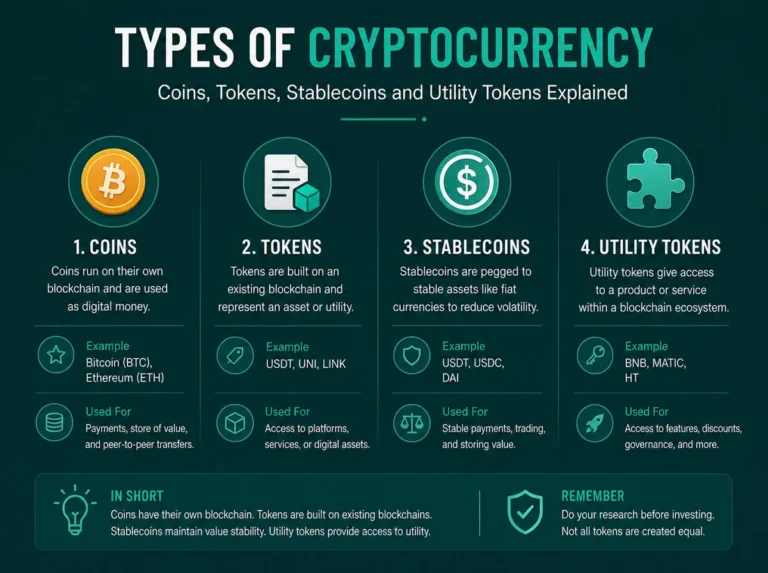
Coins
A coin is generally a crypto asset native to its own blockchain. It may be used to pay transaction fees, reward validators, support network security, or transfer value within that network.
Tokens
A token is typically created on top of an existing blockchain rather than operating on its own independent network. Tokens can represent access rights, governance rights, digital collectibles, stable-value mechanisms, or other functions defined by the relevant project.
Stablecoins
Stablecoins are crypto assets designed to seek a more stable value relative to a reference asset, currency, commodity, or other mechanism. “Stable” does not mean risk-free. A stablecoin can still face reserve, redemption, liquidity, governance, technical, or regulatory risks.
Utility tokens
A utility token is generally intended to provide access to a product, service, application, or network feature. Its practical use, market liquidity, and legal treatment can vary widely.
The next Crypto Basics article should explore these categories in depth, including the difference between coins and tokens and the risks of assuming that every stablecoin or utility token works in the same way.
How do people access and store cryptocurrency?
People generally access cryptocurrency through two broad arrangements:
- Custodial access: A third-party platform holds or controls assets or key-management systems on the user’s behalf.
- Self-custody: The user controls the wallet credentials, private keys, or recovery phrase directly.
Both approaches involve trade-offs. Custodial services may offer convenience, account recovery processes, and simplified interfaces, but users may face platform, insolvency, withdrawal, hacking, or operational risks. Self-custody can provide direct control, but it also places responsibility for backups, security, and recovery on the user.
For example, a person using a self-custody wallet who loses their recovery phrase may permanently lose access to their assets. A person holding assets on a third-party platform may face access problems if that platform is hacked, freezes withdrawals, shuts down, or becomes insolvent.
Trading Turtle’s forthcoming crypto-wallet content should cover wallet addresses, custody, seed phrases, hot wallets, cold wallets, and practical security controls in detail.
Important risks of cryptocurrency
Understanding what cryptocurrency is also means understanding what it is not: it is not a guaranteed investment, a bank deposit, or a universally protected financial product.
Price volatility
Crypto asset prices can move sharply in short periods. Volatility may be driven by liquidity conditions, market sentiment, protocol events, regulatory developments, leverage, large-holder activity, or broader economic conditions.
FINRA notes that crypto assets can be exceptionally risky and volatile, while fraud and scams involving crypto assets are common.
Scams and fraud
Common crypto-related scams include phishing, impersonation, fake investment schemes, fraudulent token launches, romance scams, malicious wallet links, and requests for seed phrases or private keys.
A legitimate service should never need your recovery phrase or private key to “verify” your wallet, unlock funds, or provide support.
Custody and security risk
Crypto transactions are often difficult or impossible to reverse once confirmed. Sending assets to an incorrect address, signing a malicious transaction, or exposing key material can lead to permanent loss.
Use strong passwords, multi-factor authentication where available, official application sources, and careful transaction verification. Treat every unexpected message, link, or wallet request as potentially malicious.
Platform and counterparty risk
A trading platform, broker, custodian, or wallet provider can experience outages, security breaches, business failure, withdrawal restrictions, or other operational problems. Holding assets through a third party means assessing the risks of that third party as well as the risks of the cryptocurrency itself.
Regulatory and tax considerations
Rules for crypto assets differ across countries and can change. Tax treatment, reporting obligations, permitted products, advertising standards, and platform requirements may all vary by location.
Before buying, selling, transferring, or trading cryptocurrency, verify the current rules and tax obligations applicable to your own jurisdiction using official local sources or qualified professional advice.
A beginner’s checklist before using crypto
Before you use cryptocurrency, take time to answer these questions:
- Do I understand what this asset does beyond its price movements?
- Do I know whether I am using custody through a platform or controlling my own wallet?
- Can I identify the correct wallet address, network, and transaction fee?
- Do I understand the consequences of losing a private key or recovery phrase?
- Have I enabled available security protections, including strong passwords and multi-factor authentication?
- Can I afford a complete loss of the money involved?
- Have I checked the current legal, tax, and platform rules that apply where I live?
For anyone interested in trading rather than simply learning about the technology, begin with a written trading plan, clear risk limits, and simulated practice. Review the site’s guides to risk management in trading, position sizing, and paper trading before considering live markets.
– Frequently Asked Questions (FAQs)
Cryptocurrency can be used as a medium of exchange in certain contexts, but acceptance is not universal. Whether it functions as “money” in practice depends on the asset, the jurisdiction, the merchant or recipient, and applicable rules.
No. Cryptocurrency is a type of digital asset, while blockchain is a technology used by many crypto networks to record and validate information. Blockchain can also have non-cryptocurrency applications.
A crypto asset is digital, but its ownership record is controlled by network rules and cryptographic authorisation. Copying a wallet address does not copy the assets associated with it, and copying a file does not provide control without the relevant private key.
Yes. Assets can become inaccessible if private keys or recovery phrases are lost, if funds are sent to an incorrect address, or if a wallet or platform is compromised. Crypto asset transactions and custody arrangements can involve permanent-loss risk.
No cryptocurrency is automatically safe. Security depends on the asset, the network, the storage method, the platform used, the user’s security practices, and market conditions. Price, fraud, custody, technical, and regulatory risks should all be considered.
Usually, no. A private key is the secret part of a cryptographic key pair used to authorise transactions, and control of it is typically required to access the assets associated with a wallet address. If you lose your private key or recovery phrase in a self-custody setup—and have no secure backup—you may permanently lose access to those assets.
No. Treat claims of guaranteed profits, risk-free returns, exclusive “signals,” or urgent investment opportunities as serious warning signs. The CFTC has warned consumers about crypto-related fraud, including scams and schemes that exploit expectations of returns; always independently verify a project and never send crypto or wallet credentials because of unsolicited messages.