What Is Liquidity in Trading? Meaning, Examples and Importance

What Is Liquidity in Trading?
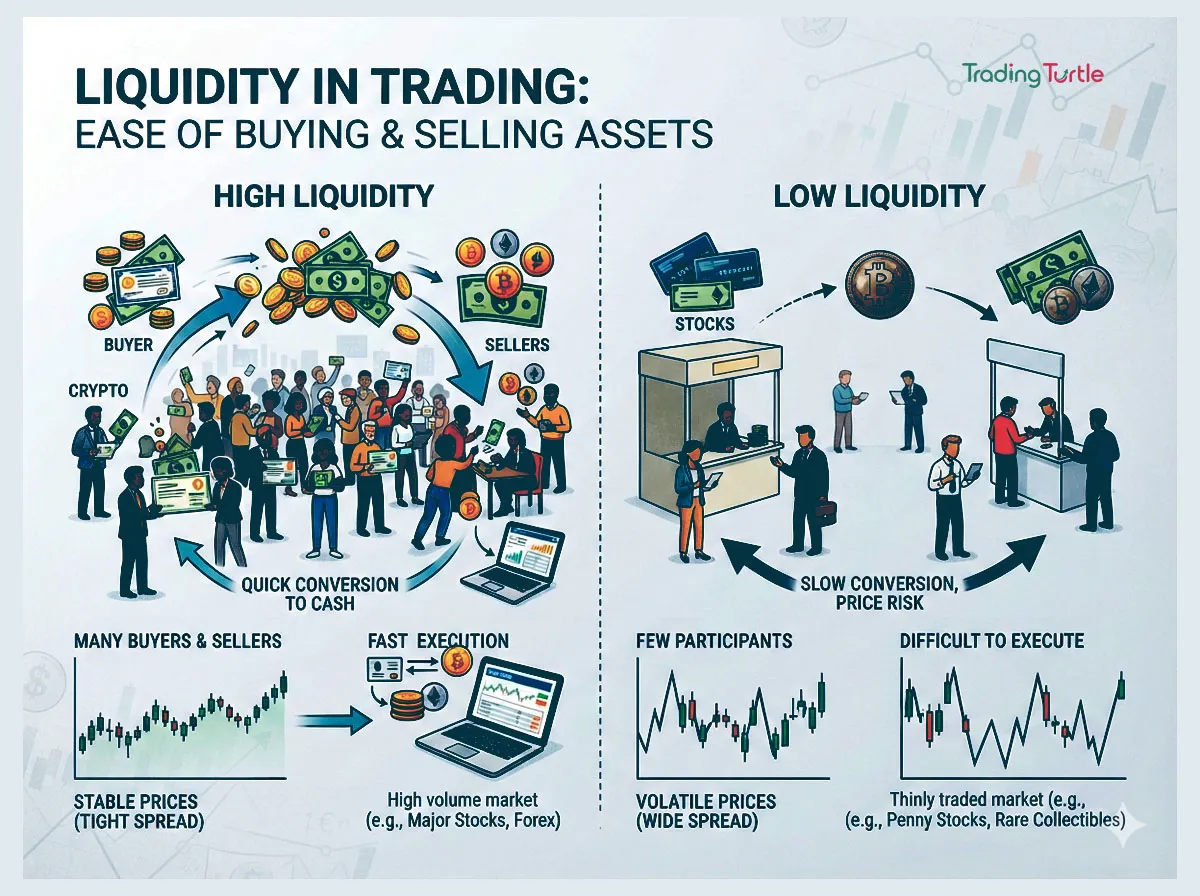
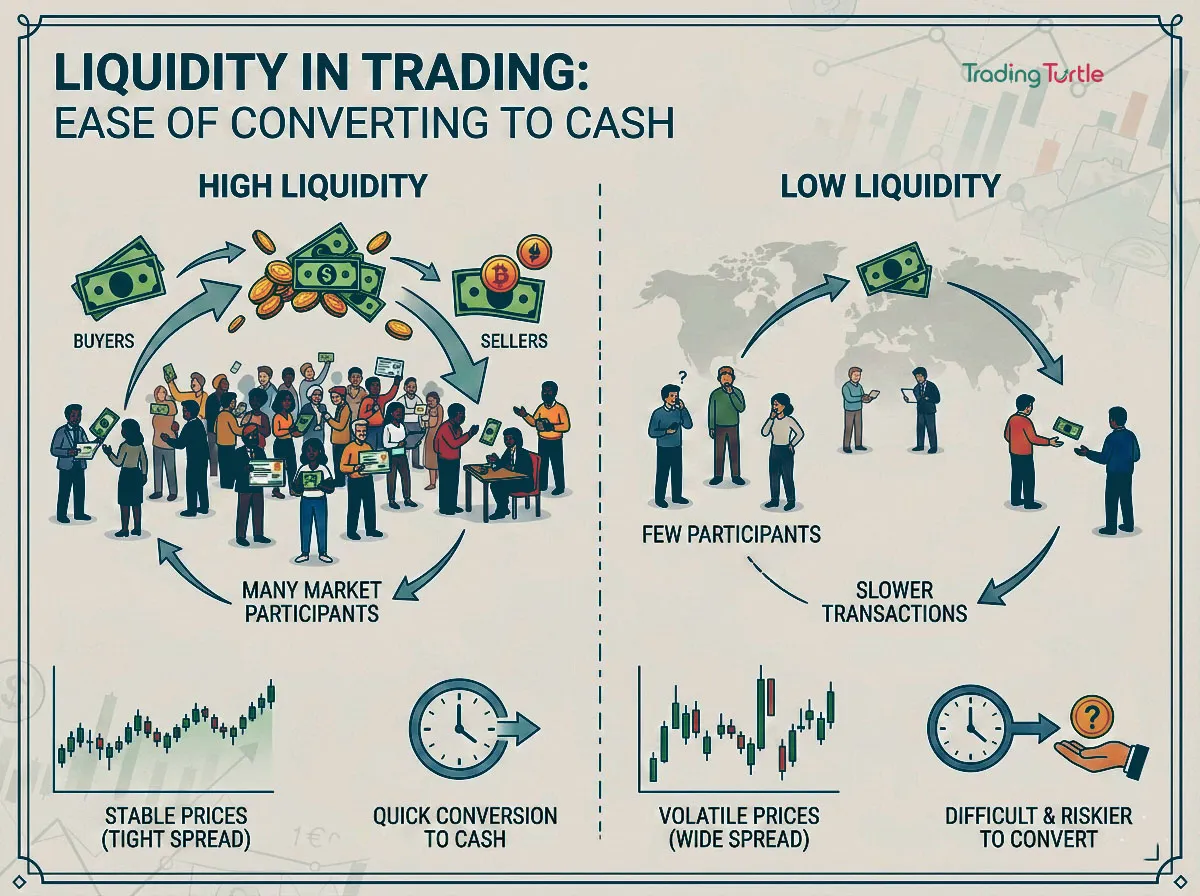
What is liquidity in trading? Liquidity is the ease with which an asset can be bought or sold without causing a significant change in its price. A highly liquid market usually has many active buyers and sellers, frequent transactions, tighter bid-ask spreads, and enough available quantity for orders to be executed more efficiently.
In simple terms, ask whether you could buy or sell now at a reasonable price without moving the market much. If few orders are available near the quoted price, even a modest trade may cost more than expected.
High market liquidity does not mean an asset is safe, profitable, or immune to sudden price moves. It means there is generally more active participation and better potential for efficient execution. Low liquidity can make it harder to buy or sell when you want, and it can increase the risk of wide spreads, slippage, partial fills, and sharp price changes.
The SEC’s Investor.gov defines stock liquidity as the ability to buy or sell shares rapidly without substantially affecting the stock price; it also notes that low-liquidity stocks can be harder to sell and may force investors to accept a larger loss.
Liquidity Meaning in Trading
To understand what is liquidity in trading, imagine two situations.
In the first, a widely traded stock has thousands of buyers and sellers active at nearby prices. You place a modest buy or sell order, and it is likely to find counterparties quickly. In the second, a thinly traded asset has limited buyers, sellers, and visible orders. Even a small trade can push its price up or down.
The first situation has stronger liquidity. The second has weaker liquidity.
Liquidity is important because markets work through matching. A buyer must find a seller, and a seller must find a buyer. The more willing participants there are near the current price, the more smoothly an asset can usually trade.
SEBI’s investor education material describes liquidity risk as the risk that an investment cannot be bought or sold promptly
Liquidity is not the same as popularity
An asset can be widely discussed online but still have poor liquidity. Social-media attention, a large number of holders, or a sharp price move does not necessarily mean there are enough active orders near the current price.
Similarly, a high-volume day does not automatically guarantee that liquidity will stay strong throughout the session. Liquidity can disappear quickly during news, sudden volatility, exchange disruptions, or market panic.
Why Liquidity Matters
The answer to what is liquidity in trading matters because liquidity affects the quality of nearly every stage of a trade: entry, position management, stop-loss execution, and exit.
Faster execution
In a liquid market, there are generally more available counterparties. This can make it easier to buy or sell without waiting for another participant to take the other side of your order.
Lower spread cost
More active buying and selling often creates tighter competition between bids and asks. This can result in a narrower bid-ask spread, although the relationship is not guaranteed at every moment.
A narrow spread can reduce the immediate execution cost of entering and exiting a trade. For short-term traders, that difference can have a major effect on the strategy’s realistic profitability.
Reduced price impact
When an order is small relative to available market depth, it is less likely to move through multiple price levels. In a thin market, a relatively small market order can consume available bids or asks and push the price away from the expected level.
More flexible exits
A liquid market generally gives traders more options to reduce or close a position. In a low-liquidity market, you may need to accept a worse price, wait longer, or receive only a partial fill.
More reliable chart levels—within limits
Technical levels such as support, resistance, breakouts, and moving averages can behave differently in thin markets because a small number of orders may cause a large move. Liquidity does not make technical analysis certain, but it can reduce some execution and price-discovery problems.
High vs Low Liquidity
The table below shows how high and low market liquidity may affect a trader’s experience.
| Factor | Higher liquidity | Lower liquidity |
|---|---|---|
| Active buyers and sellers | Usually more | Usually fewer |
| Bid-ask spread | Often narrower | Often wider |
| Order-book depth | Often deeper | Often thinner |
| Market-order execution | Usually smoother for modest order sizes | More risk of poor fills |
| Slippage risk | Often lower, not eliminated | Often higher |
| Ability to exit | Usually easier | Can be difficult |
| Price impact from one order | Often smaller | Can be larger |
| Volatility | Can still be high | Can become abrupt and uneven |
| Typical examples | Major stocks, popular index products, actively traded pairs | Thin stocks, low-volume contracts, obscure tokens |
A highly liquid asset can still experience major losses. For example, a broad market decline or unexpected company announcement can move even heavily traded shares sharply. Liquidity improves tradability; it does not remove market risk.
Liquidity, Volume and Market Depth
When learning what is liquidity in trading, it is easy to confuse liquidity with volume. They are related but not identical.
Trading volume
Volume is the amount of an asset that has traded during a particular period. It is historical or cumulative information. High volume can indicate active interest, but it does not tell you exactly how much quantity is available right now at the current bid and ask.
Market depth
Market depth shows pending buy and sell interest at different price levels. It gives a more immediate view of available orders around the current market price.
For example, an asset may have traded a large volume earlier in the day, but the current order book may be thin. If there are only a few orders near the best bid and ask, a new market order can still create slippage.
NSE’s real-time data information states that Level 1 includes the best bid and ask, Level 2 provides up to five best bid and ask prices, and Level 3 provides up to 20 best bid and ask prices.
A simple market-depth example
Assume an asset has the following sell orders:
| Ask price | Quantity available |
|---|---|
| ₹100.00 | 20 units |
| ₹100.20 | 50 units |
| ₹100.80 | 100 units |
A market buy order for 10 units may fill near ₹100.00. A market buy order for 100 units could fill across multiple levels, producing an average price higher than ₹100.00.
This is why liquidity should be assessed relative to your intended position size. A market may be liquid for a small order but unsuitable for a larger order.
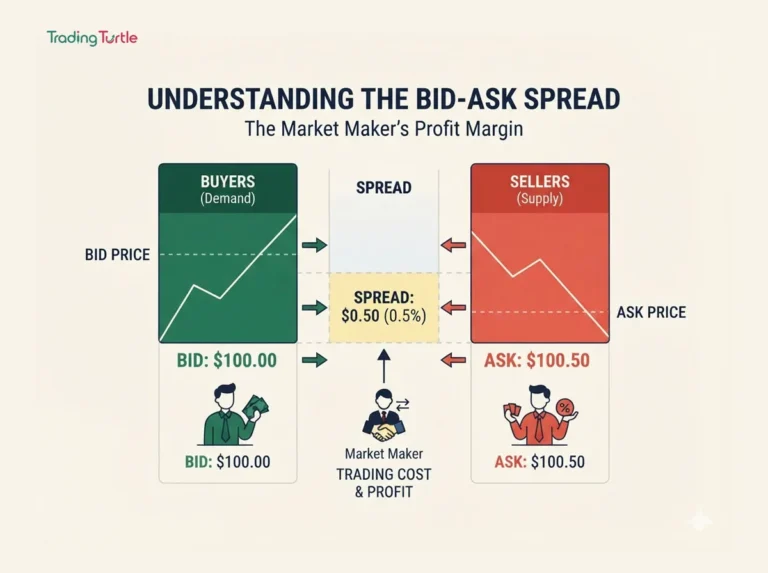
Liquidity and Bid-Ask Spread
A key part of what is liquidity in trading is understanding its relationship with the bid-ask spread.
The bid is generally the highest current price a buyer is willing to pay. The ask is generally the lowest current price a seller is willing to accept. The gap between them is the spread.
When many participants compete to buy and sell near the same price, the spread may be narrow. When buyers and sellers are far apart, the spread may widen.
A wider spread increases the immediate cost of entering and exiting. For example, if you buy at the ask and immediately sell at the bid, the loss is generally equal to the spread before brokerage, taxes, and other costs.
Read Bid-Ask Spread Explained to understand this execution cost in more detail.
Risk reminder: Do not judge liquidity using only the displayed bid-ask spread. A narrow spread with very little quantity behind it can still produce slippage if your order consumes the available volume at the best prices.
Liquidity and Slippage
Slippage occurs when your actual execution price differs from the price you expected. It can happen with market orders, stop-loss orders, and even some limit-order situations involving partial fills or rapid movement.
Liquidity is one major factor in slippage.
Example: Slippage in a thin market
Suppose a trader sees an ask price of ₹500 and submits a market buy order for 1,000 units. Only 100 units may be available at ₹500. The rest of the order may fill at higher prices, such as ₹501, ₹503, or ₹505.
The trader’s average buy price may be much higher than the original ₹500 quote. If they later need to exit quickly and the bid side is also thin, they may face further slippage.
When slippage risk increases
Slippage can become more likely when:
- The market is volatile.
- The order size is large relative to market depth.
- The asset has low market liquidity.
- Important economic, corporate, or regulatory news is released.
- The market is opening, closing, or otherwise transitioning.
- A stop-loss is triggered during a sharp move.
- A platform, exchange, or internet issue delays execution.
For an order-execution guide, read Market Order vs Limit Order.
How to Check Liquidity
There is no single perfect liquidity indicator. A practical assessment combines several observations.
1. Check the bid-ask spread
A consistently narrow spread may indicate stronger trading conditions than a wide spread. Compare the spread as a percentage of price, not only as an absolute amount.
2. Review market depth
Look at the quantity available at the best bids and asks, then inspect nearby levels. Ask whether your planned order could consume those levels.
3. Check recent volume
Review average daily volume and current-session volume. Look for consistent activity rather than a one-time spike caused by a headline or promotional event.
4. Observe price behaviour
Assets that jump sharply between trades, show large gaps, or move significantly on small orders may have lower liquidity.
5. Compare multiple time periods
A market can be liquid during peak hours and thin during quiet periods. Check activity around the time you actually intend to trade.
6. Consider the instrument itself
A liquid underlying asset does not guarantee liquid derivatives. For example, a major stock may be active, while a distant-expiry option or low-interest strike price may have a wide spread and limited depth.
7. Check scheduled events
Earnings, results, central-bank decisions, policy announcements, exchange maintenance, token unlocks, or major economic data can change market liquidity quickly.
Liquidity Across Markets
The answer to what is liquidity in trading varies by market because each market has different participants, trading hours, products, and rules.
Stocks
Large, widely traded stocks generally have more active buyers and sellers than thinly traded shares. Liquidity can still vary during the day and around results, corporate actions, or market-wide events.
Indices and index derivatives
Major index products may have strong liquidity because many traders, institutions, hedgers, and market participants use them. However, derivative liquidity can differ across expiries, strikes, and market conditions.
Options
Options require especially careful liquidity checks. An option can have a visible last traded price but limited current bids, asks, or depth. Always look beyond the last traded price before assuming you can enter or exit efficiently.
Futures
Liquidity may concentrate in the nearest or most actively traded contract. Deferred contracts can have weaker depth and wider spreads.
Crypto assets
Crypto markets operate continuously and liquidity can vary substantially by exchange, trading pair, token, and time of day. A price shown on one exchange may not be available on another. Smaller tokens may have limited depth and wider spreads, while sudden volatility can sharply reduce execution quality.
Forex
Major currency pairs often have different trading conditions from exotic pairs. Forex access, permitted products, execution models, leverage, and regulations differ by jurisdiction and provider.
Liquidity Risks
Understanding what is liquidity in trading also means understanding liquidity risk. Liquidity risk arises when you cannot buy or sell promptly at a reasonable price.
SEBI identifies liquidity risk as a situation in which an investment cannot be bought or sold promptly
Exit risk
You may have a profitable-looking position but be unable to sell the desired quantity at the displayed price. This can happen if buyers withdraw or if the bid side is too small.
Gap risk
An illiquid asset can move from one price level to another with few trades in between. Your stop-loss may trigger, but the eventual execution may be worse than expected.
Partial-fill risk
A limit order may execute only partly. You might end up with a smaller position than planned or an incomplete exit that still leaves risk in the market.
Manipulation and information risk
Thin markets can be more vulnerable to sudden order-book changes, promotional activity, and misleading signals. Visible orders can be cancelled, so depth should not be treated as a promise of future supply or demand.
Concentration risk
If your position is large relative to the asset’s liquidity, exiting can become difficult. The more your own order affects price, the more cautious you need to be.
How to Trade More Carefully
Use these steps to account for market liquidity before placing a trade:
- Choose instruments you can explain. Understand the stock, contract, token, or derivative before risking capital.
- Check bid, ask, and spread. Do not rely only on the last traded price.
- Review visible depth. Estimate whether your position size is reasonable compared with available quantities.
- Use suitable order types. Market orders prioritise execution; limit orders prioritise price control but may not fill.
- Reduce size in thinner markets. A smaller position can reduce your price impact and execution risk.
- Avoid impulsive orders around major news. Spreads and depth can change rapidly.
- Build realistic stop-loss expectations. A stop-loss can reduce risk but cannot guarantee a specific exit price.
- Track real fills in a journal. Compare planned and actual entry or exit prices to identify hidden execution costs.
- Use paper trading for process practice. Simulators may not perfectly represent live liquidity, but they can help build order discipline.
- Set a maximum risk per trade. Liquidity should be part of your position-sizing decision, alongside volatility and stop distance.
Visit the Risk Management for position sizing, stop-loss planning, drawdown control, and trading-risk foundations.
Common Mistakes
Avoid these common errors when evaluating what is liquidity in trading:
- Assuming high trading volume always means strong current liquidity.
- Looking only at the last traded price instead of bid, ask, spread, and depth.
- Using a large market order in a thin instrument.
- Entering an options contract without checking the current bid and ask.
- Ignoring liquidity because a chart pattern looks attractive.
- Treating visible order-book quantity as guaranteed; orders can be cancelled or changed.
- Carrying an oversized position in an asset that may be difficult to exit.
- Expecting a stop-loss to guarantee an exact exit price in fast markets.
- Trading just after a major announcement without reassessing spread and depth.
- Confusing an asset’s popularity with its actual market liquidity.
Key Takeaways
- What is liquidity in trading? It is the ability to buy or sell an asset quickly without substantially affecting its price.
- High market liquidity often means more active buyers and sellers, deeper order books, tighter spreads, and smoother execution for modest orders.
- Low liquidity can increase spread costs, slippage, partial fills, price gaps, and exit difficulty.
- Volume, bid-ask spread, and market depth are useful signals, but none should be assessed in isolation.
- Liquidity changes by market, instrument, time of day, volatility, and news conditions.
- A narrow spread does not guarantee sufficient depth for a large order.
- Order size should be appropriate for the available liquidity.
- Liquidity improves tradability; it does not guarantee safety, returns, or a precise exit price.
Educational disclaimer: This article is for educational purposes only and is not financial, investment, tax, or legal advice. Liquidity can change rapidly, especially during volatile markets and news events. Trading carries risk, and no level of liquidity guarantees a profit or an exact execution price.
– Frequently Asked Questions (FAQs)
Liquidity in trading means how easily you can buy or sell an asset without causing a large change in its price. A liquid asset usually has more active buyers and sellers.
Liquidity affects execution quality. Better liquidity can make it easier to enter or exit positions, while low liquidity can cause wider spreads, slippage, partial fills, and difficulty selling.
No. Volume shows how much has traded over a period, while liquidity also concerns the current availability of buyers and sellers near the market price. An asset can show high historical volume but have weak current order-book depth.
Check the bid-ask spread, current market depth, recent volume, frequency of trades, price gaps, and the quantity available at nearby bid and ask levels. Compare these with your intended order size.
Yes. Liquidity does not prevent price declines caused by market-wide selling, company news, economic events, or changing investor expectations. It mainly affects how efficiently an asset can be traded.
In a fast or thin market, there may be insufficient buyers or sellers at your trigger price. Once a stop-loss activates, the final fill can occur at the next available market prices, causing slippage.