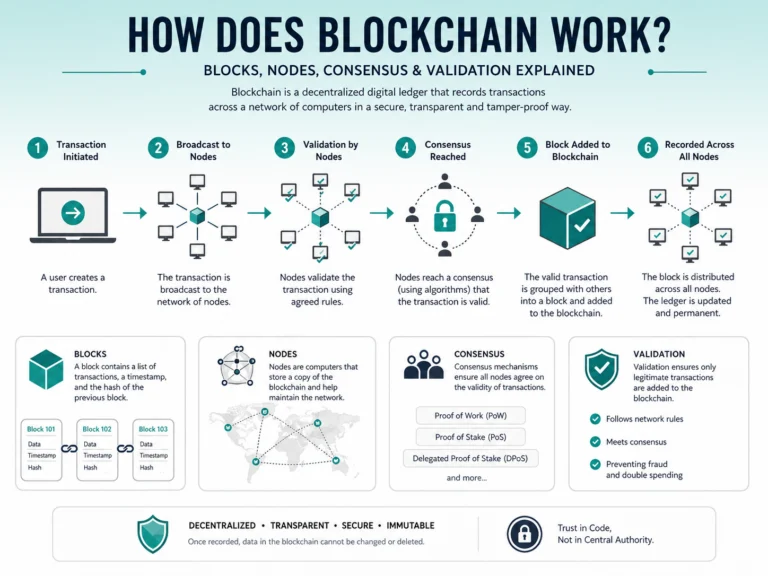
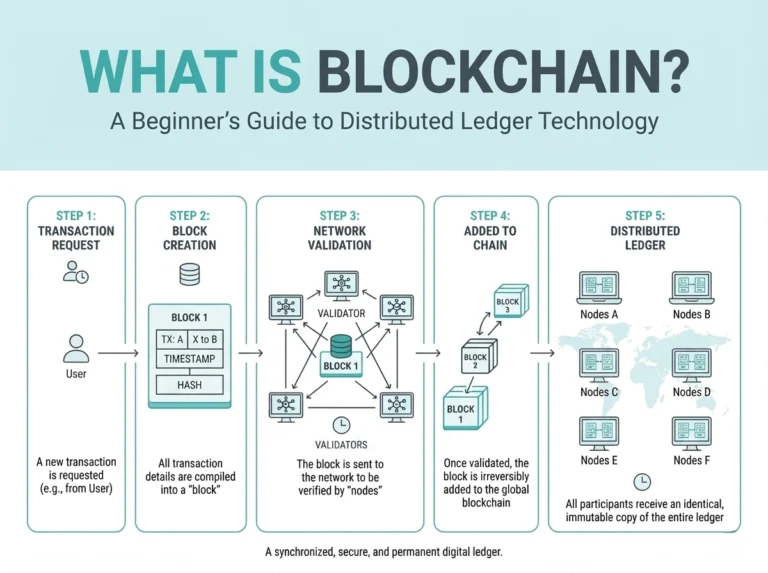
Public vs Private Blockchain: Differences, Use Cases and Limitations

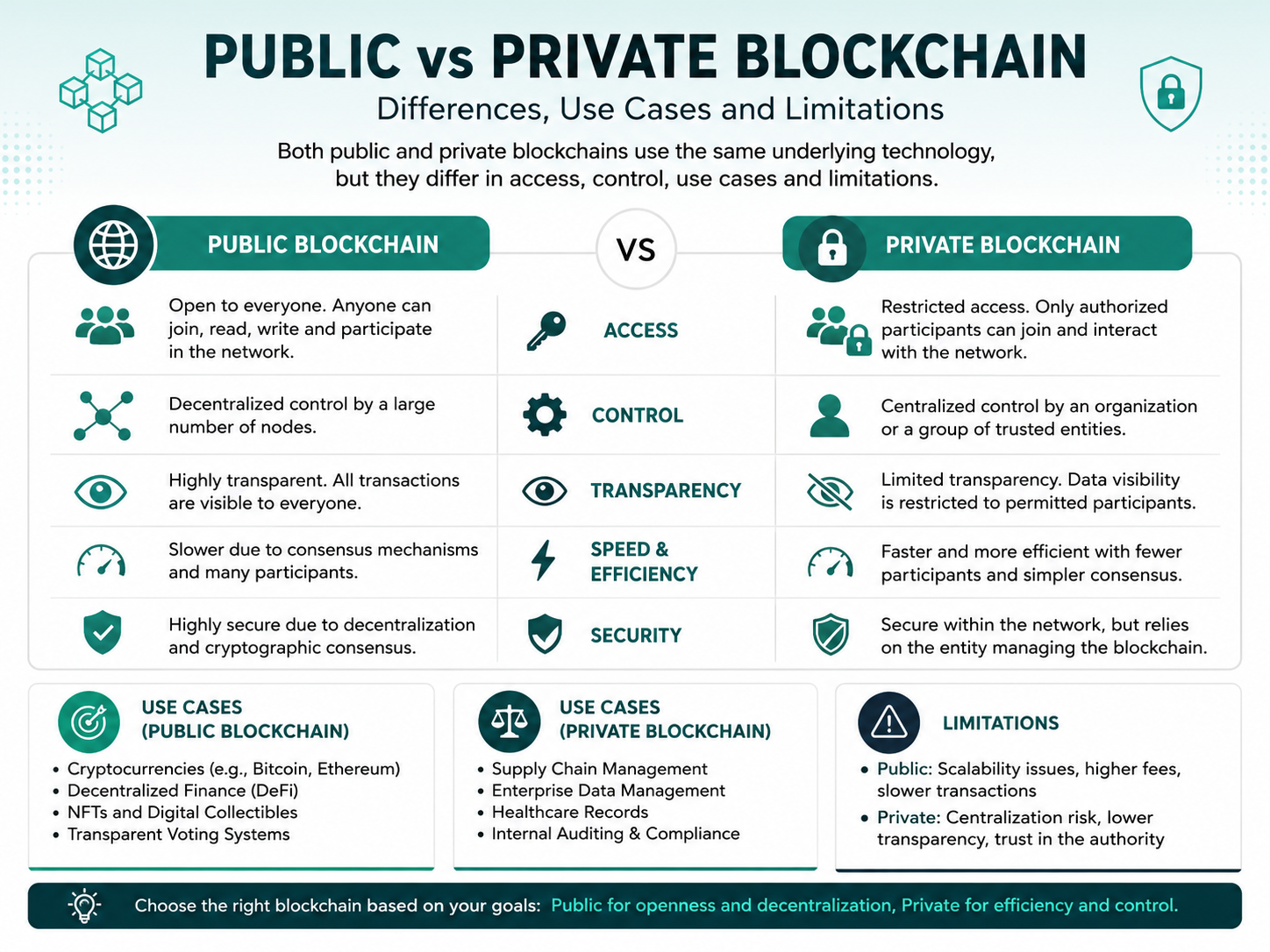
Quick answer: A public blockchain is designed for broad participation, while a private blockchain restricts access to an approved group. Compare who may read data, submit transactions, validate blocks and govern changes; the exact permissions depend on the network. Neither model is automatically better or safer.
What is a public blockchain?
A public blockchain is a network designed to allow broad participation. Depending on its specific rules, members of the public may be able to read transaction data, submit transactions, run nodes, or participate in block validation.
Public blockchains are commonly associated with open cryptocurrency networks and decentralised applications. They may use native digital assets, transaction fees, open-source software, and consensus mechanisms that do not require every participant to receive approval from a central administrator.
Typical features of public blockchains
A public blockchain may offer:
- Open or broad network access.
- Publicly inspectable transaction data.
- Participation from independent users and organisations.
- Distributed validation.
- Open-source or publicly available protocol rules.
- Native tokens or cryptocurrency incentives.
- Governance distributed across different groups.
The level of openness varies. Some public networks allow anyone to read data but restrict who can validate blocks. Others allow broader participation in both transaction submission and block production.
Education-only disclaimer: This article is for general educational purposes only. It is intended for general education and is not financial, legal, tax, technology-procurement, or cybersecurity advice. Blockchain networks involve technical, operational, governance, privacy, and regulatory risks.
Strengths of public blockchains
The main strength of a public blockchain is open participation. Users do not necessarily need to trust one company or consortium to maintain the entire record.
Public networks may also provide:
- Transparent transaction histories.
- Censorship resistance.
- Global accessibility.
- Interoperability with public applications.
- Programmable digital assets.
- Independent verification through network nodes.
These characteristics can be useful when participants do not already share a trusted central administrator.
Limitations of public blockchains
Public blockchains can involve:
- Variable transaction fees.
- Network congestion.
- Publicly visible activity.
- Limited transaction throughput.
- Complex governance.
- Irreversible transactions.
- Smart-contract vulnerabilities.
- Dependence on wallets and private keys.
- Difficulty correcting incorrect information.
Public visibility does not mean complete personal transparency. Addresses may not display a person’s name directly, but transaction activity can sometimes be analysed or linked to real-world identities.
What is a private blockchain?
A private blockchain is a network controlled by one organisation or a defined group of organisations. Participation may require approval, and access to transactions, validation, or network operations may be restricted.
A private blockchain may be used by a company, government department, industry consortium, or group of institutions that already have an established relationship.
The National Institute of Standards and Technology (NIST) distinguishes permissionless networks, where anyone may publish blocks, from permissioned networks, where only approved users may do so.
Typical features of private blockchains
A private blockchain may include:
- Approved participants.
- Restricted data visibility.
- Identified validators.
- Central or consortium-based governance.
- Controlled membership.
- Faster or more predictable processing.
- Greater ability to correct or manage operational issues.
- Integration with existing enterprise systems.
The word “private” can refer to who may access the network, who can view data, or who can validate transactions. These functions may be controlled separately.
Strengths of private blockchains
Private blockchains may be useful where organisations need:
- Confidentiality.
- Defined participant identity.
- Predictable processing.
- Controlled access.
- Selective information sharing.
- Internal auditability.
- Automated workflows.
- Shared records without giving control to one database administrator.
For example, a group of organisations may use a private network to coordinate records while allowing only approved members to validate updates.
Limitations of private blockchains
A private blockchain may introduce:
- Reliance on a central operator or consortium.
- Reduced censorship resistance.
- Fewer independent validators.
- Governance disputes between known participants.
- Greater risk of administrator control.
- Limited public verifiability.
- Vendor or infrastructure dependence.
- Potential duplication of traditional database functions.
A private blockchain is not automatically decentralised. If one organisation can change records, approve participants, alter protocol rules, or stop the network, the system depends substantially on that organisation.
Public vs private blockchain: key differences
The central difference in public vs private blockchain architecture is who can participate and who controls access.
| Feature | Public blockchain | Private blockchain |
|---|---|---|
| Participation | Generally open or broadly accessible | Restricted to approved participants |
| Validator access | May be open or distributed | Usually controlled by an organisation or consortium |
| Data visibility | Often publicly inspectable | May be limited to selected participants |
| Governance | Distributed, community-based, or protocol-driven | Centralised or consortium-based |
| Identity | May use pseudonymous addresses | Usually linked to known participants |
| Consensus | May use proof of work, proof of stake, or another open model | May use approved validators or simpler consensus |
| Performance | Can vary with public demand | Often more predictable |
| Privacy | Public transparency may limit confidentiality | Access controls may improve confidentiality |
| Main trust model | Trust in protocol and distributed participants | Trust in governing organisation or consortium |
| Common uses | Cryptocurrency, public tokens, decentralised applications | Enterprise records, controlled workflows, consortium data sharing |
This comparison is general. A network can combine characteristics, such as public data with permissioned validation or private data channels within a broader public ecosystem.
Public and private versus permissionless and permissioned
The terms are often used interchangeably, but they describe different dimensions.
Public and private
Public and private may describe:
- Who can view the ledger.
- Who can access the network.
- Whether the network is openly available.
- Whether data is visible to a broad audience.
Permissionless and permissioned
Permissionless and permissioned generally describe who can perform specific network functions, especially reading, submitting transactions, validating, or publishing blocks.
A permissionless network may allow anyone who meets the protocol requirements to participate. A permissioned network may require approval.
NIST explains that if anyone can publish a new block, a network is permissionless in that respect; if only particular users can publish blocks, it is permissioned.
Why the distinction matters
A network can be:
- Public and permissionless.
- Public and permissioned.
- Private and permissioned.
- Private with restricted reading but broader internal writing.
- Open for transactions but restricted for validation.
Therefore, asking only whether a blockchain is “public” or “private” may not provide enough information. A proper evaluation should ask who can read, submit, validate, upgrade, audit, and govern the network.
Consensus and governance
Consensus in public blockchains
Public blockchains generally need a consensus mechanism that can coordinate participants who may not know or trust one another.
The network must address questions such as:
- Who can propose a block?
- How are invalid transactions rejected?
- How are conflicting blocks resolved?
- How are dishonest actions discouraged?
- How is the ledger protected from double-spending?
- How are protocol upgrades approved?
Public networks may use proof of work, proof of stake, delegated models, or other mechanisms.
Consensus in private blockchains
A private blockchain may have known participants and approved validators. Because the network members are identified, it may not need the same type of open economic competition used by some public networks.
NIST notes that permissioned blockchains do not generally need expensive proof-of-work-style mechanisms and may use simpler consensus approaches.
This can improve efficiency, but it changes the trust model. Users depend more heavily on the organisations responsible for selecting validators and managing the network.
Governance differences
Public blockchain governance may involve:
- Developers.
- Validators or miners.
- Token holders.
- Application developers.
- Users.
- Foundations or other organisations.
Private blockchain governance may be controlled by:
- One company.
- A consortium.
- A government body.
- A designated administrator.
- A group of approved institutions.
A public network may be difficult to change quickly. A private network may be easier to upgrade but more vulnerable to unilateral control or governance disputes.
Privacy, transparency, and data access
Public blockchain transparency
Public networks often make transaction data visible to anyone who can inspect the ledger. This can support independent auditability and public verification.
However, transparency can create privacy concerns. Even when addresses do not display names, transaction patterns may reveal relationships, balances, trading behaviour, or organisational activity.
Users should not assume that pseudonymous addresses provide complete anonymity.
Private blockchain confidentiality
Private networks can restrict access to transaction records and participant identities. This may be useful for commercial records, financial data, supply chains, healthcare systems, or internal workflows.
However, private does not mean perfectly confidential. The network operator, consortium members, infrastructure providers, administrators, or authorised participants may still be able to access data.
The quality of privacy depends on:
- Access-control design.
- Encryption.
- Key management.
- Node permissions.
- Data-sharing policies.
- Administrator privileges.
- Internal monitoring.
- Legal and governance controls.
Performance and scalability
Public networks may experience congestion because they serve a large and unpredictable user base. When demand rises, fees may increase and confirmation times may become less predictable.
A private blockchain can limit participation and use approved validators. This may support more predictable performance and lower coordination costs.
However, performance is not determined only by the public-or-private label. It also depends on:
- Block size.
- Transaction complexity.
- Consensus mechanism.
- Network hardware.
- Number of validators.
- Data-storage design.
- Smart-contract execution.
- Communication between nodes.
- Governance and upgrade processes.
A private blockchain may perform efficiently because it operates under controlled conditions. A public blockchain may sacrifice some efficiency to provide broader access and independent participation.
Public blockchain use cases
Public blockchain networks may be suitable for applications that benefit from open participation and public verification.
Examples include:
Public cryptocurrency networks
Cryptocurrency networks use blockchain records to track balances, transactions, and network state without relying entirely on one central institution.
Public token systems
Public blockchains can issue fungible tokens, stablecoins, governance tokens, and non-fungible tokens that users can transfer through compatible wallets and applications.
Decentralised applications
Public smart-contract platforms can support applications for token exchange, lending, gaming, identity, collectibles, and other services.
Public audit trails
A public network can provide a visible record of events where public verification is valuable. However, it does not prove that the original information was truthful.
Private blockchain use cases
Private networks may be considered when participants are known and data access must be controlled.
Examples include:
Supply-chain coordination
A group of manufacturers, logistics providers, and distributors may share selected records while restricting access to sensitive commercial data.
Financial settlement
Financial institutions may use controlled distributed ledgers for settlement, reconciliation, or shared reporting, subject to applicable laws and operational requirements.
Identity and credentials
A permissioned system may help approved organisations issue or verify credentials without exposing every record publicly.
Internal recordkeeping
An organisation may use a private blockchain when multiple departments or entities need a shared, auditable record but do not want to rely on one department’s database.
The CFTC has discussed permissioned ledger networks in connection with clearing, settlement, supply-chain management, reporting, and compliance-related processes.
Advantages and limitations at a glance
Public blockchain advantages
Public networks may provide:
- Broader access.
- Independent verification.
- Greater censorship resistance.
- Open innovation.
- Public auditability.
- Wider network effects.
Public blockchain limitations
They may also involve:
- Variable cost and performance.
- Limited privacy.
- Complex governance.
- Public fraud and scam exposure.
- Irreversible user errors.
- Greater technical complexity.
Private blockchain advantages
Private networks may provide:
- Controlled membership.
- Improved confidentiality.
- Faster coordination.
- Predictable performance.
- Easier governance.
- Integration with existing business processes.
Private blockchain limitations
They may also involve:
- Centralised control.
- Reduced transparency.
- Dependence on administrators.
- Fewer independent validators.
- Consortium disputes.
- Limited interoperability.
- Potentially unnecessary complexity compared with a traditional database.
How to choose between public and private blockchain
The public vs private blockchain decision should start with the problem, not with the popularity of the technology.
Ask the following questions:
- Who needs to participate?
- Do participants already trust one another?
- Does the ledger need to be publicly auditable?
- Is transaction data confidential?
- Who should be allowed to validate records?
- Who can change the network rules?
- What performance and cost levels are required?
- What happens if an administrator fails?
- How will identities and access permissions be managed?
- Is a blockchain actually better than a conventional database?
If all participants trust one administrator and the primary requirement is fast, private data storage, a traditional database may be simpler.
If multiple organisations need a shared record and no single participant should control it entirely, a distributed ledger may provide a useful alternative.
Key takeaways
- Public vs private blockchain describes two broad approaches to network access, participation, visibility, and control.
- A public blockchain generally allows broader participation, while a private blockchain restricts access to approved users or organisations.
- Public networks often prioritise openness and wider decentralisation; private networks may prioritise privacy, control, efficiency, and predictable performance.
- “Public versus private” and “permissionless versus permissioned” are related but not identical terms.
- Neither architecture is automatically better. The appropriate design depends on the use case, participants, data sensitivity, governance requirements, and performance needs.
- A private blockchain may reduce some public-network risks but can introduce greater dependence on a governing organisation or consortium.
– Frequently Asked Questions (FAQs)
A public blockchain generally allows broader participation and visibility, while a private blockchain restricts access to approved users or organisations. The exact differences depend on the network’s permission, governance, and data-visibility design.
It may be partly or substantially centralised. If one organisation controls participation, validators, upgrades, or data access, the network relies heavily on that organisation.
Not automatically. Public blockchains may benefit from broader participation, but they can face attacks, smart-contract risks, scams, and governance challenges. Private blockchains may restrict access but depend more on administrators and approved participants.
They can be more predictable or efficient because they use a limited group of known validators. Performance depends on the specific architecture, hardware, consensus model, and transaction workload.
No. Permissioned describes who can perform certain network functions. A network may restrict validation while allowing broader visibility of selected data.
Many widely used cryptocurrencies operate on public or broadly accessible networks. However, cryptocurrency can also be used within private or permissioned systems.
Public blockchains can use encryption, privacy technologies, zero-knowledge methods, or off-chain systems, but users should not assume that public transaction data is private by default.