NIFTY Bank vs NIFTY 50: Exposure, Concentration and Risk

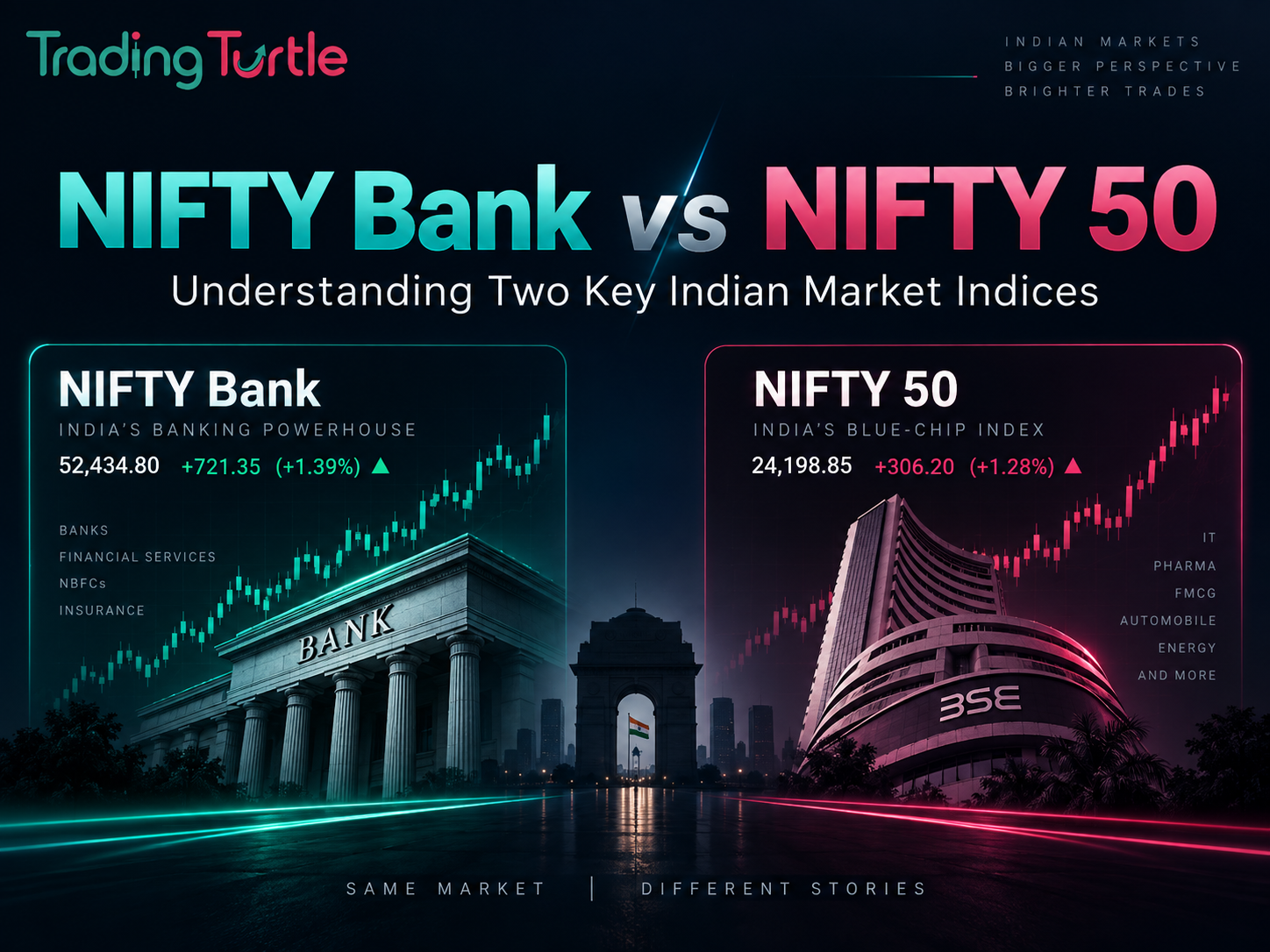
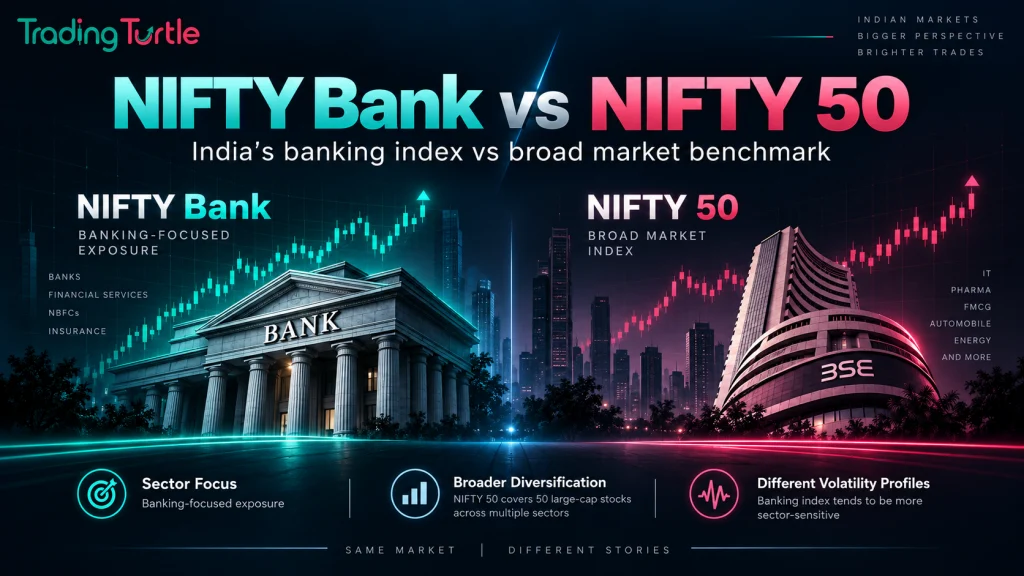
NIFTY 50 and NIFTY Bank are two of the most watched indices in India, but they measure very different things.
NIFTY 50 is a broad-market large-company benchmark spanning important sectors of the economy.
NIFTY Bank is a sectoral index focused on banking companies.
That single distinction explains many of the differences traders notice. NIFTY Bank can move more sharply when interest-rate expectations, bank earnings, credit growth or financial-sector news changes. NIFTY 50 can be influenced by banks too, but also by technology, energy, consumer businesses and other large sectors.
The useful NIFTY Bank vs NIFTY 50 comparison is therefore not “Which one is better?” It is “What exposure does each index represent, and why can their behaviour differ?”
Key Takeaways
Educational disclaimer: This article is for education only. Index composition, methodology and constituent weights can change. Verify current facts using NSE Indices methodology and factsheets before publishing or making investment decisions.
- NIFTY 50 is a diversified 50-stock broad-market index; NIFTY Bank is a banking-sector index.
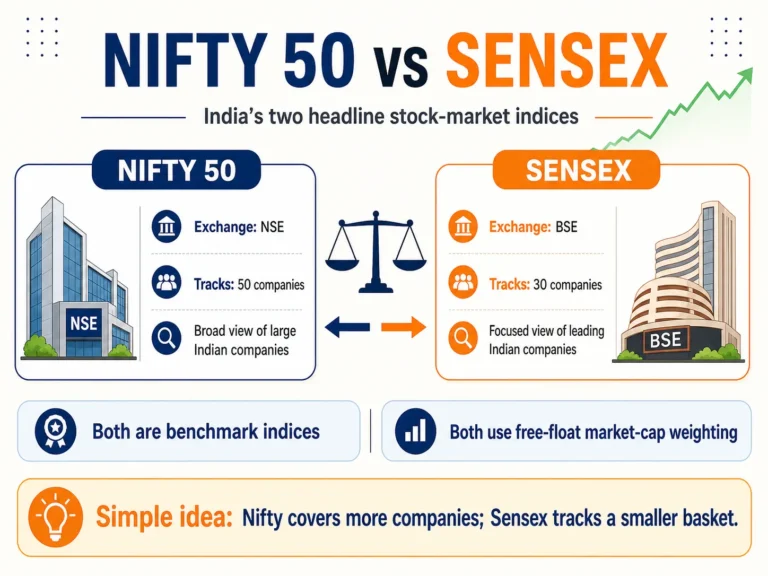
- NIFTY 50 uses free-float market-cap weighting under NSE Indices methodology.
- NIFTY Bank contains eligible banking-sector stocks under its own methodology.
- Banks can have a significant influence on NIFTY 50, but NIFTY 50 is not a pure banking bet.
- NIFTY Bank is more concentrated in one sector, so bank-specific events can have a larger effect.
- Both indices have exchange-traded derivatives, subject to current contract specifications.
- Index levels cannot be compared directly by saying one is “more expensive” because index point values use different base histories and constituent structures.
What Is NIFTY 50?
NIFTY 50 is a 50-stock benchmark designed to represent important sectors of the Indian economy.
According to current NSE Indices methodology, eligible stocks are selected under defined liquidity and eligibility criteria, and the index is weighted using free-float market capitalisation.
The index has a base date of 3 November 1995 and base value of 1,000.
As of the 2026 methodology, NIFTY 50 is reviewed semi-annually under the index rules.
Official current information: NIFTY 50 – NSE Indices.
What Is NIFTY Bank?
NIFTY Bank is a sectoral index designed to capture the performance of large and liquid Indian banking stocks that meet the relevant eligibility requirements.
NSE Indices describes it as a benchmark representing the capital-market performance of Indian banks.
Its methodology limits the universe to banking-sector companies that meet specified criteria.
Current information: NIFTY Bank – NSE Indices.
Because every constituent belongs to the banking sector, NIFTY Bank is much more concentrated economically than NIFTY 50.
NIFTY Bank vs NIFTY 50: Quick Comparison
| Feature | NIFTY 50 | NIFTY Bank |
|---|---|---|
| Index type | Broad market | Sectoral |
| Main exposure | Large companies across multiple sectors | Banking sector |
| Weighting | Free-float market-cap weighted | Methodology-defined banking index weighting |
| Economic diversification | Higher | Lower, banking-focused |
| Main drivers | Broad earnings, sectors, economy, global factors | Bank earnings, rates, credit, asset quality, financial-sector policy |
| Derivatives | Futures/options available subject to current NSE specs | Futures/options available subject to current NSE specs |
| Suitable use | Broad market benchmark | Banking-sector benchmark |
Do not copy old constituent counts or weight caps without checking the latest factsheet because methodology can change.
Why Does NIFTY Bank Sometimes Move More Than NIFTY 50?
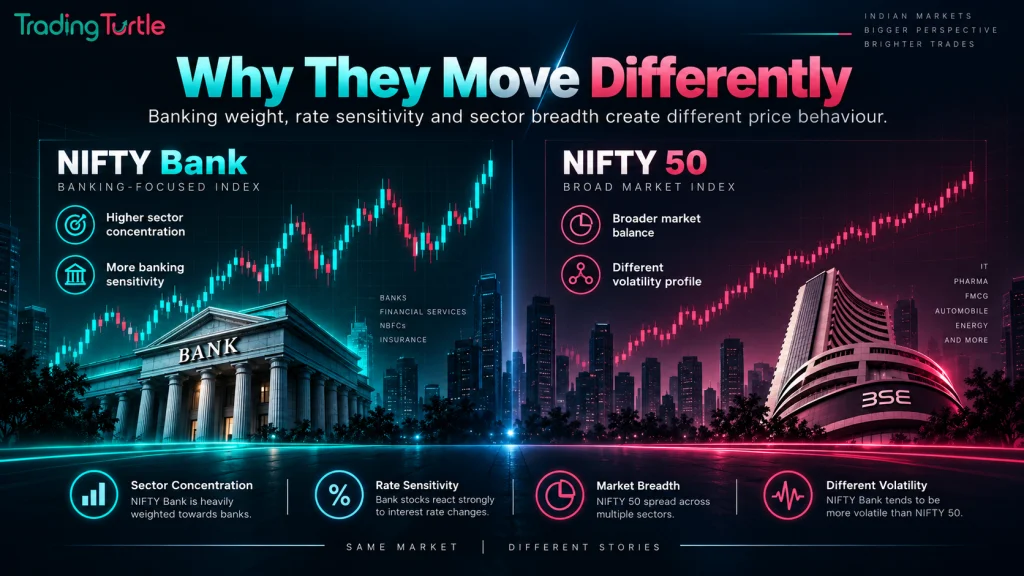
Sector concentration is the main reason.
If banking stocks fall sharply because of a sector-specific concern, almost every NIFTY Bank constituent can be affected together.
NIFTY 50 may also decline because banks are important constituents, but gains in technology, energy, consumer or other sectors can partly offset the banking weakness.
The reverse can also happen. Strong bank earnings can lift NIFTY Bank sharply while the broader NIFTY 50 remains subdued because other sectors are weak.
Banking Exposure Inside NIFTY 50
NIFTY 50 itself includes major financial companies when they meet the methodology.
That means the two indices are not independent.
If large banks make major moves, NIFTY 50 can respond strongly too.
However, NIFTY 50 contains companies from multiple sectors, so its return is the weighted result of the entire basket.
This overlap is why traders sometimes see both indices moving in the same direction but by different magnitudes.
Sector Risk vs Broad-Market Risk
NIFTY Bank concentrates sector risk.
Bank profitability can be influenced by:
- interest-rate environment;
- net interest margins;
- credit demand;
- deposit growth;
- non-performing assets;
- provisions;
- regulatory policy;
- bond yields;
- economic cycle.
NIFTY 50 spreads exposure across more industries, although it still remains concentrated in large companies and is not the entire Indian stock market.
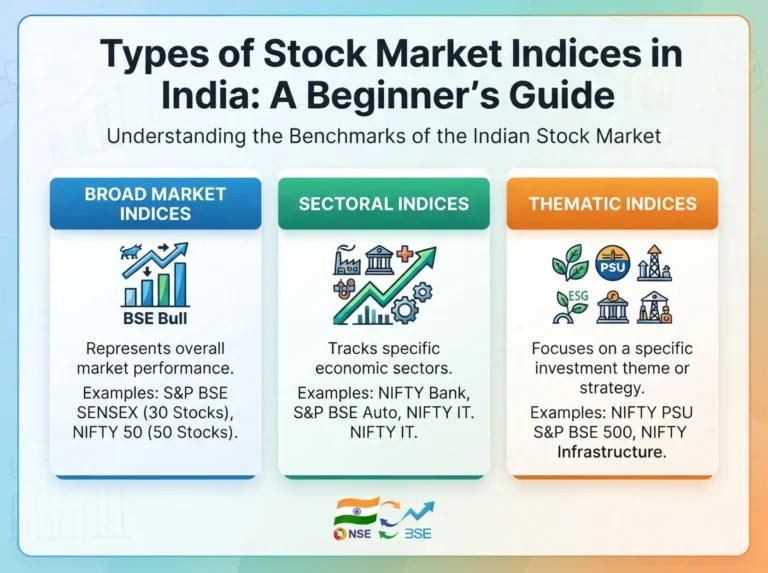
Read Types of Stock Market Indices in India for broad-market versus sectoral index categories.
NIFTY 50 Weighting
NIFTY 50 uses a free-float market-capitalisation weighted method.
Free-float market capitalisation is based on shares considered available for public trading rather than the company’s total shares including strategic/promoter holdings excluded under the methodology.
Larger free-float companies receive larger weights, subject to methodology rules.
This means a 2% move in a very high-weight constituent can affect the index more than the same 2% move in a small-weight constituent.
Our separate article How NIFTY 50 Is Calculated explains this in detail.
NIFTY Bank Weighting and Methodology
NIFTY Bank has its own eligibility and weighting rules as a sectoral index.
The methodology can be updated over time, including eligibility requirements and concentration controls.
For that reason, avoid memorising old weight caps from blogs.
Before publishing current numbers, check:
- latest NIFTY Bank factsheet;
- latest equity-index methodology document;
- recent NSE Indices press releases.
The stable educational point is that the index represents banking stocks and is designed under rules, not manually chosen every day.
Can You Compare the Index Point Levels?
No meaningful conclusion can be drawn from saying:
“NIFTY Bank is at 60,000 while NIFTY 50 is at 25,000, so NIFTY Bank is more expensive.”
Index levels are mathematical values based on their own base date, base value, divisor and constituent market capitalisation.
A higher numerical index level does not mean the constituent companies are more expensive.
Valuation requires measures such as earnings, book value, cash flow and other fundamentals—not the raw index point number.
NIFTY Bank vs NIFTY 50 Volatility
NIFTY Bank often appears more volatile because it is concentrated in one cyclical sector and contains heavily traded bank stocks.
But volatility changes over time.
During a technology shock, an energy event or broad global crisis, NIFTY 50 can also experience extreme movement.
Instead of assuming a fixed volatility relationship, measure recent realised volatility or ATR for the period you are trading.
If one index has a wider normal daily range, your stop distance and position size should adjust accordingly.
NIFTY Bank vs NIFTY 50 for Technical Analysis
Technical-analysis concepts apply to both:
- trend;
- support/resistance;
- market structure;
- volume or derivatives context;
- volatility.
But a setup should not use identical stop distances simply because both are indices.
A 100-point movement has a different percentage meaning on different index levels and different volatility regimes.
Use percentage or volatility-normalised measures rather than raw points alone.
Derivatives on NIFTY 50 and NIFTY Bank
NSE offers futures and options based on these indices, subject to current contract specifications and regulatory/exchange rules.
Derivatives introduce:
- leverage;
- margin requirements;
- expiry;
- time decay for options;
- implied volatility;
- gap risk;
- potentially rapid losses.
Contract sizes and expiry structures can change through exchange circulars. Verify current information on NSE before publishing any lot-size or expiry detail.
A beginner should understand the index itself before trading a leveraged product linked to it.
Why Traders Watch Both Indices Together
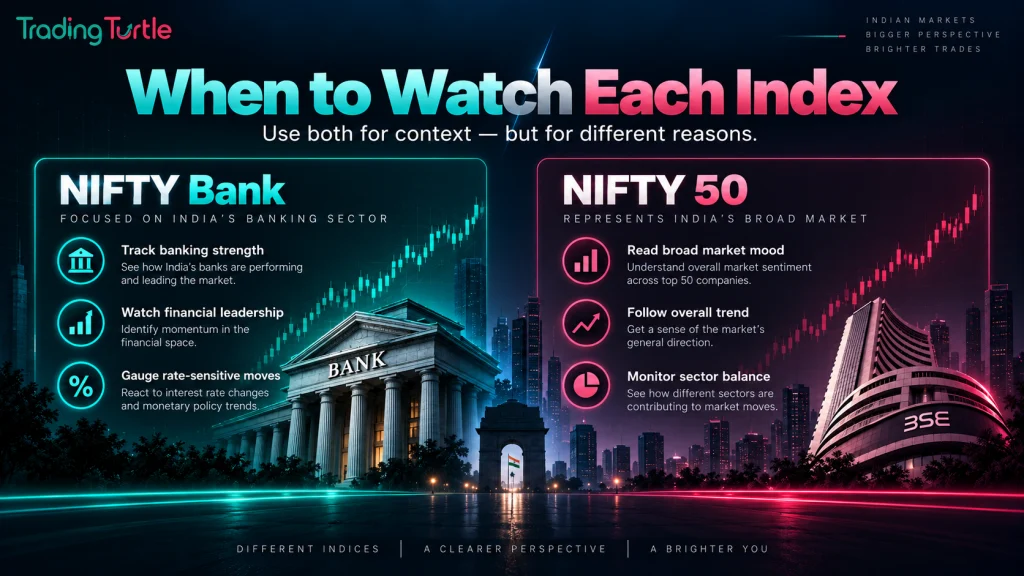
Comparing NIFTY Bank and NIFTY 50 can provide market context.
Example:
- NIFTY 50 breaks to a new high;
- NIFTY Bank remains below resistance;
- several large banks are weak.
That divergence may tell you the broad-market move is being driven more by non-bank sectors.
Another day:
- NIFTY Bank rises sharply;
- NIFTY 50 rises modestly;
- bank earnings drive the session.
This is descriptive context, not a trading signal by itself.
NIFTY Bank vs NIFTY 50 for Investors
Long-term investors usually gain exposure to indices through index funds or ETFs rather than buying an “index” directly.
A NIFTY 50 product aims to track a broad-market benchmark.
A NIFTY Bank product concentrates exposure in banking.
That changes diversification.
Sector exposure can outperform for periods and underperform for long periods. Concentration increases dependence on one industry’s cycle.
Before investing, review:
- product tracking difference;
- expense ratio;
- liquidity;
- taxation;
- index methodology;
- your existing portfolio exposure.
This article does not recommend either index product.
NIFTY Bank vs NIFTY 50 During Interest-Rate Changes
Banks are sensitive to the interest-rate environment, but the relationship is not as simple as “rates up = banks down” or “rates down = banks up.”
Rates can affect:
- loan yields;
- deposit costs;
- margins;
- bond portfolios;
- credit demand;
- asset quality;
- economic growth expectations.
Different banks can respond differently.
NIFTY 50 also reacts because rate changes influence valuations and business conditions across many sectors.
Avoid one-line macro rules.
Common Comparison Mistakes
Mistake 1: Treating index points as valuation
A 60,000 index is not automatically more expensive than a 25,000 index.
Mistake 2: Assuming NIFTY 50 is the entire market
It is a selected 50-stock benchmark, not every listed Indian company.
Mistake 3: Assuming NIFTY Bank is only private banks
Constituent eligibility follows current methodology. Check the latest list rather than relying on old assumptions.
Mistake 4: Using identical trading risk on both indices
Volatility can differ.
Mistake 5: Quoting old lot sizes or expiry rules
Derivatives specifications change. Verify them immediately before publication or trading.
Mistake 6: Calling one index “safer” without context
Broad diversification can reduce sector concentration, but market risk remains.
A Beginner Comparison Checklist
When comparing NIFTY Bank vs NIFTY 50, ask:
- Is my question about the broad market or banking sector?
- What sectors are driving NIFTY 50 today?
- Are major banks moving with or against the broad index?
- What is recent volatility in percentage terms?
- Am I comparing index levels incorrectly?
- If using derivatives, have I checked current contract specifications?
- If investing through a fund/ETF, what tracking and cost differences apply?
- Does my existing portfolio already contain heavy banking exposure?
Final Takeaway
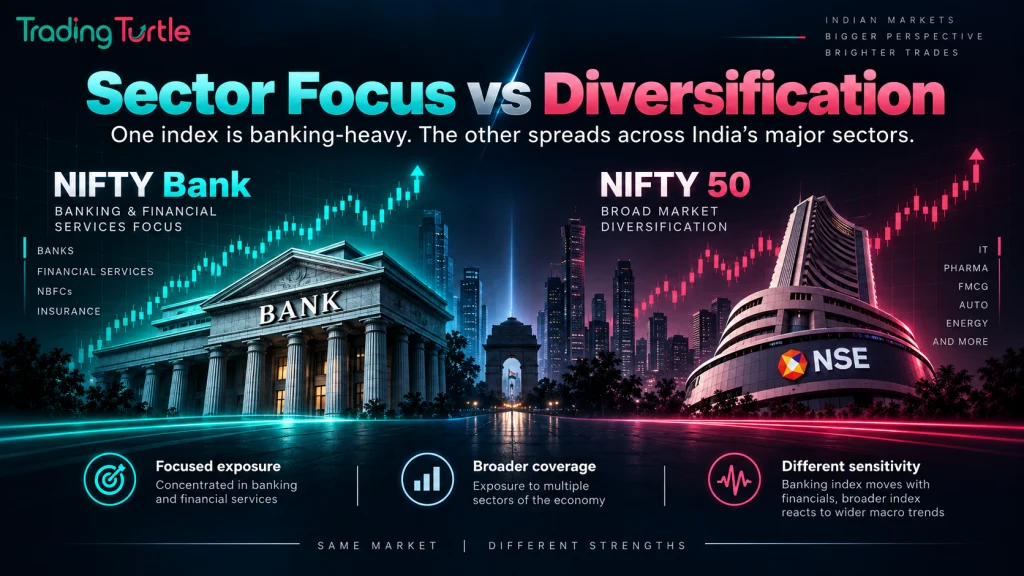
NIFTY Bank vs NIFTY 50 is fundamentally a sector index versus broad-market index comparison.
NIFTY 50 spreads exposure across 50 large companies from important sectors and uses free-float market-cap weighting. NIFTY Bank concentrates on banking stocks under its own sectoral methodology.
That concentration can make NIFTY Bank react more strongly to bank-specific conditions, while NIFTY 50 reflects a wider mix of corporate and economic drivers.
Neither index is automatically better. Use the one that matches the question you are trying to answer, and verify current methodology before relying on detailed constituent or derivatives information.
Frequently Asked Questions (FAQs)
They are separate indices. Several major banking companies can be constituents of NIFTY 50 while also being represented in NIFTY Bank if they meet the relevant methodologies.
It can be more volatile because it is concentrated in one sector and banking stocks can respond strongly to rates, credit and financial-sector news. The relationship varies over time.
No. NIFTY Bank is a banking-sector index with a constituent count determined by its current methodology. Check the latest NSE Indices factsheet for the current composition.
You cannot buy an index value itself. Investors typically use index funds, ETFs or other products designed to track an index. Traders may use derivatives, which add leverage and other risks.
There is no universal answer. A broad-market index and a sector index serve different purposes. Beginners should understand diversification, volatility and product structure before choosing exposure.
“Bank Nifty” is a common market name used for the NIFTY Bank index.