

Trading becomes much easier to understand once the language stops getting in the way. New traders often meet dozens of unfamiliar words at the same time: bid, ask, spread, liquidity, market order, support, margin, drawdown, funding rate, market capitalisation and many more.
This trading glossary explains the most useful trading terms in plain language and groups them by topic so you can find what you need quickly. The goal is not to memorise a dictionary. It is to understand enough trading terminology to read a chart, place an order, evaluate risk and follow market information without guessing what the words mean.
The definitions are intentionally concise. Where Trading Turtle already has a full guide on a concept, this trading glossary links to that deeper explanation instead of repeating an entire article.
How to Use This Trading Glossary
You can read the page from top to bottom, but this trading glossary is designed primarily as a reference. The terms are grouped into seven sections:
- Market basics
- Orders and execution
- Charting and technical analysis
- Risk and trade management
- Stocks and investing
- Derivatives and leverage
- Crypto and digital assets
If a term is completely new, read its definition first and then follow the internal link when you need more context. That keeps this trading glossary useful as a quick reference without turning every definition into a full lesson.
Educational disclaimer: This trading glossary is for educational purposes only and does not provide personalised investment, trading, tax or legal advice. Trading and investing involve risk of loss. Product names, exchange rules, broker terminology and platform features can differ by market and may change over time.
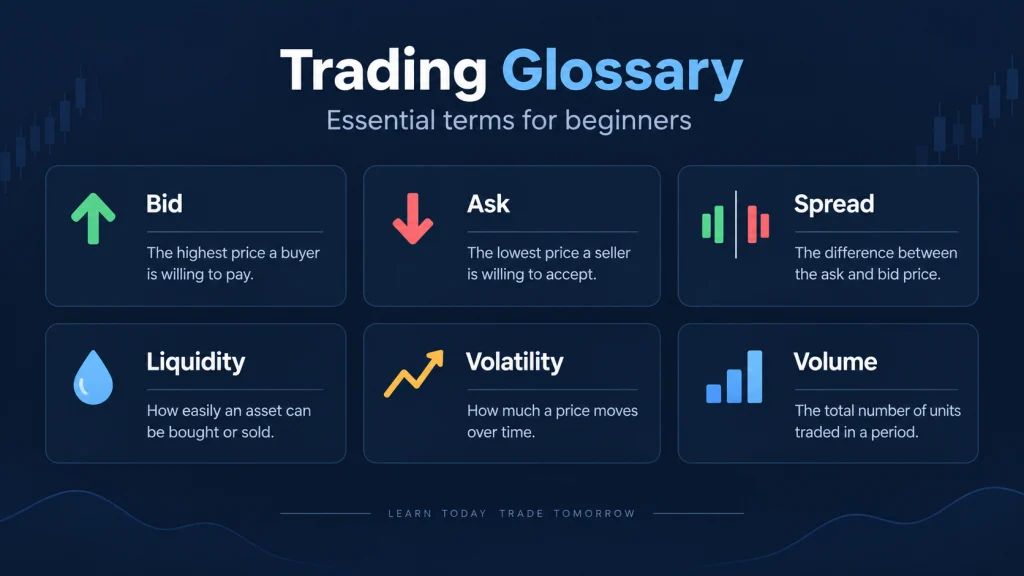
Trading Glossary: Market Basics
This section of the trading glossary covers the basic words used to describe markets, prices, participants and trading activity.
Asset: Anything with economic value that can be owned, traded or invested in. Examples include shares, bonds, commodities, currencies and cryptocurrencies.
Ask price: The lowest price at which a seller is currently willing to sell an asset. A market buy order normally interacts with available ask prices.
Bid price: The highest price at which a buyer is currently willing to buy an asset. A market sell order normally interacts with available bid prices.
Bid-ask spread: The difference between the best available bid and ask prices. A wider spread generally means a higher immediate trading cost and can be a sign of weaker liquidity. Read our guide to the bid-ask spread for examples.
Broker: A regulated intermediary or platform that provides access to financial markets and routes eligible orders to exchanges or other trading venues. Services, fees and responsibilities vary by broker and jurisdiction.
Exchange: An organised marketplace where eligible securities, derivatives or other assets are bought and sold under defined rules. Examples in India include NSE and BSE.
Liquidity: The ability to buy or sell an asset without causing a large price change. Highly liquid markets usually have more active buyers and sellers, tighter spreads and deeper available quantity. See what liquidity means in trading.
Market capitalisation: The total market value of a company’s outstanding shares, usually calculated as share price multiplied by the number of outstanding shares.
Market price: The price at which an asset is currently trading or the best available price in the market. The displayed last traded price may differ from the price at which your own order eventually executes.
Order book: A list of active buy and sell orders at different price levels. Order books can help traders assess visible demand, supply, spread and depth, although displayed orders can change or be cancelled.
Ticker symbol: A short code used to identify a listed security or instrument on a trading platform or exchange.
Trading volume: The amount of an asset traded during a specified period. In stocks, volume often refers to the number of shares traded. In other markets, the exact measure can differ.
Volatility: The degree to which price changes over time. High volatility means price is moving more sharply or unpredictably than usual; low volatility means price movement is relatively subdued.
As you move through this trading glossary, notice that several terms describe different parts of the same execution process.
Market depth: The quantity of buy and sell orders available at multiple price levels. A market can display a narrow spread but still have poor depth for a large order.
Market participant: Any person or institution active in a market, including retail traders, investors, market makers, funds, brokers and other financial institutions.
These terms form the foundation of the trading glossary because they describe the environment in which orders are matched and prices are formed.
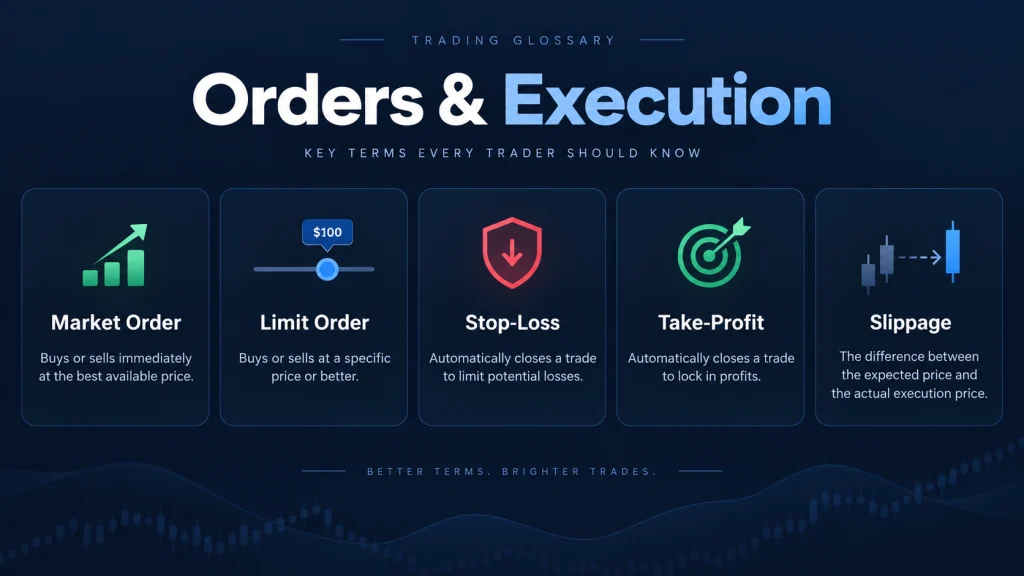
Trading Glossary: Orders and Execution
Use this part of the trading glossary when a broker or exchange screen uses order terminology that is unfamiliar.
Market order: An instruction to buy or sell as soon as possible at the best currently available price. A market order prioritises execution rather than a specific price. Our market order vs limit order guide explains the trade-off in detail.
Limit order: An order to buy or sell only at a specified price or better. It provides more price control than a market order, but execution is not guaranteed.
Stop-loss order: A conditional order designed to activate when price reaches a chosen trigger level. Traders use stop-loss orders as part of risk management, but the final execution price can differ from the trigger. Read what a stop-loss order is.
Stop-limit order: A stop order that becomes a limit order after its trigger condition is reached. It gives more control over the minimum or maximum acceptable price, but it may remain unfilled during a fast move.
Trigger price: The price condition that activates a stop or other conditional order. Trigger rules can vary between brokers, exchanges and products.
Entry price: The price at which a trader opens a position. A planned entry price can differ from the final executed price because of spread, slippage or partial fills.
Exit price: The price at which a position is closed. The difference between entry and exit contributes to the realised gain or loss before fees, taxes and other costs.
Slippage: The difference between the expected execution price and the actual fill price. Slippage can increase during fast markets, low liquidity or large orders.
Partial fill: When only part of an order is executed because there is not enough matching quantity available at the required price or under the specified order conditions.
The order section of the trading glossary is especially important before using live funds because similar order names can produce very different execution outcomes.
Fill: A completed execution of some or all of an order. One order can be filled in several pieces at different prices.
Long position: A position that generally benefits if the asset price rises. Buying shares or spot crypto creates a long exposure to that asset.
Short position: A position that generally benefits if the relevant asset price falls. Short exposure can be created in different ways depending on the market and product.
Short selling: Selling borrowed securities with the intention of buying them back later. Short selling has additional rules, costs and risks, and availability differs by market.
Take-profit: A planned price or order condition used to close a position after price moves favourably. A take-profit is a trade-management tool, not a guarantee that the market will reach the target.
Trailing stop: A stop mechanism designed to move in a favourable direction as price changes, usually by a fixed amount or percentage. Exact behaviour depends on the broker or platform.
This part of the trading glossary matters because understanding the setup is not enough if you do not understand how the order itself can execute.
Trading Glossary: Charting and Technical Analysis
The charting section of the trading glossary explains the language used to describe candles, trends, levels, momentum and market structure.
Candlestick: A chart element that displays the open, high, low and close for one selected period. The body represents the relationship between open and close, while the wicks show the period’s high and low.
OHLC: An abbreviation for open, high, low and close. These four prices describe the trading range and final closing position of a bar or candlestick.
Timeframe: The amount of market time represented by each candle or bar. Common examples include one minute, 15 minutes, one hour, one day and one week.
Technical analysis: The study of price, volume, trends, market structure, patterns and indicators to organise possible market scenarios. It does not guarantee future outcomes. Read what technical analysis means.
Trend: The general direction of price over a selected period. Markets can trend upward, trend downward or move sideways.
Uptrend: A market structure that generally forms higher swing highs and higher swing lows over the chosen timeframe.
Downtrend: A market structure that generally forms lower swing highs and lower swing lows.
Range: A period in which price moves broadly sideways between recurring support and resistance areas instead of sustaining a clear trend.
Within the charting section of this trading glossary, market structure is the link between individual candles and the broader trend.
Market structure: The organisation of price swings into trends, ranges, swing highs, swing lows, breaks and reactions. Market structure helps traders describe what price is doing before looking for a setup.
Support: A price area where buying interest has previously been strong enough to slow or reverse a decline. Support can fail and should not be treated as an unbreakable floor.
Resistance: A price area where selling pressure has previously slowed or reversed an advance. Resistance can also break. Our support and resistance guide explains how to identify these areas.
Breakout: A move above a recognised resistance area or out of a trading range. Breakouts can continue, fail or reverse, so traders often look for additional context.
Breakdown: A move below a recognised support area or range boundary. Like a breakout, a breakdown is not automatically a valid trading signal.
Pullback: A temporary move against the prevailing trend. In an uptrend, a pullback moves lower; in a downtrend, a pullback moves higher.
Retest: A return toward a recently broken or important price area. Traders sometimes watch whether price respects the level after returning to it.
Swing high: A local peak where price rises, turns and moves lower relative to nearby candles or bars.
Swing low: A local trough where price falls, turns and moves higher relative to nearby price action.
Higher high (HH): A swing high that forms above the previous meaningful swing high. Repeated higher highs can support an uptrend interpretation.
Higher low (HL): A swing low that forms above the previous meaningful swing low.
Lower high (LH): A swing high that forms below the previous meaningful swing high.
Lower low (LL): A swing low that forms below the previous meaningful swing low. Repeated lower lows can support a downtrend interpretation.
Moving average: An indicator that smooths price data over a selected number of periods. Traders often use moving averages to visualise trend direction or compare short- and long-term price behaviour.
Relative Strength Index (RSI): A momentum oscillator that measures the speed and magnitude of recent price changes on a scale from 0 to 100. An RSI reading should be interpreted in context rather than treated as an automatic signal.
Chart pattern: A recognisable price structure such as a triangle, range, flag or head-and-shoulders formation. Patterns describe market behaviour but do not guarantee direction.
Candlestick pattern: A one- or multi-candle formation used to interpret short-term price behaviour. Our guide to candlestick patterns for beginners covers the common structures and their limitations.
If chart vocabulary is the part of this trading glossary you use most often, our standalone guide on how to read trading charts brings these terms together into one practical workflow.
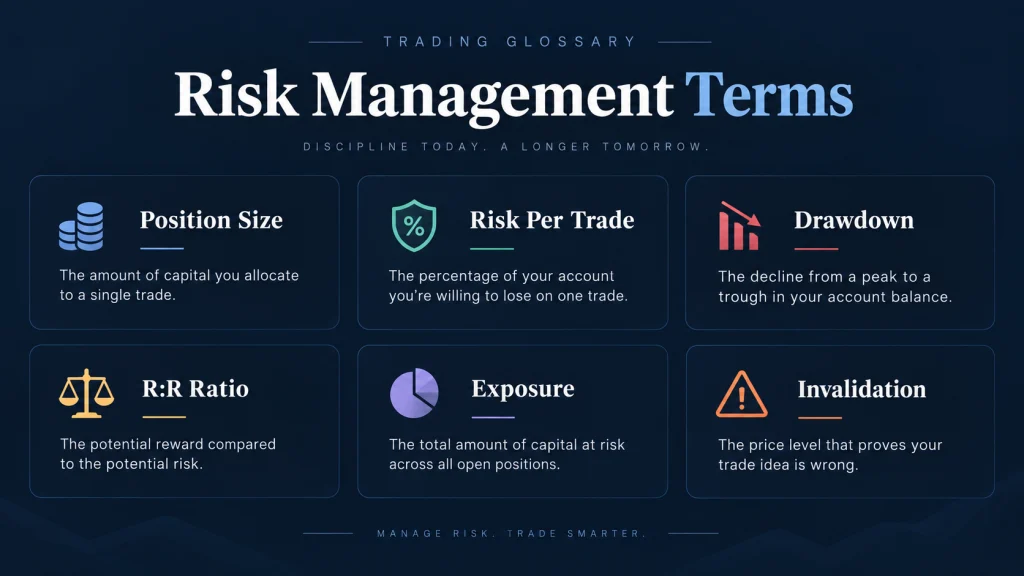
Trading Glossary: Risk and Trade Management
This part of the trading glossary focuses on the terms that describe position risk, account risk and the rules used to control exposure.
Position size: The number of shares, units, lots or contracts included in a trade. Position size determines how much money is exposed to a given price move. See our guide to position sizing in trading.
Risk per trade: The maximum amount or percentage of capital a trader plans to lose if one trade reaches its invalidation or exit condition. Actual loss can still be worse because of gaps, slippage and other execution risks.
Risk-reward ratio: A comparison between the amount a trader plans to risk and the potential reward in a trade plan. A favourable ratio does not make a low-quality trade profitable by itself.
Drawdown: The decline from a previous account or portfolio peak to a later low. Drawdown helps measure the depth of losses over time.
A risk-aware trading glossary should make clear that performance language is incomplete without also understanding losses and drawdowns.
Maximum drawdown: The largest peak-to-trough decline observed during a specified period.
Risk management: The process of controlling potential loss through position sizing, stop planning, exposure limits, diversification, liquidity checks and other rules. Read our full guide to risk management in trading.
Invalidation: A price or market condition that means the original trade idea no longer holds. Invalidation should be defined before a trade whenever possible.
R-multiple: A way to express a trade’s result relative to the amount initially planned as risk. If 1R equals ₹1,000, a +2R result equals twice that planned risk amount before costs.
Exposure: The amount of capital or notional value affected by movements in a market, asset, sector or strategy.
Diversification: Spreading capital across different investments or exposures so that one position does not determine the entire outcome. Diversification can reduce some risks but cannot eliminate market loss.
Hedging: Taking another position intended to reduce a particular risk in an existing position or portfolio. Hedging can involve additional costs and can also reduce gains.
Trading plan: A written set of rules covering market selection, setup conditions, entry, invalidation, risk, position size, exits and review.
Trading journal: A record of trades, decisions, setups, risk and outcomes used for later review. Trading Turtle provides a downloadable trading journal for structured tracking.
This trading glossary treats risk terms as core vocabulary because a trader who understands entries but not risk is missing half of the process.
Trading Glossary: Stocks and Investing
The stock-market section of this trading glossary includes both global investing language and several terms especially relevant to Indian market users.
Share: A unit of ownership in a company. The terms share and stock are often used interchangeably in beginner discussions, although usage can vary by context.
Stock: An ownership interest in a company represented by shares that may be listed and traded on an exchange.
Shareholder: A person or entity that owns one or more shares of a company.
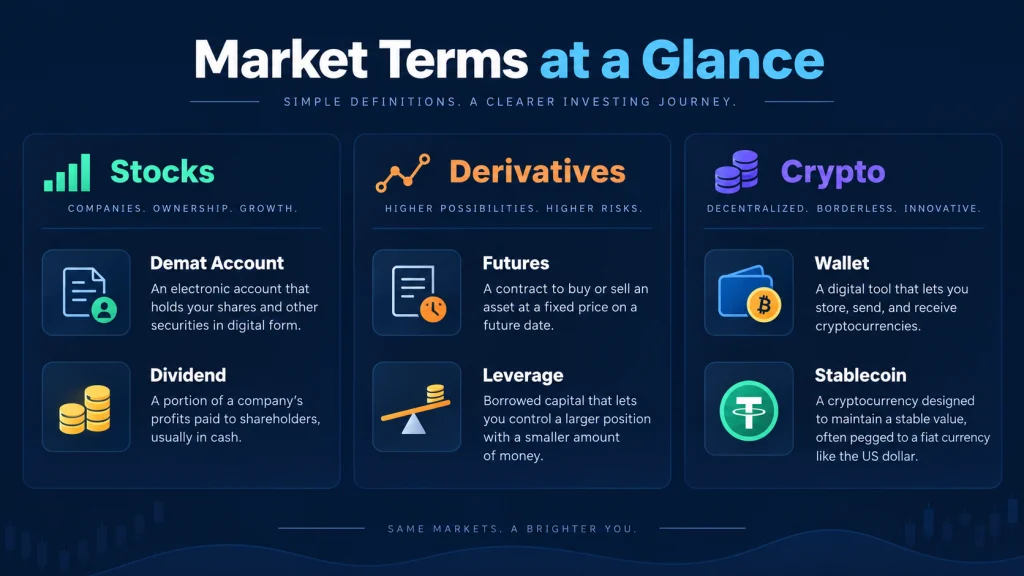
Dividend: A distribution that a company may make to eligible shareholders, usually from profits or reserves. Dividends are not guaranteed and can be changed or stopped.
Dividend yield: A percentage comparing the annual dividend per share with the current share price. It is one metric, not a complete measure of investment quality.
Initial Public Offering (IPO): The process through which a private company offers shares to public investors for the first time and may become listed on a stock exchange.
Index: A calculated basket of securities designed to represent a market, segment or theme. Examples in India include the NIFTY 50 and SENSEX.
Exchange-Traded Fund (ETF): An investment fund traded on an exchange like a stock. ETFs can track indices, sectors, commodities or other baskets of assets.
Bull market: A broad period of rising prices and generally positive market sentiment. There is no single definition that fits every market and timeframe.
Bear market: A broad period of falling prices and generally weak sentiment. The term is often used for sustained market declines rather than one bad trading day.
This trading glossary includes investing terms because many users move between long-term investing and active trading inside the same brokerage account.
Portfolio: The collection of investments or trading positions held by a person or institution.
Demat account: An account used in India to hold eligible securities in electronic form through the depository system.
Trading account: An account used to place eligible buy and sell orders through a broker. A trading account and a Demat account have different functions even though many brokers connect them in one app.
Depository Participant (DP): An intermediary authorised to provide depository-related services to investors on behalf of a depository such as NSDL or CDSL.
DP charge: A fee that may be charged when securities are debited from a Demat account. Exact charges depend on the broker, depository arrangement and transaction type.
AMC: In broker-account discussions, AMC often means annual maintenance charge. Whether an account has an AMC and how it is calculated depends on the broker and account type.
STT: Securities Transaction Tax, a tax applied to specified securities transactions in India according to current tax rules.
For a stock-focused beginner lesson rather than a reference page, see our separate guide to share market terms for beginners. That article explains the stock-market learning context in more depth, while this trading glossary covers terminology across multiple markets.
Trading Glossary: Derivatives and Leverage
Derivatives introduce specialised language, so this trading glossary keeps the definitions concise and risk-aware.
Derivative: A financial contract whose value is linked to an underlying asset, index, rate or other reference. Futures and options are common examples.
Underlying: The asset, index or reference on which a derivative contract is based.
Futures contract: A standardised agreement to buy or sell an underlying asset at a specified future date under contract terms set by the exchange or venue.
Options contract: A derivative that gives the buyer a right, but not always an obligation, to buy or sell an underlying asset under specified terms. The seller of an option can have different obligations and risks.
Call option: An option that gives its buyer the right to buy the underlying asset at a specified strike price under the contract terms.
Put option: An option that gives its buyer the right to sell the underlying asset at a specified strike price under the contract terms.
Strike price: The contract price at which an option holder can buy or sell the underlying asset if the option is exercised according to its terms.
Expiry: The date or time at which a derivative contract reaches the end of its life under the relevant exchange or product rules.
In this trading glossary, leverage-related definitions are deliberately separated from ordinary cash-market terms because the risk profile can change dramatically.
Leverage: Using borrowed funds or a derivative structure to control an exposure larger than the capital paid upfront. Leverage magnifies both gains and losses.
Margin: Money or collateral required to open or maintain a leveraged position. Margin requirements can change with product, broker, volatility and exchange rules.
Initial margin: The amount of margin required to open a leveraged position under the applicable rules.
Maintenance margin: The minimum margin that must remain available to keep certain leveraged positions open.
Margin call: A demand or requirement to add funds, reduce positions or restore margin when an account falls below required levels. The exact process differs by broker and product.
Liquidation: The forced closing or reduction of a leveraged position when required margin or risk conditions are not met. Liquidation can occur at an unfavourable price.
Notional value: The total value of the exposure represented by a derivative position, which can be much larger than the cash or margin paid upfront.
The derivative section of this trading glossary is intentionally conservative: leverage can make a small market move create a much larger percentage change in the capital committed to the trade.
Trading Glossary: Crypto and Digital Assets
The crypto section of the trading glossary explains common market, custody and derivatives terms without assuming that similar-sounding products carry the same risks.
Blockchain: A distributed ledger structure in which records are grouped and validated according to the rules of a network. Different blockchains vary in decentralisation, security design, governance and performance.
Cryptocurrency: A digital asset that uses cryptographic and network-based systems for ownership, transfer or validation. Cryptocurrencies vary widely in purpose, design and risk.
Coin: A crypto asset that is native to its own blockchain network, such as bitcoin on the Bitcoin network.
Token: A digital asset created on an existing blockchain or protocol. Tokens can represent many different rights or uses and should not be treated as interchangeable.
Stablecoin: A crypto token designed to track or maintain a relatively stable value against another asset, often a fiat currency. Stability mechanisms and reserves differ, so stablecoins can still fail or lose their peg.
This trading glossary separates spot and derivative terminology because owning an asset and holding a leveraged contract are not the same exposure.
Spot market: A market where an asset is bought or sold for current delivery or ownership rather than through a future-dated derivative contract.
Crypto futures: Derivative contracts linked to cryptocurrency prices. Depending on the product, traders can gain long or short exposure without owning the underlying coin.
Perpetual futures: A type of crypto derivative that does not have a traditional fixed expiry date. Platforms commonly use a funding mechanism to help keep the contract price aligned with the underlying spot market.
Funding rate: A periodic payment mechanism used by many perpetual futures markets. Depending on the rate and position direction, long traders may pay short traders or vice versa.
Wallet: Software or hardware used to manage the cryptographic keys that control access to blockchain-based assets. A wallet does not physically contain the coins; it manages the credentials used to access them.
Private key: A secret cryptographic credential that can authorise transactions from a blockchain address. Anyone who gains the private key may be able to control the associated assets.
Public key: A cryptographic value derived from or related to the private key and used within blockchain address and transaction systems.
Seed phrase: A sequence of words used by many wallets to restore or derive private keys. A seed phrase should be treated as highly sensitive because possession can provide access to the wallet.
Hot wallet: A crypto wallet connected to an internet-enabled device or service. Hot wallets are convenient but can be exposed to online threats.
Cold wallet: A wallet or key-storage method designed to keep private keys offline for most or all of the time. Cold storage reduces some online attack exposure but introduces its own backup and custody risks.
Self-custody: Managing your own private keys rather than relying on a third party to hold or control the assets on your behalf.
Custodial platform: A service that holds or controls crypto assets or private keys on behalf of users. Users depend on the platform’s security, operations and withdrawal policies.
This part of the trading glossary uses the same principle as the rest of the page: understand the term before using the product. Crypto terminology can sound familiar while hiding very different technical and financial risks.
Trading Glossary: Terms Beginners Commonly Confuse
A useful trading glossary should also show the difference between terms that are often treated as interchangeable even when they are not.
Some trading terms sound similar but describe different things. This trading glossary highlights a few of the most common mix-ups.
| Terms | Key difference |
|---|---|
| Bid vs ask | Bid is the best current buyer price; ask is the best current seller price. |
| Market order vs limit order | Market prioritises execution; limit prioritises a specified price condition. |
| Stop-loss vs stop-limit | A stop activates an exit condition; a stop-limit adds a price limit that can prevent execution. |
| Volume vs liquidity | Volume measures how much traded; liquidity describes how easily an order can be executed without moving price significantly. |
| Support vs resistance | Support is an area where declines have previously slowed; resistance is an area where advances have previously slowed. |
| Trend vs momentum | Trend describes directional structure; momentum describes the strength or speed of price movement. |
| Margin vs leverage | Margin is the collateral required; leverage describes the larger exposure created relative to capital. |
| Trading account vs Demat account | The trading account is used to place orders; the Demat account holds eligible securities electronically. |
| Coin vs token | A coin is native to its own blockchain; a token is typically issued on an existing network. |
| Wallet vs exchange account | A wallet manages blockchain keys; an exchange account is an account with a trading or custody service. |
How to Use a Trading Glossary Without Memorising Everything
The purpose of a trading glossary is quick understanding, not memorisation for its own sake.
A trading glossary is most useful when you connect the definitions to real examples. Instead of trying to memorise 70 terms in one sitting, learn them in the order they appear in your own trading education.
- Start with market basics: bid, ask, spread, liquidity and volume.
- Learn order types before placing any order.
- Learn chart terms when you begin technical analysis.
- Learn risk terms before calculating a position.
- Learn product-specific terminology before using stocks, derivatives or crypto.
- Return to this trading glossary whenever a new word appears in an article, charting platform or broker screen.
This approach is slower than memorising definitions, but it produces better understanding because each term has a practical context.
Trading Glossary Key Takeaways
The central value of this trading glossary is that it connects market language to the practical decisions a beginner is likely to face.
- This trading glossary covers the core language used in trading, chart analysis, risk management, stocks, derivatives and crypto.
- Bid, ask, spread, liquidity and volume describe how markets trade and how orders may execute.
- Market, limit and stop orders have different priorities and execution risks.
- Trend, support, resistance, market structure and timeframe are central chart-reading terms.
- Position size, drawdown, leverage and margin directly affect financial risk.
- Trading-account, Demat-account and depository terminology is especially relevant to Indian stock-market users.
- Crypto terms such as wallet, private key, seed phrase, stablecoin and funding rate describe very different technical and custody concepts.
- Understanding trading terminology improves clarity, but it does not remove market risk.
Frequently Asked Questions (FAQs)
A trading glossary is a reference that explains common trading terms and market vocabulary in simple language. It can include terminology related to orders, charts, execution, risk, stocks, derivatives and crypto.
Start with bid, ask, spread, liquidity, volume, market order, limit order, stop-loss, trend, support, resistance, position size and risk per trade. These terms appear frequently across brokers, trading platforms and educational material.
No. Many core terms are shared across stocks, futures, forex and crypto, but product rules, contract terms, exchange labels and broker language can differ. Always verify the definition used by the platform or exchange you are using.
There is substantial overlap. Trading terminology often focuses more on execution, short-term price behaviour and risk controls, while investing terminology may include valuation, portfolio construction, dividends and longer holding periods.
These terms explain the prices available to buyers and sellers and the immediate gap between them. They help beginners understand why the displayed market price is not always the same as the final execution price.
Use the trading glossary as a reference rather than trying to memorise every term. Look up a word when you encounter it, understand the definition, then follow the linked full guide if you need a deeper explanation.
Understanding the language can reduce confusion and prevent some basic mistakes, but it cannot remove market risk. Safe practice still requires risk management, suitable position sizing, reliable platforms and careful product research.