Why Is India’s Stock Market Rallying? Nifty Gains Nearly 12% in November as Global Stocks Slide


November 20, 2026 | Trading Turtle Market News
India’s stock market has staged a remarkable comeback in November 2026, with the Nifty 50 gaining nearly 12% since the end of October, even as global equity markets struggle with a sharp selloff in artificial intelligence-linked stocks.
On Friday, November 20, the Nifty 50 closed at 25,800.60, rising 1.12%, while the BSE Sensex advanced 897.96 points to finish at 83,919.71. Both benchmarks reached nine-month closing highs and registered their fourth consecutive weekly gains.
The recovery has been supported by record foreign portfolio investment, cooling crude oil prices, stronger banking shares and improving investor confidence.
But the rally also raises an important question: Is India entering a sustainable bull market, or is the recent surge primarily a recovery driven by global capital flows?
The answer requires looking beyond headline index returns.
Nifty 50 and Sensex: How Much Have Indian Stocks Gained?
India’s equity benchmarks have recovered rapidly from October’s weakness.
| Market indicator | October 30, 2026 | November 20, 2026 |
|---|---|---|
| Nifty 50 | 23,053.10 | 25,800.60 |
| BSE Sensex | 74,459.53 | 83,919.71 |
| BSE-listed market capitalisation | ₹475.35 lakh crore | ₹514.15 lakh crore |
The Nifty gained approximately 11.92%, while the Sensex rose 12.71% over the period.
These comparisons use October 30 closing figures published by the National Institute of Securities Markets and November 20 closing market reports.
The Nifty is also approaching its record intraday high of 26,373.20, recorded on January 5, 2026. At Friday’s close, it remained roughly 2.17% below that level.
Although the recovery is substantial, approaching a previous high does not guarantee a breakout.
Did India’s Stock Market Really Gain ₹72 Trillion in One Month?
Some social media posts claim that India’s stock market added ₹72 trillion in value within a month.
That figure requires a clearly defined starting date and a consistent measure of market capitalisation.
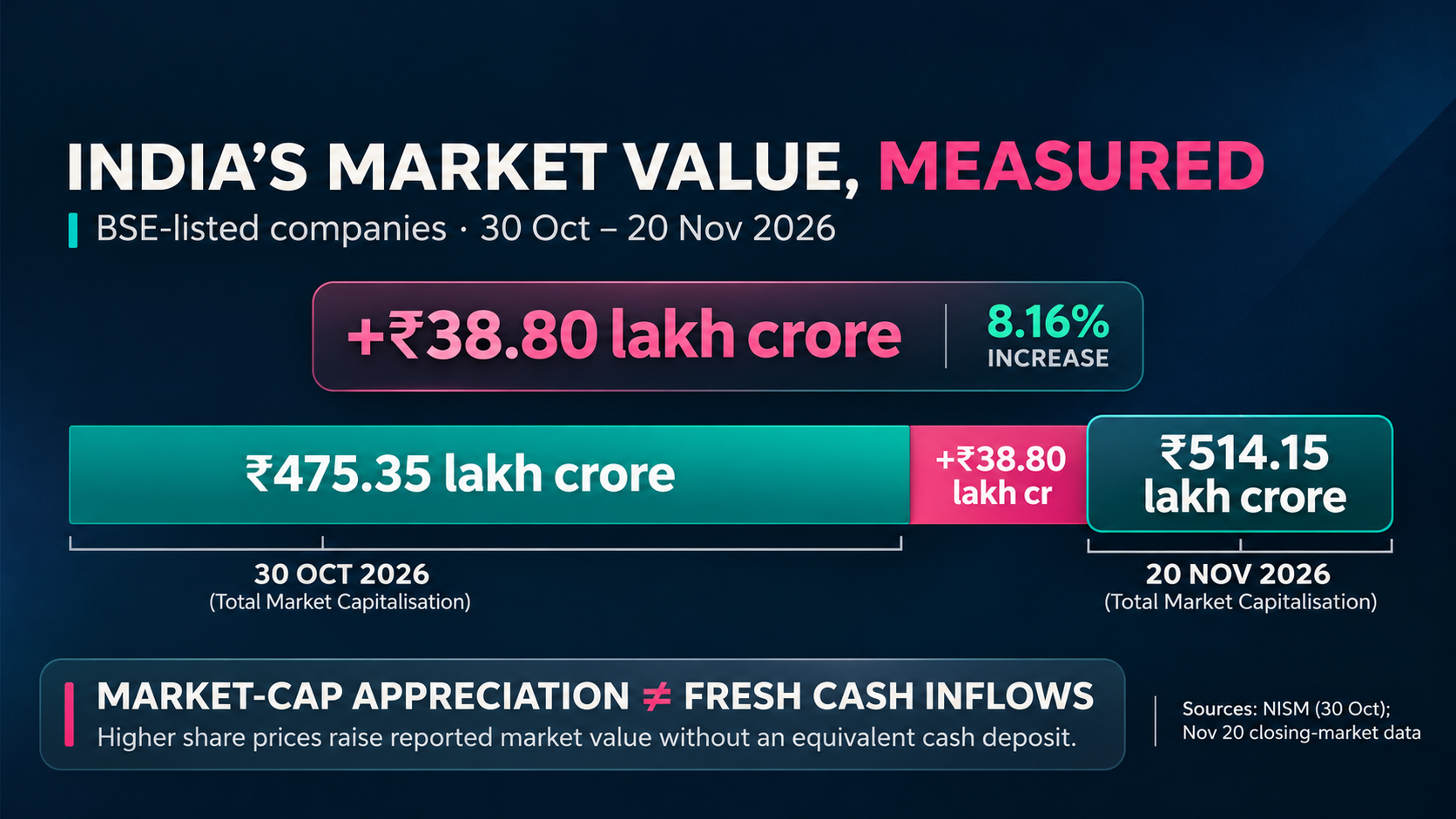
The verified comparison from October 30 to November 20 shows BSE-listed companies increasing in combined market value from ₹475.35 lakh crore to ₹514.15 lakh crore.
That is an increase of ₹38.8 lakh crore, equivalent to ₹38.8 trillion.
A different starting date, particularly near October’s market lows, would produce a larger recovery figure. However, the ₹72 trillion claim should not be presented as a verified November month-to-date increase.
There is another distinction investors should understand.
Market capitalisation is the market value of a company’s outstanding shares. When share prices rise, the reported market value increases even without an equivalent amount of new money entering the market. New listings and changes in share counts can also affect the aggregate.
Therefore, an increase in market capitalisation is not the same as cash invested or profits realised by shareholders.
Why Is India’s Stock Market Rising in November 2026?
1. Record Foreign Investment Is Supporting Indian Equities
One of the strongest drivers is the return of foreign portfolio investors (FPIs).
According to Reuters’ November 20 market report, foreign investors had invested a record $12.21 billion in Indian equities during November up to that point.
This represents a significant change in sentiment following prolonged periods of foreign selling.
Global investors appear to be reassessing their exposure to Indian equities as heavily AI-linked markets experience greater volatility.
Foreign inflows can support stock prices and the currency, particularly when investment concentrates in large, liquid companies.
However, these flows are sensitive to global interest rates, currency movements, valuation expectations and geopolitical developments.
Their continuation cannot be assumed.
2. Falling Crude Oil Prices Have Improved Market Sentiment
India is a major net importer of crude oil, making energy prices particularly important for its economy.
Reuters reported that Brent crude futures had declined approximately 23% during November, supported by hopes of easing geopolitical tensions and recovering Middle Eastern oil shipments.
Lower crude prices can ease India’s import bill and reduce pressure on inflation, the rupee and businesses dependent on fuel or petroleum-based inputs.
Industries such as aviation, automobiles and selected manufacturing segments may benefit from reduced input costs.
Nevertheless, crude oil remains vulnerable to geopolitical developments. A renewed supply disruption could quickly change the inflation and market outlook.
3. Banking Stocks Are Leading the Recovery
Financial stocks have emerged as major contributors to the rally.
During the week ending November 20, the Nifty Bank index gained approximately 5.9%, while the broader financial services index advanced around 3.7%, according to Reuters.
The Nifty Bank also reached a record level during Friday’s session.
Banks carry significant weight in India’s benchmark indices. As a result, strong performance from major financial institutions can lift the Nifty even when other sectors show weaker participation.
Improving sentiment around earnings, credit demand and institutional allocation has supported the sector.
However, strong banking stocks do not automatically indicate that every listed company is experiencing similar gains.
Why Is India Outperforming Other Global Markets?
Global markets have faced significant pressure as investors reconsider valuations in AI-related companies.
Technology-heavy markets have been especially sensitive to concerns about investment returns, earnings expectations and concentrated exposure to the AI trade.
Meanwhile, India has attracted renewed interest from investors seeking exposure to sectors such as financial services, domestic consumption and industrial activity.
Reuters reported that the broad MSCI Asia-Pacific index excluding Japan fell approximately 8.5% during the week, while India’s benchmark indices advanced.
This divergence is notable, but it should not be interpreted as permanent insulation from global risks.
India remains connected to international capital flows, crude oil markets, currency movements and global economic conditions.
A sustained global risk-off environment could eventually pressure Indian equities too.
Is the Indian Stock Market Rally Broad-Based?
Not entirely.
Although India’s headline indices have performed strongly, participation across market segments has been uneven.
For the week ending November 20, Reuters reported that small-cap stocks declined around 1.1%, while mid-cap stocks were relatively unchanged. The metals sector also fell approximately 3%.
This contrast matters for retail investors.
A rising Nifty does not necessarily mean an individual portfolio will produce comparable returns, particularly if it has significant exposure to smaller companies or underperforming sectors.
Market breadth—the proportion of stocks advancing relative to those declining—remains an important measure of whether the recovery is strengthening or becoming increasingly concentrated.
What Could Threaten the Nifty Rally?
Several developments deserve attention.
Foreign investment reversals: A change in global portfolio allocations could reduce one of the market’s strongest recent sources of support.
Crude oil volatility: Renewed geopolitical tensions or supply disruptions could increase India’s import costs and inflationary pressure.
Valuation risk: Rapidly rising prices increase the importance of corporate earnings. If profits fail to meet expectations, valuations may become difficult to sustain.
Narrow market participation: Continued weakness in small-cap and mid-cap stocks would suggest that benchmark strength is not fully translating into broader market confidence.
Investors should also monitor the Nifty’s reaction as it approaches its previous record. Resistance levels are areas to observe, not guarantees of a reversal.
What Should Indian Investors and Traders Do Now?
The market’s recovery provides useful information about sentiment, but it does not justify abandoning risk management.
Long-term investors should review diversification, portfolio allocation and whether their investment decisions remain consistent with their financial objectives.
For active traders, the more important questions are whether a valid setup exists, where the setup would be invalidated and how much capital can reasonably be risked.
Entering a position merely because an index has already rallied sharply can create unnecessary exposure to a pullback.
Trading Turtle’s pullback trading strategy guide explains how traders can evaluate retracements without assuming every decline is an opportunity.
Our risk-first trading strategy and free position size calculator can also help readers plan decisions around defined risk rather than market excitement.
For readers who follow cryptocurrency markets, India’s equity rally should not be interpreted as an automatic bullish signal for Bitcoin or other digital assets. Crypto markets have distinct liquidity, regulatory and positioning drivers, even when they respond to some of the same global macroeconomic developments.
The Bottom Line
India’s November 2026 stock market rally is significant and supported by measurable improvements in foreign investment, energy prices and financial-sector performance.
The Nifty’s nearly 12% month-to-date advance has brought it within reach of its previous record.
Yet the recovery is not without vulnerabilities.
The sustainability of the rally will depend on whether foreign capital continues entering India, corporate earnings justify higher valuations and more sectors participate in the advance.
For investors, the important question is not simply how far the Nifty has risen, but whether the underlying conditions can support further gains.
Data reflects the market close on November 20, 2026. This report is for educational and informational purposes and does not constitute investment advice.