Bid Ask Spread Explained: Meaning, Formula, Examples and Trading Impact

Bid-Ask Spread Explained
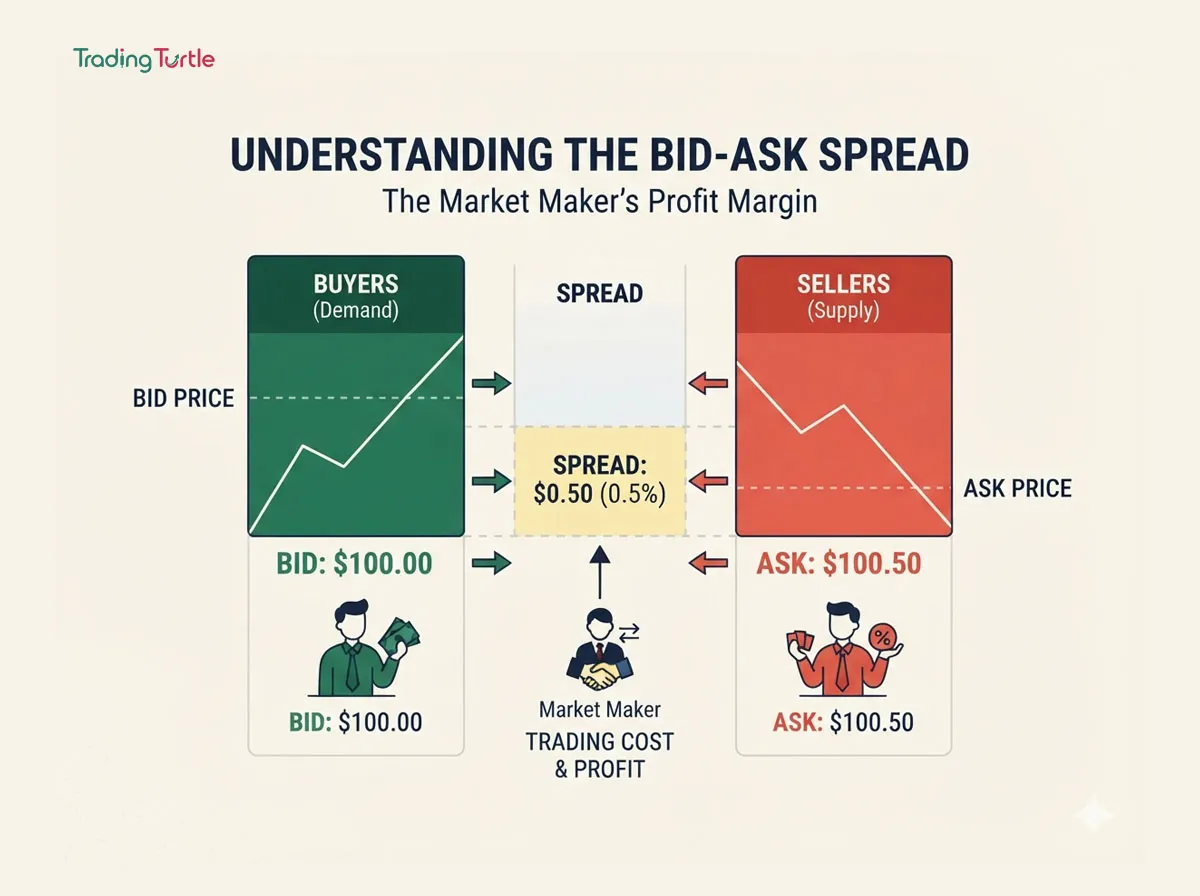
The bid ask spread is the difference between the highest price a buyer is currently willing to pay for an asset and the lowest price a seller is currently willing to accept. In simple terms, the bid ask spread meaning is the gap between the price at which you can generally sell now and the price at which you can generally buy now.
Every trader should understand the bid ask spread because it is an immediate execution cost that can affect entries, exits, stop-losses, scalping strategies, and overall profitability. A narrow spread generally means buyers and sellers are closer in price, while a wide spread suggests a larger gap between what buyers offer and sellers demand.
The U.S. Securities and Exchange Commission’s investor education material defines the bid as the highest price a buyer will pay and the ask as the lowest price at which a seller will sell; the difference between the two is the spread.investor
A spread is not necessarily a broker fee. It is a market-execution cost that exists because buyers and sellers do not always agree on one price at the same moment.
Bid, Ask and Spread Basics
To understand the bid ask spread, first separate the three terms.
Bid price
The bid is the highest price currently offered by a buyer. If you want to sell immediately using a market order, you will generally receive the best available bid price, subject to liquidity and execution conditions.
Ask price
The ask, also called the offer price, is the lowest price currently requested by a seller. If you want to buy immediately using a market order, you will generally pay the best available ask price, subject to available quantity and market movement.
Spread
The bid ask spread is the difference between these two prices:
Bid-Ask Spread=Ask Price−Bid Price
For example, imagine a stock has:
- Best bid: ₹199.80
- Best ask: ₹200.20
The spread is:
₹200.20−₹199.80=₹0.40
This ₹0.40 gap is the immediate difference between buying at the ask and selling at the bid. If you buy at ₹200.20 and immediately sell at ₹199.80, you would lose ₹0.40 per share before brokerage, statutory charges, taxes, and other costs.
That is the practical bid ask spread meaning: it represents part of the “distance” the market must move before a newly entered trade can break even.
Bid-Ask Spread Formula
The absolute spread is useful, but a percentage spread can make it easier to compare instruments with different price levels.
Absolute spread
Percentage spread
The midpoint price is:
Using the earlier example:
- Bid: ₹199.80
- Ask: ₹200.20
- Midpoint: ₹200.00
- Spread: ₹0.40
A percentage calculation matters because a ₹1 spread may be small for a high-priced instrument but significant for a lower-priced one.
Do not treat a tight percentage spread as a complete measure of trade quality. You must also consider available quantity, volatility, fees, market depth, and the probability of slippage.
SEC Investor.gov: Bid Price and Ask Price — official explanation of bid, ask, and spread terminology.
How a Spread Affects a Trade
The bid ask spread becomes most visible when you enter or exit immediately.
Assume the best prices for an asset are:
| Market detail | Price |
|---|---|
| Best bid | ₹500 |
| Best ask | ₹502 |
| Bid-ask spread | ₹2 |
| Midpoint | ₹501 |
If you place a market buy order, you may buy near ₹502. Immediately after buying, if you need to sell, you may receive only about ₹500. Before the market moves, your position is already down ₹2 per unit due to the spread.
This does not mean the trade is automatically bad. It means the expected price movement must be large enough to cover the spread and every other applicable cost.
Example: Why the spread matters to short-term traders
Suppose a scalper expects a ₹2 move in a stock, but the bid ask spread is already ₹1.20. That leaves a much smaller potential gain before fees and slippage. If the market moves slowly or reverses, the trade may have an unfavourable risk-to-reward structure.
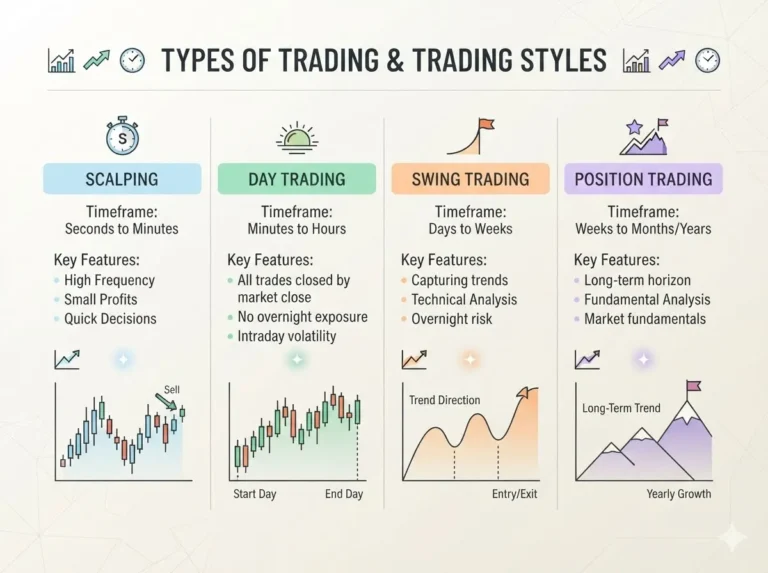
For a positional trader aiming to capture a larger move over weeks or months, the same spread may be less important relative to the expected price movement. It still matters, but it may be a smaller percentage of the overall trade thesis.
This is why the bid ask spread matters more to high-frequency and short-horizon approaches than to slower strategies, although no trader should ignore it.
Narrow vs Wide Spreads
A narrow bid ask spread means the gap between the best buyer and seller is relatively small. A wide spread means the gap is larger.
| Feature | Narrow spread | Wide spread |
|---|---|---|
| Buyer-seller price gap | Smaller | Larger |
| Immediate transaction cost | Usually lower | Usually higher |
| Market liquidity | Often stronger | Often weaker |
| Market depth | Often deeper | Often thinner |
| Market-order risk | Usually lower, not eliminated | Higher |
| Common setting | Active, heavily traded instruments | Thinly traded or volatile instruments |
| Impact on short-term strategies | Often more manageable | Can materially reduce potential returns |
A narrow spread does not guarantee that you can trade a large quantity without affecting price. The best bid and ask may show only a limited quantity. Once that quantity is consumed, your order can move to the next price levels.
A wide bid ask spread is a warning to slow down and inspect the order book, market conditions, and trading plan. It may reflect lower liquidity, greater uncertainty, higher volatility, limited competition among participants, or temporary dislocation around a news event.
Why Spreads Change
The bid ask spread is dynamic. It can change from second to second as participants add, cancel, or execute orders.
Liquidity
More active buyers and sellers often create tighter competition around the current price. This can produce a narrower spread. Lower activity may leave a wider gap between the best bid and ask.
Volatility
During sharp price movements, market participants may become less willing to quote tight prices because the asset can move before their order is filled. Spreads can widen as uncertainty rises.
Time of day
In some markets, spreads may be wider near the opening, closing, or during quieter periods. This can happen because prices are adjusting to new information or because fewer participants are active.
News and corporate events
Earnings releases, policy decisions, macroeconomic data, exchange announcements, token listings, hacks, or geopolitical news can quickly change supply and demand. The spread may widen before, during, or after such events.
Instrument type
Highly traded large-cap shares or major index contracts may often have different execution conditions from thinly traded shares, low-volume options, small-cap stocks, less-active futures contracts, or newly listed crypto assets.
Order-book depth
The best displayed prices alone do not show the full execution picture. You also need to consider how much quantity is available at each bid and ask level.
NSE provides different levels of real-time market data: Level 1 includes the best bid and ask, Level 2 includes up to five best bid and ask prices, and Level 3 includes up to 20 best bid and ask prices.nseindia
Liquidity and Market Depth
Liquidity and market depth are closely linked to the bid ask spread, but they are not identical.
What liquidity means
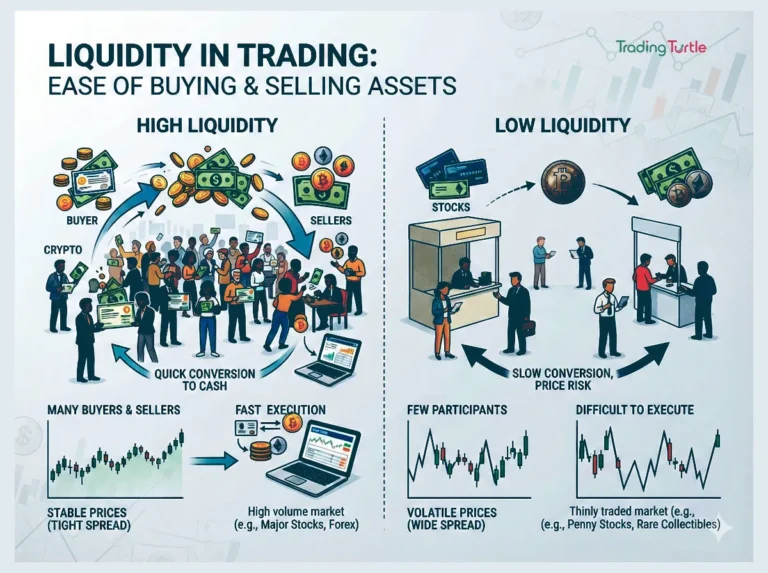
Liquidity describes how easily an instrument can be bought or sold without causing a large price change. A liquid market usually has more participants, more frequent transactions, and stronger available demand and supply.
Market depth
Market depth shows pending buy and sell interest at different price levels. It helps you see whether quantity is concentrated close to the current price or whether a larger order might consume multiple levels.
For example, an asset may show a narrow ₹0.10 bid ask spread, but only 10 shares may be available at the best ask. A market buy order for 1,000 shares could fill at progressively higher prices as it consumes the available sell orders.
This is why traders should avoid judging execution quality only by the displayed spread. A better review includes:
- Best bid and best ask.
- Quantity available at each level.
- Recent trading volume.
- Volatility.
- Size of your intended order.
- Time of day.
- Upcoming news or events.
- Expected holding period.
For a full explanation, read What Is Liquidity in Trading?.
How Order Types Affect Spread Cost
Your order type determines how you interact with the bid ask spread.
Market orders
A market buy order generally accepts available ask prices. A market sell order generally accepts available bid prices. This means a market order often crosses the spread immediately.
Market orders may be appropriate when execution speed is more important than price precision, especially in liquid instruments. But a market order can experience slippage if the available quantity at the best price is limited.
Limit orders
A buy limit order sets the maximum price you are willing to pay. A sell limit order sets the minimum price you are willing to accept. When placed away from the opposing best quote, a limit order may avoid immediately crossing the spread.
However, the trade-off is that the order may not execute. Price can move away before reaching your order, or other orders at the same level may receive priority.
For a complete guide, read Market Order vs Limit Order.
Stop-loss orders
Stop-loss functionality and execution characteristics vary by market, broker, and product. In fast conditions, a stop-loss may trigger when price reaches a level but fill at a different price. A stop-loss should be part of a broader risk plan, not treated as a guarantee.
Risk reminder: A narrow displayed spread does not guarantee a low-cost trade. Fast markets, low depth, large order sizes, price gaps, and platform or connectivity issues can cause slippage beyond the displayed bid and ask prices.
Spread Risks in Different Markets
The bid ask spread exists across financial markets, but its behaviour depends on market structure and the asset being traded.
Stocks
Large, actively traded stocks may often have narrower spreads than low-volume shares. Corporate announcements, opening and closing auctions, and sudden news can still affect execution conditions.
Options
Options can have wider spreads than the underlying stock or index, especially for far-out strikes, longer-dated expiries, or contracts with low volume and open interest. A trade that looks attractive using last traded price can become less attractive once you check the actual bid and ask.
Futures
Liquid futures contracts may offer efficient execution during active hours, but spreads and depth can change around economic data, expiry periods, lower-volume sessions, or unexpected news.
Crypto assets
Crypto markets operate across multiple venues, and spreads can differ by exchange, trading pair, market conditions, and time of day. Smaller tokens may have thin order books and larger execution uncertainty. Crypto traders should also account for platform risk, funding costs in derivatives, and withdrawal or counterparty considerations.
Forex and CFDs
Forex and contract-for-difference products may display spreads set or influenced by the provider. Product terms, liquidity sources, execution models, leverage, and rollover costs can vary significantly. Always read the provider’s official documentation and local regulatory rules.
How to Manage Spread Costs
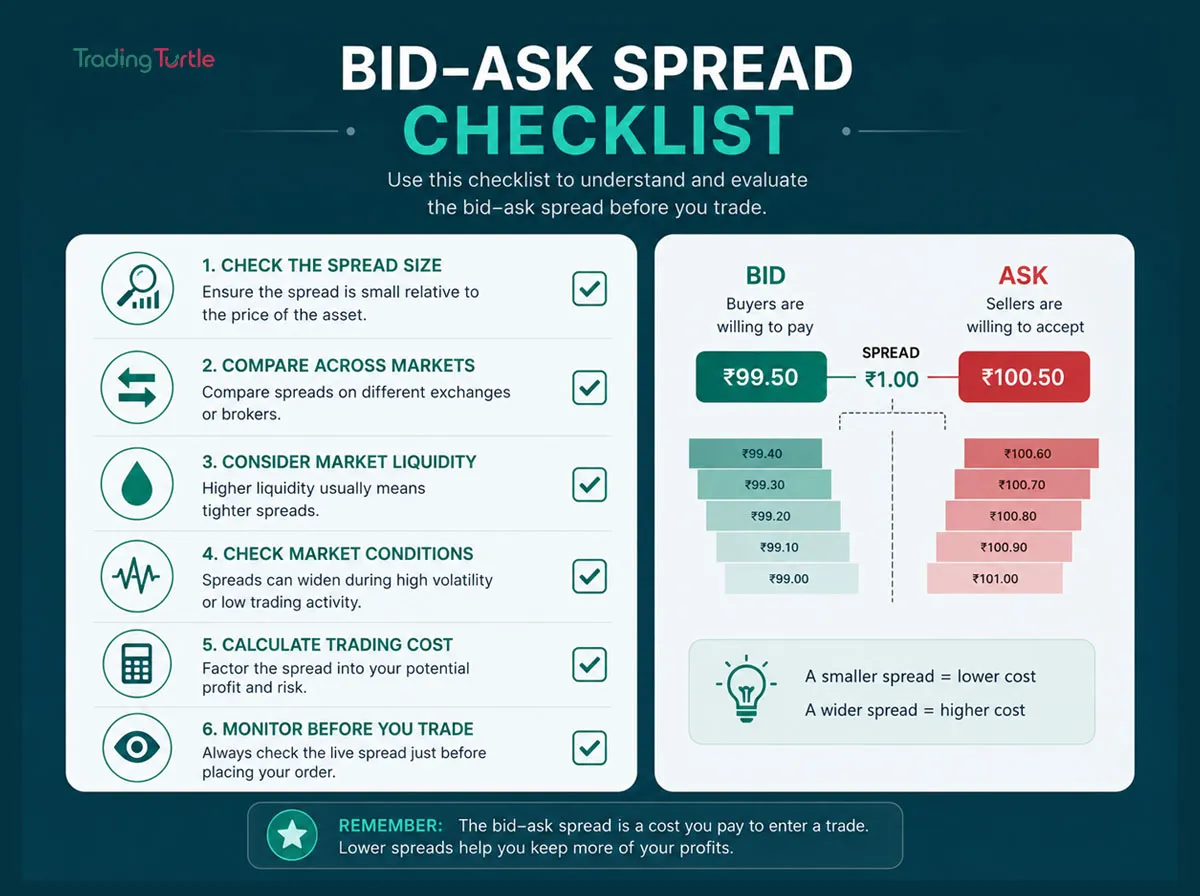
You cannot remove the bid ask spread, but you can account for it before taking a trade.
- Check both bid and ask, not just last traded price. The last price may not be currently executable.
- Review market depth when available. Check quantity at the best levels and nearby prices.
- Match order size to liquidity. Large orders can cause more slippage than small orders.
- Use limit orders when price discipline matters more than immediate execution. Remember that a limit order may not fill.
- Avoid trading thin instruments solely because they move fast. Wide spreads can make those moves costly to trade.
- Be cautious around scheduled news and market opens. Volatility can widen spreads rapidly.
- Include spread in your risk-to-reward calculation. Your target must cover the spread, fees, taxes, and potential slippage.
- Test in paper trading first. Simulations may not perfectly replicate live fills, but they can help you learn execution mechanics.
- Keep a trading journal. Record the displayed spread, expected entry, actual fill, and exit quality.
- Review broker and exchange rules. Product-specific order handling and market-data displays can vary.
A trader who ignores the bid ask spread may incorrectly believe a strategy works because chart prices look favourable, while actual fills show that the edge disappears after execution costs.
Common Mistakes
Avoid these mistakes when interpreting the bid ask spread:
- Looking only at the last traded price instead of the current bid and ask.
- Assuming a narrow spread means enough quantity exists for a large order.
- Entering illiquid options or small-cap shares without checking market depth.
- Using market orders during rapid news-driven moves without considering slippage.
- Calculating profit targets without including spread, brokerage, statutory charges, taxes, and funding costs.
- Assuming displayed order-book quantity will remain available until your order arrives.
- Confusing volume with liquidity; high historical volume does not always mean current depth is strong.
- Holding a position in a thin market without planning how you will exit.
- Treating an unfilled limit order as a technical error rather than a possible normal result.
- Relying on a low spread as evidence that an asset is low risk.
Key Takeaways
- The bid ask spread is the difference between the highest current buy price and the lowest current sell price.
- The basic formula is: ask price minus bid price.
- The bid ask spread meaning is an immediate execution cost that affects traders when they buy at the ask and sell at the bid.
- Narrow spreads often occur in more active and liquid markets, while wide spreads may signal lower liquidity or greater uncertainty.
- Spreads can widen during volatility, news events, quiet sessions, or when market depth is low.
- Market orders often cross the spread immediately; limit orders may offer price control but can remain unfilled.
- Check order-book depth, expected slippage, and your own order size—not just the displayed spread.
- Include execution costs in every trade plan, particularly for intraday trading, scalping, options, and leveraged products.
Educational disclaimer: This article is educational only and is not financial, investment, tax, or legal advice. Bid-ask spreads, liquidity, and execution conditions can change quickly. Always understand the costs and risks of an instrument before trading it.
– Frequently Asked Questions (FAQs)
A bid ask spread is the difference between the highest price a buyer is currently willing to pay and the lowest price a seller is currently willing to accept for an asset.
Subtract the bid price from the ask price:
For example, if the bid is ₹100 and the ask is ₹101, the spread is ₹1.
A lower spread often suggests better trading conditions than a higher spread, but it is not enough by itself. You should also check market depth, available quantity, volatility, order size, and potential slippage.
Buyers want to pay as little as possible, while sellers want to receive as much as possible. The difference between their best current prices creates the spread.
Yes. Spreads can change rapidly as traders place, cancel, or execute orders. They may widen during high volatility, news events, low-liquidity periods, or sudden changes in market demand and supply.
A trader who buys at the ask and sells at the bid starts with a loss equal to the spread, before other costs. The price must move enough in the trader’s favour to cover the spread, fees, taxes, and slippage.