Market Order vs Limit Order: Differences, Examples and Risks


Market Order vs Limit Order Explained
The choice between a market order vs limit order comes down to one central trade-off: execution certainty versus price control. A market order prioritises completing the trade as soon as possible at the best currently available price, while a limit order prioritises a specified price or better but may not execute at all.
Understanding market order vs limit order is essential before placing your first trade in stocks, derivatives, commodities, forex, or crypto. The same broad logic applies across markets, although the available order features, validity periods, charges, trading rules, and execution policies can vary by broker, exchange, instrument, and jurisdiction.
For a new trader, the important question is not “Which order is always better?” Instead, ask: “Do I need execution immediately, or do I need control over the price I am willing to accept?”
The National Stock Exchange of India describes a limit-price order as an order that lets the trader specify the price while entering the order into the system.
The Main Difference
In the simplest market order vs limit order comparison:
- A market order tells the system to buy or sell immediately at the best available price.
- A limit order tells the system to buy or sell only at your stated price or a better price.
A market order mainly answers, “Get me into or out of this position now.” A limit order mainly answers, “Trade only if the price meets my condition.”
Neither order type predicts direction, guarantees profit, or replaces a risk-management plan. Both are tools for execution. Choosing the wrong tool can lead to an unexpected fill, a missed trade, or a position entered without considering liquidity.
What Is a Market Order?
A market order is an instruction to buy or sell an asset immediately at the best price currently available in the market. It prioritises speed of execution rather than a specific execution price.
For example, if you place a market buy order for a liquid stock, your order will generally match with the lowest available sell offers. If you place a market sell order, it will generally match with the highest available buy offers.
In a market order vs limit order decision, a market order may be considered when getting filled quickly matters more than obtaining a precise price.
What happens after a market order is placed?
The exchange or trading venue matches your order against available orders on the opposite side of the market. Your final average price depends on available liquidity at that moment.
Suppose the sell side of an order book shows:
| Available sell price | Quantity available |
|---|---|
| ₹100.00 | 50 shares |
| ₹100.20 | 100 shares |
| ₹100.50 | 200 shares |
If you submit a market buy order for 120 shares, it may fill across multiple levels:
- 50 shares near ₹100.00
- 70 shares near ₹100.20
Your average fill could be higher than ₹100.00 because there were not enough shares available at the lowest quoted offer.
This is a simplified illustration. Actual order-book behaviour, price bands, broker controls, partial fills, and exchange rules may affect results.
Benefits of a market order
- It generally offers the best chance of immediate execution in an active market.
- It is straightforward when you care more about entering or exiting promptly than a small difference in price.
- It can be useful when closing a position to follow a predefined risk rule.
- It may be practical in highly liquid instruments with narrow bid-ask spreads.
Risks of a market order
A market order does not mean you will receive the last traded price shown on your screen. In fast or illiquid markets, the available price may change before your order reaches the market.
Zerodha explains that market orders execute at the best available price and that an illiquid instrument can fill well above or below the last traded price.
What Is a Limit Order?
The US Securities and Exchange Commission (SEC) explains that a limit order buys or sells only at a specified price or better. A buy limit can execute at or below the limit price; a sell limit at or above it.
In the market order vs limit order comparison, a limit order gives more control over acceptable price but does not promise that the trade will happen.
Buy limit order
Suppose a share is trading near ₹500, but you are willing to buy only if it falls to ₹490.
You can place a buy limit order at ₹490. Your order may execute if sellers are willing to sell at ₹490 or lower. If the market never reaches ₹490, the order remains unfilled or expires according to the order’s validity rules.
Sell limit order
Suppose you own a share trading near ₹500 and want to sell only if it reaches ₹525.
You can place a sell limit order at ₹525. The order may execute if buyers are willing to buy at ₹525 or higher. If the price does not reach that level, the order will not fill.
The US Securities and Exchange Commission (SEC) explains that a limit order may not execute if the market does not reach the specified price.
Benefits of a limit order
- You control the maximum price you are willing to pay on a buy order.
- You control the minimum price you are willing to accept on a sell order.
- It can help avoid unexpected execution at a poor price in volatile or thinly traded instruments.
- It allows you to plan entries or exits without watching the screen continuously.
Risks of a limit order
A limit order can remain unfilled even if the market trades close to your price. Price may touch the level only briefly, available quantity may be insufficient, or earlier orders at the same price may receive priority.
A limit order can also receive a partial fill. For example, you may intend to buy 500 shares, but only 150 shares may be available at your limit price before the market moves away.
Market Order vs Limit Order Comparison
| Factor | Market order | Limit order |
|---|---|---|
| Main priority | Fast execution | Price control |
| Execution price | Best available price at that moment | Specified limit price or better |
| Execution certainty | Usually higher in liquid markets, but not absolute | Not guaranteed |
| Price certainty | Lower | Higher |
| Risk of slippage | Higher, especially in volatile or illiquid markets | Lower at the limit price, but may not fill |
| Partial-fill possibility | Possible | Possible |
| Best suited for | Urgent entries or exits in liquid instruments | Planned entries or exits at a specific price |
| Key drawback | Actual fill may differ from displayed price | Trade can be missed |
| Common beginner misunderstanding | Assuming “market” means the displayed last traded price | Assuming “limit” means guaranteed execution |
This market order vs limit order table is only a starting point. Your broker may offer additional choices, such as stop-loss orders, stop-limit orders, after-market orders, validity instructions, disclosed quantity, or special product types. Always read the broker’s official order documentation before using an unfamiliar feature.
Buy and Sell Examples
The best way to understand market order vs limit order is to compare the same trade idea using each order type.
Example 1: Buying immediately
A stock is actively trading around ₹250. You have decided that you need to enter now because your strategy requires confirmation above a particular level.
- With a market buy order, your order seeks the best available sell prices immediately.
- With a buy limit order at ₹250, your order executes only at ₹250 or lower.
- If the stock quickly moves to ₹252 before your limit order is matched, the limit order may remain unfilled.
In this situation, the market order favours speed. The limit order favours price discipline.
Example 2: Buying a pullback
A stock is trading near ₹250, but your plan is to buy only if it pulls back to ₹240.
- A market order would enter near the current available market price.
- A buy limit order at ₹240 waits for the market to reach ₹240 or lower.
For this plan, a limit order better matches the intended entry condition. But if the stock rises and never returns to ₹240, no trade occurs.
Example 3: Exiting a long position
You own shares trading near ₹600. Your plan says you should exit quickly if a key support level fails.
- A market sell order prioritises getting out promptly at available bid prices.
- A sell limit order at ₹600 protects the minimum sale price, but it may not execute if buyers vanish below that level.
During a sharp decline, a limit sell order may not provide the exit you expected. This illustrates why order selection should be considered before volatility increases, not after.
Risk reminder: Price control and execution certainty cannot be fully achieved at the same time. A limit order protects the stated price condition but can remain unfilled. A market order seeks faster execution but may fill at an unexpectedly different price because of spread, liquidity, or rapid price movement.
When to Consider Each Order
There is no fixed rule for every trade, but the following framework can make the market order vs limit order choice more deliberate.
Consider a market order when
- You are trading a highly liquid instrument with a narrow bid-ask spread.
- Your trading plan requires immediate entry after a valid signal.
- You must exit promptly to respect a risk limit.
- You understand that the execution price may differ from the displayed last traded price.
- You have checked the order book and are comfortable with the likely fill.
Consider a limit order when
- You have a clearly defined maximum buy price or minimum sell price.
- You are entering a planned pullback, breakout retest, or target-based exit.
- You are trading an instrument with a wider spread or lower liquidity.
- You do not want to chase a fast-moving price.
- Missing the trade is more acceptable than accepting an unfavourable price.
The right decision depends on the context. For example, a liquid large-cap stock during normal market conditions may behave very differently from a thinly traded stock, a small-cap share, an options contract with low volume, or a volatile crypto token.
Liquidity, Spread and Slippage
A responsible market order vs limit order decision requires you to understand three related concepts.
Liquidity
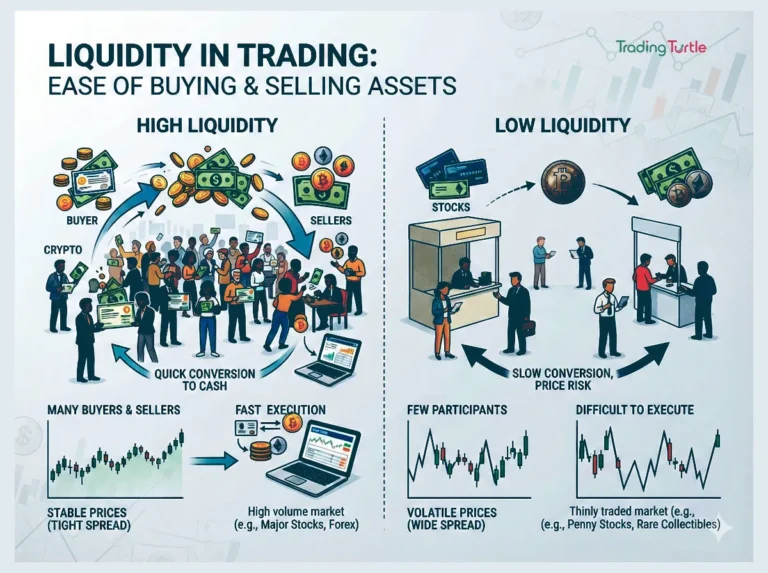
Liquidity is the ease with which you can buy or sell an asset without causing a large change in its price. Higher liquidity generally means more active buyers and sellers, deeper order books, and smoother execution.
Bid-ask spread
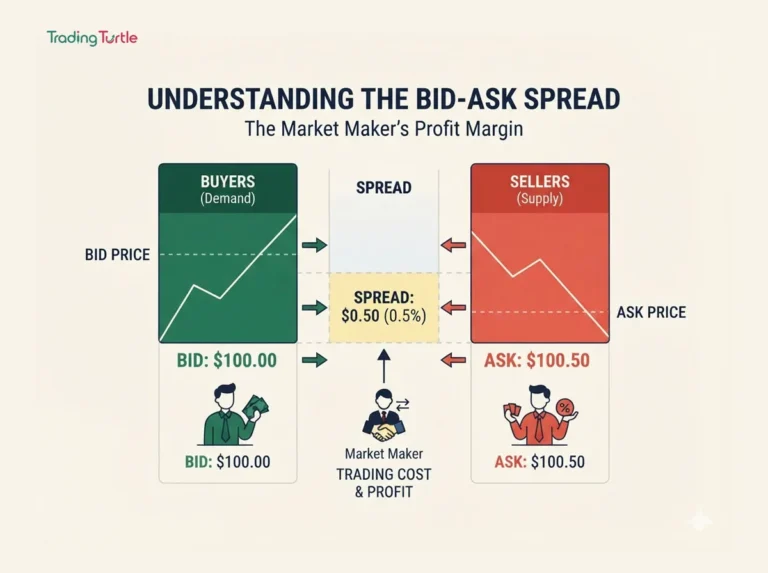
The bid is generally the highest current price a buyer is offering. The ask is generally the lowest current price a seller is asking. The difference between them is the bid-ask spread.
A narrow spread often indicates better execution conditions than a wide spread, although it does not guarantee them. Review our detailed guide on the bid-ask spread and why it matters.
Slippage
Slippage occurs when the final execution price differs from the price you expected. It is more likely during fast moves, news events, low-volume periods, market openings, or in instruments with shallow order books.
For example, you may see a stock quoted near ₹100 but receive an average fill of ₹100.60 on a large market buy order. That difference is not necessarily a platform error – it may reflect the available sell orders when the order reached the market.
Market and Limit Orders in Volatile Markets
Volatility can make the difference between order types much more visible. Prices may change several times between the moment an order is submitted and the moment it reaches the market. A market order still prioritises execution, but the final price can be materially different from the quote that was visible on screen. This risk is higher when the spread widens, liquidity falls or trading resumes after important news.
A limit order controls the worst acceptable price, but it cannot guarantee execution. In a fast rise, a buy limit below the market may be left behind. In a sharp fall, a sell limit above available bids may remain unfilled while the price continues lower. The price protection is real, yet it comes with the risk that the trade does not happen.
Opening and closing auctions, earnings announcements, economic releases and unexpected news can all create gaps. Stop orders can also become market orders after their trigger is reached, depending on the order type and broker. Traders should read the broker’s order rules and avoid assuming that a stop price is a guaranteed exit price.
Partial Fills and Order Queue
A limit order may fill only in part when fewer shares or units are available at the chosen price than the order requests. If an investor places a limit order to buy 1,000 shares at ₹100 and only 300 are offered before the market moves higher, the account may show a 300-share position and an open order for the remaining 700. The remainder may fill later, fill at different times within the limit, or stay open until it expires or is cancelled.
Queue position also matters. Other orders may already be waiting at the same price. Reaching the limit price does not always mean every order at that level will fill. Exchange priority rules, order size, displayed liquidity and rapid cancellations can influence the result. Simulated trading platforms often simplify this process, which is one reason paper fills should be reviewed cautiously.
Partial fills affect position size, average price, fees and exit planning. Before placing a large order, check whether the broker charges per order or per execution and how linked stop or target orders behave when only part of the entry fills. After any fill, confirm the actual quantity in the portfolio rather than managing the trade from the requested quantity.
Five Order-Entry Safety Checks
- Confirm the instrument. Similar company names, multiple exchanges, contract expiries and currency pairs can lead to an order in the wrong market.
- Check quantity and units. Review whether the ticket expects shares, lots, contracts or a currency amount, especially for derivatives and crypto.
- Review the bid, ask and spread. The last traded price may not be available for the quantity you want. The current spread gives a more useful view of immediate execution.
- Read the duration and conditions. Day, immediate-or-cancel, fill-or-kill and good-till-cancelled instructions behave differently. Use only conditions you understand.
- Inspect the confirmation and order status. Verify side, price, quantity, fees and whether the order is open, partially filled, filled, rejected or cancelled.
These checks take little time and prevent many operational mistakes. They do not remove market risk, but they help ensure that the order sent to the exchange matches the decision you intended to make.
A Simple Order-Type Decision Framework
Begin with the priority of the trade. If immediate execution matters more than price precision, consider whether a market order is reasonable given the liquidity and spread. If controlling the price matters more than certainty of execution, a limit order may fit better. Neither choice is automatically safe; the surrounding market conditions determine the trade-off.
- Is the instrument liquid at the quantity you plan to trade?
- Is the spread narrow enough that immediate execution is acceptable?
- Would a missed trade be less harmful than an unexpectedly poor price?
- Could news, a market open or a thin order book cause a gap?
- Can you monitor an unfilled or partially filled order and cancel it if the plan changes?
- Does the broker treat the selected duration, stop or linked order in the way you expect?
For a small order in a highly liquid instrument during normal trading, the difference may be modest. For a larger order, a thinly traded share, a volatile crypto pair or a position around news, the distinction can dominate the outcome. If the answer is unclear, reduce the size, avoid the event or practise the order in a simulator before risking real money.
The framework is not a recommendation to choose one order type. It is a way to make the execution decision explicit. A written reason—such as “price control matters more than immediate entry”—is easier to review than a habit of pressing the same button for every trade.
Common Mistakes
Avoid these errors when comparing a market order vs limit order:
- Assuming a market order will fill at the last traded price.
- Placing a large market order in an illiquid asset without checking the order book.
- Setting a buy limit above the current available ask without understanding that broker or exchange handling may make it immediately marketable.
- Setting a sell limit below the current available bid without understanding the likely execution behaviour.
- Treating an unfilled limit order as a system failure rather than the normal result of an unmet price condition.
- Forgetting that limit orders can partially fill.
- Leaving old pending limit orders active without reviewing whether the original trade idea is still valid.
- Using an order type without knowing its day-validity, cancellation, modification, or after-market rules.
- Confusing a limit order with a stop-loss order.
- Relying on an order type instead of defining position size and maximum loss.

How to Place an Order Carefully
Before you submit either order, use this practical checklist:
- Confirm the instrument: Check the exact stock, contract, pair, expiry, or trading product.
- Choose buy or sell: Confirm the direction before entering quantity.
- Review liquidity: Look at the bid, ask, spread, volume, and order-book depth where available.
- Select the order type: Decide whether execution speed or price control matters more.
- Enter quantity carefully: Use position sizing based on risk, not excitement or available margin.
- Review the price field: For a limit order, verify the precise limit price. For a market order, understand that price is not fixed.
- Check validity: Confirm whether the order is valid for the day, session, a selected duration, or another broker-supported period.
- Review before submitting: Check the order summary, estimated charges, and warnings.
- Monitor the order: Confirm whether it was fully filled, partially filled, pending, rejected, or cancelled.
- Record the trade: Note your reason, intended risk, execution quality, and lessons in a trading journal.
If you are unsure how a broker-specific order feature works, use the platform’s official help centre, customer support, or paper-trading environment before risking money.
Learn more at: NSE Equity Market Trading System
Key Takeaways
- The core market order vs limit order difference is speed versus price control.
- A market order aims to execute immediately at the best available price but does not guarantee the displayed price.
- A limit order executes only at a specified price or better but may never execute.
- Liquidity, bid-ask spreads, and slippage affect real-world order outcomes.
- Large market orders can experience poor execution in fast or illiquid markets.
- Limit orders may remain pending or receive only partial fills.
- Every order should support a broader trade plan that includes position sizing, defined risk, and an exit process.
- Learn with small size or paper trading before relying on complex order functions.
Educational disclaimer: This article is for educational purposes only and is not financial, investment, tax, or legal advice. An order type cannot eliminate market risk. Prices can move quickly, and your actual execution price may differ from the price you see on screen.
– Frequently Asked Questions (FAQs)
A market order prioritises immediate execution at the best available price. A limit order prioritises a specified price or better, but execution is not guaranteed.
A market order generally seeks immediate execution, but actual results depend on market conditions, available liquidity, exchange rules, and broker handling. In volatile or illiquid conditions, it may execute across multiple prices or have unexpected results.
Yes. A buy limit order can execute at the limit price or lower, while a sell limit order can execute at the limit price or higher.
Your order may not have received priority, available quantity may have been insufficient, the price may have touched the level only briefly, or the displayed data may not fully reflect the exact executable market conditions. A limit order is not guaranteed to execute.
Neither is universally safer. A limit order offers more price control but may not fill. A market order offers stronger execution priority but can result in slippage. The appropriate choice depends on liquidity, volatility, urgency, and your trading plan.
Beginners should first understand both through small-size practice or paper trading. Limit orders can help learners understand price discipline, while market orders may be appropriate when immediate execution is necessary in a liquid instrument. Always check your broker’s specific order rules.