Crypto Risk Management: Position Size, Stop-Losses and Volatility Planning

What is crypto risk management?
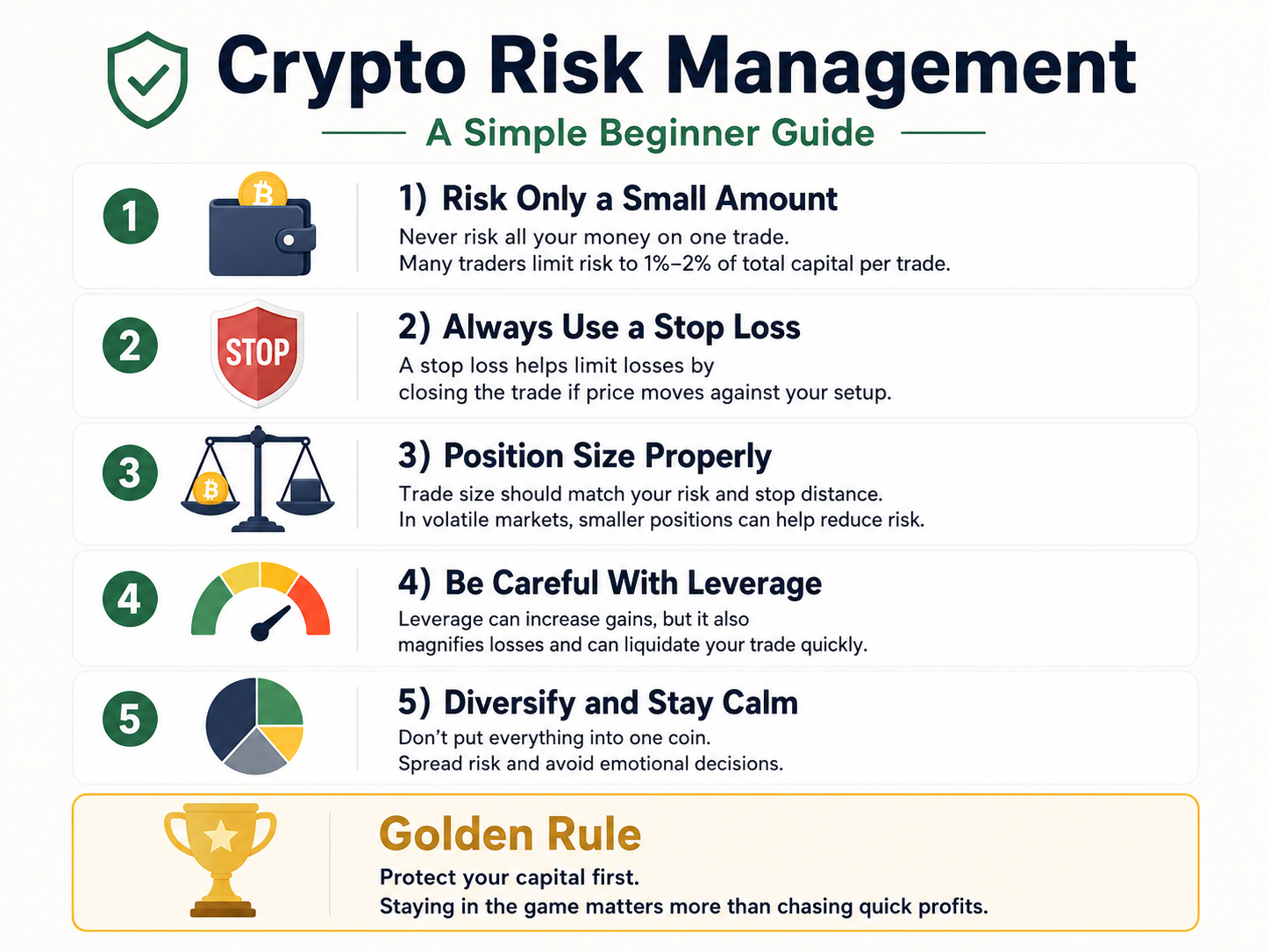
Crypto risk management is a structured process for identifying and controlling the risks associated with buying, selling, holding, or trading crypto assets.
It is broader than choosing a stop-loss. A complete framework considers:
- Market risk.
- Position size.
- Volatility.
- Liquidity.
- Leverage.
- Liquidation.
- Platform and counterparty exposure.
- Wallet and cybersecurity risk.
- Trading psychology.
- Operational errors.
- Regulatory and tax uncertainty.
The goal of crypto risk management is not to eliminate losses. Losses are an unavoidable possibility in trading. The goal is to prevent one trade, one technical error, one platform problem, or one emotional decision from causing damage that is difficult to recover from.
FINRA describes crypto assets as risky and often extremely volatile, with significant potential for loss. It also notes that crypto markets may be less liquid than traditional markets, which can make selling more difficult and amplify price movements.
Education-only disclaimer: This article is for general educational purposes only. It is not personalised investment, financial, tax, or legal advice. Cryptocurrency and derivatives trading involve substantial risk, including the possible loss of some or all capital. Examples are hypothetical and do not represent trade recommendations, target prices, or guaranteed returns.
Why crypto markets require special risk controls
Crypto markets have characteristics that can make risk management more complicated than many beginners expect.
High and changing volatility
Crypto volatility can increase quickly during market-wide sell-offs, major announcements, security incidents, liquidations, or sudden changes in liquidity.
A position size that appears reasonable during a quiet session may be too large when volatility expands. Using the same fixed quantity on every trade ignores the changing distance that price may travel.
Continuous market activity
Many crypto markets operate around the clock, including weekends and holidays. Price can move while a trader is asleep, travelling, working, or unable to access an account.
This creates additional planning requirements for:
- Open spot positions.
- Leveraged futures positions.
- Stop-loss orders.
- Weekend exposure.
- API and platform monitoring.
- Emergency account access.
Leverage and liquidation
Leverage allows a trader to control a larger position with less collateral. It also increases the speed at which losses can consume margin.
The CFTC warns that leverage amplifies the risks of virtual-currency futures trading and that losses may exceed the initial amount deposited in certain futures situations.
Liquidity and execution
A chart may show a price, but that does not guarantee that a large order can be filled at that price. Thin order books, sudden volatility, and exchange interruptions may increase slippage.
A risk plan should therefore consider the difference between:
- The expected exit price.
- The actual execution price.
- The mark price used for liquidation.
- The index price used by a derivatives platform.
- The price shown on a particular exchange.
Crypto position sizing
Crypto position sizing determines how much of an asset or contract is traded. It is one of the most important parts of crypto risk management because it controls the financial effect of an invalid trade idea.
A common mistake is to choose position size based on the amount of money available rather than the amount of money that can reasonably be lost.
Risk-based position sizing
A simplified formula is:
For a short position, the price difference should be calculated using the distance between the entry and the stop above the entry.
This formula is simplified and does not include:
- Trading fees.
- Slippage.
- Funding payments.
- Contract specifications.
- Currency conversion.
- Minimum order requirements.
- Gaps or execution delays.
These costs should be included when creating a production-ready trading system.
Hypothetical example
Assume a trader has an account value of 100,000 units of currency and decides that the maximum acceptable loss on one trade is 0.5%, or 500 units.
If the entry-to-invalidation distance is 2 units per coin, the simplified position size would be:
This is an educational calculation, not a recommendation. The actual size would need to account for fees, slippage, liquidity, contract rules, and whether the trade is spot or leveraged.
Fixed-risk versus fixed-size trading
- Fixed-risk sizing: Position size changes according to the stop distance so the planned loss remains broadly consistent.
- Fixed-size trading: The same quantity is used on every trade, even when volatility and stop distance change.
Fixed-risk sizing is generally more responsive to changing market conditions, but it still depends on realistic stops and reliable execution.
How to calculate trade risk
Trade risk should be calculated before entering a position.
For a spot trade, a simplified planned risk can be expressed as:
For a long position, the planned exit may be below the entry. For a short position, the planned exit may be above the entry.
A more complete calculation may include:
The trader should also ask whether the planned exit is realistic. A stop placed inside ordinary market noise may be triggered frequently. A stop placed too far away may create unacceptable loss unless the position size is reduced.
Risk-reward ratio
The risk-reward ratio compares the potential loss to a hypothetical profit target.
For example, if the planned loss is 1 unit and the hypothetical gain is 2 units, the ratio is often described as 1:2.
A favourable ratio does not make a strategy profitable by itself. A trade can have a large theoretical reward and still fail because:
- The target is unrealistic.
- The entry is poorly timed.
- The stop is not technically meaningful.
- The market reverses before reaching the target.
- Fees and slippage change the outcome.
- The strategy’s win rate is too low.
Use risk-reward analysis as one part of a complete framework, not as a substitute for testing.
Crypto stop-loss planning
A crypto stop-loss is an order or rule designed to exit a position when price reaches a predefined level. It can help limit losses, but it should not be treated as a guarantee.
Common stop-loss approaches
Structure-based stop
A structure-based stop is placed beyond a market feature that would invalidate the trading idea, such as:
- A recent swing low for a long position.
- A recent swing high for a short position.
- A support or resistance zone.
- A breakout level that price should hold.
- A defined range boundary.
Volatility-based stop
A volatility-based stop uses a measure such as average true range to estimate how far price may normally move.
This approach can help avoid placing stops so close that ordinary fluctuations trigger an exit. However, wider stops require smaller positions if the planned trade risk is to remain controlled.
Time-based exit
A time-based rule closes a trade if it does not behave as expected within a defined period. This can reduce exposure to stagnant positions and prevent capital from remaining locked in a setup that has lost its original relevance.
Stop-loss limitations
A stop-loss may execute at a worse price than requested during:
- Sudden price gaps.
- Extreme crypto volatility.
- Low liquidity.
- Exchange outages.
- Network or API problems.
- Fast liquidation events.
A stop-market order prioritises execution but may experience slippage. A stop-limit order provides more price control but may fail to execute if the market moves through the limit price too quickly.
The correct choice depends on the platform, product, market conditions, and trader’s execution priorities.
Managing crypto volatility
Crypto volatility should influence position size, stop placement, leverage, and total exposure.
Volatility-adjusted position size
When volatility increases, the distance between entry and a technically meaningful invalidation level may also increase. If the trader wants to keep the same maximum loss, the position size should generally decrease.
For example:
- Quiet market: wider position may fit within the risk limit.
- High-volatility market: smaller position may be required.
- Extreme market: no trade may be the most appropriate decision.
This principle is central to crypto risk management: the absence of a trade is a valid risk-control decision.
Monitor volatility conditions
A trader may monitor:
- Average true range.
- Recent candle ranges.
- Intraday high-low movement.
- Implied volatility, where reliable data is available.
- Funding changes in perpetual markets.
- Order-book depth.
- Spread and slippage.
- Correlation between assets.
No single indicator can predict future volatility. These measures are context tools, not guarantees.
Avoid volatility-based overconfidence
A large move can create the illusion that a strategy is working perfectly. However, elevated volatility can also produce:
- False breakouts.
- Rapid reversals.
- Wider spreads.
- Poor fills.
- Stop hunting perceptions.
- Sudden liquidation cascades.
- Emotional decisions.
A disciplined plan should define when market conditions are too unstable for normal execution.
Leverage and liquidation risk
Leverage risk is one of the most serious issues in crypto derivatives.
Initial and maintenance margin
Initial margin is the collateral required to open a leveraged position. Maintenance margin is the minimum collateral required to keep it open.
If losses reduce the account below the required maintenance level, the platform may close some or all of the position.
Isolated and cross margin
- Isolated margin: A designated amount of collateral is assigned to one position.
- Cross margin: Available collateral may be shared across positions.
Isolated margin may help ring-fence risk for a specific position, while cross margin can allow one position’s losses to affect more of the account. The exact rules differ between platforms.
Liquidation price
A liquidation price is an estimated level at which the platform may forcibly close a leveraged position. It is not necessarily the same as the trader’s stop-loss level.
Liquidation can be affected by:
- Leverage.
- Position size.
- Entry price.
- Maintenance margin.
- Fees.
- Funding.
- Other positions.
- Mark-price methodology.
- Available collateral.
- Platform risk tiers.
A trader should never place a stop so close to liquidation that the position may be closed automatically before the planned risk exit can operate effectively.
Funding costs
Perpetual futures commonly use funding payments between long and short traders. A position can lose money through funding even if the market price remains relatively unchanged.
When calculating crypto trading risk, include expected funding costs for positions intended to remain open for more than a short period.
Portfolio and exposure limits
Trade-level risk is only one part of risk management. A trader can follow a small risk limit on each position and still create excessive total exposure by opening many correlated trades.
Correlation risk
Several crypto assets may move in the same direction during a market-wide event. Holding positions in multiple assets does not necessarily create genuine diversification.
Consider grouping exposure by:
- Major market direction.
- Blockchain ecosystem.
- Sector or theme.
- Stablecoin dependence.
- Exchange or custody provider.
- Derivatives collateral.
- Common liquidity source.
Portfolio risk limits
A written plan may define:
- Maximum risk on one trade.
- Maximum total open risk.
- Maximum daily loss.
- Maximum weekly loss.
- Maximum leverage.
- Maximum allocation to one asset.
- Maximum exposure to one exchange.
- Maximum amount held in hot wallets.
- Maximum number of simultaneous positions.
A daily or weekly loss limit can help prevent emotional attempts to recover losses immediately.
Operational and custody risk
Crypto risk management should also protect against non-market failures.
Account security
Use:
- Strong, unique passwords.
- Multi-factor authentication.
- Withdrawal address controls where available.
- Device security and software updates.
- Carefully restricted API permissions.
- Separate trading and withdrawal credentials where possible.
- Regular account and transaction reviews.
Never share a private key or recovery phrase with support staff, trading groups, or software providers.
Exchange and platform risk
Before using a platform, review:
- Jurisdiction and availability.
- Withdrawal rules.
- Fee schedule.
- Margin and liquidation documentation.
- Security history.
- Insurance or protection statements.
- Asset custody arrangements.
- API reliability.
- Customer-support procedures.
FINRA warns that crypto assets may be held through entities with limited regulatory oversight and that scams, theft, and fraudulent service providers are significant risks.
Algorithmic trading risk
For automated systems, add controls such as:
- Maximum order size.
- Maximum daily loss.
- Maximum open positions.
- Duplicate-order prevention.
- Stale-data detection.
- WebSocket disconnection handling.
- API timeout handling.
- Kill-switch logic.
- Position reconciliation.
- Emergency notification.
- Paper-trading mode.
- Persistent trade and error logs.
A profitable strategy can still cause severe losses if a software bug sends duplicate orders or ignores a failed cancellation.
Building a practical risk plan
A written crypto risk management plan should answer these questions before trading begins:
What is the maximum acceptable loss?
Define the maximum loss for one trade, one day, one week, and the entire account. These limits should be affordable and realistic.
What invalidates the trade?
Write the market condition that proves the original idea is no longer valid. Do not choose the level only after seeing the desired position size.
How large should the position be?
Calculate size from the maximum acceptable loss and the distance to invalidation. Reduce the size when volatility, liquidity, or uncertainty increases.
What costs apply?
Include commissions, spread, slippage, funding, borrowing, conversion, and withdrawal costs where relevant.
What happens after a loss?
Define whether the trader will pause, reduce size, review the journal, or stop for the day. Avoid increasing risk to recover a previous loss.
How will results be reviewed?
Separate three outcomes:
- A profitable trade that followed the rules.
- A losing trade that followed the rules.
- A trade that violated the rules.
A losing trade can still be a good process decision if the risk was planned and controlled. A profitable trade can still be a poor decision if it involved excessive or unplanned risk.
Common crypto risk-management mistakes
Avoid these recurring errors:
- Using the same position size in every market condition.
- Treating leverage as a substitute for capital.
- Moving a stop-loss farther away after entry.
- Placing the stop at liquidation.
- Ignoring funding and fees.
- Opening several highly correlated positions.
- Trading illiquid assets with large size.
- Holding exchange balances without a custody plan.
- Sharing API keys or recovery phrases.
- Increasing risk after a winning streak.
- Trading immediately after a large loss.
- Assuming a backtest guarantees live performance.
- Treating a risk-reward ratio as proof of profitability.
- Relying on social-media signals or guaranteed-return claims.
FINRA warns that crypto prices can swing sharply and that selling may be difficult when liquidity is thin. It also describes fraud, theft and limited investor protections.
Beginner checklist
Before placing a crypto trade, confirm:
- The market type is understood: spot, margin, futures, or perpetual.
- The asset and trading pair are correct.
- The maximum acceptable loss has been calculated.
- The position size matches the risk limit.
- The invalidation level is defined.
- The stop-loss limitations are understood.
- Fees, spread, slippage, and funding are included.
- Total portfolio exposure remains within limits.
- The platform and wallet security controls are active.
- The trade has been recorded in the journal.
Build out your crypto risk plan
The checklist above covers several different decisions. These guides explain them in more detail:
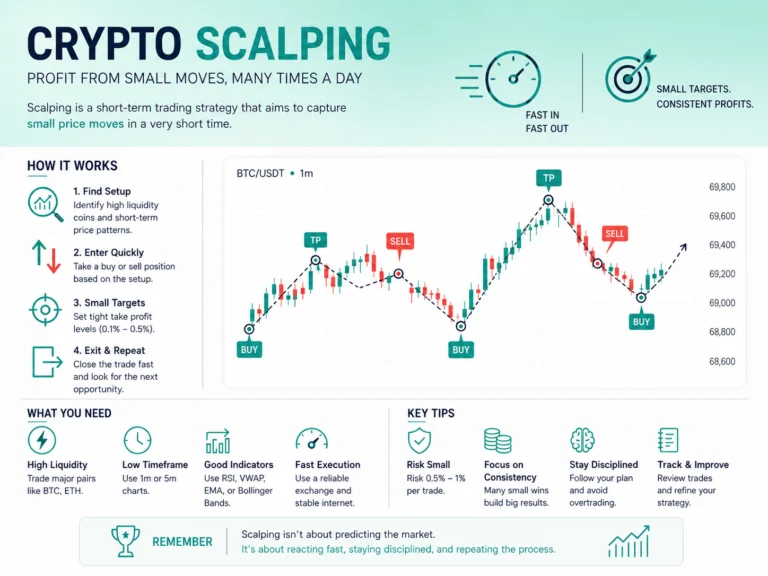
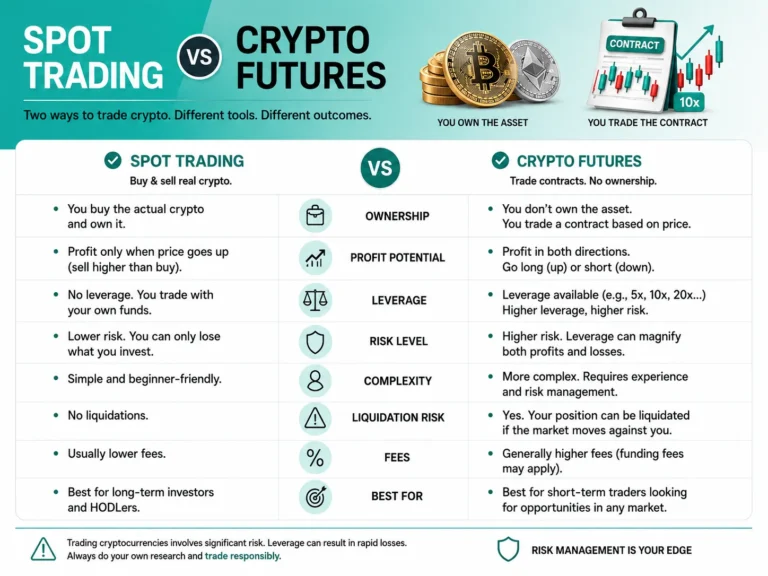
- Spot trading vs crypto futures: see how leverage, funding and liquidation change the risk.
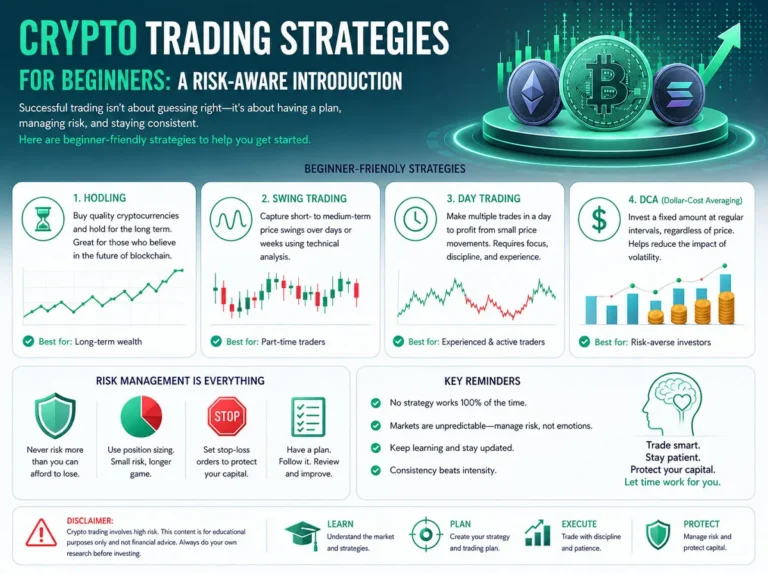
- Crypto trading strategies for beginners: compare approaches before writing your own rules.
- Position sizing in trading: work out what a losing trade could cost.
- Stop-loss orders: learn why a trigger does not guarantee the final fill.
- Paper trading: practise placing and reviewing trades before risking money.
- How cryptocurrency works: understand transactions and wallets before you trade.
Key takeaways
- Crypto risk management is the process of controlling potential losses before, during, and after a trade.
- Position sizing should be based on the amount a trader can afford to lose and the distance to the invalidation level.
- A crypto stop-loss can help automate an exit, but it cannot guarantee execution at the requested price during fast or illiquid markets.
- Crypto volatility can change rapidly, making fixed position sizes and excessive leverage dangerous.
- Futures traders must separately manage margin, funding, leverage, and liquidation risk.
- A complete risk plan includes trade-level limits, daily loss limits, total exposure limits, custody controls, and a review process.
– Frequently Asked Questions (FAQs)
Position sizing is one of the most important parts because it controls how much capital is exposed to an incorrect trade idea. However, effective risk management also requires stop planning, exposure limits, security controls, and discipline.
There is no universal percentage that suits every person. A trader should use a limit that is affordable, consistent with their financial circumstances, and small enough to withstand a series of losses without causing emotional or financial distress.
No. A stop-loss may execute at a different price during fast markets, gaps, low liquidity, platform outages, or significant slippage. The planned risk should account for the possibility of imperfect execution.
Yes. Futures require additional controls for leverage, margin, funding, mark price, maintenance margin, contract specifications, and liquidation. A spot-market risk plan should not be copied directly to a leveraged futures account.
No. Several crypto assets may be highly correlated and decline together during a market-wide event. Diversification may change concentration risk, but it cannot eliminate market, custody, liquidity, or platform risk.
Leverage reduces the collateral required for a given exposure but does not reduce the market risk of that exposure. It can magnify losses and create liquidation risk. Beginners should understand the product fully before considering leveraged trading.
Yes. Trading software can enforce position limits, stop rules, daily loss limits, and emergency shutdowns. Automation also introduces API, data, software, connectivity, and order-reconciliation risks, so every bot needs monitoring and a reliable kill switch.