Position Sizing in Trading: How to Calculate Trade Risk

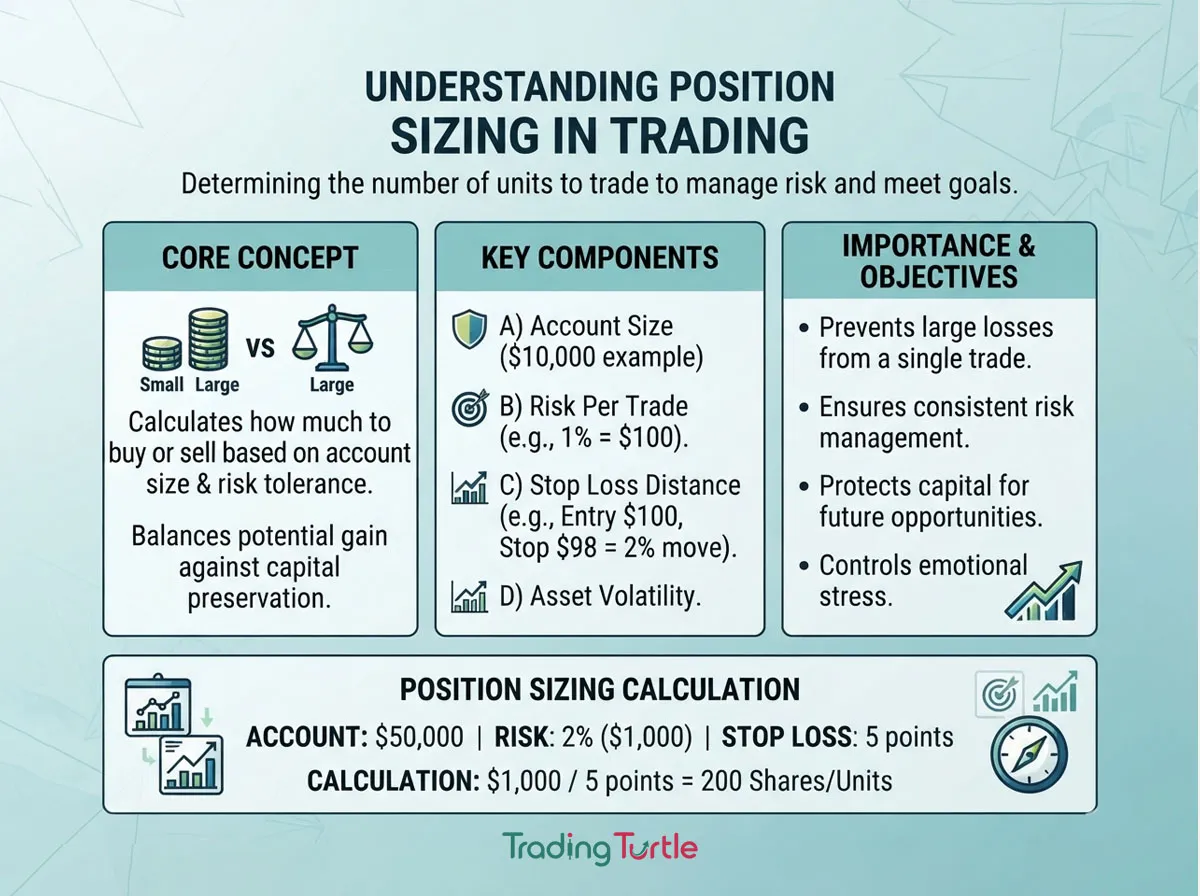
Position sizing in trading is the process of deciding how much capital to commit to a single trade so that a loss stays within a predefined limit. It is one of the most practical parts of risk management because it connects account size, stop-loss distance, and acceptable risk into a specific trade size.
Many beginners focus first on entries, indicators, or chart patterns, but position sizing in trading often does more to protect a trading account than a clever entry alone. A solid setup can still become dangerous when the position is too large, while an average setup can become survivable when risk is controlled properly.
This guide explains what position sizing in trading means, why it matters, how to calculate it, and how to apply it to stocks, spot trades, and crypto futures in a practical way.
What position sizing means
Position sizing in trading means choosing the number of shares, units, lots, or contracts to trade based on risk rather than emotion. Instead of asking only, “Do I like this setup?”, the trader also asks, “How large can this trade be without risking too much?”
A trading position size is not the same as conviction. Even if a setup looks strong, the position still needs to match the size of the account and the distance to the stop-loss.
For example, a trader with a ₹1,00,000 account may decide to risk only 1% on each trade, which means the maximum planned loss on one idea is ₹1,000. If the stop-loss is far from the entry, the position must be smaller; if the stop-loss is tight, the position can be larger while keeping the same rupee risk.
Why position sizing matters
Position sizing in trading matters because losses are part of trading, and poor sizing can turn normal losses into account-damaging events. The goal is not to avoid every losing trade; the goal is to make sure one loss or a small losing streak does not do outsized harm.
Good position sizing helps in several ways:
- It limits the damage from a single trade.
- It makes performance more consistent across different setups and market conditions.
- It reduces emotional trading because the risk per trade is decided before entry.
- It makes strategy testing more meaningful by keeping trade risk stable over time.
- It supports the broader principles explained in Risk Management in Trading: A Practical Guide for Beginners.
Without position sizing, a trader can accidentally risk 5%, 10%, or more of the account on one idea simply because the quantity was chosen randomly. That kind of inconsistency is especially dangerous in leveraged products such as futures.
The core position sizing formula
The simplest way to approach position sizing in trading is to start with the amount of money that can be risked on one trade.
Risk amount
First calculate the maximum risk amount for the trade:
If the account size is ₹2,00,000 and the trader risks 1% per trade, the risk amount is ₹2,000.
Position size formula
Then calculate the trade size:
For a long trade, the denominator is the difference between entry and stop-loss. For a short trade, it is the difference between stop-loss and entry, because the trader is measuring how much could be lost per unit if the trade fails.
This gives the number of shares, units, or contracts that fit the predefined risk amount.
How to calculate position size step by step
A practical calculation usually follows the same sequence each time.
1. Decide account size
Use the amount of capital actually allocated to that trading strategy or account. A trader running separate stock and crypto portfolios should not casually combine both if the funds are managed differently.
2. Set the risk per trade
Many traders choose a fixed percentage such as 0.5%, 1%, or 2% of account equity for each trade. The exact number varies by strategy, volatility tolerance, and experience, but the important part is consistency.
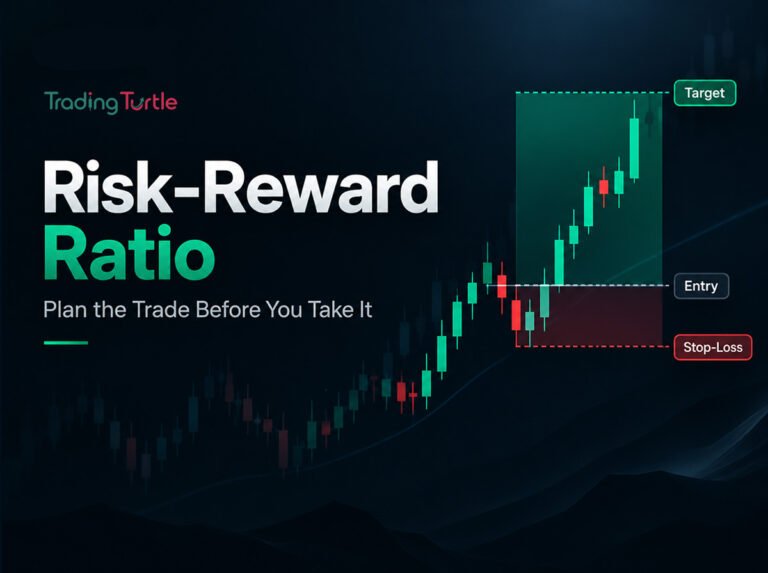
3. Define the entry and stop-loss
The stop-loss should come from the trade structure, not from the position size calculation. In other words, a stop-loss belongs where the trade idea is invalidated, not where the trader wishes the size calculation would look better.
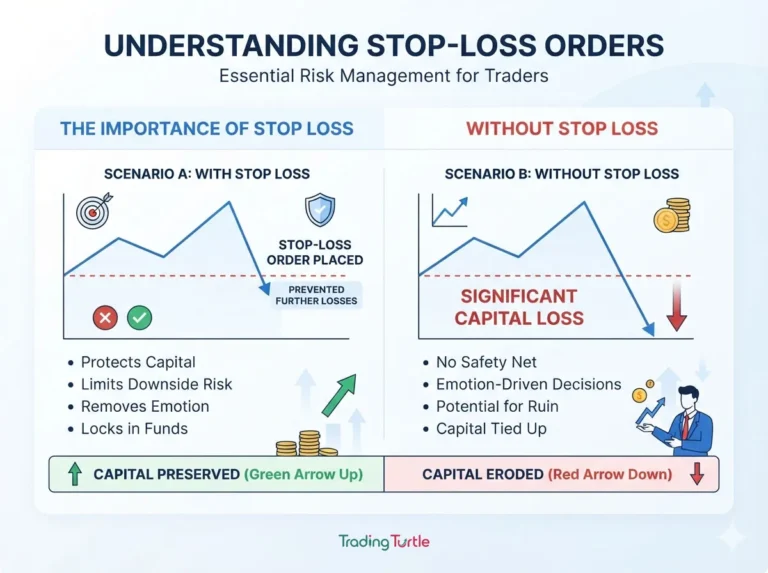
This is where the earlier article on what is a stop-loss order naturally connects, because stop-loss placement directly affects trading position size.
4. Measure per-unit risk
Subtract the stop-loss from the entry for a long trade, or subtract the entry from the stop-loss for a short trade. This gives the amount of money at risk per share, unit, or contract.
5. Divide total risk by per-unit risk
Once total risk and per-unit risk are known, divide one by the other. The result is the largest trading position size that still fits the plan.
6. Check practical constraints
Before placing the order, confirm that the position size also makes sense in the real market. This includes lot-size rules, available margin, contract size, fees, slippage, bid-ask spread, and minimum order requirements.
Position sizing examples
The idea becomes easier to understand through worked examples.
Example 1: Stock trade
A trader has a ₹1,50,000 account and risks 1% per trade, so the maximum loss is ₹1,500. The trader plans to buy a stock at ₹500 with a stop-loss at ₹485, so the per-share risk is ₹15.
The trader can buy 100 shares and keep the planned loss near ₹1,500 if the stop-loss is hit.
Example 2: Spot crypto trade
A trader has a spot account worth $5,000 and risks 1% on a BTC trade, so the risk amount is $50. If the planned entry is $60,000 and the stop-loss is $59,500, the per-unit risk is $500 per BTC.
The trader can buy 0.1 BTC and keep the planned loss near $50 before fees and slippage.
Example 3: Crypto futures trade
A trader has a USDT-margined futures account with $2,000 and risks 1% per trade, so the maximum planned loss is $20. The trader wants to go long ETH at $3,000 with a stop-loss at $2,980, so the per-unit risk is $20 per ETH.
The position size is 1 ETH equivalent. If leverage is used, the margin required may be smaller than the notional value, but the trade risk still comes from the distance to the stop-loss and the size of the position, not from leverage alone.
Example 4: Same account, different stop-loss distance
Suppose the same trader still risks $20 per trade. If one setup needs a $10 stop-loss distance, the position can be 2 units; if another needs a $40 stop-loss distance, the position can only be 0.5 units.
This is one of the most important lessons in position sizing in trading: wider stops require smaller sizes if the trader wants to keep risk per trade constant.
Common position sizing methods
Not every trader sizes positions in exactly the same way, but most methods build around similar ideas.
Fixed percentage risk
This is the most common beginner-friendly method. The trader risks a fixed percentage of current account equity on every trade, such as 1%.
It is simple, adaptable, and naturally scales down after losses and up after gains. For many educational trading systems, this is the clearest way to explain position sizing in trading.
Fixed currency risk
Some traders prefer risking a fixed amount like ₹1,000 or $25 per trade regardless of account fluctuations. This can work for small changes in equity, but over time it becomes less precise than percentage-based sizing because account size changes while the risk amount stays the same.
Volatility-based sizing
In this method, position size changes according to market volatility. A very volatile asset gets a smaller size, while a relatively stable asset may allow a larger size, assuming the risk limit remains constant.
This method can be useful for traders who work across different instruments with very different daily ranges, but it still requires a stop-loss and a defined risk-per-trade rule.
Fixed lot or fixed quantity sizing
Some traders always buy the same number of shares or contracts. This is easy to execute but often poor from a risk perspective because a fixed quantity does not account for price changes, stop-loss distance, or volatility.
Mistakes to avoid
Several common errors weaken position sizing in trading even when the formula itself is simple.
Risking too much per trade
Large position sizes can feel exciting in the short term, but they make drawdowns much harder to recover from. A few oversized losses can undo months of disciplined trading.
Moving the stop-loss to justify a bigger size
This is a subtle but dangerous habit. The stop-loss should reflect the chart structure or trade invalidation point, not a desired position size.
Ignoring slippage and spreads
The planned loss and actual loss are not always identical. In fast or illiquid markets, the execution price may differ from the intended stop-loss, and the bid-ask spread can also affect outcomes.
Using leverage as an excuse to oversize
Leverage lowers the upfront margin requirement, but it does not lower the actual market risk created by a large position. In practice, leverage can make it easier to take a position that is far too large for the account.
Forgetting fees and contract details
In stocks, charges may be small but still matter over many trades. In crypto futures, funding, fees, tick size, contract multiplier, and liquidation rules can all affect the real-world risk profile.
How stop-loss, liquidity, and execution affect size
Position sizing in trading does not exist in isolation. It works best when it is connected to the broader structure of the trade and the actual market environment.
Stop-loss placement
A tighter stop-loss usually allows a larger position size, while a wider stop-loss requires a smaller one for the same risk per trade. But a stop-loss should still be realistic; an unrealistically tight stop may reduce size calculations neatly while increasing the chance of being stopped out by normal price movement.
Liquidity
Highly liquid markets usually have smoother execution and narrower spreads than thin markets. In less liquid markets, the practical risk may be higher than the theoretical risk because entry and exit prices can move unexpectedly.
Order type
Execution method matters as well. A market order may fill immediately but at a less favourable price, while a limit order provides price control but may not fully fill. That makes order selection part of practical risk management rather than a purely mechanical execution detail.
Position sizing and leverage
Leverage often confuses beginners because it changes the amount of margin required but does not remove the need for proper risk control. Position sizing in trading should be based first on potential loss at the stop-loss, then checked against available margin and platform rules.
A trader using 10x leverage is not automatically taking more risk than a trader using no leverage. The real question is whether the final position size causes the potential loss to exceed the planned risk amount.
In crypto futures, this point matters even more because liquidation risk can appear before a carefully chosen stop-loss has time to work if the position is too large for the account. That is why futures traders should size positions conservatively and understand contract specifications, maintenance margin, and exchange liquidation mechanics before trading live.
Key takeaways
- Position sizing in trading means deciding how large a trade can be while keeping the loss within a predefined limit.
- The usual inputs are account size, risk per trade, entry price, and stop-loss price.
- Wider stop-loss distances require smaller positions if risk per trade is kept constant.
- The same risk logic applies across stocks, spot trades, and crypto futures, although futures add margin and liquidation complexity.
- Good position sizing supports survival, consistency, and clearer strategy evaluation over time.
– Frequently Asked Questions (FAQs)
Position sizing in trading is the method of calculating how many shares, units, or contracts to trade so that the maximum planned loss stays within a chosen limit.
It helps control downside risk, reduce emotional decisions, and keep losses on single trades from causing disproportionate damage to the account.
Many beginners study models that use 0.5% to 1% risk per trade because smaller risk can make learning and drawdowns easier to manage, although the right figure depends on the strategy, asset class, and trader’s tolerance for volatility.
Leverage changes margin requirements, but it should not replace position-sizing discipline. The trade still needs to be small enough that the loss at the stop-loss stays inside the planned risk amount.
It is much harder to calculate sensible trade risk without a clear exit level. In most beginner education, position sizing works best when it is paired with a defined stop-loss or another clearly structured invalidation point.