Risk-First Trading Strategy for Beginners: How to Protect Capital Before Seeking Returns

What Is a Risk-First Trading Strategy?
A risk-first trading strategy is an approach in which a trader defines acceptable risk before analysing potential returns. Instead of starting with the question, “How much can this stock rise?” the trader begins with:
- How much capital can be exposed?
- Where would the trade idea be invalidated?
- What is the maximum acceptable loss?
- How many similar positions can be held?
- What conditions would cause the trade to be cancelled?
A risk-first trading strategy does not attempt to predict every market movement. It creates rules for surviving the trades that do not work.
This approach can be applied to swing trading, position trading and other forms of stock trading. It can also be combined with trend-following, breakout, pullback and range-based methods. The entry method may change, but the risk controls should remain clear.
Education-only disclaimer: This article is for educational purposes only. It is not personalised financial advice or a recommendation to buy or sell any security. No risk-management method can eliminate losses, and you may lose part or all of your trading capital.
Risk management is not loss elimination
Risk management cannot guarantee a profitable result. A stop-loss may execute at a worse price during a gap, a liquid stock may become difficult to trade during extreme conditions and several positions may lose money at the same time.
The purpose of a risk-first trading strategy is not to remove uncertainty. Its purpose is to keep uncertainty from creating losses that are larger than the trader can reasonably accept.
SEBI identifies market risk, liquidity risk, volatility risk and business risk among the risks faced by market participants. It also notes that diversification across companies and asset classes can help reduce concentration risk.
Why Risk Comes Before Entry
Many beginners choose a stock first and think about risk afterwards. This often leads to a trading plan built around hope:
- The trader finds a stock that appears attractive.
- The trader decides how many shares to buy.
- A stop-loss is added later.
- The stop is moved when the market moves against the position.
A risk-first trading strategy reverses this process:
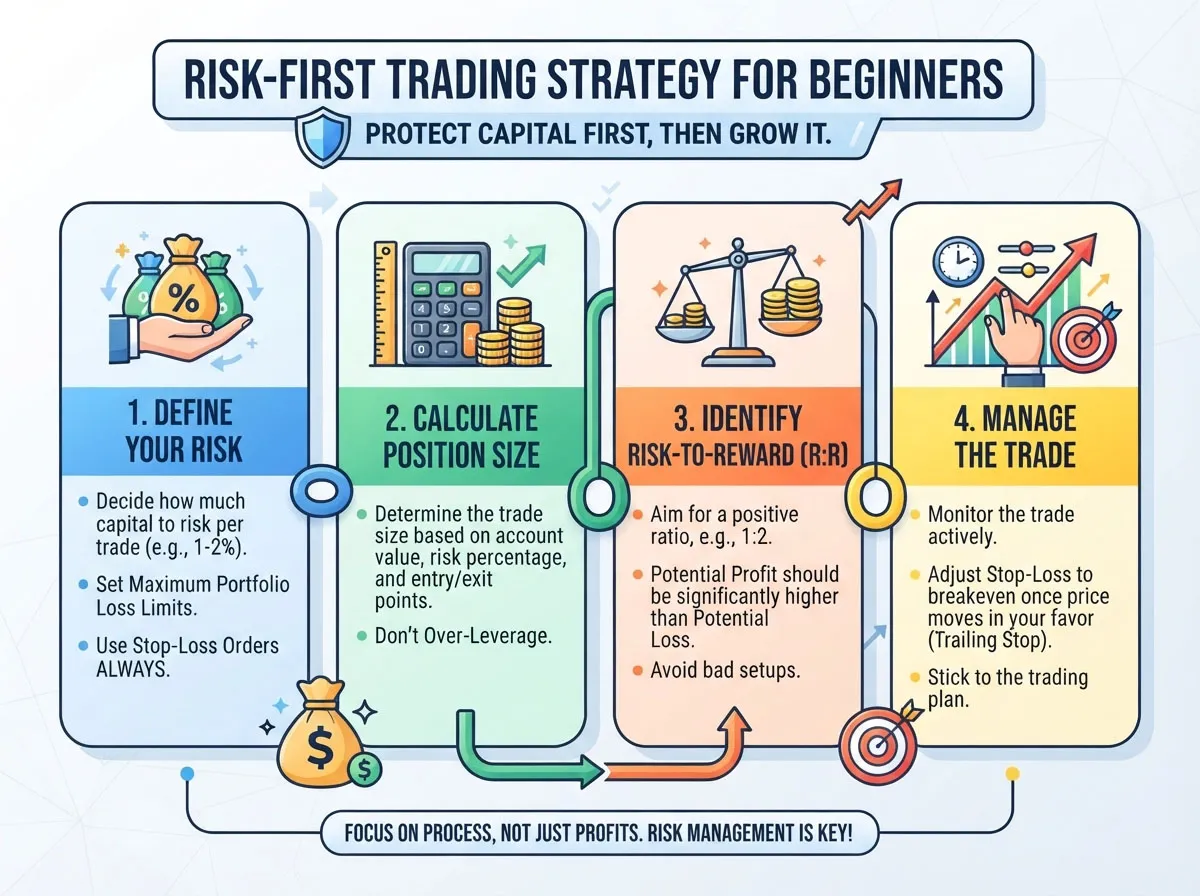
- Define the maximum acceptable loss.
- Identify the logical invalidation level.
- Calculate the position size.
- Check total exposure.
- Enter only if the setup still offers acceptable conditions.
This order of operations helps prevent the stock price from deciding the amount of money at risk.
The effect of large losses
Losses do not affect an account in a symmetrical way. If a trading account falls by 10%, it must gain approximately 11.11% to return to its previous level. After a 50% decline, the account requires a 100% gain to recover.
This is why capital preservation matters. A trader who controls losses has more capital available to participate in future opportunities.
A risk-first trading strategy does not focus on winning every trade. It focuses on avoiding a sequence of avoidable decisions that can seriously damage the account.
The Core Principles of Risk-First Trading
1. Define risk before reward
Before entering a trade, identify the maximum amount that could be lost if the stop-loss is reached or the trade must be closed manually.
A potential profit target should not determine how much capital is placed at risk. The risk should be acceptable even if the trade fails.
2. Use position sizing to control exposure
The stop-loss decides where the trade idea is wrong. Position sizing determines how much money is lost if that level is reached.
A wide stop does not necessarily mean the trade must be rejected. The position size can be reduced to keep the money risk within the planned limit.
3. Treat every trade as uncertain
A strong chart pattern can fail. A company with good financial results can experience a sharp price decline. A breakout can become a false breakout.
A risk-first trading strategy assumes that any individual trade can fail and prepares for that possibility before entry.
4. Limit concentration
Holding several stocks from the same sector may create concentrated exposure. A sector-wide event can affect all positions simultaneously.
Risk should therefore be measured at the account level, not only trade by trade.
5. Respect liquidity
Liquidity affects the ease and cost of entering or exiting a position. Low-volume stocks can have wider spreads, larger price gaps and more slippage.
SEBI describes liquidity risk as the possibility that an investment cannot be bought or sold promptly. A risk-first trading strategy includes liquidity in the stock-selection process.
6. Adapt to volatility
A stock that normally moves ₹5 per day may move ₹20 during an important announcement or broad market sell-off. A stop that works in quiet conditions may be too close during high volatility.
Risk controls should account for the stock’s normal price movement and the broader market environment.
How to Build a Risk-First Trading Plan
A written plan can turn risk management from a general intention into a practical process.
Step 1: Define available trading capital
Separate trading capital from money needed for rent, household expenses, education, emergency savings or other essential commitments.
The amount available for trading should reflect the possibility of losses. Money that may be needed soon should not be exposed to a volatile trading strategy.
SEBI’s investor education material recommends matching investments with time horizon and risk tolerance and warns against using volatile investments for money needed in the near future.
Step 2: Set a maximum risk per trade
A trader may define a maximum rupee amount or percentage of the trading account that can be lost on one position. There is no universal percentage suitable for every trader.
The chosen amount should consider:
- Account size.
- Financial obligations.
- Trading experience.
- Strategy volatility.
- Maximum acceptable drawdown.
- Psychological comfort with losses.
The most important rule is consistency. Changing the risk amount because a trade looks especially attractive can create unintended exposure.
Step 3: Set a maximum daily or weekly loss
A risk-first trading strategy may include a daily or weekly loss limit. Once that limit is reached, the trader stops opening new positions and reviews the results.
This rule can help prevent:
- Revenge trading.
- Increasing position size after a loss.
- Repeated entries in a choppy market.
- Emotional attempts to recover money quickly.
A loss limit does not improve the quality of a strategy automatically. It creates a boundary that can prevent one difficult session from becoming a larger account problem.
Step 4: Define maximum open exposure
Calculate the amount that could be lost if all open positions reach their stop-losses. This figure should include positions that appear unrelated but may be affected by the same market or sector event.
For example, owning several banking stocks may create more sector exposure than owning one banking stock and one company from a different industry.
Step 5: Define the trade invalidation point
The invalidation point should be based on market structure, not on the amount the trader wants to lose.
Examples include:
- Below a support zone.
- Above a resistance zone for a short position.
- Beyond a recent swing low or high.
- Outside a pattern boundary.
- Beyond a volatility-adjusted level.
If the required stop is too far away for the trader’s risk budget, the position size should be reduced or the trade should be skipped.
Position Sizing and Trade Risk
Position sizing is one of the most practical parts of a risk-first trading strategy.
Basic position-sizing formula
For a long stock trade:
For example, assume:
- Trading capital: ₹100,000.
- Maximum planned risk: ₹1,000.
- Entry price: ₹250.
- Stop-loss: ₹240.
- Risk per share: ₹10.
The theoretical position size is:
The position would have a market value of ₹25,000 before costs. Brokerage, taxes, slippage, liquidity and possible overnight gaps are not included in this simple calculation.
Why the number of shares is not the starting point
A common mistake is deciding to buy a fixed number of shares, such as 500 shares, before checking the stop-loss distance. The resulting risk may be much larger than expected.
A risk-first trading strategy starts with the acceptable loss. The quantity is calculated afterwards.
Reward-to-risk ratio
The reward-to-risk ratio compares the potential profit to the planned loss. Suppose a trader risks ₹10 per share and identifies a potential reward of ₹20 per share. The hypothetical ratio is 2:1.
This ratio can be useful when comparing setups, but it does not predict success. A trade with a 3:1 ratio can still fail, while a trade with a lower ratio may succeed more frequently.
A complete evaluation should consider:
- Win rate.
- Average win.
- Average loss.
- Trading costs.
- Slippage.
- Maximum drawdown.
- Market conditions.
- Rule-following quality.
Stop-Loss Planning
A stop-loss is an order or instruction intended to close a position when price reaches a predetermined level. In a risk-first trading strategy, the stop-loss should be connected to the reason for entering the trade.
Structure-based stop-loss
A structure-based stop may be placed beyond:
- A recent swing low.
- A support zone.
- A resistance zone.
- A consolidation boundary.
- A pattern invalidation point.
This approach attempts to give the trade enough room to develop while still defining where the idea has failed.
Volatility-based stop-loss
A volatility-based stop adjusts the distance according to the stock’s typical price movement. Tools such as Average True Range may help estimate recent volatility.
A more volatile stock may need a wider stop than a stable stock. If the wider stop creates too much rupee risk, the position size should be reduced.
Stop-loss limitations
A stop-loss does not guarantee the exact exit price. The actual result may be different because of:
- Overnight gaps.
- Low liquidity.
- Rapid price movement.
- Trading halts.
- Order execution delays.
- Technical or broker-related issues.
The trader should account for these limitations instead of treating a stop-loss as complete protection.
Avoiding stop-loss manipulation
Moving a stop farther away after entering is one of the most damaging habits in stock trading. It changes the original risk calculation and may convert a controlled loss into an uncontrolled loss.
A trader may adjust a stop according to a written trailing-stop rule, but an emotional adjustment made only to avoid accepting a loss is not risk management.
Managing Total Portfolio Exposure
A risk-first trading strategy must consider the account as a whole.
Correlated positions
Two stocks from different companies may still move together if they belong to the same sector or respond to the same economic factor.
Potential sources of correlation include:
- Same industry.
- Same index.
- Same commodity exposure.
- Similar interest-rate sensitivity.
- Similar dependence on global markets.
- Same regulatory risk.
A trader should ask, “How many positions could be affected by the same event?” rather than only asking whether each trade has an individual stop-loss.
Cash and reserved capital
Keeping some capital uncommitted can provide flexibility during uncertain conditions. It may also reduce the pressure to enter low-quality trades simply because all available money is already allocated.
Cash is not a guarantee of safety, and it may carry inflation or opportunity costs. It is simply one way to manage exposure.
Portfolio drawdown rules
A drawdown is the decline from an account’s previous peak. A risk-first trading strategy may include a rule to reduce position size after a predefined drawdown.
For example, a trader may pause, review the journal or use smaller positions after a losing period. The exact rule should be decided before the drawdown occurs.
Risk-First Rules for Different Market Conditions
During a strong uptrend
A trader may focus on pullbacks or continuation setups, but should avoid assuming that every stock will rise. Strong trends can experience sharp corrections and overnight gaps.
A risk-first trading strategy still requires a defined invalidation point and position size.
During a sideways market
Sideways conditions can produce frequent false breakouts. The trader may reduce activity, wait for price to reach range boundaries or use smaller positions.
Trading every movement inside an uncertain range can increase transaction costs and emotional mistakes.
During high volatility
When volatility rises, stop distances may need to become wider. To maintain the same rupee risk, position size must then become smaller.
If the required stop is too wide or execution conditions are poor, avoiding the trade may be more appropriate than forcing a smaller-quality setup.
Around major events
Earnings announcements, corporate actions and major economic releases can create sudden price movements. A trader should decide in advance whether positions will be held through such events.
A risk-first trading strategy does not assume that a positive announcement will produce a positive price reaction.
Common Risk-Management Mistakes
Risking more because a trade looks attractive
A strong setup can create overconfidence. Increasing position size because the expected outcome feels certain undermines the risk-first process.
Using the entire account on one idea
Even a carefully researched stock can experience an unexpected event. Concentrating most of the account in one position creates significant single-stock risk.
Ignoring transaction costs
Frequent trading can make small costs meaningful. Include brokerage, taxes, exchange charges, slippage and other applicable costs when reviewing results.
Treating unrealised profit as available capital
A position that is currently profitable can reverse quickly. Increasing exposure based on unrealised gains may create more risk than the account can tolerate.
Averaging down without a written rule
Buying more after a price decline increases exposure while the original trade may be proving incorrect. Averaging down should never be an automatic response to discomfort.
Using leverage without understanding liquidation
Leverage increases both exposure and loss potential. A trader should understand margin requirements, forced liquidation, interest or funding costs and the impact of price gaps before using leveraged products.
Ignoring psychological risk
A position may be technically acceptable but psychologically too large. If a trader cannot follow the stop-loss because the possible loss feels unbearable, the position size may be excessive.
Hypothetical Example
Assume a trader has ₹200,000 in trading capital and decides that the maximum acceptable loss on one stock trade is ₹1,000.
A hypothetical setup has:
- Entry price: ₹420.
- Logical stop-loss: ₹400.
- Risk per share: ₹20.
- Maximum money risk: ₹1,000.
- Theoretical position size: 50 shares.
The notional position value is ₹21,000. If the stop is reached, the estimated loss before costs is ₹1,000.
Now assume a second potential trade also carries a theoretical risk of ₹1,000. The trader must consider whether both positions are highly correlated and whether ₹2,000 of combined open risk is acceptable.
The example does not indicate that the trade should be taken. It demonstrates how a risk-first trading strategy calculates exposure before entry.
Key Takeaways
- A risk-first trading strategy defines acceptable loss before considering potential profit.
- Position size should be calculated from the money risk and stop-loss distance.
- A stop-loss should be placed where the trade idea is invalidated, not merely where the loss feels comfortable.
- Total portfolio exposure matters because correlated positions can lose together.
- Liquidity, volatility, overnight gaps and leverage can increase actual losses.
- Daily, weekly and account-level risk limits can reduce emotional overtrading.
- A good reward-to-risk ratio does not guarantee a successful trade.
- Capital protection is not a promise of profit; it is a process for controlling uncertainty.
– Frequently Asked Questions (FAQs)
A risk-first trading strategy is a trading approach in which the trader defines acceptable loss, stop-loss placement, position size and total exposure before entering a position. The potential return is considered only after the risk is understood.
Both matter, but strong stock selection cannot fully protect an oversized position. A stock may look attractive and still decline unexpectedly. Risk management helps control the account impact when the analysis is wrong.
There is no universal amount that applies to everyone. The appropriate amount depends on account size, financial circumstances, strategy volatility, experience and personal risk tolerance. A trader should choose a limit that remains manageable during a losing streak.
No. A stop-loss may execute at a different price during a gap, rapid movement or poor-liquidity condition. It is a risk-control tool, not an absolute guarantee.
No. Position sizing controls the amount exposed to one trade. Diversification distributes exposure among different securities or asset classes. A portfolio can contain many positions and still be highly concentrated if they are correlated.
Some traders use a fixed percentage of account capital as a risk limit, but no single rule is suitable for everyone. The important point is to establish a consistent risk limit that reflects the trader’s circumstances and strategy.
No. A risk-first trading strategy cannot guarantee profits or prevent every loss. It is designed to limit avoidable exposure and help a trader remain financially and psychologically capable of continuing after losing trades.