Demat Account vs Trading Account vs Broker App: What’s the Difference?

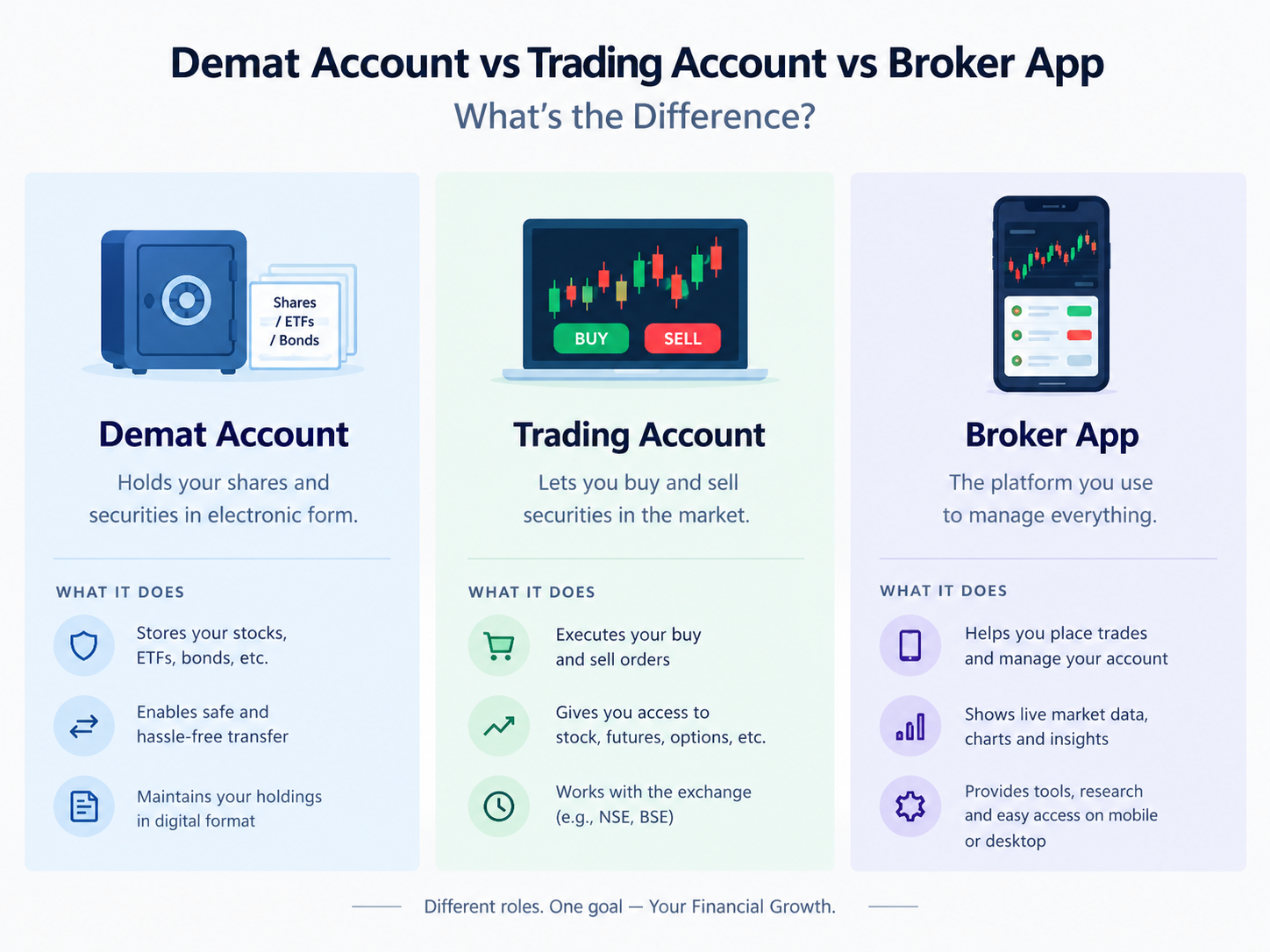
The simplest way to understand demat account vs trading account is this: a trading account is used to place and record buy/sell transactions through a broker, while a demat account holds eligible securities electronically through a depository participant. The broker app is only the software interface that may combine access to both accounts, funds, reports and market tools on one screen.
Education-only disclaimer: This article is for educational purposes only. Account-opening requirements, broker workflows, depository processes and charges can change. Verify the current terms with your broker, depository participant, NSDL/CDSL and SEBI before acting.
Key takeaways
- A demat account is mainly for holding eligible securities in electronic form.
- A trading account is used to place and record market transactions through a stock broker.
- A broker app is the interface; it is not a third legal account type that replaces the other two.
- NSDL and CDSL are depositories; investors access depository services through a depository participant.
- Buying a delivery share involves both the trading side and the demat side.
- Derivative contracts are handled differently from delivery share holdings.
- Understanding demat account vs trading account makes broker fees, statements and order flow much easier to understand.
Demat account vs trading account: the difference in one table
The demat account vs trading account distinction becomes clearer when you separate holding from transacting.
| Feature | Demat account | Trading account | Broker app |
|---|---|---|---|
| Main purpose | Hold eligible securities electronically | Place and record market orders/transactions | Give you software access to brokerage and account functions |
| Core relationship | Depository services through a DP | Stock broker / trading member | Software provided by the broker or platform |
| Holds shares? | Yes, eligible delivery holdings | No; it records/handles transactions | Displays holdings but does not itself become the depository |
| Places exchange orders? | No | Yes, through the broker | Lets you enter orders that the broker routes |
| Typical records | Demat statement, holdings, debits/credits | Order book, trade book, ledger, contract notes | Interface that displays many of these records |
| Relevant infrastructure | NSDL/CDSL via DP | Exchange/broker/clearing workflow | Mobile/web technology layer |
If you remember only one thing, remember this:
Trading account = transaction access. Demat account = electronic holding. Broker app = interface.
What is a demat account?
In the demat account vs trading account comparison, the demat side is about custody. A demat account is an account used to hold eligible securities in dematerialised, or electronic, form.
Before electronic depositories became the normal system, investors relied heavily on physical share certificates. Dematerialisation replaced much of that paper-based process with electronic records.
In India, depository infrastructure is provided by NSDL and CDSL. Investors typically open and operate a demat account through a Depository Participant (DP) rather than dealing with the depository as if it were a retail broker.
NSDL’s own account-opening information directs investors to choose a DP and notes that many DPs can also facilitate a linked trading account.
What can appear in a demat account?
Depending on eligibility and the services involved, a demat account can hold instruments such as:
- listed equity shares;
- ETFs;
- bonds or debentures in demat form;
- certain mutual-fund units;
- government securities and other eligible instruments.
A demat account is therefore closer to an electronic securities-holding record than to a trading screen.
This is the first major difference in demat account vs trading account: the demat side answers, “What eligible securities do I hold?” The trading side answers, “What market transaction am I trying to execute?”
What is a trading account?
On the other side of demat account vs trading account, a trading account is the relationship through which you place buy and sell instructions with a stock broker and maintain the transaction-side records associated with those trades.
When you open a modern brokerage account, the trading account is often created together with the demat account. That convenience can make the distinction invisible.
The trading account is where you typically interact with:
- buy and sell orders;
- order types;
- open orders;
- executed trades;
- intraday positions;
- derivative positions;
- funds ledger;
- margins;
- contract notes and trade records.
If you are still learning order mechanics, understanding market orders and limit orders is more important than memorising every button in a broker app.
The demat account vs trading account difference is not about which one is “better.” They solve different problems.
What is a broker app?
A broker app is software, which is why demat account vs trading account should not be confused with an app-versus-account comparison.
That sounds simple, but it prevents a lot of confusion.
The app can show:
- your demat holdings;
- trading-account funds;
- market data;
- charts;
- orders;
- positions;
- watchlists;
- statements;
- support tickets.
Because everything appears under one login, it can feel as though “the app” is holding your shares and executing the trade by itself.
It is not.
The app is a front end connected to the broker’s systems and, through the regulated market infrastructure, to exchanges, clearing/settlement systems and depository services.
A change in app design does not change the basic demat account vs trading account distinction underneath it.
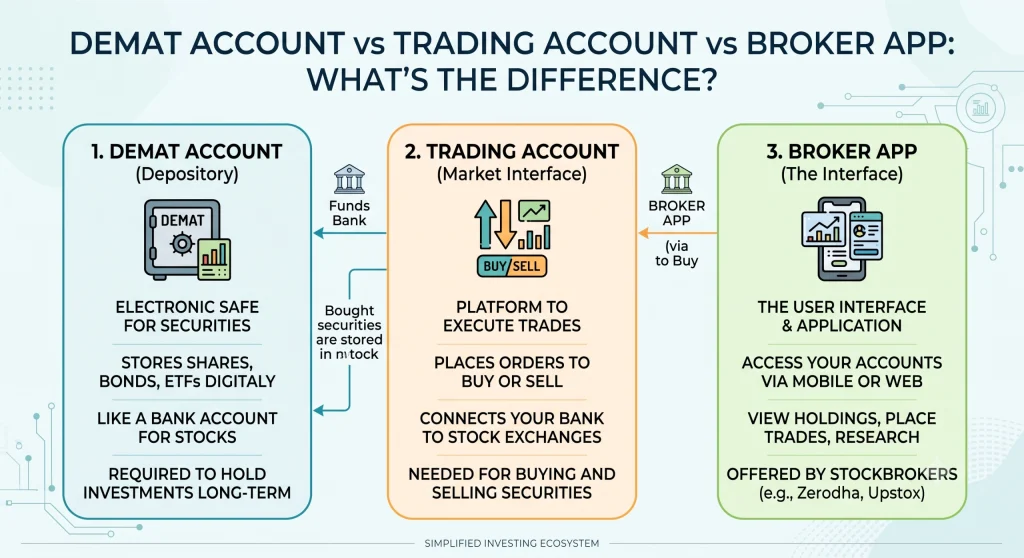
How the demat account, trading account and broker app work together
For demat account vs trading account, a useful mental model is:
You → broker app → trading account/broker → exchange and clearing system → demat account/depository for eligible delivery securities
That is deliberately simplified. The actual market infrastructure has more moving parts, but the flow is enough to understand each layer’s job.
The broker app
Where you enter the instruction.
The trading account
The transaction relationship and records through which the broker handles the order.
The exchange
Where eligible buy and sell orders are matched according to market rules.
Clearing and settlement
Where the obligations created by the executed trade are processed.
The demat account
Where eligible delivered securities are credited to or debited from your electronic holdings through the depository system.
Once you understand that chain, how the stock market works becomes much less abstract.
What happens when you buy a share for delivery?
Suppose you want to buy 10 shares of a listed company and hold them. This example shows demat account vs trading account working together rather than competing with each other.
Step 1: You enter the order in the broker app
You choose the security, quantity, order type and other relevant order details.
Step 2: The broker routes the order
The instruction moves through your trading relationship to the exchange.
Step 3: The order is matched
If a compatible sell order is available and your conditions are met, the trade executes.
Step 4: The transaction enters clearing and settlement
Funds and securities obligations are processed through the relevant market infrastructure.
Step 5: The securities are credited to demat
After the applicable settlement process completes, eligible delivery shares are credited to your demat account.
This is why demat account vs trading account is not an either/or choice for a normal delivery investor. The trading account helps execute the purchase; the demat account holds the delivered securities.
What happens when you sell a delivery share?
The flow works in the opposite direction, and it makes the demat account vs trading account distinction just as visible on a sale.
Step 1: You place the sell order
You use the broker app and trading account to enter the sell instruction.
Step 2: You authorise the securities debit where required
The broker/DP workflow may use an approved mechanism such as depository authorisation, DDPI arrangements or other current processes to allow the required securities debit. The exact user flow depends on your account setup and applicable rules.
Step 3: The exchange trade executes
A matching buyer is found and the trade is confirmed.
Step 4: Securities leave the demat account through settlement
The relevant quantity is debited as part of settlement.
Step 5: Sale proceeds are reflected through the broker/funds workflow
Availability and withdrawal timing follow the applicable settlement and broker processes.
This is also where investors often encounter a DP charge. A fee associated with a demat debit can apply even when the brokerage itself is low.
Understanding demat account vs trading account therefore helps you understand why some charges appear only when delivery holdings move out of demat.
Where do NSDL and CDSL fit?
NSDL and CDSL are securities depositories. That depository role is central to understanding demat account vs trading account in India.
A depository is part of the infrastructure that enables electronic holding and transfer of securities. It is not the same thing as your stock broker.
You normally access depository services through a DP. Many stock brokers also act as, or are connected with, a DP, which is why one onboarding flow can create both trading and demat relationships.
When comparing a broker, check:
- whether the demat account is with NSDL or CDSL;
- the DP entity name;
- DP charges;
- how to access depository statements;
- how sell authorisation works;
- account maintenance fees;
- nomination and KYC processes.
SEBI’s investor materials repeatedly encourage investors to deal with registered intermediaries and keep their account information and statements updated.
The depository layer is a key part of demat account vs trading account because the demat holding is not simply a number invented by the broker app.
Can I have a demat account without a trading account?
Yes. The answer is another reminder that demat account vs trading account describes two separate functions.
A demat account can exist for holding eligible securities even if you are not actively placing exchange trades through a linked trading account. NSDL’s FAQs also note that some providers offer 3-in-1 arrangements combining demat, trading and bank accounts, which itself shows that the accounts are conceptually separate even when packaged together.
There can be situations where a person maintains a demat account mainly for holdings, transfers or other depository services.
Can I have a trading account without a demat account?
It depends on what you are doing. The practical meaning of demat account vs trading account changes with the product being traded.
For delivery-based equity investing, a demat account is needed to hold the securities after settlement.
For some derivative activity, the position is a contract rather than a delivery share holding, so the demat account does not play the same role in holding the open derivative position. The broker still needs the appropriate trading relationship and segment access.
For a beginner, there is rarely a useful reason to make this more complicated than necessary. If your goal is to invest in stocks, a linked trading-plus-demat setup is the normal practical path.
Can I have multiple demat and trading accounts?
Yes, subject to KYC, broker/depository requirements and the normal account-opening process.
Some investors keep accounts with more than one broker for different workflows. That can be useful, but it also adds:
- more logins;
- more statements;
- more account-maintenance considerations;
- more DP relationships;
- more records to reconcile;
- more chances to leave an old account unused.
The demat account vs trading account distinction becomes especially important when you have multiple brokers, because your trading relationship and your actual securities holdings may be distributed across different accounts.
Do not create extra accounts just because opening them is easy.
What is a 2-in-1 account?
A 2-in-1 arrangement usually refers to a broker offering the trading and demat relationships together.
That is common with online stock brokers because it creates a smoother user experience: one onboarding flow, one app and linked settlement/holding processes.
The two functions remain conceptually different even when the login is shared.
What is a 3-in-1 account?
A 3-in-1 account typically combines:
- bank account;
- trading account;
- demat account.
NSDL notes in its FAQs that many DPs offer 3-in-1 arrangements for investor convenience.
The benefit is integration. Funds can move through a linked banking relationship, orders are placed through the trading side and eligible securities are held in demat.
The trade-off is that convenience should not stop you from comparing charges, service quality and account terms.
A bundled account does not erase the demat account vs trading account distinction; it simply packages the pieces together.
Demat account vs trading account charges
The cost structure also reflects the different jobs each account performs, so demat account vs trading account can be understood through fees as well as functions.
Common demat-side costs
Depending on the DP and account type:
- annual maintenance charge;
- DP transaction charge when securities are debited;
- pledge/unpledge fees;
- off-market transfer fees;
- dematerialisation/rematerialisation fees;
- other service charges.
Common trading-side costs
Depending on the broker and segment:
- brokerage;
- call-and-trade fees;
- auto-square-off fees;
- margin/funding costs;
- platform/subscription fees where applicable;
- order/API-related fees in some plans.
Market-wide costs
Separate from the simple demat account vs trading account classification, an executed trade can also attract:
- STT/CTT;
- exchange transaction charges;
- SEBI turnover fees;
- GST on applicable service charges;
- stamp duty.
That is why a broker’s “₹0” or “₹20” headline cannot tell you the total cost by itself.
Which account contains which records?
This is a practical way to remember demat account vs trading account when you are looking at statements rather than definitions.
Demat-side records
Look for:
- holding statement;
- securities credits/debits;
- depository statements;
- consolidated account statements where applicable;
- ISIN-level holding records;
- pledge or lien information.
Trading-side records
Look for:
- order book;
- trade book;
- positions;
- contract notes;
- funds ledger;
- brokerage/charge breakdown;
- margin records.
Broker app
The app may display both sets of information in one dashboard.
If you ever switch brokers, face an app outage or need to reconcile a discrepancy, knowing which record belongs to which layer becomes useful.
This is where demat account vs trading account stops being a textbook distinction and becomes a practical account-management skill.
Example: one app, three different jobs
Imagine you open a modern broker app.
On the home screen you see:
- ₹25,000 available funds;
- five stocks under “Holdings”;
- an open NIFTY futures position;
- an order waiting to execute.
Those four items are not all the same kind of record.
- Available funds relate to the broker/trading ledger and funding workflow.
- Holdings represent eligible securities in the demat/depository system.
- The futures position is a trading/derivative position, not a demat share holding.
- The pending order is an instruction on the trading side.
The app simply presents them together.
That single screen is exactly why beginners search demat account vs trading account in the first place: technology makes separate market functions look like one account.
Common mistakes beginners make
Mistake 1: Thinking the broker app “holds” the shares
The app displays holdings. The demat/depository infrastructure is what records electronic securities holdings.
Mistake 2: Assuming a demat account lets you trade directly on the exchange
The demat account is not an order-routing account.
Mistake 3: Ignoring DP charges
Delivery sellers may see a DP debit cost even when brokerage looks low.
Mistake 4: Treating derivatives like delivery shares
An open futures or options position is not simply sitting in demat like a delivery equity holding.
Mistake 5: Keeping old accounts open without checking AMC
Multiple accounts can create ongoing cost and record-management work.
Mistake 6: Giving someone unrestricted access because “it’s only the app”
Your broker login can provide access to sensitive market and account functions. Protect passwords, OTPs and authorisation credentials.
Mistake 7: Focusing on account labels but not learning order mechanics
Knowing demat account vs trading account is useful, but you still need to understand the order you are placing and the risk of the security or derivative itself.
Conclusion
The demat account vs trading account comparison is much easier once you stop thinking of the broker app as the account itself.
In demat account vs trading account, the trading account is the transaction layer and the demat account is the electronic securities-holding layer. The app is the interface that lets you interact with both and see market information in one place.
That demat account vs trading account distinction helps you understand where shares are held, why DP charges exist, which statements matter and what happens when you buy or sell for delivery.
Before opening a broker account, learn the basic account structure, compare the current tariff and confirm the regulated entities involved. Then focus on the part that matters most: making informed decisions rather than simply having easy access to a buy button.
For the broader foundation, what stocks represent and how to invest in stocks are useful next steps.
Frequently Asked Questions (FAQs)
The main demat account vs trading account difference is purpose. A demat account holds eligible securities electronically through the depository system, while a trading account is used to place and record market transactions through a broker.
Not exactly. Many brokers bundle the demat and trading account into one onboarding experience, but the demat account is part of the depository relationship while the trading account is part of the brokerage transaction relationship.
No. The app is the software interface used to access the trading account and often the linked demat information. Deleting the app from your phone does not erase the underlying accounts.
For normal delivery-based listed equity investing through a broker, you generally use the trading account to place the purchase and the demat account to hold the delivered shares after settlement.
They perform different functions, so the comparison is not meaningful as a simple “safer” choice. Use a SEBI-registered broker/DP, protect account credentials, monitor statements and understand the applicable security and authorisation controls.
Yes. Opening a demat account does not itself require you to place a stock trade. Account terms and maintenance charges can still apply depending on the provider and account type.
Linking arrangements depend on the broker/DP setup and operational rules. Do not assume a demat account will automatically link to every broker you use. Confirm the process with the relevant broker and DP.
Changing the app interface does not by itself move your securities. If you change brokers and want to move eligible holdings, you follow the applicable depository transfer process. Check the old and new DP details and any transfer/closure charges.