Binance India: 5 Checks That Reveal Your Total Spot Cost


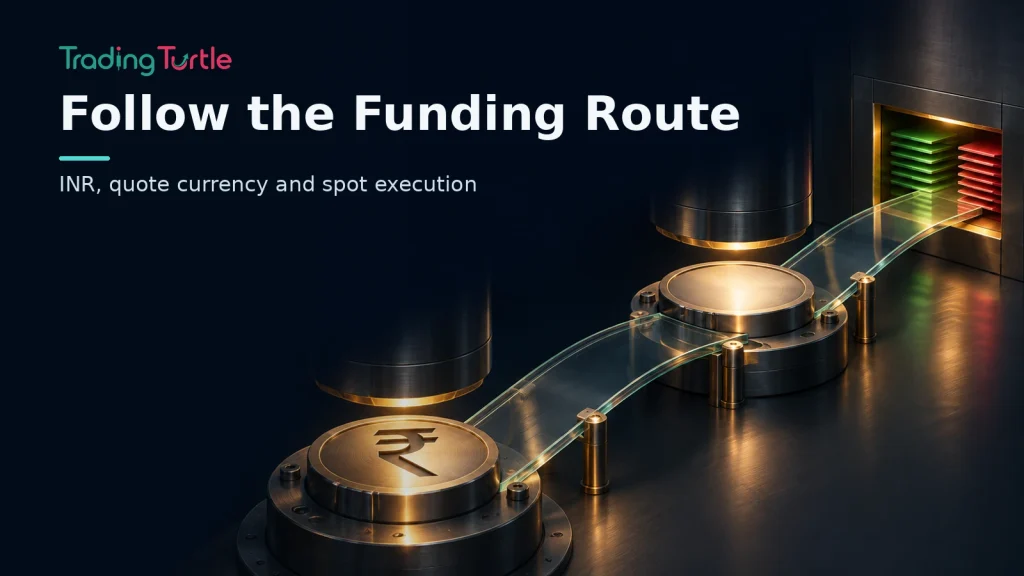
Binance India spot costs start with a published trading rate, but the rate applies when the order fills. A reader starting and ending in rupees has a longer journey. The currency used to fund the order book, the actual execution price and the way back to INR can each change what the trade costs.
Editorial scope. This guide evaluates public product material and published documentation. Account-specific access, transaction execution and payouts were outside the scope of this review.
Affiliate disclosure. Trading Turtle has an affiliate relationship with Binance. The article links to official sources and uses the same editorial criteria for alternatives. Visit Binance using our affiliate link.
Risk disclaimer. Crypto products and NFTs are unregulated and can be highly risky. There may be no regulatory recourse for any loss from such transactions.
1. Find out what balance actually buys the asset
The Binance India fee page gives a regular-user spot fee reference of 0.10%. Its public India trading interface also shows markets quoted in USDT, including BTC/USDT, and sign-in for placing an order. A reader may see a rupee conversion on screen even though the order book settles in a different unit. Read the pair itself and identify the quote asset before comparing prices. Binance fee explanation · Public Binance spot interface
An INR price on a Binance India market screen can help you read the market. The order preview is where you establish which balance is debited. For an INR-first comparison, write down the starting rupee amount, the amount of quote currency you can acquire and the net crypto quantity received after the fill. When the last amount is the same on two platforms, their total rupee debit is comparable. When the amount differs, compare the price per net unit received.
Three different routes can appear alongside each other. A direct fiat action uses an account payment channel. P2P matches the user with a participant under the platform’s order rules. A crypto deposit transfers an asset on a blockchain. Binance publishes an INR deposit landing page which asks visitors to sign in for available payment methods. That verifies the existence of the entry point, while the signed-in screen determines whether the route is offered on an individual account. Official INR deposit page
2. Compare Binance India spot execution costs
Open the Binance India spot fee schedule for the same product and tier as your intended order. Binance publishes a separate fee table for fiat spot pairs and lists promotions and discounted rates in its fee documentation. Carrying a discounted rate from one product to another can produce a plausible but wrong estimate. Compare first using the standard rate applicable to the pair, then add eligible reductions only after seeing them on the account. India spot fees · Fiat spot fee table
The best ask is a starting point, not the price of the whole order. A market buy takes one or more displayed asks. If the desired quantity is greater than what’s available at the first price, the remaining quantity can fill at higher levels. A limit order defines a price boundary and trades execution certainty for price control. Once there’s a fill, use the volume-weighted average and total fee from the record. Trading Turtle order terminology
A fair comparison uses the same asset, order size, approximate moment and destination. If one platform gives you a smaller spot fee but a worse rate for obtaining the quote asset, compare the two effects in rupees. Keep any withdrawal or network charge separate. This review examines the public market and published schedules. It does not report a signed-in quote, trial execution or completed payout.

3. Treat P2P and fiat payout as different experiences
A peer-to-peer offer can quote INR, but the quoted price is set by, or offered to, another participant. Compare the amount received after any quoted charges, and read the payment instructions and limits before taking the order. The provider publishes a separate P2P fee table. Even a transaction that displays a zero platform fee can have a less attractive quote than another route. Binance P2P fees
For a direct payout through Binance India, inspect the eligible currency and settlement method on your own account. For an existing crypto balance, first check how you would return to INR or what network is available to receive it elsewhere. Make both exit checks before adding funds. A signed-out landing page alone cannot establish a same-day bank withdrawal, current limit or generally available payment method.
| Route being evaluated | Compare this cost | Retain this record |
|---|---|---|
| Direct fiat funding or payout | Total paid or received and any visible route charge | Bank or provider reference and statement entry |
| P2P | Effective INR price and any order-specific fee | Order ID and settlement evidence |
| On-chain deposit or withdrawal | Net units that arrive on the correct network | Address, hash, network and fee record |
Keep any dispute work inside the documented support route. A bank reference can show account movement, while a network hash identifies an on-chain transaction. The route determines which evidence helps support investigate. A guide to exchange withdrawal risk
4. Read regulatory and account records separately
A parliamentary response lists Binance under Nest Services Limited, formerly Binance International Limited, as a reporting entity. The same response describes FIU-IND registration and related compliance. Reporting obligations do not establish whether a given payout works, how custody losses would be handled or which region-specific features an account has today. Lok Sabha response and annexes
Export your Binance India trade history in its original units and preserve the timestamp. Match it to deposits, withdrawals and any statement needed for tax reconciliation. If the account records a stablecoin conversion and a subsequent spot fill, preserve both events. Combining them into a round INR figure can conceal differences that matter to future reconciliation. Stablecoins and other crypto assets
5. Choose an exchange based on your route
Binance India is worth comparing when you need a specific order book or a pair quoted in a crypto asset and can complete the funding, withdrawal and reporting steps. If your actual goal is a straightforward INR purchase and bank exit, compare a venue with an INR order book and an established bank route for your account. The lowest spot line on a fee page is only one part of that decision. Look for an explainable total debit and an evidenced route out.
The three pieces to capture before a decision are the actual preview, the planned exit and an example of the transaction records you can export. That makes it possible to review how the platform will fit your process without treating a referral promotion as evidence about product quality.
Break the journey into balances you can verify
When you work across an INR bank account and a USDT order book, create a row for each movement. Record the rupee amount before funding, the quote currency credited, and the gross and net quantities after execution. If you eventually sell, record the resulting crypto or fiat balance and the amount reaching the final destination. Each balance should be supported with a record before you treat the journey as complete. The same accounting frame gives you a fair comparison between a platform with a direct INR pair and a platform that requires a conversion.
A useful distinction is between a reversal on the same book and a withdrawal from the venue. You can close a BTC/USDT trade and hold USDT afterward. That closes BTC exposure, but it does not establish a rupee bank credit. A participant who wants INR at the end should model that second step before choosing the first platform. Likewise, someone who wants self-custody should compare the net amount on the intended network, because a quoted INR value in an exchange account is not the same measure as a token balance after an on-chain fee.
Compare two order previews without assuming a live fill
An order-book snapshot and a preview answer different questions. The snapshot can show liquidity visible at the time you checked. A preview tells you what the application is prepared to show for the chosen order type and size. An actual completed order then generates the authoritative fill. If you only have the first two, record the evidence as observed information before execution rather than a measured fill.
Separate venue access from execution in your notes. The public India platform lets a reader see supported spot markets and public fee terms. Sign-in is needed for the full funding journey. If the critical part of your decision is direct INR payout eligibility, verify it on your own signed-in account and keep the source and date. If the question is whether a particular asset is supported on a network, find the receiving wallet details first and use a separate destination check. Binance India spot market · Trading Turtle wallet basics
When comparing an INR quote with a stablecoin route, account for the time between observations. A price change on the underlying asset can distort what looks like a fee difference. Record the quote currency, timestamp and quantity and refresh both screens together when evaluating a real decision. That yields a better basis for comparison than a fee table detached from the route.
Frequently asked questions
What is the standard Binance spot fee?
Binance describes 0.10% per trade for regular users as a standard spot rate. Pair-specific and fiat rate schedules can differ, so check the preview.
Does an INR deposit page confirm direct withdrawal to my bank?
The public INR page asks users to sign in for methods. Confirm deposit and withdrawal separately for the actual account.
What’s the difference between a P2P quote and a spot fee?
A P2P quote is the price in a participant order. A spot fee is a charge tied to execution on the order book.
How can I compare with another exchange fairly?
Match the asset, net quantity and quote time and compare the full rupee debit and intended exit route.