Bybit Review 2026: Fees, Safety, KYC, Pros & Cons

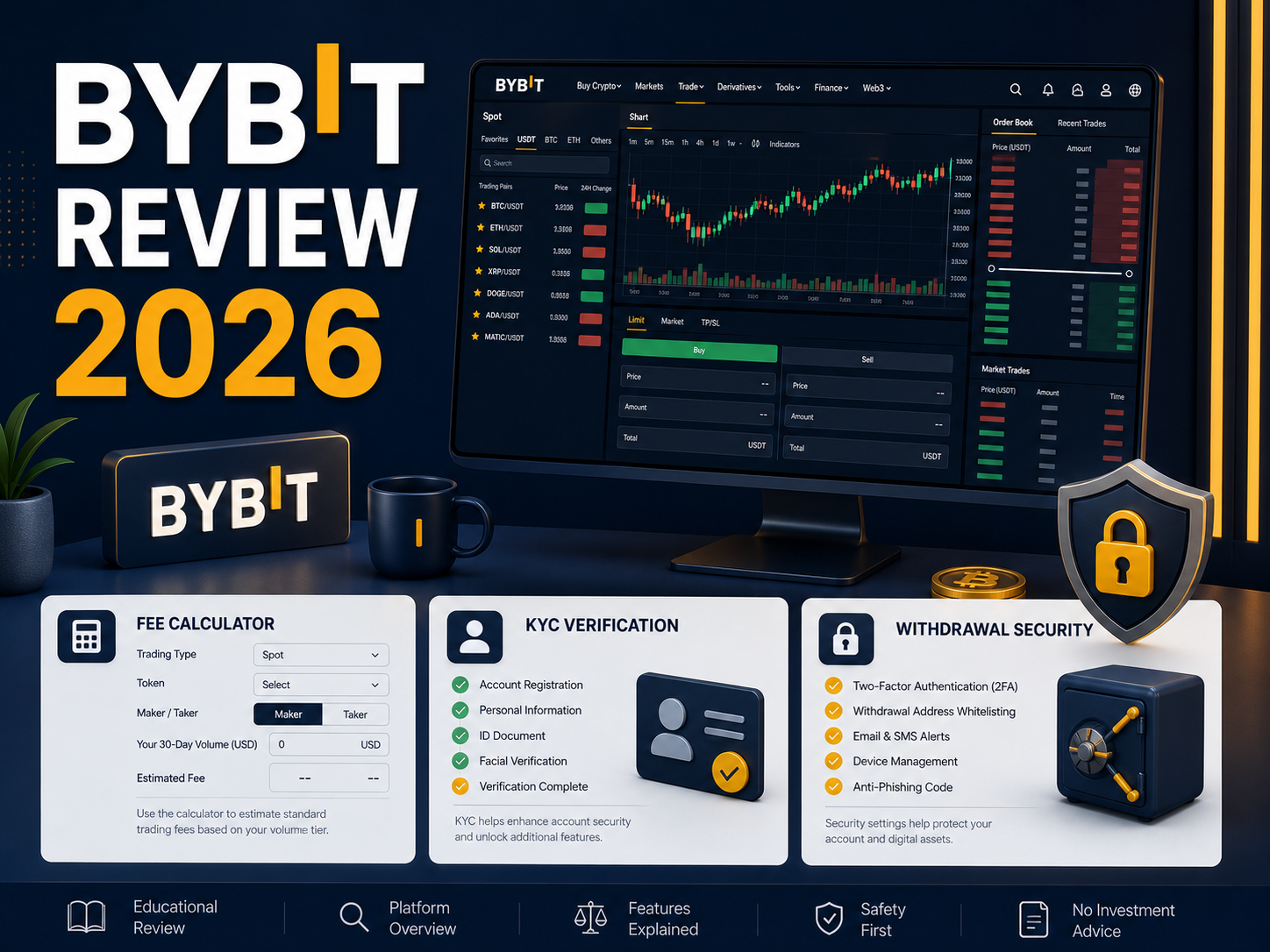
Bybit is a large global cryptocurrency exchange offering spot trading, perpetual and futures contracts, options, margin products and other crypto services. This Bybit review examines the exchange from a practical, risk-aware perspective: trading fees, KYC, security, Proof of Reserves, the major 2025 security incident, India availability, custody risks and whether the platform makes sense for beginners.
Bybit Review: Quick Answer
Bybit is a feature-rich crypto exchange with competitive trading fees, compulsory KYC, deep derivatives functionality and regularly published Proof of Reserves. However, any Bybit review in 2026 also has to account for the approximately $1.5 billion theft from one of its Ethereum cold wallets in February 2025. The exchange remained operational, replenished reserves and has continued publishing independently reviewed reserve reports, but the incident remains an important part of its security record.
For Indian users, the practical answer is also clearer than it was in early 2025: Bybit registered with India’s Financial Intelligence Unit and later restored broader access to Indian users. FIU registration, however, does not make cryptocurrencies legal tender, guarantee investment safety or remove a user’s tax and compliance obligations.
Education-only and risk disclaimer: This article is for educational purposes only and does not provide financial, investment, legal or tax advice. Cryptocurrency prices can be highly volatile, derivatives can magnify losses, and funds held on a centralised exchange remain exposed to custody, operational, cybersecurity and regulatory risk.
Bybit Review 2026: Key Takeaways
- Bybit offers spot, futures, perpetual contracts, options and other crypto products, although availability varies by jurisdiction.
- Standard non-VIP crypto-to-crypto spot fees are currently 0.10% maker and 0.10% taker, subject to region and account tier.
- Standard identity verification is required for Bybit products and services.
- Bybit suffered a major security incident on 21 February 2025 involving roughly $1.5 billion in virtual assets.
- The FBI attributed the theft to North Korea-linked TraderTraitor activity.
- Bybit continued operating after the incident and subsequently published Proof-of-Reserves reports showing major covered assets above 100% reserve ratios.
- Bybit expanded its Proof-of-Reserves coverage to 50 tokens in July 2026.
- Bybit is registered with FIU-IND and restored broader access for Indian users in 2025.
- Registration or Proof of Reserves should not be interpreted as a guarantee that funds cannot be lost.
- Beginners should understand spot trading, order types, wallet custody and leverage before using advanced exchange products.
What Is Bybit?
Bybit is a centralised cryptocurrency exchange founded in 2018. It has developed from a derivatives-focused venue into a broader crypto platform offering spot markets, derivatives, options, trading tools and other digital-asset products.
For this Bybit review, the important distinction is that Bybit is not simply a place to buy cryptocurrency. Its interface and product range are also designed for active traders, particularly users interested in derivatives.
That can be useful for experienced participants, but a larger product catalogue does not automatically make an exchange better for a beginner.
Someone buying cryptocurrency for the first time may need only:
- A straightforward spot market.
- Transparent fees.
- Reliable deposits and withdrawals.
- Strong account security.
- Clear KYC requirements.
- Good liquidity.
- A simple method of transferring assets to a personal wallet.
Advanced margin, perpetual and options products may add complexity before they add practical value.
Bybit Crypto Exchange
Trade spot crypto and access advanced markets from one platform
Spot Trading • Convert • Derivatives • Security Tools
Affiliate disclosure: Some links on this page may be affiliate links. If you register or use a service through one of these links, Trading Turtle may earn a commission at no additional cost to you. This does not influence our reviews, ratings or editorial conclusions.
Is Bybit Available in India in 2026?
Yes. Bybit currently serves Indian users and is registered with the Financial Intelligence Unit-India as a Virtual Digital Asset Service Provider reporting entity.
This point deserves a clear answer because Bybit’s India position changed significantly during 2025.
Bybit temporarily restricted services for Indian users in January 2025 while dealing with local compliance requirements. The company then announced its registration with FIU-IND in February 2025. By September 2025, Bybit said its mobile apps had returned to Indian app stores and broader platform access was being restored. Bybit’s FIU-IND registration announcement
The underlying FIU-IND enforcement history is also relevant. FIU-IND issued an order concerning Bybit’s earlier provision of virtual digital asset services to Indian clients without fulfilling applicable PMLA reporting obligations. FIU-IND order
That history is important because registration should not be presented as though Bybit had always operated under the same Indian compliance status.
Does FIU registration mean Bybit is government-approved?
No.
FIU-IND registration primarily relates to obligations under India’s anti-money-laundering and counter-terrorist-financing framework. It should not be interpreted as:
- Government approval of individual cryptocurrencies.
- A guarantee of exchange solvency.
- Investor insurance.
- A guarantee against hacks.
- SEBI approval of crypto investments.
- Recognition of cryptocurrency as legal tender.
Indian users still need to consider applicable tax, reporting and other legal obligations independently.
That distinction is central to a responsible Bybit review because “registered” and “risk-free” are very different concepts.
Bybit Fees in 2026
Trading cost is one of Bybit’s stronger competitive features, although users should always check their own account before trading because rates can vary by region, product, VIP level and promotional conditions.
According to Bybit’s current trading fee structure, standard VIP 0 crypto-to-crypto spot trading currently carries:
| Product | Maker fee | Taker fee |
|---|---|---|
| Crypto spot trading | 0.10% | 0.10% |
| Perpetual & futures | 0.020% | 0.055% |
| Options | 0.020% | 0.030% |
These are base rates rather than a promise about what every user will pay. Bybit specifically notes that actual rates can vary by region and recommends checking the account’s fee page after identity verification.
Bybit spot trading fee example
Suppose a trader executes a $1,000 equivalent crypto spot transaction at a 0.10% fee.
The approximate trading fee would be:
$1,000 × 0.10% = $1
A $10,000 equivalent filled order at the same rate would incur approximately $10 in trading fees.
This simple example also demonstrates why trading frequency matters. A low-looking percentage can become meaningful when someone enters and exits repeatedly.
Maker vs taker fees
A trader’s fee category depends on whether the order adds liquidity to or immediately removes liquidity from the order book.
A market order commonly executes against existing orders and therefore normally acts as a taker order. A limit order can become a maker order when it rests on the book rather than executing immediately.
Understanding market orders and limit orders is therefore useful before placing live exchange orders.
Bybit’s own spot-fee documentation currently lists 0.10% maker and 0.10% taker fees for standard non-VIP spot users, while noting regional and VIP variations. Bybit fee schedule
Don’t evaluate an exchange on trading fees alone
This Bybit review does not treat the lowest advertised fee as the same thing as the lowest real cost.
Users may also encounter:
- Blockchain withdrawal fees.
- Funding payments on perpetual contracts.
- Borrowing interest when using margin.
- Fiat payment or withdrawal charges.
- Bid-ask spread.
- Slippage.
- Liquidation costs or losses.
- Currency-conversion costs.
Market depth matters too. Liquidity in trading affects how efficiently larger or urgent orders may execute.
Bybit KYC Requirements
Bybit now requires identity verification for its products and services.
According to Bybit’s current KYC documentation, at least Standard identity verification is mandatory for Bybit products and services, with additional verification potentially required depending on region, product or service.
Bybit currently describes three individual verification levels:
Standard
Standard verification includes identity assessment and proof of identity.
Advanced
Advanced verification adds proof of address.
Pro
Pro verification includes enhanced due diligence and may require further supporting information.
Bybit’s current verification instructions explain that additional documents may sometimes be requested for withdrawals or fiat transactions even after higher-level verification has been completed. Bybit verification guide
For a modern centralised exchange, compulsory KYC is not unusual. Users should nevertheless understand what personal information they are submitting and how the platform handles it.
From a beginner’s perspective, this Bybit review considers transparent KYC requirements preferable to creating the impression that an exchange can be used indefinitely without identity checks when that is no longer the case.
Is Bybit Safe?
Bybit has meaningful security controls and transparency mechanisms, but it should not be described as completely safe.
No centralised crypto exchange deserves an “unhackable” label.
The most important evidence is Bybit’s own security history.
The February 2025 Bybit Hack
On 21 February 2025, a major attack resulted in approximately $1.5 billion in virtual assets being stolen from Bybit.
The FBI later attributed the theft to North Korea and described the activity as TraderTraitor. The FBI’s Bybit hack advisory
Bybit reported that the attack affected an Ethereum cold wallet during a transfer process involving Safe multisig infrastructure. Subsequent forensic work cited by Bybit concluded that compromised Safe developer credentials enabled malicious manipulation of the signing interface rather than identifying a compromise in Bybit’s core infrastructure. Bybit forensic update
Bybit’s detailed incident timeline put the compromised assets at approximately $1.46 billion. Bybit incident timeline
Whatever the technical attack path, the practical takeaway for users is straightforward:
A very large quantity of assets was successfully removed from a wallet used in Bybit’s custody process.
That fact should not be minimised.
What happened after the hack?
Bybit continued processing withdrawals and said customer assets remained backed. A subsequent Hacken review reported that Bybit had restored 1:1 reserves for in-scope assets within roughly 72 hours. Hacken reserve review
The response matters positively when assessing the exchange.
But a fast recovery does not erase the incident.
A balanced Bybit review therefore considers both:
Positive: operational continuity, reserve replenishment, public incident communication, external forensic investigation and continued reserve reporting.
Negative: a custody workflow involving the exchange was successfully exploited in one of the largest cryptocurrency thefts recorded.
That is a more useful conclusion than simply calling Bybit “safe” or “unsafe.”
Bybit Proof of Reserves
Bybit publishes Proof of Reserves designed to demonstrate that covered customer liabilities are backed by corresponding on-chain assets.
The most recent major update located for this Bybit review was released in July 2026.
Bybit said its 38th Proof-of-Reserves report reflected balances as of 22 July 2026, expanded coverage to 50 tokens and was independently reviewed by Hacken. According to the report, major assets including BTC, ETH, USDT and USDC had reserve ratios above 100%. Bybit’s July 2026 Proof-of-Reserves update
Reported ratios included approximately:
| Asset | Reported reserve ratio |
| USDT | 105% |
| USDC | 174% |
| BTC | 104% |
| ETH | 102% |
Those figures provide useful evidence that reported in-scope liabilities were backed at that snapshot date.
What Proof of Reserves does not prove
Proof of Reserves is useful, but it has limits.
A reserve attestation should not automatically be treated as:
- A full company financial audit.
- Proof that no undisclosed liabilities exist outside its scope.
- A cybersecurity guarantee.
- Proof that funds can never be frozen.
- Protection against future mismanagement.
- Insurance against exchange failure.
Hacken’s own Bybit reports explicitly describe Proof of Reserves as point-in-time verification and state that it should not be considered a comprehensive financial audit of the organisation’s overall financial position. Hacken audit report
That limitation is important.
The existence of Proof of Reserves improves transparency. It does not eliminate exchange custody risk.
Custody: Should You Keep Crypto on Bybit?
When crypto is held inside a centralised exchange account, the user depends on the exchange’s custody systems and withdrawal infrastructure.
That is different from controlling assets through a wallet whose private keys or seed phrase are controlled directly by the user.
Anyone unsure about this distinction should understand what a crypto wallet is and basic crypto wallet safety before deciding where to hold digital assets.
Self-custody also carries its own risks.
A person controlling private keys directly can lose assets through:
- Lost recovery phrases.
- Phishing.
- Malware.
- Incorrect blockchain networks.
- Address mistakes.
- Malicious smart contracts.
- Poor backup practices.
So the correct conclusion is not “exchange bad, wallet good.”
It is that custodial and self-custodial arrangements have different failure modes.
For this Bybit review, exchange custody remains one of the most important risks for long-term holders to understand.
Bybit Spot Trading
Bybit’s spot market allows users to buy and sell supported cryptocurrencies without automatically using leverage.
That makes spot trading conceptually simpler than derivatives, although cryptocurrency itself can still experience severe price volatility.
Users should still consider:
- Market liquidity.
- Bid-ask spreads.
- Trading fees.
- Order type.
- Withdrawal network.
- Custody.
- Asset-specific risk.
Spot trading may make more sense for a beginner to understand before moving into leveraged products.
Bybit Futures and Perpetual Contracts
Bybit is particularly well known for derivatives.
Perpetual and futures contracts provide price exposure without operating exactly like simply purchasing the underlying crypto asset.
Unlike spot trading, crypto futures can involve leverage, margin requirements, liquidation, funding payments and substantially more complex risk.
For example, leverage can allow a trader to control a position larger than the cash initially committed.
It also means relatively small adverse price movements can produce disproportionately large losses.
That is why this Bybit review considers the platform’s derivatives functionality a feature for knowledgeable users rather than an automatic advantage for beginners.
Users considering leveraged products should have a defined risk management framework before worrying about how much leverage an exchange technically offers.
Bybit Crypto Exchange
Buy, convert and trade crypto in one platform
Spot Trading • Convert • P2P • Security Tools
Bybit Restricted Countries and Regional Availability
Bybit does not offer the same services everywhere.
Its current terms list excluded or restricted jurisdictions and also make clear that access can depend on local regulation and product-level restrictions.
The restrictions include a number of major jurisdictions and can change over time. Users should therefore verify their current country and product eligibility rather than relying on an old exchange comparison.
Bybit’s current eligibility and jurisdiction terms
This is particularly important for people travelling, changing residence or using a platform account created under a different jurisdiction.
Using location-masking tools to circumvent restrictions can create account and compliance problems and is not a sensible workaround.
Bybit Pros and Cons
Pros
Competitive standard trading fees
Standard crypto spot rates of 0.10% maker and taker are competitive among large centralised exchanges, although actual account rates can vary.
Strong derivatives functionality
Experienced traders have access to perpetuals, futures, options and more advanced trading infrastructure.
Regular Proof-of-Reserves reporting
The exchange continues to publish reserve information and expanded its reported coverage to 50 tokens in July 2026.
Indian regulatory position is clearer
FIU-IND registration and the restoration of platform access provide Indian users with more regulatory clarity than existed during the service restriction at the beginning of 2025.
Transparent response after a major incident
The 2025 security event was serious, but Bybit remained operational, communicated publicly and continued independent reserve reporting afterward.
Cons
Major 2025 security breach
No serious Bybit review should hide the approximately $1.5 billion incident.
Centralised custody risk remains
Assets left on Bybit remain dependent on exchange infrastructure, procedures and withdrawal access.
Advanced products can overwhelm beginners
A large derivatives catalogue can encourage inexperienced users to enter leveraged markets before understanding their risks.
Fees are more complicated than one headline rate
Funding, borrowing interest, withdrawal charges, spreads and product-specific costs can materially affect total trading cost.
Regional restrictions matter
The platform and particular products are not available equally in every jurisdiction.
Is Bybit Good for Beginners?
Bybit can be used by beginners, but it is not necessarily the simplest starting environment.
A beginner who uses only the spot market, learns basic order execution and ignores leverage can keep the workflow relatively straightforward.
The danger arises when a new user interprets the availability of futures, margin or high leverage as a reason to use them.
Before progressing beyond basic spot transactions, it makes sense to understand:
- Crypto trading strategies.
- Market orders and limit orders.
- Liquidity.
- Risk management.
- Position sizing.
- Crypto wallet safety.
A good exchange interface cannot compensate for poor risk management.
Who Might Bybit Suit?
Based on this Bybit review, Bybit may be worth evaluating for users who:
- Want both spot and sophisticated derivatives markets.
- Understand maker/taker pricing.
- Need an exchange with substantial trading functionality.
- Value recurring Proof-of-Reserves reporting.
- Are comfortable completing KYC.
- Understand centralised custody risk.
Who May Want a Simpler Alternative?
Bybit may be unnecessarily complex for someone who:
- Only wants to make occasional cryptocurrency purchases.
- Does not need derivatives.
- Finds advanced trading interfaces distracting.
- Wants a strongly India-specific INR-first experience.
- Prefers minimising exposure to centralised exchange custody.
The right platform depends on the task rather than on which exchange has the longest feature list.
Bybit Review Verdict
The conclusion of this Bybit review 2026 is neither “Bybit is completely safe” nor “avoid Bybit because it was hacked.”
Both conclusions are too simplistic.
Bybit is a major, sophisticated crypto exchange with competitive fees, substantial derivatives infrastructure, mandatory identity verification, FIU-IND registration for the Indian market and continuing Proof-of-Reserves reporting.
At the same time, the February 2025 theft is a material security event that should remain part of any assessment of the platform. The fact that customer reserves were replenished and withdrawals continued is important; the fact that the incident happened is equally important.
For beginners, Bybit’s spot functionality may be manageable, but its strongest differentiating features largely sit in advanced trading products that require considerably more risk knowledge.
For experienced users, the platform offers substantially more depth—but leverage, exchange custody and jurisdictional restrictions remain risks rather than features.
The best way to use this Bybit review is therefore not to ask, “Is Bybit safe?”
A better question is:
Does Bybit provide the specific services you need, at acceptable cost, under a level of custody, regulatory and trading risk you understand?
– Frequently Asked Questions (FAQs)
Bybit currently operates for Indian users and is registered with FIU-IND as a virtual digital asset service provider reporting entity. This does not make cryptocurrencies legal tender or guarantee investments against loss.
Yes. Bybit announced its FIU-IND registration in February 2025 after resolving previous regulatory issues. Broader user access was subsequently restored.
Bybit continued operating after the February 2025 theft, replenished reserves and has continued publishing Proof-of-Reserves reports. However, the incident demonstrates why no centralised crypto exchange should be considered completely risk-free.
The FBI described the February 2025 theft as approximately $1.5 billion in virtual assets. Bybit’s incident timeline put the compromised amount at roughly $1.46 billion.
Bybit said customer assets remained backed and continued processing withdrawals. Subsequent reserve reporting showed covered assets backed at or above reported liabilities. That does not mean future losses are impossible.
Yes. Bybit states that at least Standard identity verification is mandatory for its products and services, with higher verification potentially required for particular products, regions or account activity.
Yes. Bybit publishes recurring Proof-of-Reserves reports. Its July 2026 update expanded coverage to 50 tokens and reported reserve ratios above 100% for major assets including BTC, ETH, USDT and USDC.