What Is a Crypto Wallet? A Beginner’s Guide to Storing Digital Assets

What is a crypto wallet?
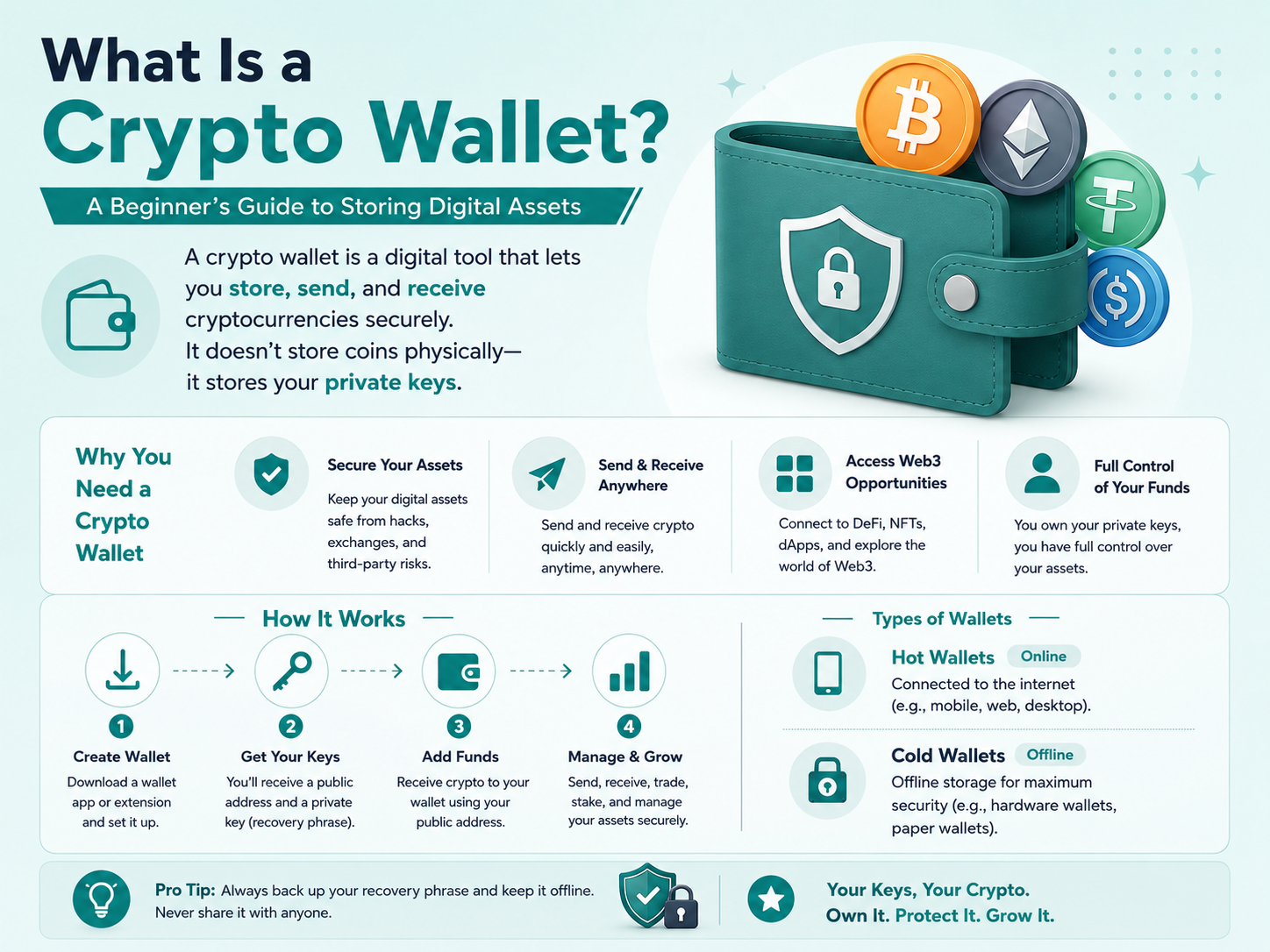
What is a crypto wallet? A crypto wallet is a software application, physical device, or third-party custody arrangement that helps a user access and manage cryptocurrency or other digital assets.
The most important point is that a wallet does not usually store crypto assets in the same way a physical wallet stores currency notes. Instead, the blockchain records which address controls a particular asset balance. The crypto wallet manages the private keys or access credentials used to control those assets.
Investor.gov explains that crypto wallets do not store crypto assets themselves; they store the private keys or passcodes used to access the assets.
When people ask what is a crypto wallet, they are often asking two different questions:
- How can I see, receive, and send digital assets?
- Who controls the private keys required to authorise transactions?
The answer to the second question is especially important. In a self-custody arrangement, the user controls the private key or recovery phrase. In a custodial arrangement, a platform may control the keys on the user’s behalf.
Education-only disclaimer: This article is for general educational purposes only. It is not investment, financial, tax, legal, or cybersecurity advice. Crypto assets can be lost through mistakes, fraud, theft, platform failure, or loss of access credentials. Never share a private key or seed phrase.
How does a crypto wallet work?
To understand what is a crypto wallet, it helps to understand how a blockchain transaction is authorised.
A crypto wallet commonly performs four practical functions:
- Generates or manages private and public keys.
- Creates wallet addresses.
- Displays balances and transaction activity from the relevant blockchain.
- Signs transactions when the user wants to move assets.
A private key is secret information used to authorise a transaction. A public key can be used to derive or verify information associated with an address, depending on the blockchain design.
When a user sends crypto, the wallet does not typically move a file from one phone to another. It creates and signs a transaction request, which is then broadcast to the appropriate blockchain network. Network participants validate the transaction according to the network’s rules.
NIST defines a wallet as an application used to generate, manage, store, or use private and public keys, and notes that wallets can be implemented as software or hardware modules.
This means a wallet is best understood as a key-management and transaction-signing tool.
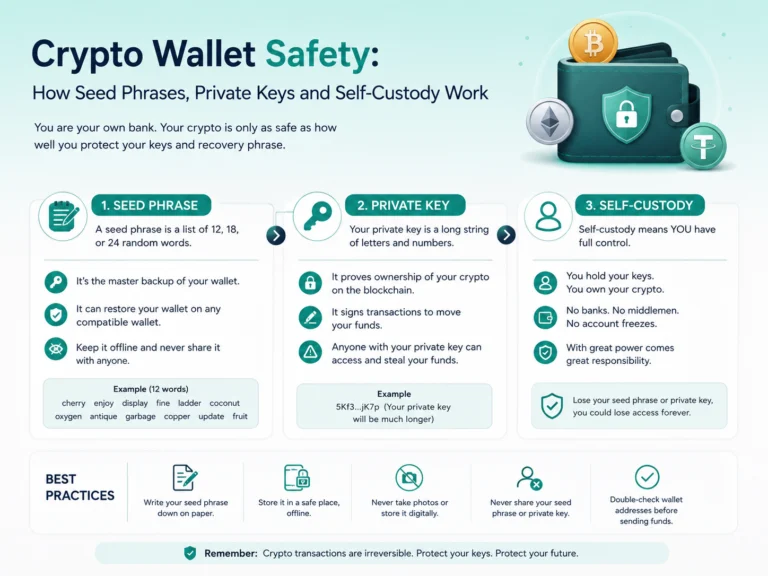
Wallet addresses, private keys, and seed phrases
A beginner who understands these three concepts has a much stronger foundation for using crypto safely.
Wallet address
A wallet address is a public identifier used to receive crypto assets on a particular blockchain. It is generally safe to share an address with someone who needs to send assets to you.
However, an address must be used on the correct blockchain network. Some asset names exist on multiple networks, and sending funds through an unsupported network can lead to loss or a difficult recovery process.
Before sending crypto, verify:
- The receiving address.
- The correct blockchain network.
- The supported asset and token standard.
- Any memo, tag, or additional identifier required by the receiving service.
- The transaction fee and minimum deposit requirements.
Private key
A private key is the secret cryptographic credential that enables control of assets linked to a wallet address.
In practical terms, the person or service that controls the private key usually controls the ability to transfer those assets. Investor.gov states that the person holding the private key to a wallet address on the appropriate blockchain can generally transfer the assets associated with that address.
This is why private keys must never be shared. A legitimate wallet provider, exchange, support agent, trading group, or recovery service should not need your private key.
Seed phrase or recovery phrase
A seed phrase, often called a recovery phrase, is a sequence of words that can be used to restore access to a self-custody wallet. Depending on the wallet design, it may generate or recover the private keys associated with the wallet.
The CFTC warns that a seed phrase can recreate a private key and that users should never give a private key or seed phrase to anyone.
A seed phrase should not be:
- Stored in screenshots, unencrypted notes, or cloud documents.
- Shared through messages, email, social media, or support chats.
- Entered into a website because someone claims to be providing help.
- Given to another person in exchange for an offer, reward, recovery service, or investment opportunity.
If a seed phrase is lost without a reliable backup, self-custody assets may become permanently inaccessible. If it is exposed, another person may be able to transfer the assets.
Custodial versus self-custody wallets
The next part of answering what is a crypto wallet is understanding custody.
Custodial wallets
A custodial wallet is an arrangement in which a third party, such as an exchange or platform, manages private keys or holds assets on behalf of the user.
A custodial service may offer easier account recovery, password resets, trading integration, and customer support. However, it also creates dependence on the third party’s systems, security practices, solvency, withdrawal rules, and account controls.
If a custodial platform freezes an account, experiences a breach, restricts withdrawals, or fails, the user may not have direct control of the underlying private keys.
Self-custody wallets
A self-custody wallet gives the user direct responsibility for the private keys or seed phrase. The main advantage is control: the user does not rely on an exchange or other platform to sign transfers.
The trade-off is responsibility. A self-custody user must protect their credentials, create secure backups, verify transactions carefully, and recognise phishing attempts.
Neither arrangement is automatically suitable for every person. The right choice depends on the user’s experience, security practices, purpose for holding crypto, and ability to manage recovery information responsibly.
| Consideration | Custodial wallet | Self-custody wallet |
|---|---|---|
| Private-key control | Usually managed by a third party | Managed directly by the user |
| Account recovery | May be possible through the provider | Usually depends on the recovery phrase backup |
| Convenience | Often simpler for beginners | Requires more user responsibility |
| Platform dependency | High | Lower for asset access, but wallet software and network risks remain |
| Main security concern | Platform failure, hack, or account compromise | Lost keys, exposed seed phrase, phishing, or user error |
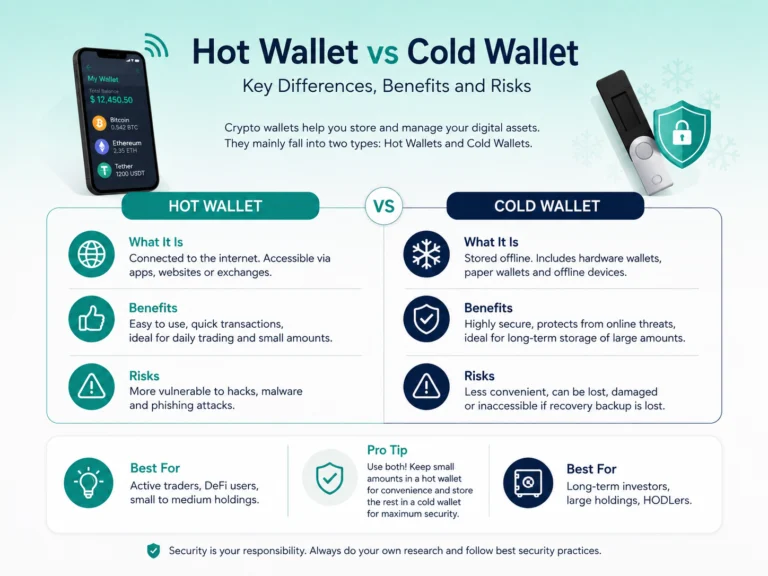
Types of crypto wallets
Crypto wallets can be grouped by connectivity and custody model.
Hot wallets
A hot wallet is connected to the internet. It may be a mobile application, browser extension, desktop application, or exchange-based wallet.
Hot wallets are designed for accessibility and convenience. They can be useful for small balances, transfers, decentralised applications, and frequent interaction with blockchain services.
The risk is that an internet-connected wallet may be more exposed to phishing, malicious software, compromised devices, fake applications, or unauthorised smart-contract approvals.
Cold wallets
A cold wallet is kept offline or designed to reduce direct exposure to internet-based threats. It may include a specialised hardware device or an offline key-generation arrangement.
Cold storage can reduce some online attack surfaces, but it does not eliminate risk. A user can still lose access through poor backups, device damage, physical theft, incorrect setup, or a fraudulent recovery process.
The CFTC advises users to keep only assets they are prepared to spend or trade in internet-connected wallets and consider offline storage for the rest.
Software wallets
Software wallets operate through a mobile device, desktop computer, or browser. They are accessible and often easy to use, but their safety depends on the device, application source, operating-system security, and user behaviour.
Hardware wallets
A hardware wallet is a dedicated device designed to help store and use private keys while keeping them isolated from an internet-connected computer or phone during transaction signing.
A hardware device is not automatically safe merely because it is called a hardware wallet. Users should verify authenticity, follow setup instructions carefully, protect the recovery phrase, and avoid purchasing devices that may have been tampered with.
What a crypto wallet can and cannot do
A crypto wallet can help users view addresses, sign transactions, interact with supported networks, and manage access credentials.
However, a wallet cannot guarantee that:
- A transaction was sent to the intended recipient.
- A token or decentralised application is legitimate.
- A smart contract is safe.
- A platform will remain solvent.
- A transaction can be reversed.
- An asset will retain value.
- A person claiming to offer support is genuine.
This is why understanding what is a crypto wallet should be paired with basic transaction hygiene. Before approving any transaction, read the request, confirm the website or application, verify the asset and network, and understand what permissions are being granted.
A transaction can be technically valid while still being financially harmful. For example, a user may approve a malicious smart contract, send assets to a scammer, or sign a transaction through a fake wallet interface.
How to use a crypto wallet safely
Crypto wallet safety is an ongoing process, not a one-time setup task.
Start by downloading wallet software only from verified official sources. Fake applications and impersonation websites often look similar to legitimate services.
Use a strong, unique password for every wallet-related account. Enable multi-factor authentication for custodial accounts where available. Keep devices updated, use screen locks, and avoid signing transactions on devices you do not control.
For self-custody, create a secure offline backup of the seed phrase. Store it in a location protected from loss, theft, fire, water damage, and unauthorised access. Do not rely on memory alone.
When sending crypto for the first time, a small test transfer may help confirm that the address, network, and destination are correct. This does not remove risk, and fees may apply, but it can reduce the impact of an address or network error.
Finally, avoid disclosing the amount or type of assets you hold. Investor.gov advises users to keep crypto holdings private, use strong passwords and multi-factor authentication, carefully evaluate custodians, and watch for phishing scams.
Common crypto wallet mistakes
The most expensive wallet mistakes are often simple and preventable.
A user may copy the wrong address, select an unsupported network, sign a transaction without reading it, or trust a fake support message. Another frequent error is treating a seed phrase as a password that can be changed later. In many self-custody systems, exposure of the seed phrase means the wallet should be considered compromised.
Do not assume that customer support can reverse a blockchain transaction. Once a transaction is confirmed, recovery may be impossible unless the recipient voluntarily returns the assets or the receiving platform can assist.
Avoid relying on search-engine advertisements or social-media links to access a wallet. Navigate through verified sources and double-check domain names. Scammers often create urgency by claiming that an account is locked, a wallet needs verification, or a reward will expire.
Key takeaways
- A crypto wallet is software, hardware, or a custody arrangement used to manage the credentials needed to access crypto assets.
- Crypto wallets do not normally hold digital assets in the same way a physical wallet holds cash; they manage private keys and help users sign transactions.
- A wallet address is generally used to receive crypto, while a private key authorises control over assets associated with that address.
- A custodial wallet places key-management responsibility with a third party; self-custody places that responsibility with the user.
- Choosing how to store crypto involves trade-offs between convenience, control, recovery options, and security risk.
– Frequently Asked Questions (FAQs)
A crypto wallet is used to manage the private keys or credentials needed to access and transfer crypto assets. It can also display wallet addresses, balances, transaction history, and supported blockchain interactions.
Not in the same way a physical wallet stores cash. Blockchain records track asset ownership or control, while a wallet manages the private keys or passcodes used to authorise transactions.
Yes. A person may use different wallets for different purposes, such as an internet-connected wallet for small transactions and a separate offline arrangement for longer-term storage. However, multiple wallets also increase the need for organised backups and careful security practices.
In a self-custody setup, losing the private key or recovery phrase may permanently prevent access to the associated assets. There may be no password-reset process or central authority able to restore access.
No. An exchange account is usually a custodial arrangement managed by a platform. A crypto wallet may be self-custody or custodial, depending on who controls the private keys.
No. Hardware wallets may reduce some online risks, but they do not protect against lost recovery phrases, physical theft, phishing, incorrect transactions, malicious approvals, or poor backup practices.