Paper Trading vs Live Trading: Key Differences for Beginners

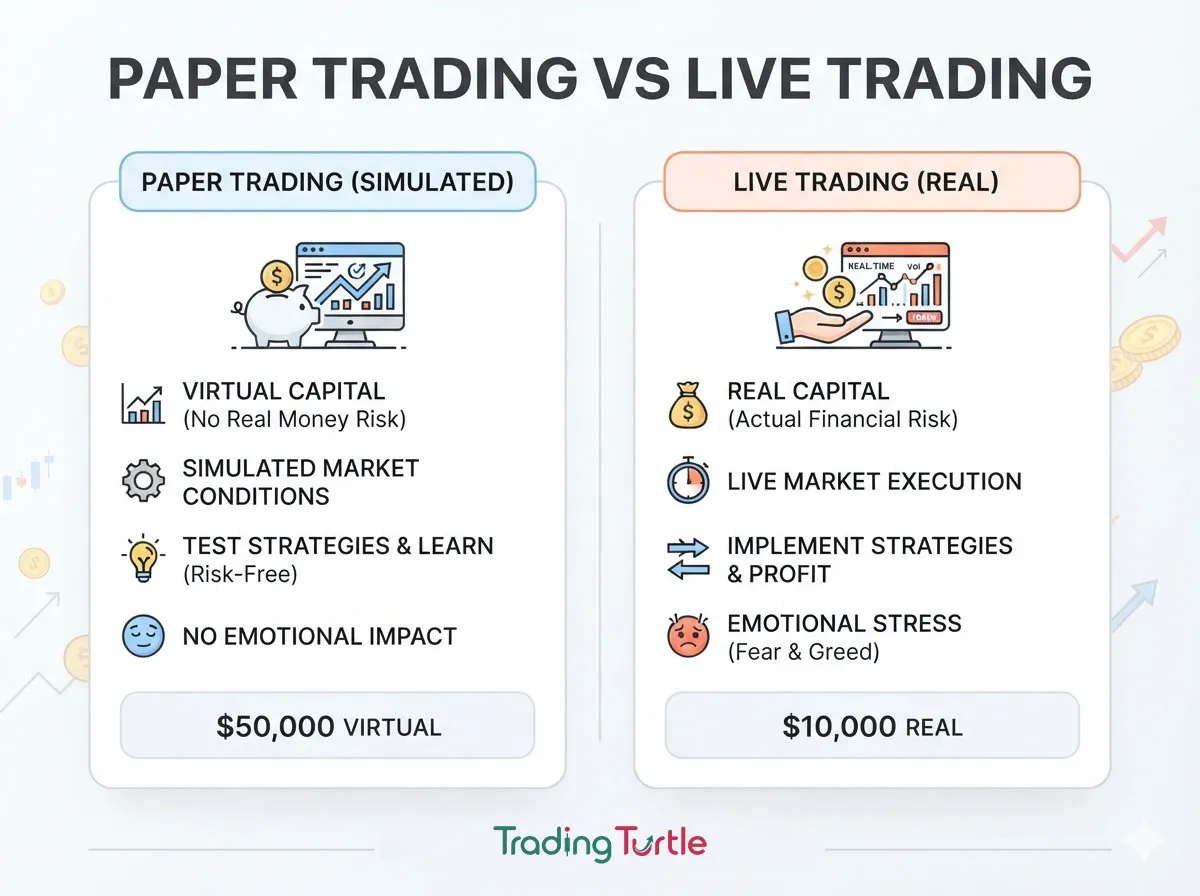
Paper trading and live trading use many of the same charts, order types, and trading rules, but they are not the same experience. Paper trading uses virtual money in a simulated environment, while live trading puts real capital at risk and exposes the trader to real execution, costs, and emotions.
For beginners, paper trading is a useful place to learn platform mechanics and test a defined process. Live trading, however, is where a strategy meets real spreads, slippage, fees, liquidity and psychological pressure. Understanding the difference can help traders use simulation as preparation rather than mistaking it for proof that a strategy will work with real money.
Education-only disclaimer: This article is for educational purposes only. It is not personalised investment advice, trading advice, or a recommendation to buy or sell any security, currency, or crypto asset. Trading can result in losses, and leveraged products can increase those losses.
The difference in simple terms
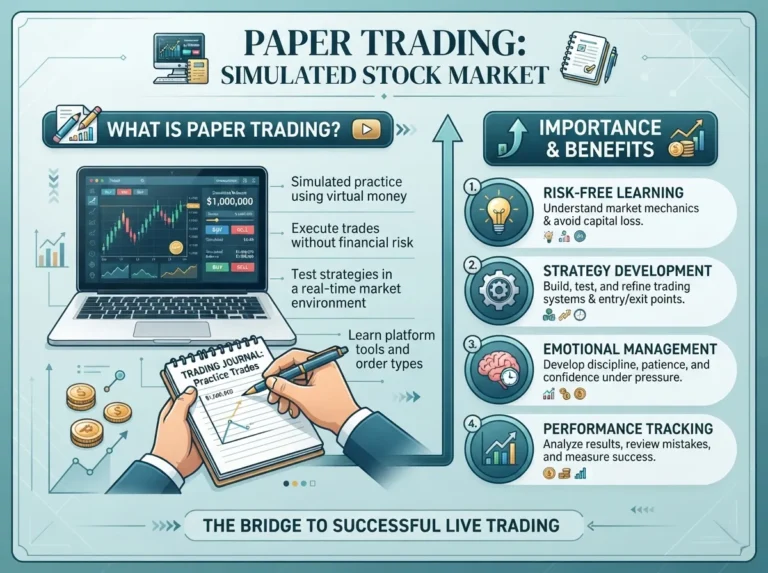
Paper trading is simulated trading. A platform gives the trader virtual funds and lets them practise selecting instruments, placing orders, and tracking hypothetical profit and loss without putting real money at stake.
Live trading uses an actual funded account. Every entry, exit, fee, delay and mistake affects real capital. That difference changes not only the financial outcome but also the decision-making process.
Neither format is automatically better in every situation. Paper trading is usually better for learning mechanics and testing rules; live trading is necessary to understand how a trader responds when risk is real. A sensible learning path uses both at the appropriate stage.
Paper trading vs live trading at a glance
| Area | Paper trading | Live trading |
|---|---|---|
| Money used | Virtual balance | Real capital |
| Financial consequence | No direct monetary loss | Gains and losses affect the account |
| Emotional pressure | Usually lower | Often materially higher |
| Order fills | May be simplified or idealised | Depend on real market conditions |
| Fees and funding | May be missing or simplified | Applied according to broker or exchange rules |
| Slippage | May be understated | Can occur, especially in volatile or illiquid markets |
| Main value | Learning, practice and process testing | Testing execution, psychology and a strategy under real conditions |
The key point is that paper results and live results should not be treated as interchangeable. A simulation can provide useful evidence that a process is clear and repeatable, but it cannot guarantee that the same results will appear after real-world trading friction is introduced.
What paper trading does well
Paper trading is most useful when it has a defined purpose. It can teach the workflow of trading before the trader has to make decisions under financial pressure.
Learning platform and order mechanics
A paper account lets a beginner practise entering market orders, limit orders and stop-loss orders. That reduces avoidable operational mistakes when using a live platform for the first time.
For example, a trader can learn the practical difference between an immediate market order and a price-controlled limit order before committing capital. This is a useful point to link naturally to the site’s guide on order types.
Testing whether rules are clear
A trading plan should specify what qualifies as an entry, where the trade idea is invalidated, how much is at risk, and how the trade will be managed. Simulated trading can reveal whether those rules are specific enough to apply consistently.
If a trader repeatedly changes the entry rule, moves the stop-loss, or takes trades outside the plan while using virtual money, those habits are unlikely to improve automatically once real money is involved.
Building a trading journal
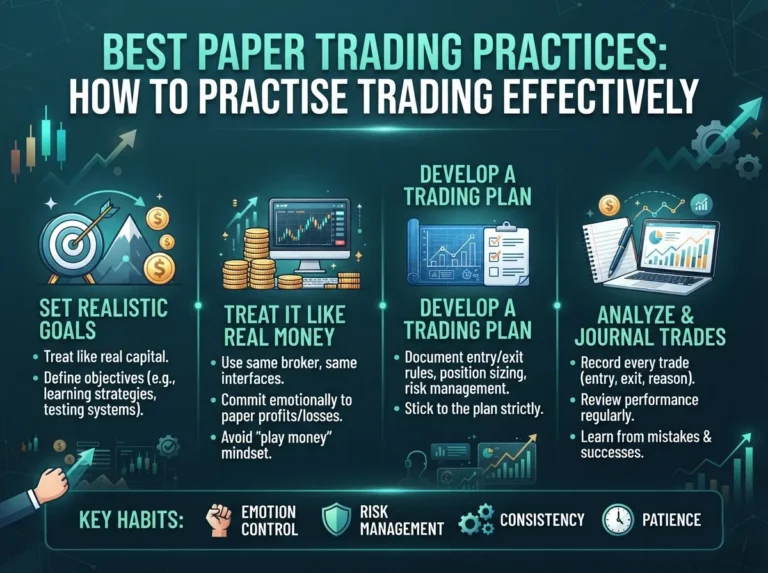
Paper trading gives beginners a low-cost way to start journaling. A useful record includes the market, time frame, entry reason, entry price, stop-loss, target, planned risk, result and notes on whether the plan was followed.
The goal is not to collect impressive-looking wins. It is to identify whether the process produces consistent decisions over a meaningful sample of trades.
What changes in live trading
Live trading introduces conditions that a simulator may only approximate. These differences become more important as a market becomes faster, less liquid, more volatile or more leveraged.
Real financial consequences
A paper loss may be disappointing, but it does not reduce a bank balance or trading account. A live loss does. That can make a trader hesitate on valid entries, exit early, refuse to close a losing position, or increase size after a win.
The SEC’s investor publication on day-trading risks notes that active trading can involve substantial losses and significant costs. This is relevant even for traders who do not day trade, because it illustrates how frequent decisions and leverage can magnify practical risk.
Actual transaction costs
Live orders can incur brokerage, commissions, exchange charges, taxes, spreads, financing or funding costs, depending on the market and platform. A strategy that appears attractive before costs may look very different after realistic costs are recorded.
This is especially important for active strategies with many entries and exits. A paper trading simulator that omits or simplifies costs may overstate the practical result.
Platform and operational risk
Live trading also includes real operational issues: internet interruptions, delayed data, order-entry errors, authentication failures, exchange outages and platform-specific restrictions. These are not reasons to avoid learning, but they are reasons to use conservative risk controls and understand the platform before placing meaningful live orders.
Execution, spread and slippage
Execution is one of the clearest differences between paper trading and live trading. In a simulation, an order may fill immediately at the displayed price; in the market, the available price can change between clicking the order button and receiving a fill.
Bid-ask spread
The bid is the highest current buying price and the ask is the lowest current selling price. The difference between them is the spread. Entering at the ask and exiting at the bid means the trade can begin with a small cost even before the market moves.
This is why a natural internal link to the site’s explanation of the bid-ask spread is useful here. Spreads are usually more manageable in highly liquid instruments, but they can become meaningful in thin or volatile markets.
Slippage
Slippage happens when an order fills at a worse price than expected. It can occur during sharp price moves, when liquidity is limited, or when a large order consumes available orders at the desired price.
For a small, liquid stock or a major spot crypto pair, slippage may be modest under normal conditions. In small-cap stocks, low-liquidity tokens, fast-moving crypto futures, or during major news events, it can be much more significant.
Partial fills and order behaviour
A limit order is not a guarantee of a fill. A stop order is not a guarantee of an exact exit price. These details matter because paper platforms may not model order queues, partial fills or rapid changes in available liquidity with full realism.
Traders should therefore evaluate a strategy with some allowance for imperfect execution rather than assuming every planned price will be achieved.
Risk and position sizing
The same risk-management framework should be used in paper trading and live trading. Each trade should have a predefined invalidation point, a planned maximum loss, and a position size that fits the account.
A simple process is to set a risk-per-trade limit, identify the stop-loss distance, and calculate a quantity that keeps the planned loss within that limit. This is a natural place to link to the site’s detailed guide on position sizing.
The important difference is behavioural. In simulation, it is easy to follow a 1% risk rule because the loss is not real. In live trading, the same trader may be tempted to widen a stop, double down, or skip the stop-loss altogether. That is why sound risk management needs rules that are simple enough to follow under pressure.
Why emotions matter
Emotions are not a minor issue in live trading; they are part of the environment. The possibility of losing real money can change how a person perceives risk and reacts to ordinary price movement.
Fear and hesitation
A trader may identify a valid setup but hesitate because the last trade was a loss. The result can be entering late, missing the trade, or abandoning a tested rule after a short drawdown.
Greed and overconfidence
After a run of profitable trades, traders may increase size without changing the underlying strategy or risk plan. That can make a routine losing trade much more damaging than intended.
Revenge trading
Revenge trading is the attempt to recover a loss quickly through impulsive, oversized or unplanned positions. It is difficult to observe honestly in paper trading because virtual losses generally do not trigger the same emotional response.
A useful lesson from simulation is not merely whether an idea made virtual profit. It is whether the trader can follow the same written process again and again. Small live size may then help test whether that discipline survives when the outcome matters.
Stocks, spot crypto and futures
The gap between paper trading and live trading exists in every market, but the sources of risk vary.
Stocks and ETFs
For liquid large-cap shares and broad ETFs, execution is often relatively orderly during normal market conditions. However, spreads, gaps, corporate news and the market open or close can still affect fill prices.
Beginners using Indian markets should also understand the basic trading and account process before participating with real capital. SEBI’s investor education material is a useful official starting point for market-learning resources.
Spot crypto
Spot crypto trading does not use borrowed exposure by default, but it can still involve sharp volatility, trading fees, spread differences across venues, and custody or platform risk. A paper result on one venue may not precisely reflect the execution conditions available on another.
Crypto futures
Crypto futures add leverage, margin, funding and liquidation mechanics. A simulated futures position may teach order placement, but a live leveraged position can lose value rapidly when price moves against it.
The CFTC’s customer advisory on virtual-currency trading risks highlights volatility, platform risks and the absence of guaranteed trading strategies. Traders considering futures should understand contract specifications and liquidation rules, then use deliberately conservative size rather than treating leverage as extra buying power.
A practical transition process
Moving directly from unlimited virtual risk to large live positions is usually a poor training design. A gradual transition allows the trader to separate strategy problems from execution and psychology problems.
1. Start with a written paper-trading plan
Define the market, time frame, setup, entry condition, stop-loss, position-sizing rule and exit approach. Use a realistic virtual account value that resembles the capital likely to be used later.
2. Trade a meaningful sample
Do not judge a process from a few outcomes. Review a reasonable sample of trades and focus on rule adherence, average loss, average gain, drawdown and execution quality—not just win rate.
3. Record realistic friction
Where the platform does not include all costs, add estimated fees and note whether the market was liquid enough for the planned order size. Avoid assuming every stop or limit order would have filled perfectly.
4. Move to very small live size
If the process appears clear and consistent, a small live position can test the emotional and operational gap. The objective is not to make meaningful income at this stage; it is to see whether the planned rules can still be followed with real capital at risk.
5. Scale only after evidence
Increasing size should be a deliberate decision supported by consistent execution, risk control and a documented review process. A few successful trades are not enough evidence by themselves.
Common mistakes
Treating paper profits as guaranteed future results
A simulator can show whether a method is logically testable, not whether it is certain to make money live. Market conditions, costs and behaviour can materially change the outcome.
Using unrealistic capital or position sizes
Paper trading a ₹10,00,000 account while planning to start live with ₹50,000 creates a mismatch in risk, quantity and expectations. Simulated conditions should resemble the intended real-world approach.
Ignoring losses because they are virtual
Paper losses should still be reviewed. If a stop-loss is ignored or a position is doubled down in simulation, note it as a process failure rather than dismissing it because no money was lost.
Moving live with leverage too soon
Leverage can increase exposure quickly, but it also increases the speed and scale of potential losses. Beginners should learn the underlying market and risk framework before considering leveraged products.
Focusing only on win rate
A high win rate does not automatically mean a strategy has sound risk-reward characteristics. Track average loss, average gain, maximum drawdown, costs and whether rules were followed.
Key takeaways
- Paper trading uses virtual funds; live trading puts real capital at risk.
- Simulation is useful for learning order mechanics, practising a strategy and building a journal.
- Live trading introduces real costs, execution uncertainty, slippage and emotional pressure.
- Use the same stop-loss and position-sizing rules in both environments.
- A gradual move from paper trading to very small live positions is generally more informative than jumping straight to full-size risk.
- Past simulated performance is not a guarantee of future live results.
– Frequently Asked Questions (FAQs)
Paper trading is usually the better starting point because it allows beginners to learn platform tools, order types and trading rules without immediate financial loss. It is not a complete replacement for live trading, because it cannot fully reproduce real execution or emotional pressure.
Live results can differ because of fees, spreads, slippage, partial fills, delays, liquidity and changes in decision-making when money is actually at risk. Simulators may not model every one of these factors accurately.
There is no universal timeline. A trader may consider a very small live account after following a defined paper-trading process over a meaningful sample, documenting results, and demonstrating consistent risk control. This is an educational framework, not a recommendation to trade.
Some platforms offer simulated crypto futures or derivatives environments. They can help a learner understand interface mechanics, but they may not fully reflect live leverage, funding, liquidity, liquidation or execution conditions.
Yes. Practising stop-loss placement and position sizing makes paper trading more realistic and helps develop risk-management habits before live trading.