Best Paper Trading Practices: How to Practise Trading Effectively

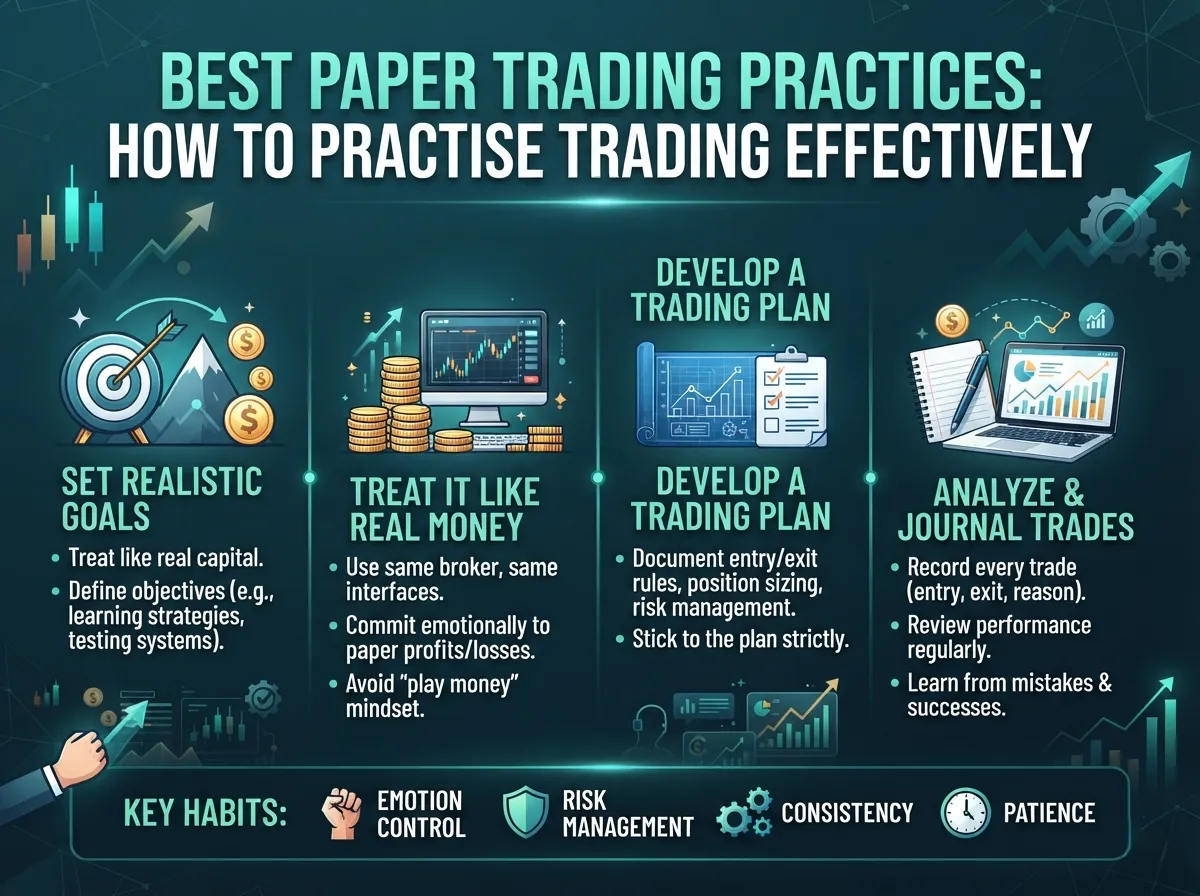
The best paper trading practices make simulated trading feel as close as practical to the real process a trader intends to follow. That means using realistic account size, clear entry and exit rules, position sizing, a trading journal, and honest performance review instead of treating a simulator like a game.
Paper trading can be an excellent learning tool, but only when it is structured. Random virtual trades may teach platform buttons; they rarely teach a repeatable trading process. A disciplined simulation phase can help beginners identify weak rules, execution errors, and risk-management gaps before real capital is exposed.
This guide explains how to practise paper trading effectively across stocks, ETFs, spot crypto and, with extra caution, crypto futures.
Education-only disclaimer: This article is for educational purposes only. It is not personalised investment advice, trading advice, or a recommendation to buy or sell any security, currency, or crypto asset. Simulated results do not guarantee live-market results.
Why paper trading needs a process
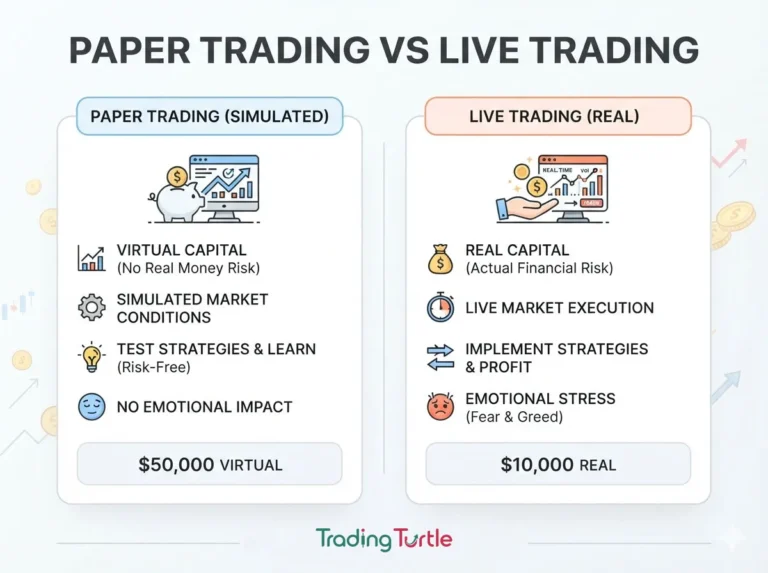
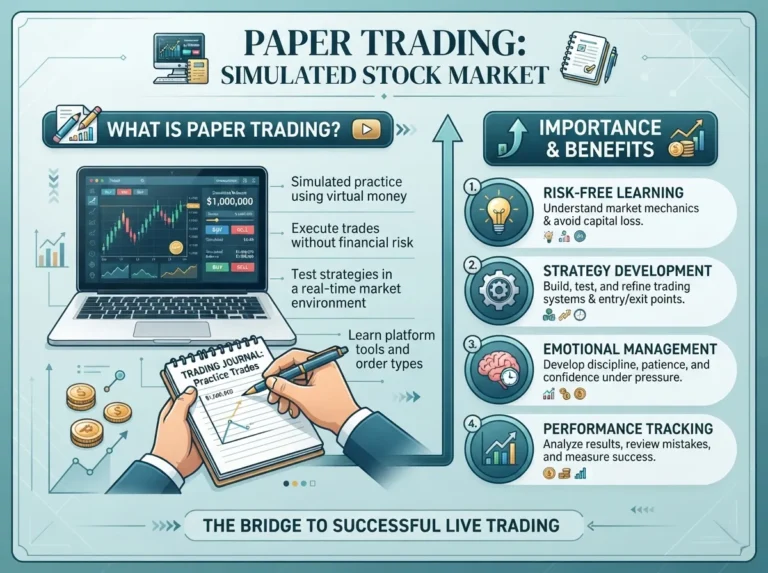
Paper trading works best as a training environment. It allows a trader to rehearse a decision-making process without the immediate financial consequence of a live loss.
But a simulator does not automatically create discipline. A trader who enters random positions, changes rules halfway through a trade, ignores stop-losses, or uses unrealistic position sizes is not testing a strategy. They are only generating random outcomes.
The goal of paper trading should be to answer practical questions: Are the entry rules unambiguous? Is risk defined before entry? Can the plan be followed repeatedly? Are the results still reasonable after realistic trading friction is considered?
Choose a realistic market and account size
One of the best paper trading practices is to make the simulation resemble the intended live environment. Start with the market, instruments and capital level that are realistically expected later.
Start with one market and one trading style
A beginner does not need to simulate stocks, options, crypto spot, crypto futures and forex at the same time. Choose a limited, liquid universe and a single style, such as swing trading in large-cap stocks, short-term trading in a broad ETF, or spot trading in a few major crypto assets.
This makes data easier to review. It also prevents market-specific rules from becoming mixed together. A strategy that works on a daily stock chart may require different execution assumptions from a short-term crypto futures strategy.
Mirror the intended live account
If the likely live account is ₹75,000 or $1,000, set the paper account near that amount. Avoid practising with a virtual balance that is ten or twenty times larger than the capital that will actually be used.
Account size affects quantity, position sizing and the ability to diversify. A realistic simulation produces more relevant habits and makes risk calculations meaningful.
Write clear trading rules
Core of paper trading practices should be based on written rules rather than a vague feeling that price may rise or fall. The rules do not need to be complicated, but they should be precise enough that another person could understand why a trade was taken.
Define the setup
Specify the market condition and price behaviour required before entry. For example, a swing-trading setup might require an uptrend, a pullback toward a prior support area, and a clear invalidation point below that area.
The purpose is not to claim that any setup is guaranteed to work. It is to create a repeatable definition that can be evaluated over many examples. For foundational chart-reading concepts, read our guide on support and resistance or the explanation of a market trend.
Define entry, invalidation and exit
Every planned trade should include:
- The entry condition and intended order type.
- The price or market condition that invalidates the trade idea.
- The stop-loss level.
- The planned position size.
- The initial exit approach, such as a target, trailing process or rule-based exit.
This structure prevents the common habit of inventing rules after a trade has already gone wrong.
Use risk management from day one
Paper trading should include the same risk rules intended for live trading. Ignoring risk because the money is virtual can create habits that become expensive later.
Set a risk-per-trade limit
Choose a small, consistent percentage or cash amount as the maximum planned loss per trade. The figure will depend on the account, strategy and market, but it should be decided before entry rather than after price starts moving.
The calculation should take account size, entry price and stop-loss distance into account.
Place a logical stop-loss
A stop-loss should be based on where the trade idea no longer makes sense, not on the amount a trader wants to lose. A tight stop may permit a larger position, but an unrealistically tight stop can also be triggered by ordinary market movement.
Treat every simulated loss as real feedback
Virtual losses do not reduce the account, but they should still be reviewed. Did the market invalidate the original idea? Was the position too large? Was the setup taken outside the rules? These questions build the review habit needed for any future live activity.
Practise order execution realistically
The choice of order type affects outcomes. Paper trading should be used to practise the mechanics of market, limit and stop orders—not merely to record a hypothetical perfect entry price.
Do not assume perfect fills
A market order prioritises execution, not a guaranteed price. A limit order offers price control, but it may not fill. A stop order can be triggered during fast movement and may execute away from the intended level.
When using a simulator, note what the platform actually models. If it fills every order instantly at the displayed price, manually allow for less favourable execution in the review process.
Practise with liquid instruments
Early simulation is usually more informative with instruments that have regular trading activity and relatively narrow spreads. Low-liquidity assets can be useful later for learning about execution risk, but they may add too many moving parts for a beginner.
Keep a paper trading journal
A journal turns a list of trades into a learning record. It helps distinguish between a strategy problem, an execution problem and a discipline problem.
What to record
A practical paper trading journal can include:
| Field | Why it matters |
|---|---|
| Date and time | Helps identify market-session patterns |
| Instrument and market | Shows where the strategy was used |
| Time frame | Keeps analysis consistent |
| Setup and entry reason | Confirms that the trade matched the plan |
| Entry, stop and exit | Documents risk and execution |
| Position size | Shows whether sizing rules were followed |
| Planned risk | Makes results comparable across trades |
| Fees, spread and estimated slippage | Adds realism to the review |
| Outcome and notes | Captures lessons and rule violations |
A screenshot of the setup can also help, provided it is organised and reviewed rather than stored without purpose.
Separate outcome from quality
A winning trade can be poor if it broke the rules. A losing trade can be good if it followed a valid plan and respected the predefined risk limit.
This distinction is essential. Good process does not guarantee every trade will win, but poor process can create hidden risk even during a run of profitable outcomes.
Measure results that matter
The best paper trading practices focus on more than win rate. A strategy may win frequently but still lose money if occasional losses are much larger than average wins.
Review a meaningful sample
Five or ten trades are usually too few to assess a paper trading strategy process. Review a larger sample that includes different market conditions where possible, then ask whether the rules were followed consistently.
A useful review can examine:
- Win rate.
- Average gain and average loss.
- Largest planned loss and largest actual simulated loss.
- Maximum drawdown.
- Total costs and estimated execution friction.
- Number of rule violations.
- Performance by setup type or market condition.
Focus on expectancy and discipline
Expectancy is the average amount a strategy may make or lose per trade over a sample, after accounting for the frequency and size of wins and losses. It is more useful than a single winning streak because it considers both sides of the results.
Do not treat a positive simulated sample as a promise of future performance. The review is evidence for further testing, not a guarantee.
Include costs, spread and slippage
A major limitation of paper trading strategy is that some platforms simplify real-world friction. To make simulation more realistic, record costs that the paper platform does not include.
Fees and charges
Depending on the market and platform, trading can involve brokerage, exchange charges, taxes, regulatory fees, funding costs or other costs. Check the applicable schedule before live use and include reasonable estimates during simulation.
For India-focused market participation, SEBI’s investor guidance on do’s and don’ts emphasises reviewing applicable charges and keeping trading records. It is a useful reminder that costs and documentation are part of responsible market participation.
Spread and slippage assumptions
For each trade, estimate the entry and exit effect of the spread. In volatile periods, also add a modest slippage allowance. The exact assumption will depend on the instrument, order type and market conditions.
This does not make paper trading perfectly realistic, but it prevents the most optimistic interpretation of results.
Use paper trading Strategy across different markets
The core practice is similar across markets, but the operational details change.
Stocks and ETFs
Paper trading stocks and ETFs can help beginners practise market sessions, order types and risk limits. Use liquid instruments first, be aware of corporate announcements and gaps, and avoid assuming that every opening or closing price will be available at the expected level.
Spot crypto
Spot crypto simulation can help practise volatility management and 24/7 market awareness. Use major assets first, account for venue-specific fees and spreads, and remember that a simulated fill may not match live conditions during sudden price movement.
Crypto futures
Simulated futures can help users understand the order interface, but it should not be treated as a substitute for understanding leverage, margin, funding and liquidation. In live futures, a position that is too large can become dangerous quickly.
The CFTC’s virtual-currency risk advisory notes the volatility and risks associated with virtual currencies and warns that there is no guaranteed trading strategy. Use this context to keep futures examples educational and risk-first.
Know when to move beyond simulation
There is no fixed number of paper trading strategy or days that makes someone ready for live trading. A more useful question is whether the trader has demonstrated a repeatable process, realistic record-keeping and consistent risk control.
A measured transition may look like this:
- Paper trade a clearly defined strategy using realistic capital and risk rules.
- Review a meaningful sample of trades, including mistakes and estimated costs.
- Improve the plan if repeated rule violations or weak assumptions appear.
- If appropriate, test the process with very small live size rather than jumping to meaningful exposure.
- Review whether the same discipline survives real execution and real emotions before making any increase in size.
The purpose of small live size is not to chase income. It is to observe the difference between a simulated process and the real decision-making environment.
Common paper trading mistakes
Treating the simulator as a game
Random entries and oversized virtual positions may feel exciting, but they do not create useful information about a real trading plan.
Changing rules after every loss
A paper trading strategy cannot be evaluated if its entry, stop or exit rules change whenever a trade fails. Record the outcome first; improve the rule only after a structured review.
Ignoring risk because there is no real money
Paper trading should reinforce risk habits. Always define a stop-loss, position size and maximum planned loss before entry.
Using too many instruments
Following dozens of markets can create noise and encourage impulsive trading. Start narrow, then broaden only when the existing process is organised.
Moving to live trading after a short winning streak
A handful of profitable paper trading strategy is not enough evidence that a strategy or trader is ready for large live exposure. Simulation results should be reviewed over a wider sample and tested against realistic execution assumptions.
Key takeaways
- The best paper trading strategy make simulation as realistic and structured as possible.
- Use an account size, instruments and position sizes that match the intended live approach.
- Define the setup, entry, stop-loss, position size and exit plan before each trade.
- Keep a journal and judge trades by process quality as well as profit or loss.
- Include realistic assumptions for fees, spreads and slippage.
- Treat positive paper results as evidence for further testing, not as a guarantee of live success.
– Frequently Asked Questions (FAQs)
There is no universal timeline. A trader should focus on whether they can follow a clear process over a meaningful sample, journal decisions, include realistic costs and manage risk consistently. This is an educational framework, not a recommendation to trade.
Ideally, yes. A virtual balance close to the intended live account makes position sizing, risk limits and expectations more realistic.
Yes. If the simulator does not include relevant fees, spreads or funding costs, estimate them in the journal. This gives a more conservative and useful view of the strategy.
For many beginners, the most valuable habit is consistently documenting every trade: the reason for entry, planned risk, position size, exit and whether the rules were followed.
It can help with platform familiarity and planned risk rules, but it cannot fully recreate live leverage, funding, fast execution, liquidation mechanics or emotional pressure. Futures should be treated as a higher-risk product.