What Is a Stop-Loss Order? Types, Examples and Mistakes

What Is a Stop-Loss Order?
Simple definition
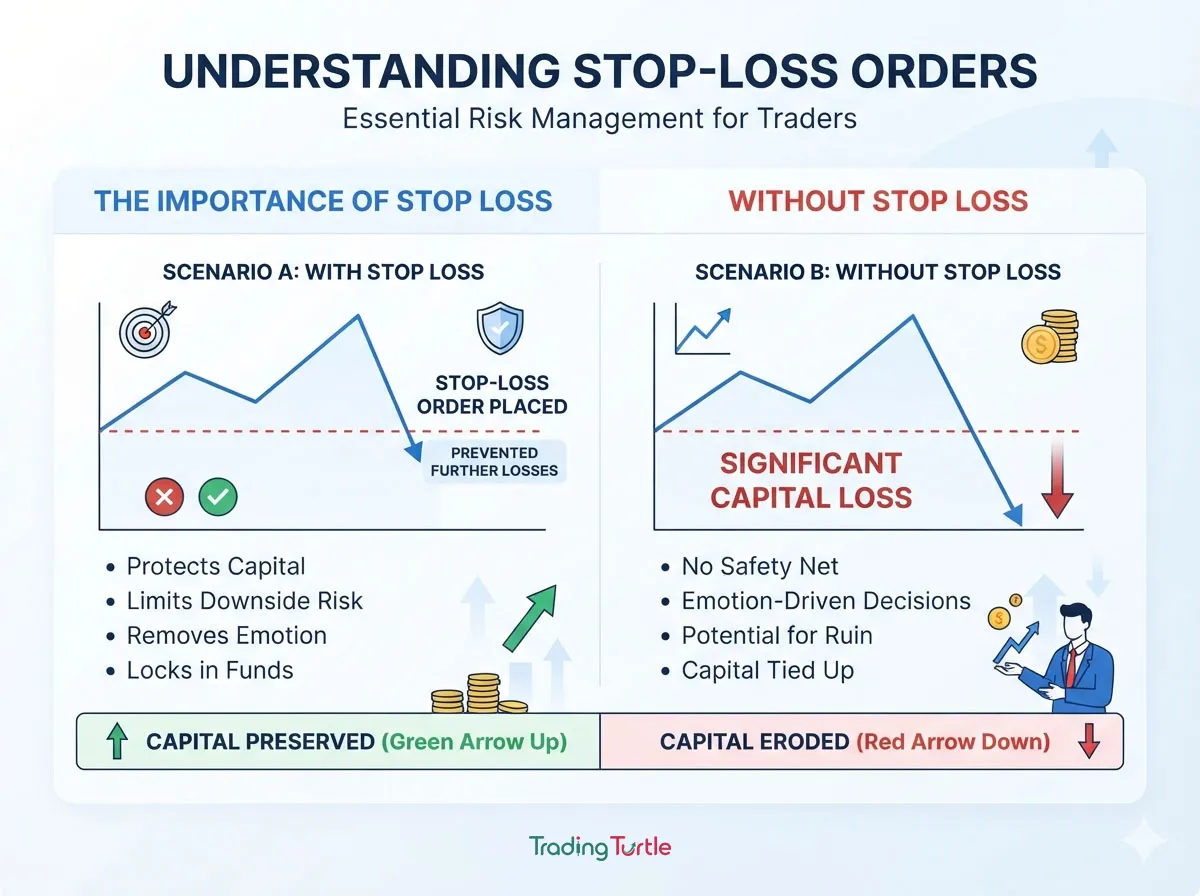
A stop-loss order is a conditional instruction placed with a broker or trading platform. It activates when the market reaches a chosen trigger price, helping a trader exit a long or short position when price moves beyond the level they planned to accept.
For a long position, a stop-loss commonly involves a sell instruction below the entry price. For a short position, it commonly involves a buy instruction above the entry price. A stop order becomes active only after its trigger condition is met.nseindia+1
Why traders use it
A stop-loss order helps turn a general intention – such as “I will exit if the setup is invalid”—into an executable rule. It can reduce the need to watch every price movement, but it does not remove trading risk or guarantee that the order will fill at the trigger price.
A well-considered stop-loss in trading is usually part of a broader process that also includes position sizing, liquidity checks, trade planning, and realistic expectations about slippage.
Stop-loss does not guarantee a fixed loss
It is important to distinguish a trigger price from an assured exit price. When a stop-market order triggers, it typically becomes a market order and seeks the best available price; a sudden gap or thin order book can therefore produce an execution meaningfully different from the stop level.investor+1
How a Stop-Loss Order Works
Long-position example
Imagine a hypothetical trader buys a share at ₹1,000 and decides the trade idea no longer holds if the price falls to ₹950.
The trader may place a sell stop-loss with a trigger price of ₹950. If the relevant market price reaches or falls through ₹950, the broker releases the order according to its order type.
- With a stop-market approach, the order seeks execution at the best available market price after triggering.
- With a stop-limit approach, the order enters with a specified limit price, so execution is conditional on available buyers at that price or better.
The ₹950 trigger does not mean the exit will always occur at exactly ₹950.
Short-position example
Now imagine a hypothetical trader sells an asset short at ₹1,000 and plans to exit if it rises to ₹1,050. The trader may place a buy stop-loss above the prevailing market price.
Exchange guidance describes this basic logic clearly: sell stop orders trigger when the last traded price reaches or falls below the sell trigger, while buy stop orders trigger when the last traded price reaches or exceeds the buy trigger.
Trigger price and limit price
Many beginners confuse these two fields:
| Term | Meaning | Why it matters |
|---|---|---|
| Trigger price | The price that activates the stop-loss instruction | Until this condition is met, the order may remain inactive in the stop-loss book. |
| Limit price | The worst acceptable price for a stop-limit order | It can protect against an unexpectedly poor fill, but the order may not execute. |
| Market execution | An instruction to seek the best available price once triggered | It improves the chance of exit, but the final execution can differ from the trigger price. investor+1 |
Types of Stop-Loss Orders
Stop-loss market order
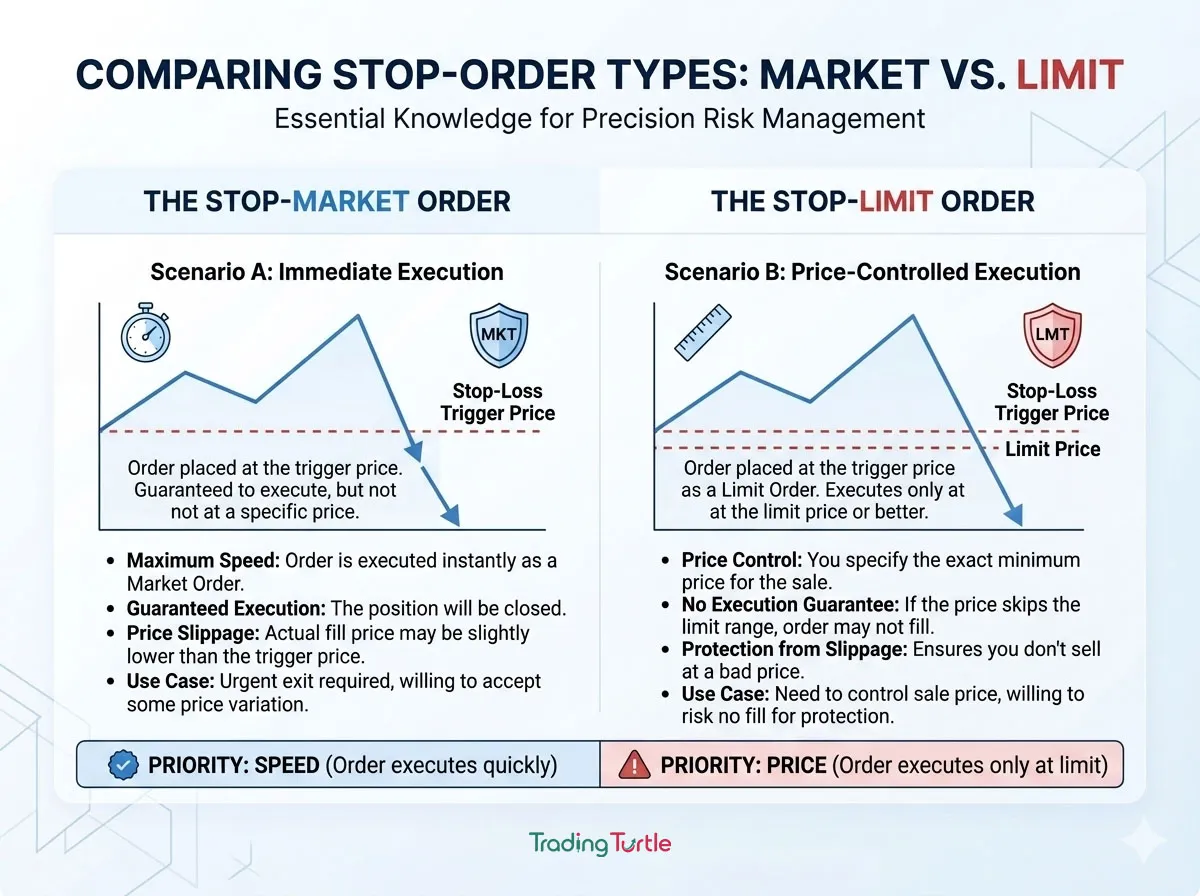
A stop-loss market order uses a trigger price without a separate limit price. Once triggered, it converts to a market order and seeks execution at the best available available price.
This structure prioritises the likelihood of leaving the position, not price certainty. It may be useful for traders focused on exiting quickly, but volatile conditions can create slippage.
Stop-loss limit order
A stop-loss limit order uses both a trigger price and a limit price. When the trigger is reached, the order is released as a limit order.
For example, suppose a long position has:
- Trigger price: ₹950
- Limit price: ₹948
When the trigger is reached, the sell order will seek a fill at ₹948 or higher. If the market falls rapidly below ₹948 and buyers are unavailable at that price, the order may remain unfilled while the position continues to lose value.
In India, platforms often describe stop-loss limit orders as SL orders and stop-loss market orders as SL-M orders, although availability can differ by broker, asset class, exchange rules, and current regulations.
Trailing stop-loss order
A trailing stop-loss moves in a favourable direction as market price moves in favour of the position, based on a fixed rupee distance or percentage. It is designed to adjust the stop level mechanically, but platform rules vary widely.
For example, a trader might set a trailing distance of ₹20. If a share rises from ₹1,000 to ₹1,080, a trailing stop may move upward as defined by the platform. If the price later reverses by the selected distance, it may trigger.
Before using one, verify exactly how the platform calculates the trail, which reference price it uses, whether it works after market hours, and how it behaves in gaps.
Buy and sell stop orders
A sell stop-loss is normally used to manage downside risk in a long position. A buy stop-loss is normally used to manage adverse upward price movement in a short position or to protect a short position’s gains.
Stop-Loss Examples
Example: Stop-market order
This hypothetical example is educational only.
A trader buys 10 shares at ₹500 each, creating a ₹5,000 position. They set a sell stop-loss trigger at ₹480.
- Entry price: ₹500
- Stop trigger: ₹480
- Intended risk per share: ₹20
- Intended loss before costs: ₹200
If the market trades smoothly at ₹480, the order may fill near that level. If negative news causes a fast fall from ₹485 to ₹465, however, a stop-market order may fill closer to ₹465 rather than ₹480. This difference is known as slippage.
Example: Stop-limit order
A trader owns shares bought at ₹500 and enters:
- Stop trigger: ₹480
- Limit price: ₹478
If price reaches ₹480, the order becomes active. It can sell at ₹478 or above. But if the price gaps immediately to ₹470 and does not return to ₹478, the position may remain open.
This illustrates the central trade-off:
| Order type | Main priority | Main risk |
|---|---|---|
| Stop-market | Higher chance of exit after triggering | Fill price can be worse than expected |
| Stop-limit | Greater control over minimum acceptable sale price | Order might not fill at all |
How to Choose a Stop-Loss Level
Start with trade invalidation
A stop-loss level should relate to the reason for entering the trade. Ask: At what price would my original setup no longer make sense?
For example, a trader who buys because price held above a support zone may decide the trade thesis is weakened if price closes decisively below that zone. The stop should not be chosen merely because it represents a convenient round-number percentage.
Technical levels can be useful reference points, but they are not guarantees. Learn more in Support and Resistance: How to Identify Key Trading Levels and What Is Technical Analysis?.
Account for normal volatility
Assets do not move by the same daily or intraday amount. A stop that is too close may be triggered by ordinary market noise, while a stop set very far away may expose too much capital.
Useful context can include:
- Recent price range and volatility
- Nearby support or resistance
- Liquidity and bid-ask spread
- Scheduled events, earnings, policy announcements, or token unlocks
- The asset class and trading timeframe
- Whether the position uses leverage
A stop-loss is most useful when its distance is considered alongside position size. A wider stop does not necessarily require greater rupee risk if the position size is reduced accordingly.
Calculate risk before entering
For a long position, planned price risk per unit can be expressed as:
For a short position:
The approximate planned trade risk is:
These calculations exclude brokerage, taxes, funding charges, slippage, and the possibility of a worse fill. They are planning tools, not promises of the maximum loss.
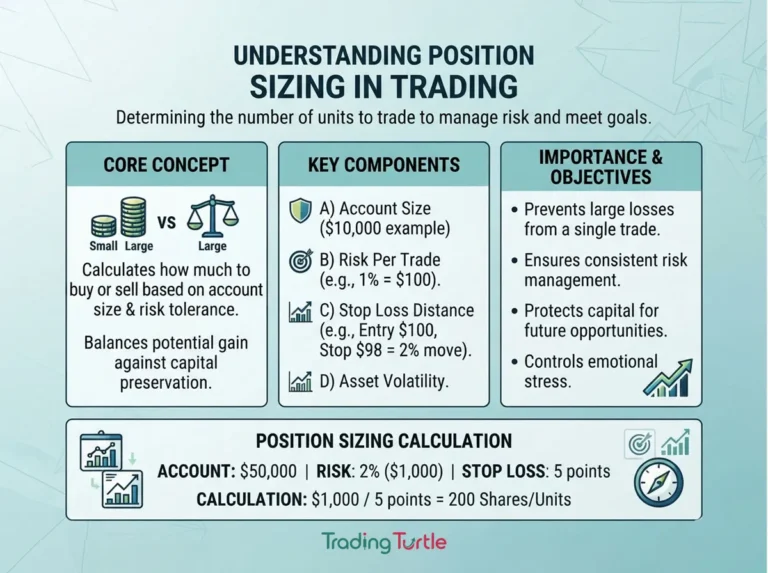
The next article, [Position Sizing in Trading: How to Calculate Trade Risk], explains how to choose quantity after deciding where a trade idea is invalidated.
Benefits and Limitations
Potential benefits
A stop-loss order may help traders:
- Define risk before entering a trade
- Reduce emotional decision-making during a sharp decline
- Avoid monitoring every tick while an order is active
- Apply more consistent trade-management rules
- Link an exit plan to position sizing and maximum portfolio risk
A stop order is commonly used as a risk-management tool because it can initiate an exit after the designated price is reached.
Important limitations
A stop-loss order cannot:
- Guarantee a specific execution price
- Protect against all overnight or event-driven gaps
- Ensure an order is filled during severe illiquidity
- Make a poor position size safe
- Prevent losses from fees, taxes, funding, or borrowing costs
- Replace research, diversification, and a risk-management plan
In a fast market, the actual transaction price can differ substantially from the stop price. The U.S. SEC specifically warns that stop and stop-limit orders have different execution and non-execution risks.
Common Stop-Loss Mistakes
Setting a stop at a random percentage
A fixed “5% stop” can be too narrow for one asset and too wide for another. Price structure, volatility, timeframe, and trade size matter more than a one-size-fits-all rule.
Instead, identify the point at which the trade idea is invalidated, then adjust quantity so that the planned rupee risk remains appropriate.
Placing the stop at an obvious level
Many traders place stops exactly at a recent low, a whole-number price, or a highly visible support level. Markets may briefly trade through obvious levels before reversing, although no placement method can reliably avoid this outcome.
Consider whether the stop gives reasonable room for normal volatility without exceeding the planned risk amount.
Ignoring bid-ask spread and liquidity
The last traded price is not always the price at which you can actually exit. A wide bid-ask spread or a shallow order book can increase the difference between the visible trigger and the realised fill.
Read [Bid-Ask Spread Explained] and [What Is Liquidity in Trading?] before relying on stop orders in less-liquid instruments.
Using a stop-limit order without understanding non-execution risk
A stop-limit order may feel safer because it sets a minimum sell price or maximum buy price. Yet that price protection can mean the order does not fill when the market moves through the limit quickly.
Traders should choose between stop-market and stop-limit orders based on the trade-off they are actually willing to accept: potential price slippage versus the possibility of remaining in the position.
Widening a stop after entry without a plan
Moving a stop farther away simply because price is approaching it can increase risk after the trade begins. It may turn a small planned loss into a larger, unplanned one.
Any stop adjustment should follow a written rule established before entry, not a reaction to discomfort.
Treating a stop as a complete risk plan
Stop-loss orders work best alongside appropriate position size, diversification where relevant, realistic leverage, and attention to volatility. Derivative exposure can magnify both gains and losses, so risk controls are especially important in futures and options.
Forgetting to check order status
Order types, trigger rules, trading sessions, product eligibility, and platform availability can vary. Always verify that the stop-loss order is accepted, active, linked to the correct position, and not cancelled or modified unexpectedly.
Stop-Loss Orders in India
SL and SL-M orders
Indian trading platforms commonly use these labels:
- SL: Stop-loss limit order; it includes a trigger price and a limit price.
- SL-M: Stop-loss market order; it generally includes a trigger price, after which the order seeks market execution.
The exact order workflow and availability may differ across brokers, instruments, and exchanges. NSE documentation explains that stop-loss orders remain in the stop-loss book until the stated trigger condition is reached, after which they are released into the regular order book.
Verify before placing
Before placing any stop-loss order, review your broker’s current order-type documentation and confirm:
- Whether SL or SL-M is available for that instrument
- The permitted relationship between trigger and limit price
- Whether orders can remain active overnight
- The platform’s trigger-price reference
- Rules for equities, futures, options, commodities, currencies, and crypto products
- Brokerage, exchange charges, taxes, funding, and margin implications
Rules and product features can change, so use official broker and exchange documentation rather than relying on old screenshots or social-media posts.
Stop-Loss and Leverage
Why leverage changes the risk
Leverage lets a trader control a larger position using a smaller amount of capital. That increases both potential gains and potential losses, and a small underlying price movement can have a large effect on margin.
A stop-loss is not a substitute for understanding liquidation, margin requirements, maintenance margin, funding costs, or exchange-specific risk controls. In leveraged futures or crypto perpetuals, liquidation may occur before a manually planned exit can function as expected, depending on the venue’s rules and market conditions.
Use conservative assumptions
When planning a leveraged trade, consider more than the trigger level:
- Expected slippage
- Liquidation price and maintenance margin
- Funding or borrowing costs
- Gaps and sudden volatility
- Order-book depth
- Platform outages or connectivity issues
For a foundation on building a risk framework, read Risk Management in Trading: A Practical Guide for Beginners.
– Frequently Asked Questions (FAQs)
No. A stop-loss can trigger an exit attempt, but a stop-market order may execute at a worse price than the trigger in a fast or illiquid market. A stop-limit order can avoid an undesired price but may not execute.
A standard limit order is used to buy or sell at a specified price or better. A stop-loss order is activated only after a trigger price is reached; depending on its type, it then becomes a market order or a limit order.
SL usually refers to a stop-loss limit order with a trigger and limit price. SL-M generally refers to a stop-loss market order with a trigger price, which seeks market execution after activation.
Yes. A trader holding a short position may use a buy stop-loss above the current market price to attempt to manage losses if price rises.
Not necessarily in the same form, but every trade should have a clearly understood risk and exit plan. The appropriate method depends on the instrument, liquidity, strategy, timeframe, and risk capacity.
Yes. If the exchange or platform’s trigger condition is met, the stop-loss order can activate even if price later reverses. Review the platform’s specific trigger rules before trading.