Risk Management in Trading: A Practical Guide for Beginners

Risk Management in Trading Explained
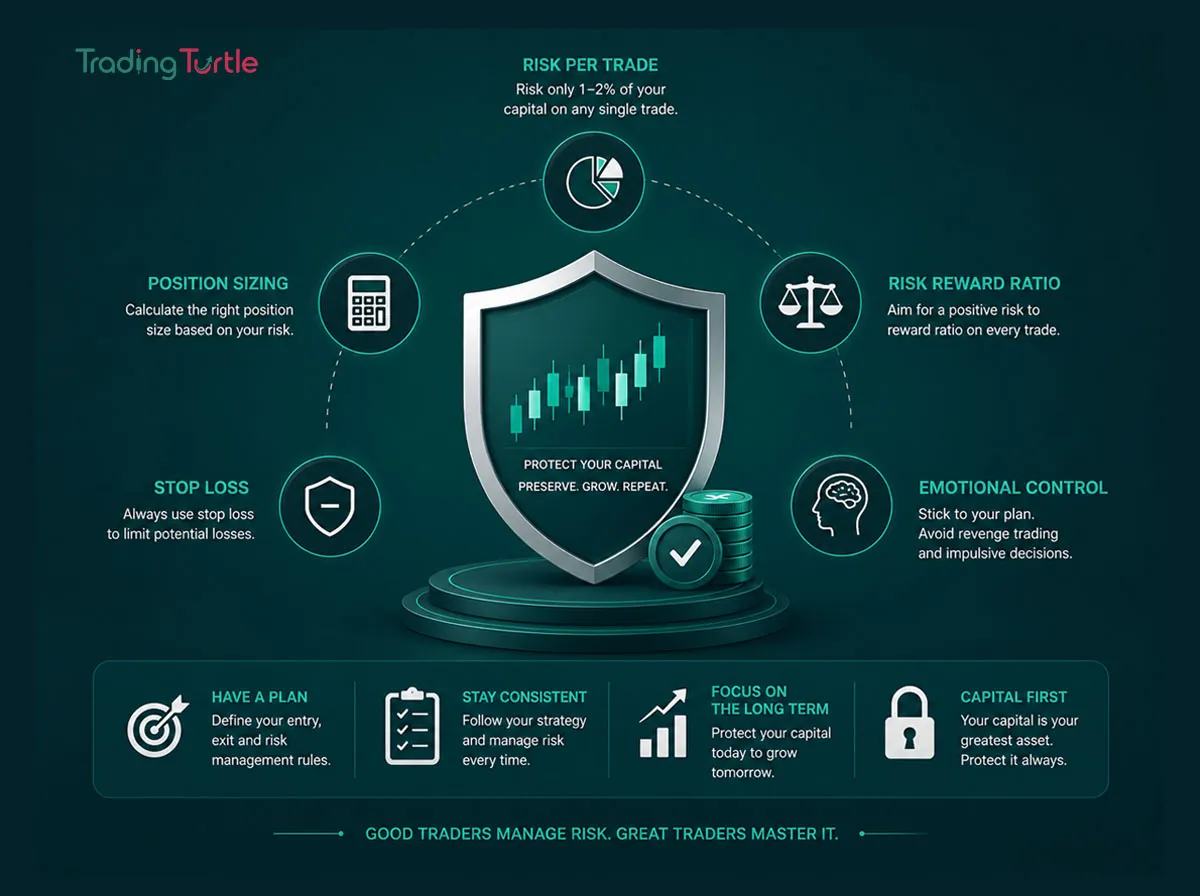
Risk management in trading is the process of identifying, measuring, and controlling how much money you could lose before you place a trade. It includes position sizing, stop-loss planning, portfolio exposure, drawdown limits, trade selection, execution awareness, and the discipline to stop when your plan says to stop.
Many beginners spend most of their time searching for profitable entries. Entries matter, but a strong setup can still create serious damage if the position size is too large, leverage is excessive, or losses are allowed to grow without a defined exit. Effective risk management in trading focuses first on survival: preserving capital so you can continue learning, reviewing, and improving.
A trading plan should answer three questions before an order is placed:
- What proves this trade idea wrong?
- How much money can I lose if that happens?
- Is that possible loss acceptable relative to my total capital and current market conditions?
SEBI’s investor education resources identify market, liquidity, and other forms of securities-market risk, while NISM’s investor-certification material includes risk management, hedging, diversification, due diligence, and transparency among its learning objectives.nism+1
Why Risk Management Matters
Risk management in trading matters because every trade has uncertainty. Even a well-researched setup can fail because of unexpected news, market-wide selling, liquidity changes, an earnings surprise, a gap at the open, or an error in analysis.
The purpose of risk controls is not to avoid every losing trade. That is impossible. The purpose is to ensure that one loss, one day, or one poor period does not create damage that is difficult to recover from.
For example, a trader who loses 50% of their capital needs a 100% return on the remaining capital merely to return to the starting balance. The deeper the drawdown, the harder recovery becomes.
That is why trading risk management should come before profit expectations. A trader who can keep losses controlled has more time to gather data, learn from mistakes, and avoid emotionally driven decisions.
Risk reminder: No stop-loss, order type, strategy, indicator, or algorithm can guarantee a maximum loss in every market condition. Fast moves, gaps, low liquidity, and technical failures can lead to execution at a worse price than expected.
The Building Blocks of Risk
A complete approach to risk management in trading combines several connected decisions. Focusing on only one, such as a stop-loss, is not enough.
Trade risk
Trade risk is the amount you may lose if your trade idea fails and the planned exit is reached. It should be known before the order is placed.
For a long trade, the basic calculation is:
For a short trade, it is:
Position risk
Position risk is the total money at risk after you multiply the risk per unit by the number of units you buy or sell.
This is why position sizing matters. A narrow stop-loss with an oversized position can still create unacceptable risk.
Market risk
Market risk is the possibility that an asset, sector, index, or broader market moves against you. It can be influenced by economic data, company announcements, policy changes, global events, and market sentiment.
Liquidity risk
Liquidity risk arises when you cannot buy or sell promptly at an acceptable price. SEBI describes this as a risk that an investment cannot be bought or sold promptly.
Operational risk
Operational risk includes internet outages, exchange downtime, broker-platform issues, software bugs, incorrect order entries, API failures, and poor record keeping. Algorithmic traders should treat operational controls as part of risk management in trading, not as an afterthought.
Position Sizing
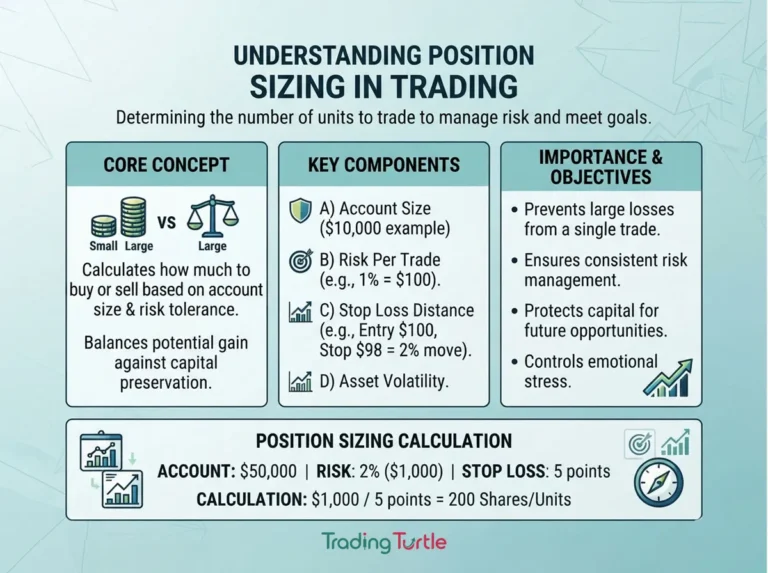
Position sizing is one of the most important parts of risk management in trading. It determines how many shares, contracts, units, or tokens you can trade while keeping the potential loss within your predefined limit.
A common framework is to risk only a small, fixed percentage or fixed cash amount of your total trading capital on one trade. The exact number is a personal risk decision—not a universal rule—but consistency matters more than chasing a particular percentage.
Position-sizing formula
For example, assume:
- Trading capital: ₹1,00,000
- Maximum planned loss for this trade: ₹1,000
- Planned entry: ₹500
- Planned stop-loss: ₹490
The risk per share is:
The maximum position size based on ₹1,000 of planned risk is:
This example excludes brokerage, taxes, slippage, and possible gap risk. In real trading, leave room for execution costs and the possibility that an exit may occur beyond the stop price.
Why position size should change
Position size should not be fixed only because you used the same amount last time. It may need adjustment when:
- Your stop-loss distance is wider or narrower.
- The asset is more volatile.
- Liquidity is weaker.
- The trade uses leverage.
- Several correlated positions are already open.
- Major news or an event creates unusual uncertainty.
- You are approaching a daily or weekly loss limit.
A disciplined trader does not increase size simply because they feel highly confident. Confidence does not change market uncertainty.
Stop-Loss Planning
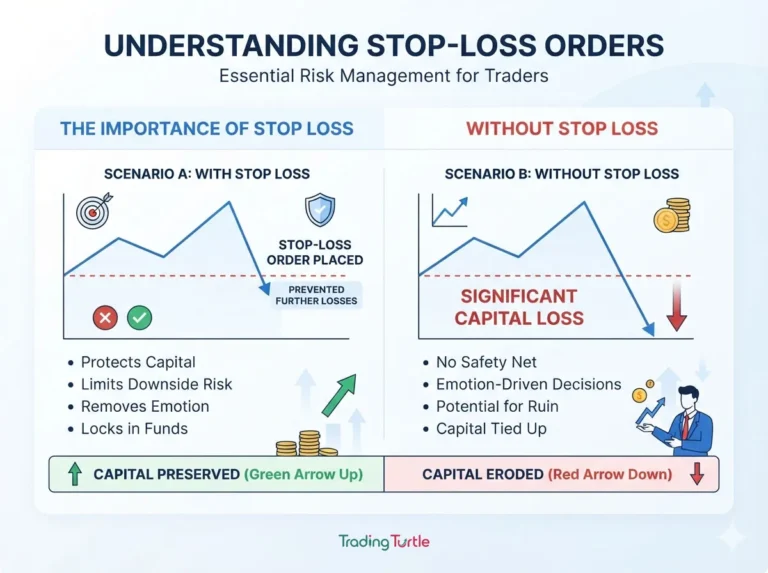
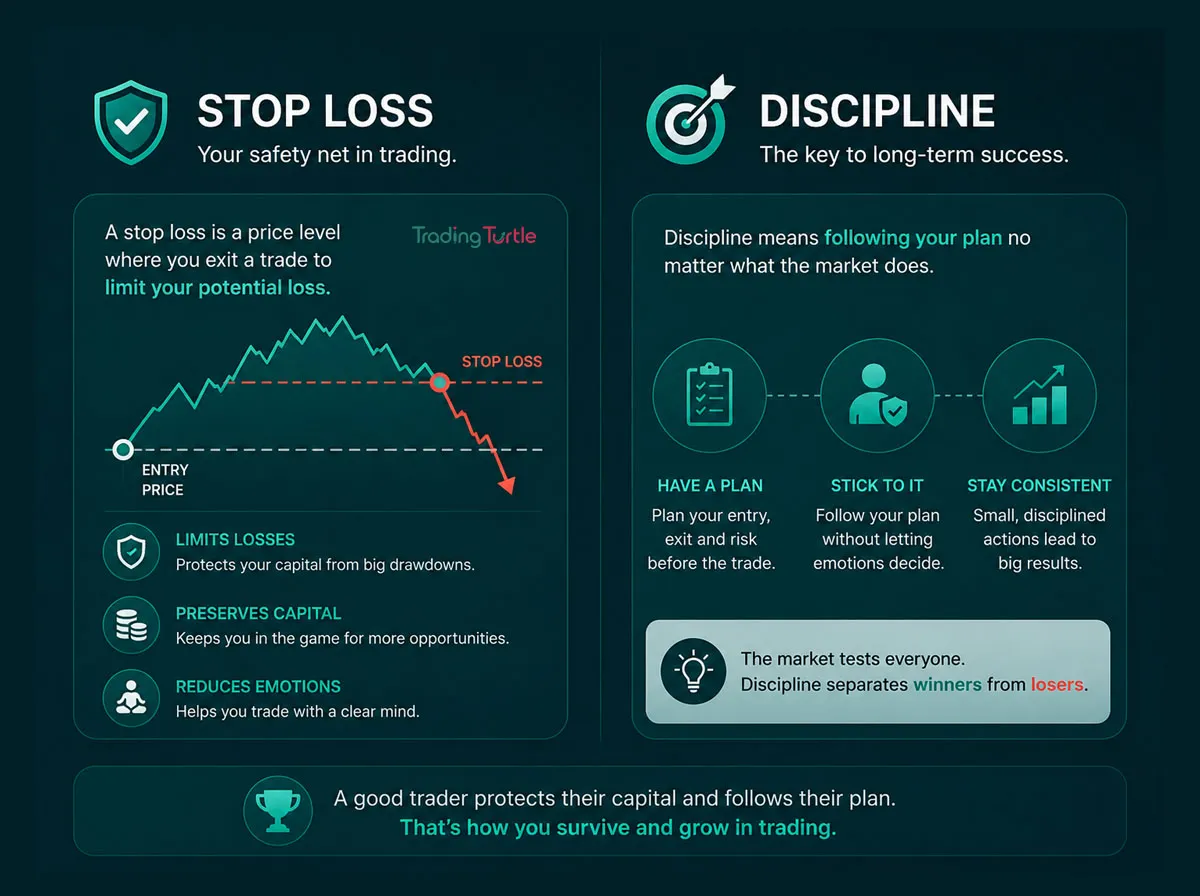
A stop-loss is a predefined level at which you exit or reduce a position if the market invalidates your trade idea. In risk management in trading, a stop-loss should be based on the logic of the setup, not on a random amount you hope not to lose.
A logical stop-loss
For a long trade, a stop-loss may be placed below a level that should hold if the trade thesis is correct, such as a support area or the low of a pattern. For a short trade, it may be above a resistance level or recent swing high.
The level must be far enough away to allow normal movement, but close enough to limit damage if the trade is wrong. This balance affects position size.
A stop-loss is not a guarantee
A stop-loss can be useful, but it does not guarantee an exact exit price. During gaps, low liquidity, major news, or rapid moves, the order may fill worse than expected. That is why trading risk management includes conservative position size and not merely placing a stop order.
Read Market Order vs Limit Order to understand how execution and order choices can affect exits.
Do not widen a stop impulsively
Moving a stop-loss farther away simply because you do not want to accept a loss changes the original risk plan. If the setup is invalid, the correct response is usually to follow the plan, record the outcome, and review it later.
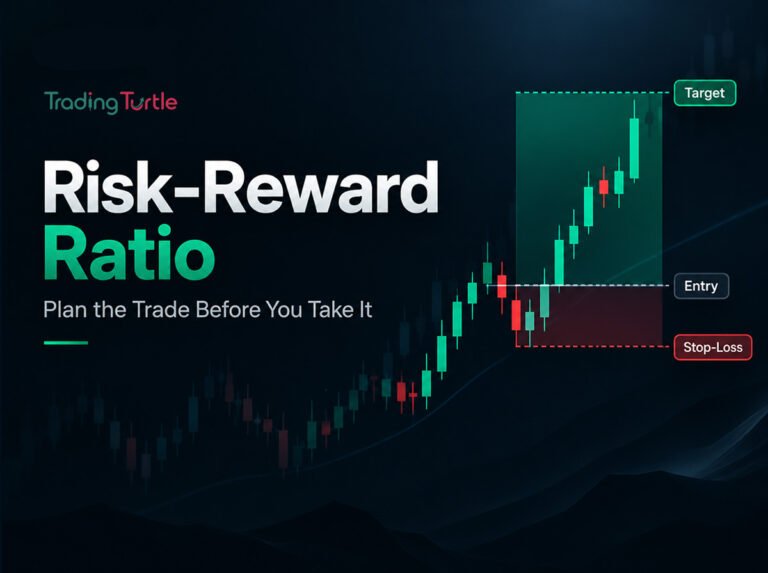
Risk-Reward Ratio
Risk-reward ratio compares the amount you may lose if a trade fails with the amount you expect to gain if the trade works.
For example, if the planned risk is ₹10 per share and the potential reward is ₹20 per share, the risk-reward ratio is 2:1.
A favourable risk-reward ratio does not guarantee a profitable strategy. A trade can have a 3:1 planned reward and still fail repeatedly. However, it helps traders evaluate whether the potential reward is reasonable relative to the defined loss.
Risk-reward is not enough alone
A strategy must also consider:
- Win rate.
- Execution costs.
- Slippage.
- Spread.
- Market conditions.
- Frequency of valid setups.
- Emotional ability to follow the plan.
- Whether targets are realistic for the asset’s normal volatility.
Avoid forcing trades simply because the chart appears to offer an attractive ratio. A weak setup with a distant target is not automatically a good trade.
Managing Leverage and Margin
Leverage allows traders to control a larger position with a smaller amount of capital. It can amplify gains, but it also magnifies losses. For this reason, leverage requires stricter risk management in trading than an unleveraged position.
SEBI’s educational material warns that derivatives may multiply profits and losses because the payment or margin can be small relative to the value of the underlying asset.
Leverage can hide position size
A trader may see a small margin requirement and assume the position is small. But the true exposure is based on the notional value of the contract or leveraged position—not just the margin blocked.
Before using leverage, understand:
- Contract size or notional exposure.
- Initial and maintenance margin requirements.
- Mark-to-market effects.
- Funding or financing costs where applicable.
- Liquidation rules.
- Expiry and settlement terms for derivatives.
- How a small percentage price move affects your capital.
If you cannot calculate the maximum reasonable loss under adverse conditions, the position is likely too complex or too large.
Liquidity and Execution Risk
Liquidity is a core part of risk management in trading because a good plan can still fail if you cannot enter or exit near your expected price.
A highly liquid instrument often has more active buyers and sellers, narrower spreads, and deeper available quantity. A thin instrument may have wide spreads, limited order-book depth, rapid price jumps, and greater slippage risk.
NSE describes Level 1 data as including the best bid and ask, while deeper levels provide multiple bid and ask prices; this is useful context for assessing available market depth.
Check the spread before you enter
The bid-ask spread is the difference between the highest available buyer price and the lowest available seller price. A trader who buys at the ask and immediately sells at the bid generally loses the spread before other costs.
Review Bid-Ask Spread Explained before trading short-term strategies or lower-volume instruments.
Match order size with liquidity
A market might be suitable for a small order but unsuitable for a large order. If your quantity is large compared with visible depth, it can move across multiple bid or ask levels and create a worse average fill.
Learn more in What Is Liquidity in Trading?.
Daily and Weekly Loss Limits
A defined daily or weekly loss limit is a practical circuit breaker. It tells you when to stop trading and review, rather than continuing because you feel pressure to recover.
Daily loss limit
A daily loss limit is the maximum loss you are willing to accept in one session. Once reached, stop opening new trades for the day. Do not immediately increase size, change strategies, or move to a more volatile instrument.
Weekly loss limit
A weekly loss limit provides a wider layer of protection. It can prevent a series of poor sessions from turning into a major drawdown.
When a limit is reached, review:
- Whether you followed your written rules.
- Whether market conditions changed.
- Whether losses came from valid setups or impulsive trades.
- Whether position size was appropriate.
- Whether you need to pause, paper trade, or simplify your approach.
A loss limit is valuable only if it is respected. It should be decided while calm—not changed during a losing streak.
Portfolio and Correlation Risk
A trader may believe they are diversified because they hold several positions. But if all positions move for similar reasons, the total risk may be concentrated.
For example, buying several banking stocks, long index futures, and call options on a financial-sector ETF may create overlapping exposure to the same market move. Similarly, holding multiple highly correlated crypto assets can behave like one oversized position during a market-wide decline.
Questions to ask before adding a trade
- Does this position move similarly to one I already hold?
- Is my total exposure too large if all related assets move against me?
- Am I adding risk because of a new valid setup, or because I want to recover losses?
- Could one macro event affect all positions at once?
- Does my remaining capital support this additional risk?
Portfolio-level trading risk management means tracking total exposure, not judging each position separately.
A Practical Risk Checklist
Use this checklist before every trade. It turns risk management in trading from a vague principle into a repeatable process.
- Trade thesis: Can I explain the setup in one or two clear sentences?
- Invalidation: What exact event, price area, or condition proves the trade idea wrong?
- Entry: What is my intended entry price or trigger?
- Stop-loss: Where is the logical exit point if I am wrong?
- Position size: Does the quantity keep my planned loss within my risk limit?
- Liquidity: Have I checked the bid, ask, spread, depth, and expected slippage?
- Leverage: Do I understand the full notional exposure and worst-case practical risk?
- Event risk: Are earnings, macro data, policy decisions, expiry, or major news due?
- Correlation: Does this add excessive exposure to similar assets or sectors?
- Exit plan: How will I take profit, reduce risk, or exit if conditions change?
- Loss limits: Am I within my daily and weekly loss limits?
- Journal: Have I recorded the reason for the trade before entering?
If you cannot answer these questions, the better decision is often to wait.
Common Mistakes
Avoid these common failures in risk management in trading:
- Choosing quantity based on available margin instead of planned maximum loss.
- Placing a stop-loss without calculating the total money at risk.
- Moving or removing a stop-loss to avoid accepting a loss.
- Adding to a losing trade without a written strategy and risk limit.
- Using leverage because it makes a larger position appear affordable.
- Ignoring spread, slippage, taxes, funding, and other trading costs.
- Taking multiple correlated positions without measuring total exposure.
- Trading after reaching a daily loss limit.
- Increasing size after losses to “win it back.”
- Treating a backtest or paper-trading result as proof of live-market safety.
- Failing to prepare for liquidity risk around major news.
SEBI reported that 93% of individual traders in equity futures and options incurred losses between FY22 and FY24, reinforcing the importance of conservative sizing, product understanding, and risk discipline in leveraged markets.
Key Takeaways
- Risk management in trading means deciding and controlling possible loss before you enter a position.
- Position size should be based on entry, stop-loss distance, and maximum acceptable loss—not confidence or available margin.
- A stop-loss supports discipline but cannot guarantee an exact exit price during gaps or rapid moves.
- Risk-reward ratio is useful, but it must be assessed alongside win rate, costs, liquidity, and realistic market conditions.
- Leverage magnifies both gains and losses, so it requires stricter controls.
- Liquidity, spreads, and slippage are execution risks that must be included in every trade plan.
- Daily and weekly loss limits can reduce emotional decision-making after a losing streak.
- Track total portfolio exposure, especially when positions are correlated.
- Consistent trading risk management is more valuable than finding a perfect entry.
Educational disclaimer: This article is for education only and is not financial, investment, tax, or legal advice. Risk controls can reduce potential losses, but they cannot prevent all losses or guarantee results. Trading involves substantial risk, particularly when leverage, derivatives, or volatile assets are involved.
– Frequently Asked Questions (FAQs)
Risk management in trading is the process of controlling potential losses through position sizing, stop-loss planning, leverage limits, liquidity checks, exposure monitoring, and disciplined trading rules.
No. A stop-loss is only one tool. Complete risk management also includes position size, leverage control, liquidity assessment, portfolio exposure, loss limits, and disciplined execution. Stops can also fill worse than expected in fast markets.
Position sizing is deciding how many shares, contracts, units, or tokens to trade based on the distance between your entry and stop-loss, along with the maximum amount you are willing to lose.
Leverage increases exposure beyond the cash committed to a position. As a result, a relatively small price move can create a large gain or loss compared with your trading capital. Derivatives can magnify both outcomes.
Stop trading for the day. Review your trades later when calm, identify whether losses followed your process, and avoid increasing size or taking impulsive recovery trades.