Crypto Trading Strategies for Beginners: A Risk-Aware Introduction

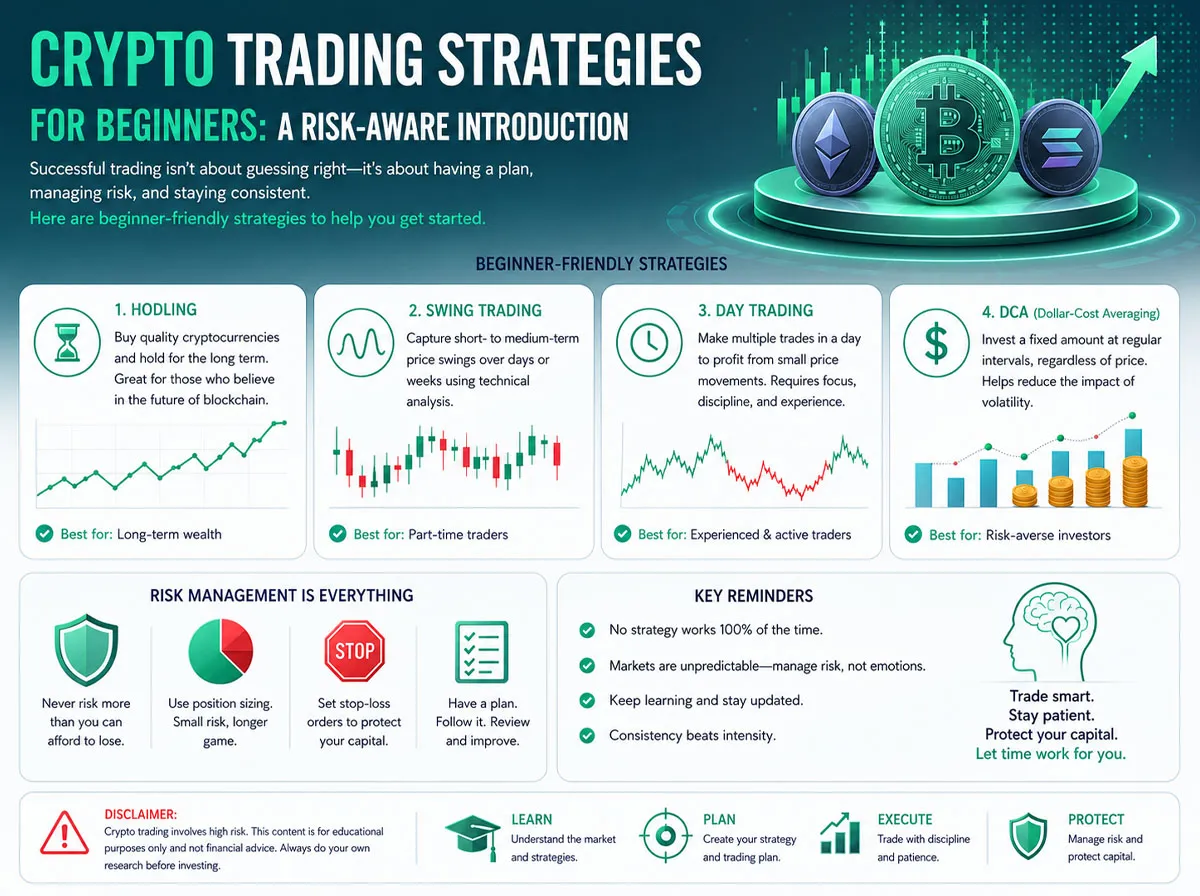
What are crypto trading strategies?
Crypto trading strategies are repeatable frameworks used to make trading decisions. A strategy normally defines:
- What market or asset is being analysed.
- Which timeframe is used.
- What conditions qualify as a setup.
- Where a trade may become invalid.
- How much capital is exposed.
- How an exit is planned.
- How the result will be recorded and reviewed.
A strategy is not simply a prediction that price will rise or fall. It is a process for responding to a defined market condition while accepting that any individual trade can lose.
For crypto trading for beginners, this distinction is important. A person may correctly identify a bullish market and still lose money because of poor position sizing, excessive leverage, a late entry, high fees, or an exit plan that was never defined.
A complete approach combines market analysis with crypto risk management. Technical analysis may help a trader describe price behaviour, but risk management determines how much damage an incorrect idea can cause.
Education-only disclaimer: This article is for general educational purposes only. It is not personalised investment, financial, tax, or legal advice. Crypto assets are volatile and speculative. The examples are hypothetical and do not represent trade recommendations, guaranteed outcomes, target prices, or promises of profit.
Choosing a crypto trading approach
Before comparing crypto trading strategies, decide what type of trading activity you are actually studying.
Spot trading
In spot trading, a trader buys or sells the underlying crypto asset. The trader generally does not borrow funds to increase the position size.
A spot trading strategy may focus on:
- Buying and selling an asset without leverage.
- Holding an asset for a defined period.
- Using technical or fundamental analysis.
- Managing the risk of price declines.
- Planning how and where the asset will be stored.
Spot trading still involves substantial risk. A trader can lose money when the asset price declines, when liquidity is poor, when a platform fails, or when the asset cannot be sold at the expected price.
Crypto futures and perpetual contracts
Crypto futures and perpetual contracts are derivatives whose value is linked to an underlying crypto asset. They may allow traders to take long or short positions and may involve margin and leverage.
These products require a separate understanding of:
- Initial and maintenance margin.
- Funding payments.
- Liquidation.
- Mark price.
- Contract specifications.
- Position mode and order types.
- Counterparty and platform risk.
A derivatives strategy should not be treated as a simple extension of a spot trading strategy. Leverage can make a relatively small market movement have a much larger impact on account equity.
The CFTC states that virtual-currency values can be more volatile than traditional fiat currencies and that volatility is amplified in margined futures contracts.
Holding period
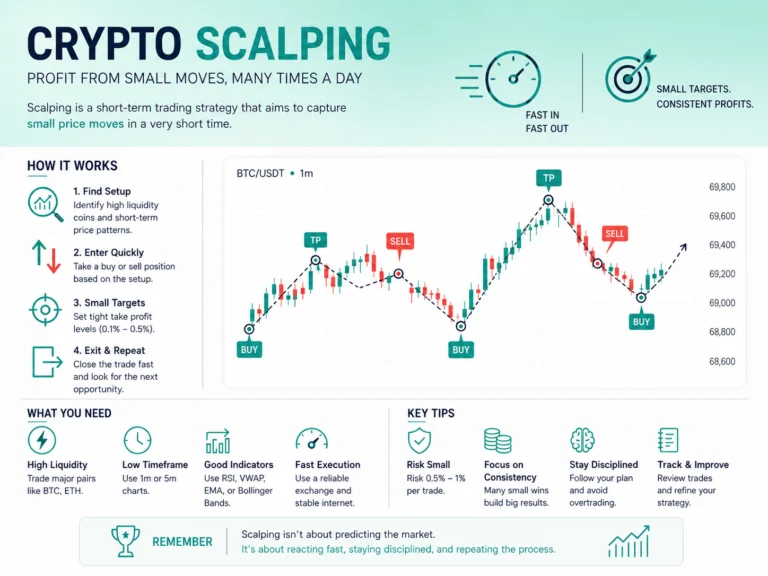
A trading approach can also be classified by how long positions are held:
| Approach | Typical focus | Main challenge |
|---|---|---|
| Scalping | Very short-term price movements | Fees, execution speed, noise, and emotional pressure |
| Intraday trading | Opening and closing positions within a day | Rapid decision-making and changing volatility |
| Swing trading | Capturing multi-day or multi-week moves | Overnight risk and wider price fluctuations |
| Position trading | Holding through broader market trends | Large drawdowns and long periods of uncertainty |
These labels do not guarantee a particular result. The best approach depends on the trader’s available time, knowledge, risk tolerance, capital, tools, and ability to follow rules consistently.
Trend-following strategy
Trend following is one of the most widely discussed crypto trading strategies. It attempts to participate in a sustained move rather than predict every short-term fluctuation.
A trader may describe a market as being in:
- An uptrend, where price forms a sequence of higher highs and higher lows.
- A downtrend, where price forms lower highs and lower lows.
- A range, where price repeatedly moves between broadly defined support and resistance areas.
A trend-following framework may use:
- Market structure.
- Moving averages.
- Breaks and retests.
- Support and resistance.
- Momentum indicators.
- Multiple timeframes.
Example of a trend framework
A hypothetical plan might require:
- The higher timeframe to show a consistent directional structure.
- The trading timeframe to produce a pullback.
- Price to show evidence that the pullback may be ending.
- A predefined level where the idea would be considered invalid.
- A position size based on the distance to that invalidation level.
This is an educational framework, not a signal. A trend can reverse without warning, and an apparent pullback can become a full market reversal.
Strengths and limitations
Trend following may benefit from strong directional markets. Its limitations include:
- Late entries after a large move.
- Multiple small losses during sideways conditions.
- False breakouts and failed reversals.
- Difficulty deciding when a trend has ended.
- Large differences between theoretical and actual execution.
A trend-following strategy should therefore include a clear definition of what constitutes a trend failure.
Range-trading strategy
A range-trading strategy assumes that price is moving between a relatively identifiable upper and lower area. The trader may study reactions near support and resistance rather than assume that a sustained trend is underway.
A range framework may consider:
- Repeated reactions near the upper and lower boundaries.
- Failed attempts to break outside the range.
- Volume and momentum changes.
- Distance between the potential entry and invalidation level.
- Whether the expected reward justifies the risk.
Risks of range trading
Ranges do not last forever. A trader who repeatedly sells near the upper boundary or buys near the lower boundary may be caught when price breaks decisively in one direction.
Range trading can also become dangerous when traders treat an approximate area as a precise line. Support and resistance are zones, not guarantees. Price may overshoot an area before reversing or may continue through it.
A range strategy should define when the range is no longer valid. It should also account for transaction fees, slippage, and the possibility that price may leave the range during a volatile event.
Breakout strategy
A breakout strategy attempts to participate when price moves beyond a previously observed consolidation area, range, trendline, or other market structure.
A trader studying a breakout may examine:
- How long price consolidated before the move.
- Whether the breakout occurred with increased activity.
- Whether the candle closed beyond the relevant area.
- Whether price retested the broken level.
- Whether the broader market context supports the move.
- Where the breakout idea would be invalidated.
False breakouts
A false breakout occurs when price moves beyond an important level but fails to continue and returns inside the previous structure. False breakouts are common in volatile markets and can cause traders to enter at unfavourable prices.
Potential safeguards include:
- Waiting for a confirmed close rather than reacting to a brief price spike.
- Using a retest framework instead of chasing the first move.
- Reducing position size when volatility is unusually high.
- Defining risk before entering.
- Avoiding entries when the potential stop distance is too large.
No confirmation method eliminates false breakouts. A strategy should be designed to handle failed setups rather than assume that confirmation always leads to continuation.
Swing-trading approach
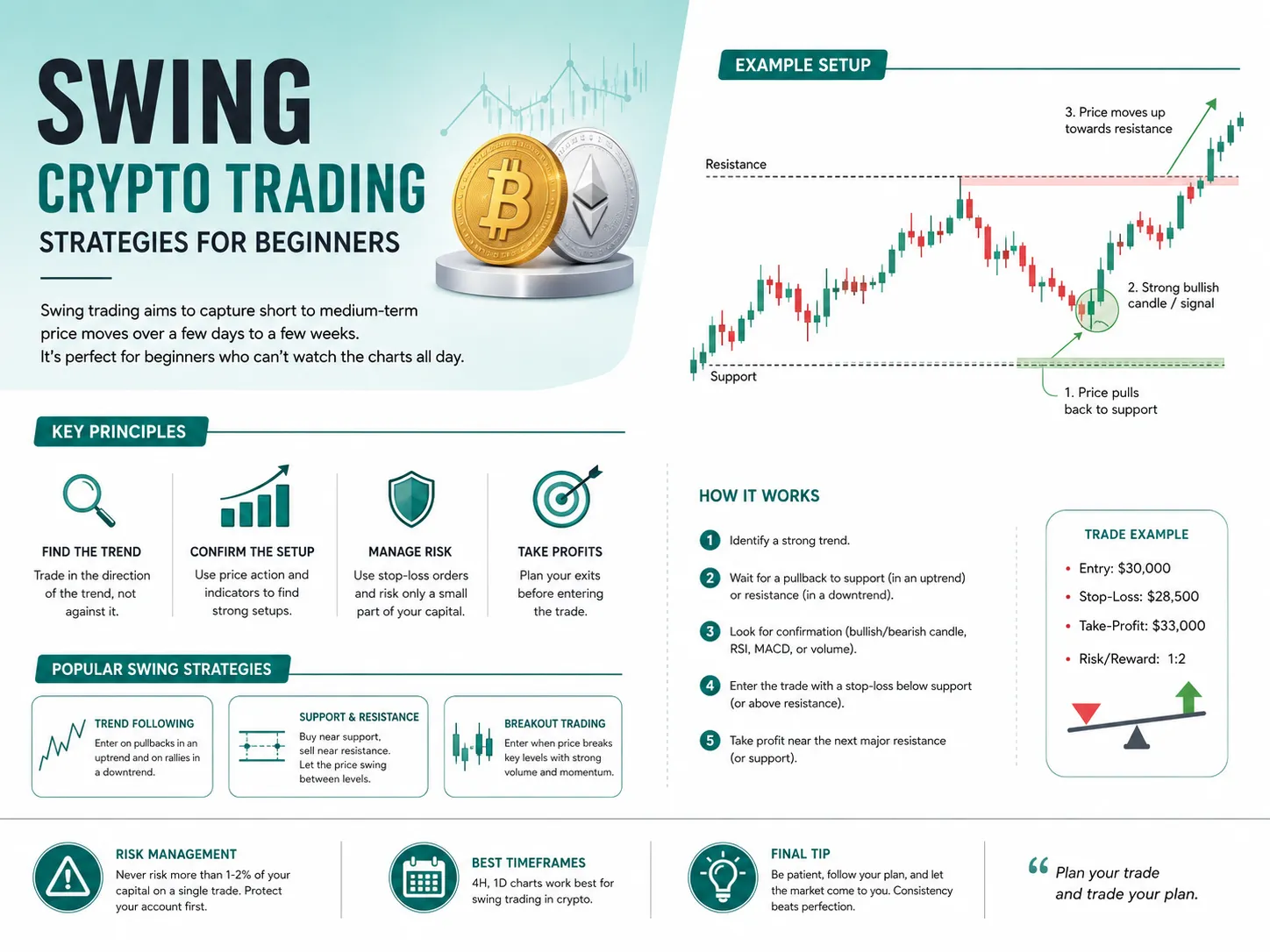
Swing trading attempts to capture a portion of a price movement over a period that may last from several days to several weeks. It is often considered by people who cannot monitor charts continuously.
A swing-trading process may include:
- Identifying a higher-timeframe market structure.
- Finding a potential setup on an intermediate timeframe.
- Defining the entry condition.
- Calculating position size from the planned risk.
- Setting an invalidation level.
- Planning partial or final exits.
- Reviewing the trade after closure.
Swing trading is not automatically safer than intraday trading. Crypto markets operate continuously, and significant price changes can occur while a trader is asleep or away from the screen.
A swing trader should consider:
- Overnight and weekend price gaps.
- News and event risk.
- Funding costs for derivatives.
- Liquidity during different market sessions.
- The possibility of holding through a sharp drawdown.
- Whether the position size is appropriate for the wider stop distance.
Building a risk-aware crypto trading plan
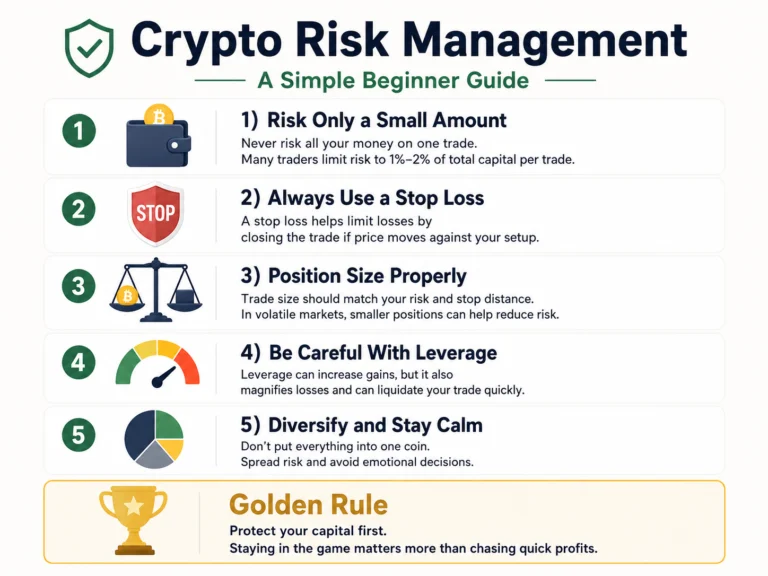
The most important part of crypto trading strategies is often the risk framework rather than the entry signal.
Define risk per trade
Risk per trade is the amount a trader is prepared to lose if the trade reaches its invalidation point. It should be defined before the position is opened.
A basic position-sizing relationship is:
This simplified formula does not include every cost, such as fees, slippage, funding, contract specifications, or currency conversion. It is an educational illustration rather than a complete execution formula.
For a detailed explanation,read Position Sizing in Trading: How to Calculate Trade Risk.
Use an invalidation level
An invalidation level is the price or condition at which the original trade idea is no longer valid. It should be based on the market structure or method, not chosen only because it produces a preferred position size.
A stop-loss order may help automate an exit, but it does not guarantee execution at the exact requested price during fast markets, gaps, outages, or extreme illiquidity.
Limit total exposure
A trader may have several positions that are highly correlated. For example, owning multiple assets that respond similarly to market-wide movements can create more exposure than the number of individual trades suggests.
A risk-aware plan may set limits for:
- Maximum loss on one position.
- Maximum total open risk.
- Maximum daily or weekly loss.
- Maximum exposure to one asset or sector.
- Maximum leverage.
- Maximum number of simultaneous positions.
Account for fees and slippage
A strategy that appears profitable before costs may perform very differently after:
- Trading commissions.
- Bid-ask spreads.
- Slippage.
- Funding payments.
- Withdrawal fees.
- Borrowing or margin costs.
FINRA notes that crypto assets can be less liquid than traditional financial instruments, which may increase volatility and make it more difficult to sell.
Testing and improving a strategy
A strategy should be tested before relying on it with live capital.
Historical testing
Backtesting applies a set of rules to historical data. It can help identify:
- How often the rules generated setups.
- The size and frequency of losses.
- The effect of different market conditions.
- The impact of fees and slippage.
- Whether the strategy depends on a small number of unusually successful trades.
Historical testing has limitations. Data quality may be poor, the rules may be interpreted differently in real time, and future market conditions may not resemble the past.
Avoid changing the rules repeatedly until the historical results look attractive. This can create overfitting, where the strategy matches old data but performs poorly in new conditions.
Paper trading
Paper trading allows a trader to practise entries, exits, position sizing, and recordkeeping without placing real orders. It can help test the operational side of crypto trading for beginners.
Paper trading does not fully reproduce:
- Emotional pressure.
- Slippage.
- Liquidity limitations.
- Platform outages.
- Real funding payments.
- The psychological impact of losses.
Use paper trading as a learning and process-testing tool, not as proof that a strategy will be profitable live.
Maintain a trading journal
A journal can record:
- Date and time.
- Asset and market type.
- Timeframe.
- Setup description.
- Entry and exit conditions.
- Position size.
- Planned and actual risk.
- Fees and funding.
- Screenshot or chart context.
- Emotional state.
- Whether the rules were followed.
Review the journal using a meaningful sample of trades rather than judging the strategy from one or two outcomes.
Common beginner mistakes
Beginners often focus on finding the perfect indicator instead of building a complete process. Common mistakes include:
- Trading without a written plan.
- Using leverage before understanding liquidation.
- Increasing position size after a loss.
- Chasing a rapid price move.
- Moving a stop-loss farther away to avoid accepting a loss.
- Treating social-media opinions as research.
- Ignoring fees, funding, spreads, and slippage.
- Using too many indicators with conflicting signals.
- Testing a strategy on too little data.
- Confusing a profitable trade with a good decision.
- Risking essential savings or borrowed money.
- Assuming that a past return will repeat.
Crypto assets can experience dramatic and unpredictable price movements. FINRA warns that crypto assets are often extremely volatile and that investors may lose all of their investment.
A practical beginner workflow
A structured learning workflow may look like this:
- Learn how spot markets, futures, perpetual contracts, margin, and liquidation differ.
- Select one market and one timeframe rather than monitoring everything.
- Write precise entry, invalidation, exit, and position-sizing rules.
- Test the rules on historical data without changing them after every result.
- Paper trade the method in realistic market conditions.
- Record every trade and review rule-following separately from profitability.
- Start with the smallest practical exposure only after understanding the risks.
- Stop and review the process if the predefined loss limit is reached.
This workflow does not guarantee success. Its purpose is to reduce impulsive decisions and make weaknesses easier to identify.
Key takeaways
- Crypto trading strategies are structured methods for analysing markets, planning entries and exits, and controlling risk.
- Beginners should understand the difference between spot trading and leveraged derivatives before selecting an approach.
- Trend, range, breakout, and swing-based methods each work in different market conditions and can also fail.
- A strategy is incomplete without position sizing, invalidation rules, risk limits, and a trading journal.
- Paper trading and historical testing can help identify weaknesses before live trading, but neither guarantees future results.
- Leverage can amplify both gains and losses. The CFTC warns that leverage can magnify losses and may result in losses exceeding the initial amount deposited in some futures contexts.
– Frequently Asked Questions (FAQs)
There is no universally best strategy. A beginner should choose an approach that is understandable, testable, compatible with available time, and supported by clear risk controls.
Spot trading avoids some risks associated with margin and liquidation, but it can still result in substantial losses from price declines, poor liquidity, custody problems, fraud, or platform failure. Futures add leverage, funding, liquidation, and contract-specific risks.
No. A strategy can produce losses, including during periods when its historical results appeared favourable. Claims of guaranteed returns or risk-free crypto trading should be treated as warning signs.
There is no suitable amount for everyone. A person should not risk money needed for living costs, debt payments, emergencies, or essential financial goals. Position sizing should be based on an affordable maximum loss, not on a desired profit.
Beginners should first understand spot trading, position sizing, margin, liquidation, funding, and order execution before considering leverage. Leverage magnifies exposure and can accelerate losses.
There is no universal minimum period. The test should include enough trades and different market conditions to evaluate rule-following, drawdown, execution assumptions, and costs. A small number of winning paper trades is not sufficient evidence.