Crypto Scalping Strategy: Execution, Costs and Short-Term Risk

What is a crypto scalping strategy?
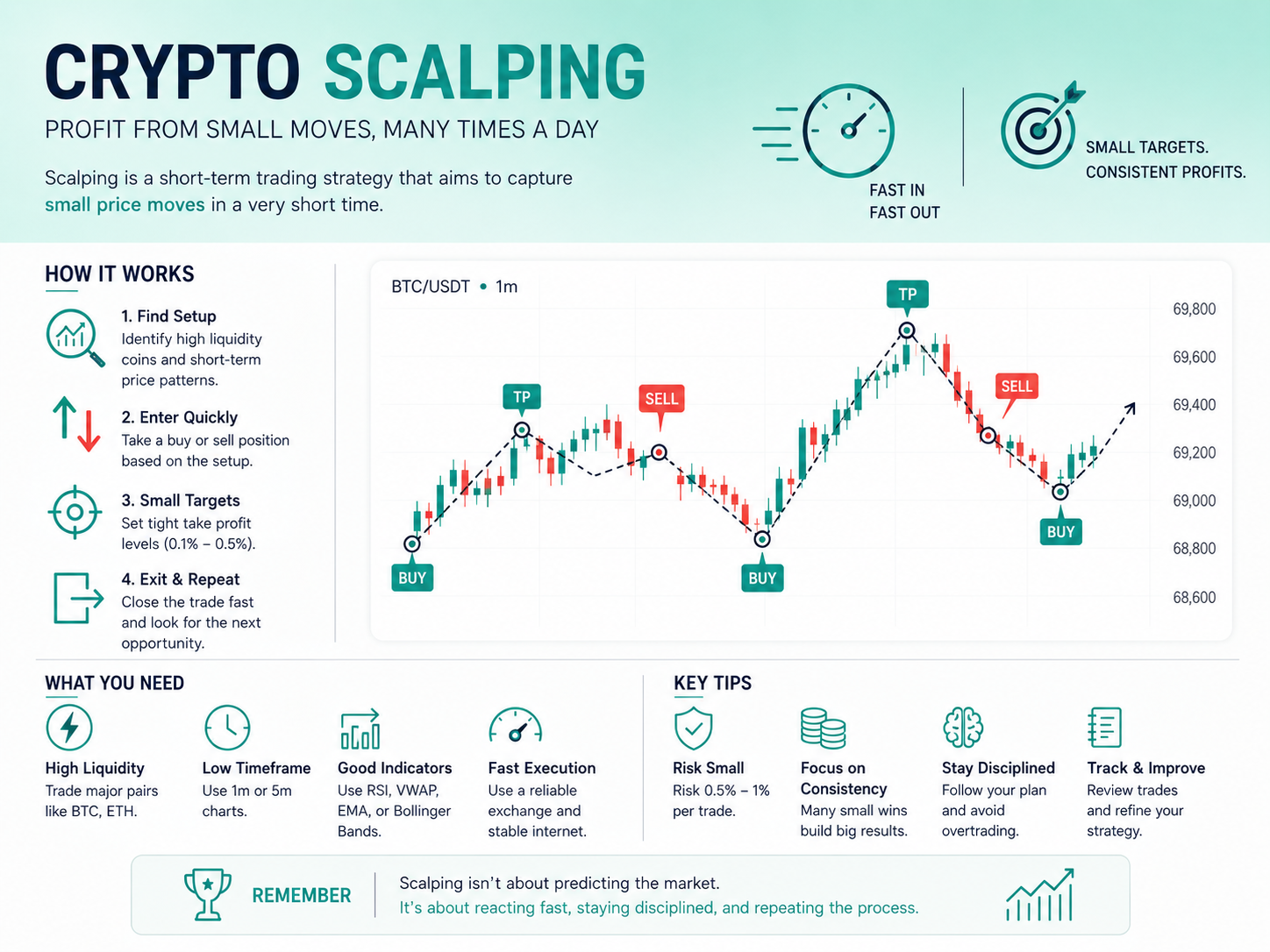
A crypto scalping strategy is a short-term trading framework designed to capture relatively small price movements over minutes or, in some cases, seconds. A scalper does not need to predict a major trend for the next week or month. Instead, the objective is to identify a repeatable short-term imbalance, execute efficiently, manage risk quickly, and avoid turning a small trade into an unplanned larger position.
The holding period in crypto scalping may range from a few seconds to several minutes. Some traders may hold positions longer when the short-term structure remains valid, but the defining feature is that decisions are based on lower timeframes and short-duration price movement.
A professional crypto scalping strategy is not simply “buy low and sell high” on a one-minute chart. It requires a clear process for market selection, context, entry confirmation, position size, stop placement, exit rules, and post-trade review.
Scalping is often misunderstood because the individual profit target may appear small. However, small targets leave little room for error. Spread, fees, slippage, delayed execution, and one oversized loss can erase the result of many small winning trades.
Education-only disclaimer: This article is for general educational purposes only. It is not investment, financial, tax, or legal advice. Crypto scalping involves rapid decision-making, transaction costs, execution risk, and potentially substantial losses. The examples below are hypothetical, not trade signals, recommendations, or guarantees of performance.
Why execution matters in crypto scalping
Execution is the difference between the price a trader expects and the price actually received. For longer-term traders, a small execution difference may have limited importance. For a crypto scalping strategy, it can determine whether a setup is viable at all.
Consider a setup with a narrow target and a narrow invalidation level. If the spread consumes a meaningful portion of the expected move, the trade begins at a disadvantage. If slippage causes the entry or exit to fill away from the expected price, the actual risk-reward relationship may be much worse than the planned one.
A crypto scalper should understand four execution concepts:
| Concept | Why it matters for scalping |
|---|---|
| Bid-ask spread | The difference between buy and sell prices can reduce or eliminate a small expected gain |
| Slippage | A market order may fill at a worse price than expected during fast movement |
| Liquidity | Thin order books can make exits difficult and increase price impact |
| Fees | Frequent trading can create substantial cumulative costs |
A short-term strategy should therefore be tested after realistic costs, not only on clean chart screenshots. FINRA notes that lower liquidity can make an asset harder to sell and can worsen price volatility.
Choosing the right market and timeframe
A crypto scalping strategy should begin with a market-selection rule. Not every crypto asset is suitable for short-term execution.
A scalper generally looks for a market with consistent trading activity, relatively narrow spreads, adequate order-book depth, reliable chart data, and an exchange that can process orders without frequent interruption. This does not make the market safe; it simply reduces some avoidable execution problems.
Trading a highly illiquid token can produce misleading chart patterns. A candle may appear to break a level, but a small order can move price sharply because there are few resting orders. In such conditions, stop placement, take-profit execution, and market-order fills can become unpredictable.
Timeframes used in crypto scalping
Scalpers may use a combination of timeframes rather than relying on only one chart.
A practical structure can include:
- A higher timeframe, such as 15-minute or one-hour, for broad market direction and key levels.
- An execution timeframe, such as one-minute, three-minute, or five-minute, for entry timing.
- A lower-level order-flow or order-book view, where available, for execution context rather than prediction.
The exact timeframe is less important than consistency. A trader should define the same observation process for every trade instead of switching timeframes until a preferred signal appears.
Core principles of a professional scalping process
A disciplined crypto scalping strategy is based on selectivity. The goal is not to trade constantly. The goal is to act only when the market condition matches the written setup.
Start with market context
A scalp should have context. Before looking for a one-minute entry, identify whether the broader market is trending, ranging, breaking out, or becoming unusually volatile.
For example, if the higher timeframe is in a strong uptrend, a scalper may focus on short-term pullbacks that hold above a relevant support zone. If the market is ranging, the scalper may wait for reactions near the range boundaries instead of entering in the middle where the risk-reward relationship is less clear.
This approach prevents the common mistake of treating every small candle pattern as a standalone opportunity.
Trade only liquid conditions
A short-term crypto trade becomes more difficult when liquidity declines. A market may be active during major trading sessions but become thin at other times. Liquidity can also disappear during rapid news events, exchange disruptions, or liquidation cascades.
A professional process includes a “no-trade” condition. If spreads widen, order-book depth collapses, or the market becomes disorderly, staying flat may be the best decision.
Define risk before entry
Before submitting an order, the trader should know:
- The entry condition.
- The invalidation level.
- The expected loss if invalidated.
- The first exit area.
- The maximum number of attempts allowed at the setup.
- The total loss limit for the session.
Without these rules, a scalp can become an emotional attempt to recover a small loss.
A crypto scalping strategy framework
The following is an educational example of a structured crypto scalping strategy. It is not a trade signal and should be tested independently before any live use.
Step 1: Identify the higher-timeframe condition
First, use a higher timeframe to determine whether the market is trending, ranging, or unclear.
A trader might classify the market as:
- Trend condition: Price forms higher highs and higher lows, or lower highs and lower lows.
- Range condition: Price repeatedly reacts between a support zone and resistance zone.
- Unclear condition: Price is choppy, spreads are expanding, or there is no clean structure.
The strategy should avoid unclear conditions. Scalping in the middle of a random, fast-moving market often creates frequent false signals.
Step 2: Mark one decision area
A decision area is a price zone where the market has previously shown a meaningful reaction. It may be a support area, resistance area, breakout-retest zone, session high or low, or a short-term consolidation boundary.
The key is to mark the zone before the scalp setup appears. Redrawing levels after every candle makes the process subjective and difficult to test.
Step 3: Wait for short-term confirmation
Once price reaches the decision area, the trader waits for evidence that the market may react.
A confirmation may include a failed breakdown, a reclaim of a level, a break of a minor internal structure, or a candle close showing rejection from the area. The exact trigger must be defined in advance.
For a long-oriented hypothetical setup, price may pull back into support, reject lower prices, and then break above a short-term lower high. For a short-oriented setup, the opposite sequence may apply near resistance.
The purpose is not to predict perfectly. It is to wait until the market provides a condition that fits the strategy rules.
Step 4: Set the invalidation level
The invalidation level should be located where the setup no longer makes sense. For example, if a long scalp depends on support holding, a sustained break below the support zone may invalidate the idea.
The invalidation level should not be chosen merely to create a small stop. If the technically valid stop is too wide for the planned risk, the correct response is to reduce position size or skip the trade.
Step 5: Plan the exit before entry
A scalper may use a defined first target, a nearby opposing liquidity area, or a time-based exit if the expected momentum does not appear.
A plan can also include partial exits, but only if the approach has been tested. Taking partial profit without a rule may create inconsistent results and make the strategy impossible to evaluate.
Entry, invalidation, and exit planning
The quality of a crypto scalping strategy depends on whether every stage can be described objectively.
Entry criteria
Entry criteria should answer: “What must happen before I act?”
For example, a pullback scalp might require a higher-timeframe uptrend, price entering a marked support zone, a rejection candle, and a break above a short-term structure level. If one condition is missing, there is no trade.
This level of precision prevents impulsive entries caused by fear of missing out.
Invalidation criteria
Invalidation should answer: “What proves this idea is wrong?”
A stop-loss may be placed beyond a level that the setup should not break if the trade thesis is valid. However, a stop-loss is a risk-control tool, not proof that the placement is correct.
In fast crypto markets, stop orders may experience slippage or execute at a worse price than expected. Traders should account for this possibility when calculating risk.
Exit criteria
Exit criteria should answer: “When do I take a gain, reduce exposure, or close a stagnant trade?”
A scalper may exit because:
- Price reaches the planned target.
- Price reaches opposing short-term liquidity.
- The original momentum disappears.
- The trade remains inactive beyond a defined time.
- A reversal signal invalidates the position.
- The daily loss or exposure limit has been reached.
The exit process matters as much as entry. Holding a scalp position indefinitely because it is temporarily losing turns a short-term strategy into an unplanned swing trade.
Fees, spread, and slippage
Costs are among the most overlooked parts of crypto scalping.
A crypto scalping strategy may generate many trades each day or week. Even small fees can become substantial when applied repeatedly. The same applies to spread and slippage.
Suppose a hypothetical setup aims for a 0.30% price movement. If combined entry and exit costs, spread, and slippage total 0.15%, half of the expected gross move has already been consumed. If the average realised slippage increases during fast markets, the strategy may become unprofitable despite a high percentage of winning trades.
For that reason, performance should be reviewed in terms of net results:
Funding is especially relevant for perpetual futures positions held across a funding interval. Although many scalps are short, an unexpectedly extended position can still incur funding costs.
A sound strategy journal should record actual entry price, actual exit price, fees, expected risk, realised risk, and slippage. Without that data, the trader cannot know whether the apparent edge survives real execution.
Scalping spot versus crypto futures
A crypto scalping strategy can be applied to spot markets or crypto futures, but the risk profile is different.
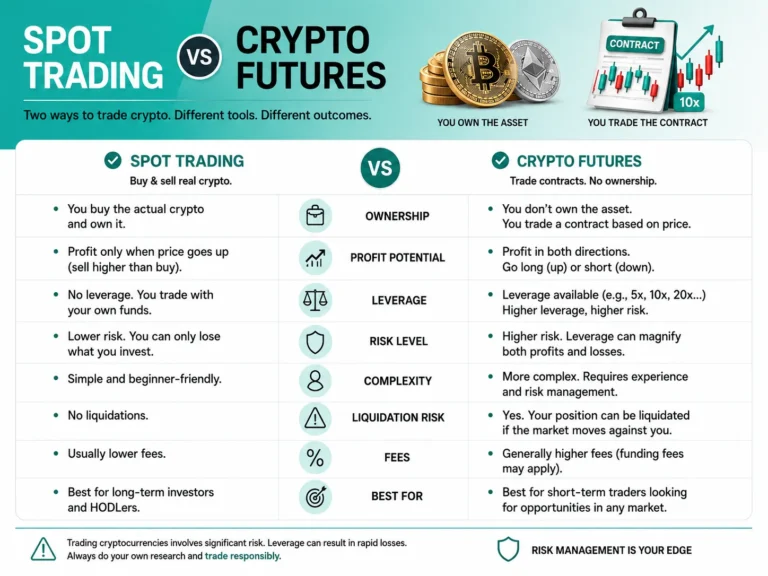
In spot markets, the trader buys or sells the underlying asset. There is no futures liquidation resulting solely from margin requirements, although the asset can still decline sharply and platform or custody risks remain.
In crypto futures, the trader uses a derivative contract. Futures can allow short positions and leveraged exposure, but they also introduce margin, funding, mark-price, maintenance-margin, and liquidation risk.
Leverage can make small market fluctuations highly significant. A small price move against an overleveraged scalp can lead to rapid loss or forced liquidation. The CFTC warns that virtual-currency trading involves speculation and volatility risk, while leverage can amplify the risks of a trade.cftc+1
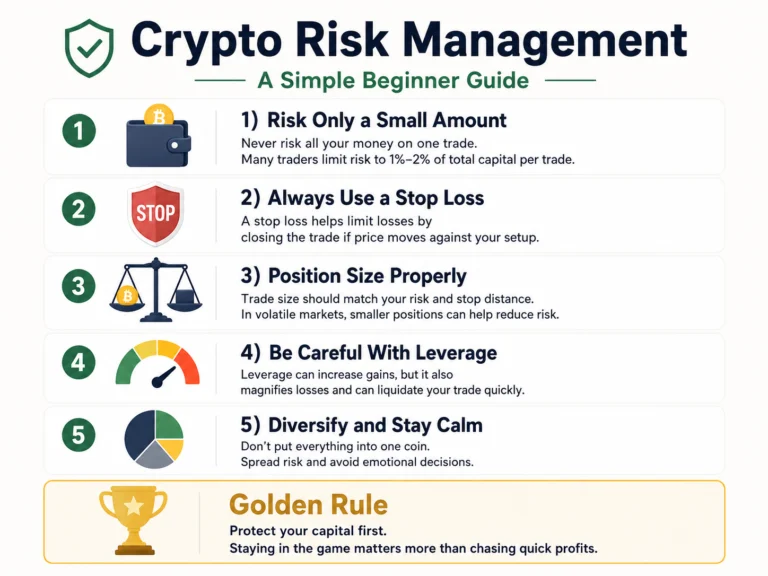
A trader should not use leverage simply because scalping targets are small. Position size, not leverage alone, determines the financial risk of a trade.
Risk controls for crypto scalpers
A professional scalping process needs limits that protect the trader from a series of ordinary losses and from exceptional market conditions.
A useful risk framework may define a maximum loss per trade, maximum number of losing trades in a session, maximum daily loss, and maximum total exposure. It should also include a rule for stopping after a technical failure, emotional mistake, or unusual market event.
For example, a trader may stop trading for the session after reaching a pre-defined daily loss limit. This does not guarantee that losses will be avoided, but it can prevent a small drawdown from becoming a much larger one through revenge trading.
For automated scalping systems, risk controls should extend beyond the chart setup. The system should have order-size limits, maximum position limits, duplicate-order prevention, stale-data detection, API error handling, position reconciliation, and a kill switch. A bot that loses connectivity or submits repeated orders can create risks that no chart-based stop-loss can solve.
Common crypto scalping mistakes
The most damaging scalping mistakes are usually not complex. They are repeated process failures.
- Taking trades in the middle of a range rather than at a planned decision area.
- Trading illiquid pairs because the chart appears to move quickly.
- Using market orders without measuring average slippage.
- Ignoring cumulative fees and spread.
- Increasing size after a losing trade.
- Turning a scalp into a swing trade by removing or widening the stop.
- Opening multiple correlated positions at the same time.
- Using excessive leverage for a small target.
- Trading through emotional fatigue, frustration, or overconfidence.
- Copying unverified social-media signals.
- Running an automated strategy without safeguards or monitoring.
FINRA cautions that crypto assets can involve extreme volatility, lower liquidity, fraud, and a significant risk of loss. These risks make discipline and cost control particularly important for short-term traders.
How to test a crypto scalping strategy
A scalping method should be tested in stages.
Start by writing the strategy in plain language: market condition, decision area, confirmation, stop placement, target, and no-trade conditions. Then review historical chart data and record every setup that met those rules—not only the examples that worked.
After historical review, paper trade the process in real time. This helps identify practical issues such as delayed entries, hesitation, spread expansion, poor fills, and difficulty monitoring multiple conditions at once.
Finally, evaluate results after fees and realistic execution assumptions. A strategy that succeeds only when entries are perfect or costs are ignored is not robust enough for live use.
Paper trading cannot replicate every live condition. It does not fully reproduce stress, slippage, liquidity changes, platform interruptions, or the psychological effect of actual losses. It is still valuable because it tests whether the trader can follow the process consistently.
Key takeaways
- A crypto scalping strategy aims to capture small, short-term price movements through tightly defined entries, exits, and risk limits.
- Scalping depends heavily on execution quality, liquidity, spread, fees, slippage, and trader discipline.
- A good scalp setup begins with market context; it should not rely on an indicator signal alone.
- The strategy must define invalidation before entry, because small price moves can quickly turn into large relative losses when using leverage.
- Crypto scalping is operationally demanding and may not suit traders who cannot monitor the market consistently.
- High volatility can create opportunity, but it can also widen spreads, increase slippage, and make stop-loss execution less predictable. Crypto assets are often extremely volatile and may also be less liquid than traditional financial instruments.
– Frequently Asked Questions (FAQs)
A crypto scalping strategy is a short-term trading method that aims to capture small price movements through quick entries and exits. It requires predefined rules for market selection, entry, invalidation, risk, execution, and exits.
No strategy is automatically profitable. A crypto scalping strategy must overcome fees, spreads, slippage, volatility, execution errors, and losing trades. Historical performance or a short run of successful trades does not guarantee future results.
Many scalpers use one-minute, three-minute, or five-minute charts for execution and a higher timeframe for context. The best choice depends on the written method, available liquidity, trading costs, and the trader’s ability to execute consistently.
Spot and futures have different risks. Spot trading avoids derivative liquidation caused by margin requirements, while futures can provide short exposure and leverage but add funding, margin, and liquidation risk. The product should match the trader’s knowledge and risk controls.
There is no correct number. A strategy should define the market conditions that qualify for a trade. Trading more frequently does not automatically improve results and can increase fees, fatigue, and impulsive decisions.
Beginners can study and paper trade a crypto scalping strategy, but live scalping requires fast execution, a detailed understanding of costs, and strong discipline. It may be less suitable than slower approaches for people who cannot monitor markets closely.