KuCoin Review 2026: Fees, Safety, KYC, Complaints & Pros and Cons

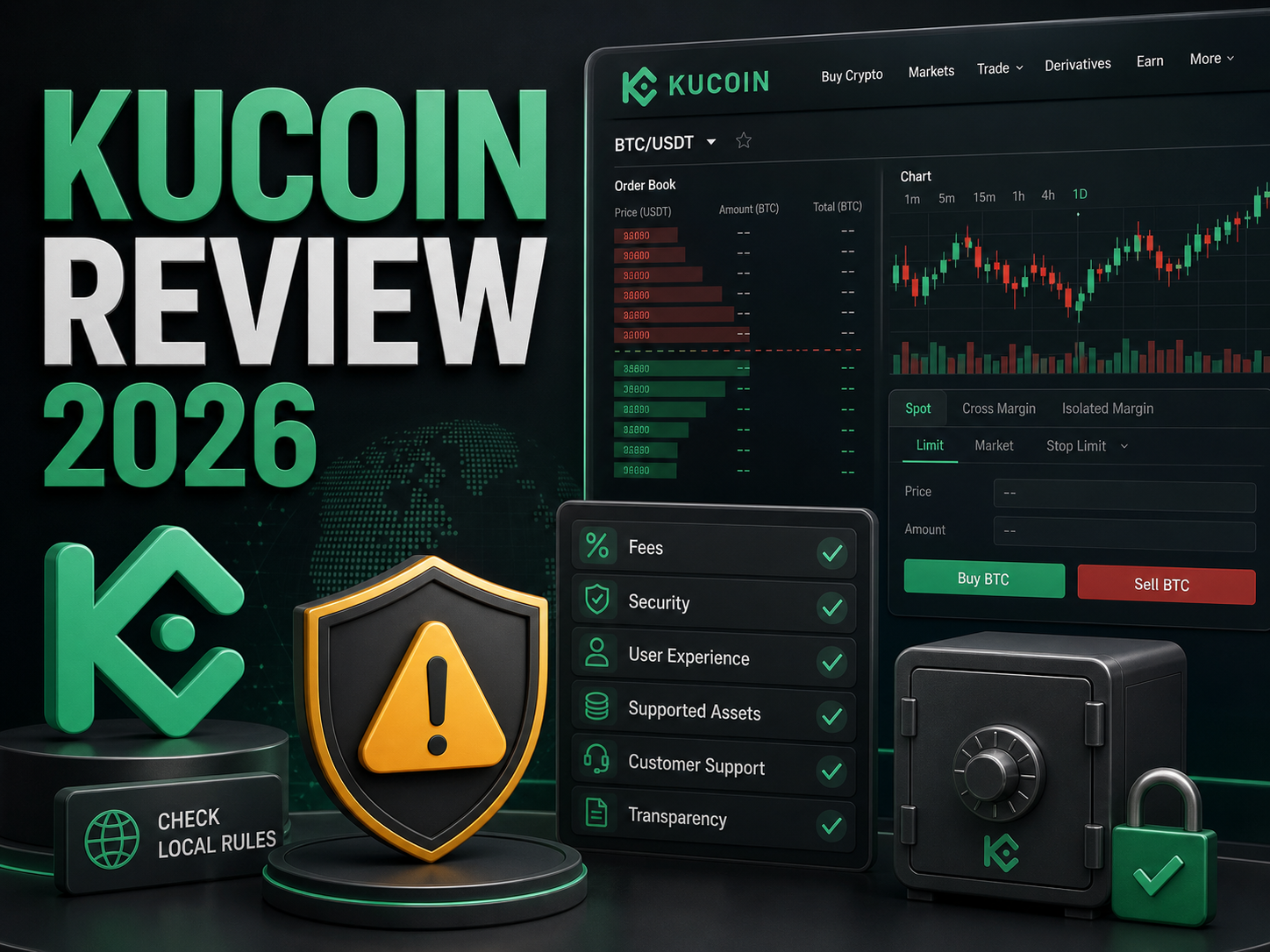
KuCoin Review: Quick Verdict
KuCoin has several genuine strengths: a large selection of cryptocurrencies, competitive Spot trading fees, advanced trading tools, built-in trading bots and access to smaller altcoins that may not be available on every major exchange.
But this KuCoin review also finds more reasons for caution than we would expect a beginner to ignore.
KuCoin has faced significant regulatory action in several jurisdictions. Its operator pleaded guilty in the United States in January 2025 to operating an unlicensed money-transmitting business and agreed to penalties of more than $297 million. KuCoin also agreed to leave the U.S. market for at least two years.
The exchange has previously been permanently barred from participating in Ontario’s capital markets, received an FCA warning in the United Kingdom, faced enforcement in the Netherlands, temporarily stopped serving French users, and experienced further regulatory intervention involving its European entity in 2026.
Educational disclaimer: This article is for educational and informational purposes only. It is not financial, investment, legal or tax advice. Crypto assets are volatile, centralized exchanges involve custody and counterparty risk, and availability varies by jurisdiction.
Customer-feedback signals also deserve attention. KuCoin’s Trustpilot rating is currently unavailable because of a breach of Trustpilot’s guidelines, with Trustpilot stating that fake reviews were removed. Of roughly 1,650 displayed reviews at the time of checking, about 75% were one-star reviews. Recurring complaints concern frozen withdrawals, prolonged verification requests and difficulty obtaining useful human support.
G2 presents a less severe but still mixed picture, with KuCoin at about 2.9/5 from a much smaller review sample. Users there praise coin selection and fees but also report problems with support, withdrawal processes and interface complexity.
These reviews are user-submitted and individual allegations cannot automatically be treated as proven facts. Review platforms also tend to attract dissatisfied customers. But when the same themes appear repeatedly across different communities, they are worth considering alongside the exchange’s formal regulatory record.
| Area | Assessment |
|---|---|
| Spot trading fees | Competitive |
| Altcoin selection | Major strength |
| Beginner usability | Moderate; interface can be complex |
| Advanced trading tools | Extensive |
| KYC | Mandatory for new users |
| Security | Improved controls, but material 2020 hack history |
| Proof of Reserves | Published regularly |
| Customer-service reputation | Significant concern |
| Withdrawal complaints | Recurring in user reviews |
| Regulatory history | Material concern |
| India status | FIU-IND registered |
| United States | Not available |
| Best suited for | Experienced altcoin/active traders who understand the risks |
| Beginner verdict | Not our strongest first-choice profile |
The conclusion of this KuCoin review is therefore mixed: KuCoin offers real trading advantages, especially for altcoin access, but its regulatory history and recurring customer-service complaints make due diligence particularly important.
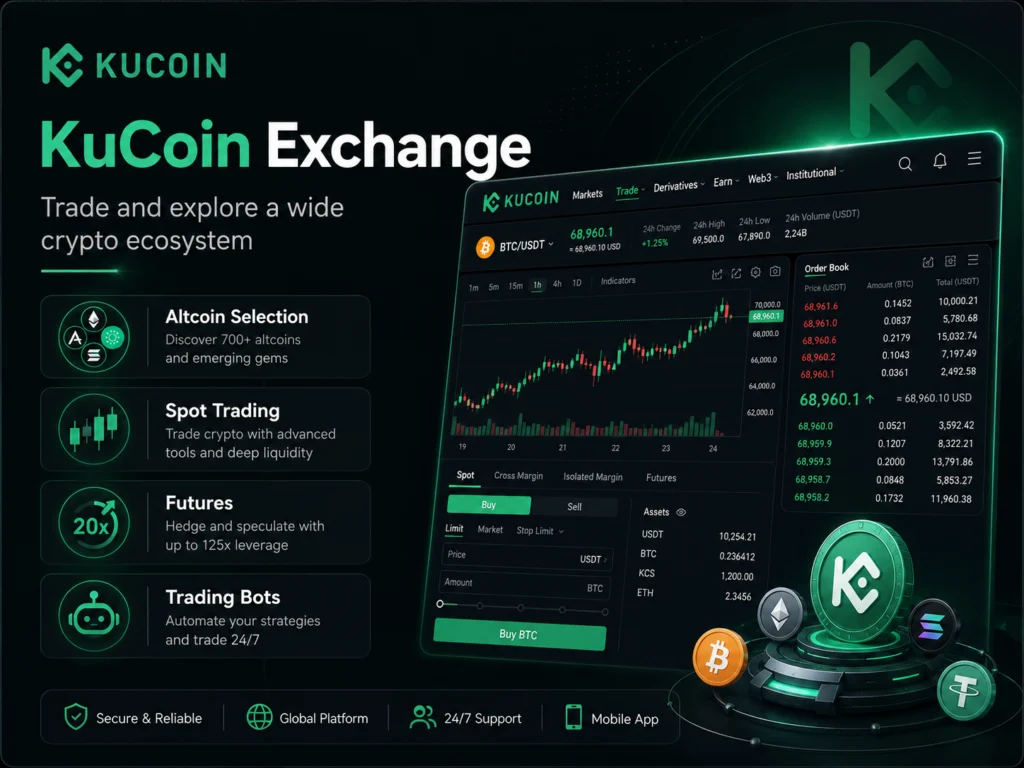
KuCoin Exchange
Explore a broad range of crypto markets and trading tools
Spot Trading • Altcoins • Futures • Trading Bots
What Is KuCoin?
KuCoin is a centralized cryptocurrency exchange launched in 2017.
The exchange provides Spot trading, futures, margin, P2P services, Earn products, automated trading bots and access to a large range of digital assets.
KuCoin currently describes its platform as supporting more than 1,000 crypto assets. That breadth is one reason the exchange became popular with traders looking for smaller or newly listed altcoins.
That does not mean more listed tokens automatically make an exchange better.
Smaller crypto assets can have:
- lower liquidity;
- wider spreads;
- higher volatility;
- greater delisting risk;
- weaker project fundamentals; and
- greater susceptibility to manipulation or failure.
If the mechanics of digital assets are still unfamiliar, understanding what cryptocurrency is provides a more useful starting point than choosing an exchange based only on the number of available tokens.
Is KuCoin Good for Beginners?
KuCoin can be used by beginners, but this KuCoin review does not consider simplicity one of its strongest advantages.
The platform contains numerous products and promotional elements alongside its basic Spot interface.
A new user may encounter:
- Spot trading;
- margin;
- futures;
- leveraged products;
- trading bots;
- P2P;
- Earn;
- KCS-related features;
- promotions; and
- newly listed tokens.
For experienced traders, having these functions under one account can be useful.
For a beginner, it can make the platform considerably easier to misuse.
The safest learning path is not to explore every feature simply because it appears in the application. Understanding the distinction between spot trading and crypto futures is particularly important before using any leveraged product.
Spot trading generally involves buying or selling the underlying crypto asset through the exchange account. Futures provide derivative exposure and can introduce leverage, funding payments and liquidation risk.
A beginner does not need KuCoin Futures in order to use KuCoin.
KuCoin Review: Trading Fees
KuCoin’s standard fees are competitive, but its fee structure is more complicated than a single 0.10% number suggests.
For a standard VIP 0 account, KuCoin currently lists the following base rates:
| Market | Maker | Taker |
| Spot Class A | 0.10% | 0.10% |
| Spot Class B | 0.20% | 0.20% |
| Spot Class C | 0.30% | 0.30% |
| Futures | 0.02% | 0.06% |
The exact classification depends on the trading pair, while higher VIP levels can receive lower rates. KuCoin also provides eligible KCS-based Spot fee discounts. Its current VIP fee structure should therefore be checked for the specific pair before trading.
A simple fee example
At a 0.10% fee, a hypothetical $1,000 Spot trade would generate approximately:
$1,000 × 0.10% = $1
But that is not necessarily the full transaction cost.
Actual trading costs can also include:
- bid-ask spreads;
- slippage;
- withdrawal fees;
- blockchain network charges;
- fiat payment-provider charges;
- margin interest; and
- futures funding.
This KuCoin review therefore considers the base Class A Spot fee competitive, while recommending that users check the exact pair rather than assuming every token trades at 0.10%.
Market Orders, Limit Orders and Trading Costs
KuCoin states that a market order normally incurs a taker fee because it executes against existing liquidity, while a qualifying limit order can add liquidity as a maker.
Understanding market orders and limit orders is therefore useful before judging trading cost purely by the published fee percentage.
An illiquid altcoin may have a low nominal trading fee but a wide spread and significant slippage.
That is especially relevant on an exchange known for listing many smaller assets.
KuCoin’s Dormancy Fee Deserves Attention
One unusual policy should be highlighted in any current KuCoin review.
KuCoin applies a dormancy fee to certain inactive non-KYC/non-KYB accounts that have received a direct notification.
In its May 2026 updated policy, KuCoin states that affected balances worth less than 2 USDT can be charged in full. For larger balances, the formula can include a 2-USDT component plus 1% of the relevant token amount, with assessment performed monthly. Verified KYC/KYB accounts are exempt.
This matters particularly to legacy users in restricted jurisdictions who may no longer be able to complete KYC.
KuCoin itself advises affected users in restricted countries to withdraw assets and close their accounts.
The dormancy policy has also appeared in negative customer reviews during 2026. The existence of the fee is not merely a reviewer allegation—the policy is published by KuCoin itself.
Does KuCoin Require KYC?
Yes. New KuCoin users must complete identity verification to use the platform’s products and services.
KuCoin states that since 31 August 2023, new users must submit identification documents and complete facial verification.
Older accounts that did not complete standard verification are restricted mainly to functions such as selling assets, closing futures or margin positions and redeeming certain products.
KuCoin’s current identity-verification requirements explain the process directly.
Users should never send identification documents, authentication codes or account credentials to somebody claiming to represent KuCoin through Telegram, WhatsApp or another private communication channel.
KuCoin Review: Is KuCoin Safe?
KuCoin has strengthened its security framework and currently publishes Proof of Reserves, but its history includes a major security incident.
The 2020 KuCoin hack
On 26 September 2020, attackers gained access to KuCoin hot-wallet private keys.
KuCoin later said approximately $285 million in crypto assets were affected.
According to KuCoin’s post-incident account, approximately $222 million was recovered through cooperation with exchanges and projects, another $17.45 million through law-enforcement/security efforts, and the remaining approximately $45.55 million was covered by KuCoin and its insurance fund. KuCoin said users ultimately suffered no loss from the incident.
The exchange subsequently redesigned parts of its wallet and security infrastructure.
A historical hack does not automatically prove that an exchange is unsafe today, but a serious KuCoin review should not omit it.
KuCoin Proof of Reserves in 2026
KuCoin continues to publish periodic Proof-of-Reserves information.
Its 31 July 2026 snapshot reported approximately:
- BTC reserve ratio: 112%
- ETH reserve ratio: 121%
- USDT reserve ratio: 116%
- USDC reserve ratio: 122%
KuCoin also provides Merkle-tree verification intended to allow users to verify inclusion of their account assets. The current KuCoin Proof of Reserves page publishes the latest ratios.
This is a positive transparency measure.
However, Proof of Reserves should not be interpreted as an absolute guarantee of solvency, future withdrawals or operational security. A reserve snapshot primarily provides evidence relating to the assets included in that particular verification process.
Centralized-exchange custody therefore remains a separate risk.
Understanding crypto wallet safety and self-custody is useful before deciding how much crypto genuinely needs to remain on an exchange.
KuCoin’s Regulatory and Ban History
Regulatory history is one of the most important findings in this KuCoin review.
KuCoin has not merely faced occasional criticism. It has been subject to formal enforcement or restrictions in multiple major jurisdictions.
United States: guilty plea and market exit
KuCoin is not currently available to U.S. users.
In January 2025, Peken Global Limited—the entity operating KuCoin—pleaded guilty in the United States to operating an unlicensed money-transmitting business.
The U.S. Department of Justice said KuCoin failed for years to maintain adequate anti-money-laundering and Know Your Customer controls, failed to register with FinCEN and failed to file required suspicious-activity reports.
KuCoin agreed to pay more than $297 million in forfeiture and fines and to exit the U.S. market for at least two years.
KuCoin separately informed U.S. users that accounts would be closed from 23 January 2025 and that U.S. IP access would be restricted.
Its current terms continue to list the United States as a restricted location.
This is not simply a historical warning. U.S. residents should not attempt to bypass the restriction using VPNs or inaccurate residency information.
Canada: permanent Ontario market ban
KuCoin also faced enforcement in Ontario, Canada.
In 2022, Ontario’s Capital Markets Tribunal found that KuCoin entities operated an unregistered crypto trading platform offering crypto contracts and futures without complying with Ontario securities-law requirements.
The Tribunal imposed monetary sanctions and a permanent market-participation ban.
KuCoin’s current terms list Ontario and British Columbia among restricted locations.
United Kingdom: FCA warning
The UK’s Financial Conduct Authority issued a warning against KuCoin in October 2023.
The FCA stated that KuCoin was not authorised by it and may have been promoting financial services or products without permission.
The regulator also warned that consumers dealing with the firm would not have access to normal Financial Ombudsman Service or Financial Services Compensation Scheme protections if something went wrong.
The FCA subsequently reported working with technology companies to remove illegal crypto promotions and apps linked to non-compliant promotions.
This should not be inaccurately described as a blanket criminal ban on KuCoin throughout the UK. It is nevertheless a significant regulatory warning that UK users should understand.
Netherlands: unregistered operation
The Dutch central bank, De Nederlandsche Bank, took enforcement action against Peken Global Limited for providing crypto services in the Netherlands without the legally required registration.
DNB stated plainly that offering those services without registration was against Dutch law.
KuCoin’s current global terms list the Netherlands as a restricted location.
France and the European Union: a complicated transition
KuCoin terminated its legacy services for French residents during 2025, including Spot, derivatives, P2P, bots and Earn.
A separate European entity, KuCoin EU Exchange GmbH, later received MiCA authorization in Austria in November 2025 and appears on the French AMF’s authorised provider list.
However, the Austrian FMA prohibited new business in February 2026 after key AML and sanctions-compliance roles were no longer appropriately filled. The new-business prohibition was lifted in May, but the FMA said commencement of operations remained prohibited because other supervisory and governance requirements were still outstanding.
KuCoin’s own 30 June 2026 EU update likewise said services had not yet resumed at that point, despite the MiCA licence remaining valid.
European users therefore need to check the current KuCoin EU service status rather than assuming that a licence automatically means every service is presently operational.
Is KuCoin Legal in India?
Yes. As of August 2026, KuCoin is permitted to provide supported crypto/VDA services to Indian users under India’s current AML framework, and KuCoin is registered with FIU-IND.
But that was not always its compliance position.
India’s Financial Intelligence Unit issued KuCoin a notice in December 2023 because it had continued serving Indian clients without complying with its obligations under the Prevention of Money Laundering Act.
On 22 March 2024, FIU-IND imposed a ₹34.5 lakh penalty after finding the violations substantiated.
KuCoin then completed FIU-IND registration and has since maintained an India-specific support section.
Is KuCoin banned in India?
No. KuCoin is not currently banned in India.
Indian users can use supported KuCoin services, subject to KYC, AML, tax and product-specific requirements.
FIU registration should not be misunderstood as a government guarantee that KuCoin is risk-free or that every KuCoin product is approved for every user. FIU-IND registration relates primarily to the exchange’s reporting and anti-money-laundering obligations.
Crypto assets are also not legal tender in India. Being permitted to own or trade a crypto asset is different from that asset being official Indian currency.
For this KuCoin review, India therefore represents one of the jurisdictions where KuCoin has moved from prior non-compliance into a registered AML reporting framework.
KuCoin Review: What Do Users Actually Say?
This is an area where KuCoin performs poorly enough that it should not be buried near the bottom of the article.
Trustpilot
At the time this KuCoin review was fact-checked, Trustpilot showed KuCoin’s overall rating as unavailable because of a breach of Trustpilot’s guidelines.
Trustpilot also states:
“We’ve removed a number of fake reviews for this company.”
Among the approximately 1,650 reviews displayed, the visible distribution was roughly:
- 75% one-star
- 4% two-star
- 11% three-star
- 3% four-star
- 7% five-star
Recent complaints repeatedly mention:
- frozen or delayed withdrawals;
- repeated identity-verification requests;
- unclear timelines;
- generic customer-support responses;
- difficulty resolving P2P disputes;
- account-access problems; and
- dormancy fees.
These are allegations made by individual reviewers. They are not independently verified simply because they appear on Trustpilot.
However, the combination of a heavily negative review distribution and a Trustpilot guideline warning is a meaningful reputation signal.
G2
KuCoin’s reputation on G2 is more balanced but still not strong.
At the time of review, KuCoin had a rating of approximately 2.9 out of 5 from around 34–35 reviews.
G2’s review summary identifies advantages such as:
- wide cryptocurrency selection;
- comparatively low fees;
- trading tools; and
- automation features.
Reported negatives include:
- slow customer support;
- withdrawal issues;
- interface complexity;
- security concerns; and
- lack of transparency in some account disputes.
The sample is small, and some G2 reviews are marked as incentivized, so the score should not be treated as a scientific measure of all KuCoin customers.
It does, however, reinforce the same customer-support concern visible elsewhere.
Reddit and community complaints
Recent Reddit posts also contain recurring allegations of withdrawals being frozen for extended periods and support repeatedly returning generic responses.
One March 2026 user alleged that withdrawals had been disabled for seven months despite previous compliance checks. Another May 2026 user reported a fiat withdrawal remaining in “processing” while support advised waiting without giving a clear reason.
Other threads include similar complaints, although not every commenter reports a negative experience. In one February 2026 discussion, another user explicitly said they had personally experienced no problem.
That balance is important.
Social-media complaints cannot prove that every account restriction was unjustified. Exchanges may legally freeze or review transactions because of sanctions, fraud investigations, source-of-funds checks or other compliance requirements.
The concern is not simply that checks occur.
It is the repeated user claim that communication and resolution can be slow or unclear when those checks occur.
Why Withdrawal Complaints Matter More Than Interface Complaints
A confusing interface is inconvenient.
Difficulty accessing funds is materially more serious.
KuCoin’s own terms allow it to restrict or suspend accounts under circumstances including suspected illegal activity, fraud, government orders, investigations and unusual activity.
Such controls are normal parts of AML and fraud prevention.
The question for users is how quickly legitimate cases are reviewed and how effectively the exchange communicates when additional evidence is required.
For that reason, this KuCoin review treats recurring support and withdrawal complaints as a more important downside than cosmetic issues with the application.
If using any centralized exchange, consider making a small test withdrawal before depositing an amount you would find difficult to have temporarily locked during a compliance review.
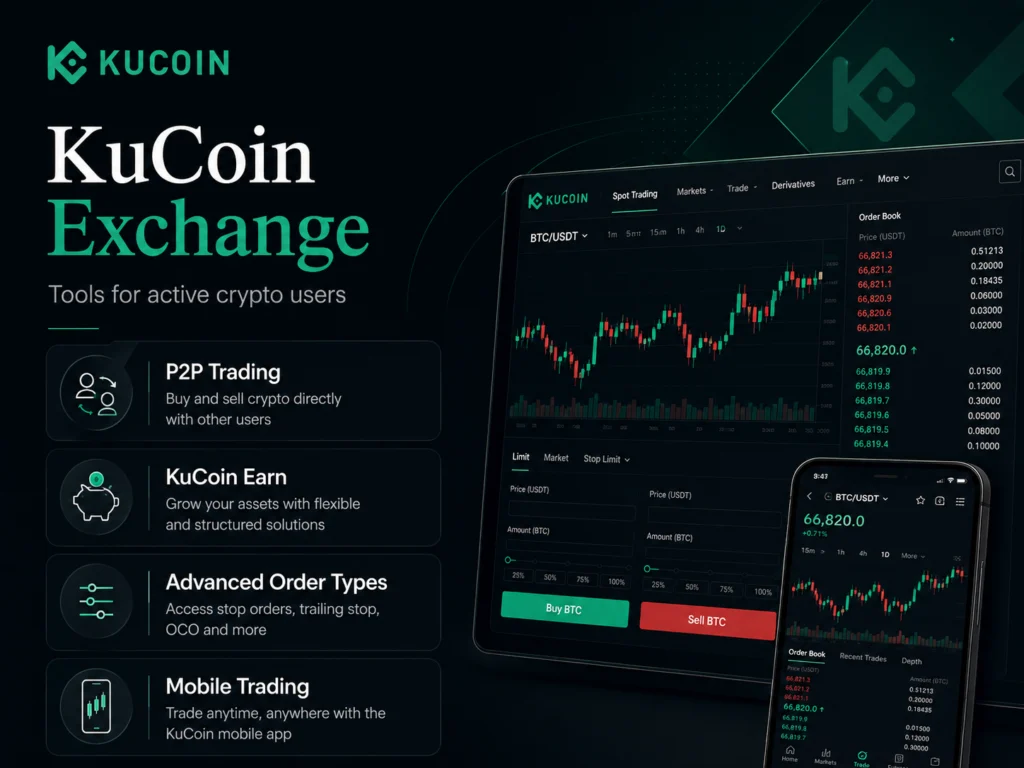
KuCoin Trading Tools
More ways to manage, trade and access crypto
P2P Trading • KuCoin Earn • Advanced Orders • Mobile Trading
KuCoin Spot Trading
KuCoin’s Spot exchange remains one of its stronger products.
It provides:
- large asset selection;
- multiple trading pairs;
- charting;
- order books;
- market and limit orders;
- advanced order controls; and
- relatively competitive fees.
For users specifically searching for smaller altcoins, KuCoin can offer markets that are unavailable on more conservative exchanges.
But less-established tokens can also be considerably riskier.
Before increasing exposure simply because a token is available, apply normal risk management principles and consider whether the asset has sufficient liquidity to enter and exit realistically.
Exchange listing should never be interpreted as a guarantee that a token is legitimate, liquid or likely to increase in value.
KuCoin Futures and Leverage
KuCoin offers futures to eligible users in supported jurisdictions.
Its standard VIP 0 Futures rates currently begin around 0.02% maker and 0.06% taker, although the exact rate should always be checked before placing an order.
Low fees do not reduce leverage risk.
Leveraged futures can expose the trader to:
- liquidation;
- funding payments;
- larger-than-expected position exposure;
- rapid losses;
- margin interactions; and
- forced exits during volatile markets.
A trader should determine exposure through position sizing rather than using the maximum leverage made available by the exchange.
For beginners, KuCoin’s derivatives functionality is not a reason to choose the platform.
It is an advanced product that should be considered separately from the basic Spot exchange.
KuCoin Trading Bots
KuCoin includes built-in trading bots such as Spot Grid and other automated strategies.
The platform says the bots operate in the cloud and do not require the application to remain open. Spot-bot strategies receive their own fee treatment, while Futures Grid has separate charges.
Bots can automate predefined rules.
They do not make a strategy profitable.
A grid bot can lose money when market conditions change, a leveraged futures bot can be liquidated, and automation can allow a bad rule to continue operating faster than a human trader would.
The existence of built-in bots is therefore a useful technical feature, not evidence of predictable returns.
KuCoin Pros and Cons
Pros
- Very broad altcoin selection.
- Competitive Class A Spot fees.
- Strong Spot and derivatives trading tools.
- Built-in trading bots.
- P2P and additional crypto services.
- Mandatory KYC for new users.
- Regular Proof-of-Reserves publication.
- Current reserve ratios above 100% for major reported assets.
- Indian FIU-IND registration.
- 2020 hack losses were ultimately covered according to KuCoin.
Cons
- Serious regulatory history across multiple jurisdictions.
- Guilty plea and approximately $297 million U.S. resolution.
- No current U.S. service.
- Permanent Ontario market-participation ban.
- FCA warning in the United Kingdom.
- Dutch enforcement for operating without required registration.
- European regulatory interruptions during 2025–26.
- Material 2020 security breach.
- Trustpilot rating currently unavailable following a guideline breach.
- About three-quarters of displayed Trustpilot reviews are one-star.
- G2 rating only around 2.9/5.
- Recurring user complaints about withdrawal freezes and support.
- Dormancy fees can apply to some inactive unverified accounts.
- Advanced interface can overwhelm beginners.
- Large altcoin catalogue also exposes users to many higher-risk assets.
KuCoin Review: Who Might Still Find It Useful?
Despite the concerns above, KuCoin is not without a clear use case.
The exchange may appeal to an experienced trader who:
- lives in a supported jurisdiction;
- has completed KYC;
- specifically needs access to smaller altcoins;
- understands centralized-exchange custody;
- is comfortable with advanced order interfaces;
- understands withdrawal and compliance procedures; and
- accepts the platform’s regulatory and security history.
Those are different requirements from someone opening their first crypto account.
This KuCoin review therefore sees more value for experienced, altcoin-focused users than for someone who wants the simplest and most regulatorily straightforward entry into crypto.
Who Should Be Particularly Cautious?
KuCoin may be a poor fit if:
- you live in a restricted jurisdiction;
- reliable human customer support is a top priority;
- you are uncomfortable with its enforcement history;
- you do not want centralized custody;
- you need a very simple beginner interface;
- you are likely to trade unknown altcoins simply because they are listed;
- you intend to use high leverage before understanding liquidation; or
- you would struggle financially if a compliance review temporarily restricted withdrawals.
A platform can have competitive fees and useful tools while still being the wrong platform for a particular user.
What to Check Before Depositing Money on KuCoin
Verify your country first
KuCoin’s current terms list several restricted locations, including the United States, Singapore, mainland China and Hong Kong, Malaysia, Kazakhstan, Ontario and British Columbia, France and the Netherlands. The list can change.
Never use inaccurate residency information or a VPN to circumvent exchange restrictions.
Complete KYC before depositing significant funds
Do not wait until a withdrawal is needed to discover that additional verification is required.
Make a small withdrawal test
Test both the blockchain network and the withdrawal process before keeping a larger balance on the platform.
Check the exact token network
A correct wallet address on the wrong blockchain network can still cause asset loss.
Understand custody
Crypto stored on KuCoin remains dependent on KuCoin’s custody and withdrawal infrastructure.
Save records
Keep transaction IDs, deposit records, source-of-funds documentation and customer-support ticket numbers.
These records can become important if an account enters additional compliance review.
KuCoin Review: Final Verdict
KuCoin remains technically capable.
Its large altcoin catalogue, competitive Spot fees, futures platform, trading bots and broad range of tools explain why it continues to attract active crypto traders.
But features are only one part of an exchange review.
KuCoin has accumulated an unusually significant regulatory history: a U.S. guilty plea and market exit, a permanent Ontario market ban, a UK regulatory warning, Dutch enforcement and European service interruptions. India is one area where its compliance position materially improved after KuCoin registered with FIU-IND following an earlier ₹34.5 lakh penalty.
Its public customer-service reputation is also difficult to dismiss. Trustpilot’s rating is currently unavailable after a guideline breach, around 75% of displayed reviews are one-star, and G2 gives the platform approximately 2.9/5. Recent complaints repeatedly mention withdrawal restrictions and slow or unclear support.
Those complaints do not prove that KuCoin improperly froze every account mentioned. Financial platforms sometimes have legitimate legal reasons to pause withdrawals or request enhanced due diligence.
But users do not evaluate an exchange only by what happens when trading works normally.
They also need to consider what happens when something goes wrong.
For that reason, the final conclusion of this KuCoin review is cautious.
KuCoin can still be useful for experienced users who specifically value its altcoin selection and advanced trading tools, but its regulatory history and customer-support reputation make it harder to recommend as a default first exchange for beginners.
Anyone who chooses to use KuCoin should verify regional eligibility, complete KYC before depositing significant assets, enable all available security controls, make a small test withdrawal, keep clear transaction records and avoid keeping more funds on a centralized exchange than are genuinely needed for the intended activity.
Low fees and a large coin catalogue are valuable.
Reliable access, regulatory clarity and effective support when an account has a problem matter just as much.
Written By: Trading Turtle Editorial Team
– Frequently Asked Questions (FAQs)
KuCoin is a real, large centralized cryptocurrency exchange operating in many countries, but its regulatory record is complicated. Its operator pleaded guilty in the United States to operating an unlicensed money-transmitting business and paid more than $297 million in penalties and forfeiture. The exchange is registered with FIU-IND in India and has obtained regulatory approvals through separate entities in some other markets. Whether KuCoin can legally serve you depends on your jurisdiction.
KuCoin provides KYC, account-security controls and Proof of Reserves, but it suffered a major approximately $285 million security breach in 2020. KuCoin says affected users ultimately suffered no loss after recovered funds and insurance coverage. Centralized-exchange risk still remains.
Yes. KuCoin is currently FIU-IND registered and can offer supported VDA services to Indian users under India’s AML framework. FIU-IND previously fined KuCoin ₹34.5 lakh for earlier PMLA non-compliance before the exchange completed registration.
No. KuCoin is not currently banned in India. It is registered with FIU-IND, although Indian KYC, AML, tax and product-level rules still apply.
No. KuCoin exited the U.S. market following its January 2025 criminal resolution and agreed to remain out for at least two years. U.S. accounts were closed and U.S. IP access restricted.
KuCoin received a permanent market-participation ban in Ontario in 2022. Its current terms list Ontario and British Columbia as restricted locations. Users elsewhere in Canada should verify current availability and local requirements before using the platform.
Recent negative reviews commonly cite withdrawal restrictions, extended verification, support delays, P2P disputes and account-access problems. Trustpilot currently shows KuCoin’s rating as unavailable because of a guideline breach and says fake reviews were removed; roughly 75% of displayed reviews are one-star. These are user reports rather than independently established facts about every case.