How Does the Share Market Work? A Beginner’s Guide to Buying and Selling Shares in India

If you are new to investing, one of the first questions you may ask is: how does the share market work?
A trading app can make buying or selling a stock look almost instant. You select a company, enter the number of shares, press Buy or Sell, and a confirmation may appear within seconds.
But several systems operate behind that one action.
Understanding how the share market works in practice means understanding how companies issue shares, how investors access exchanges, how buy and sell orders meet, and what happens after a trade is executed.
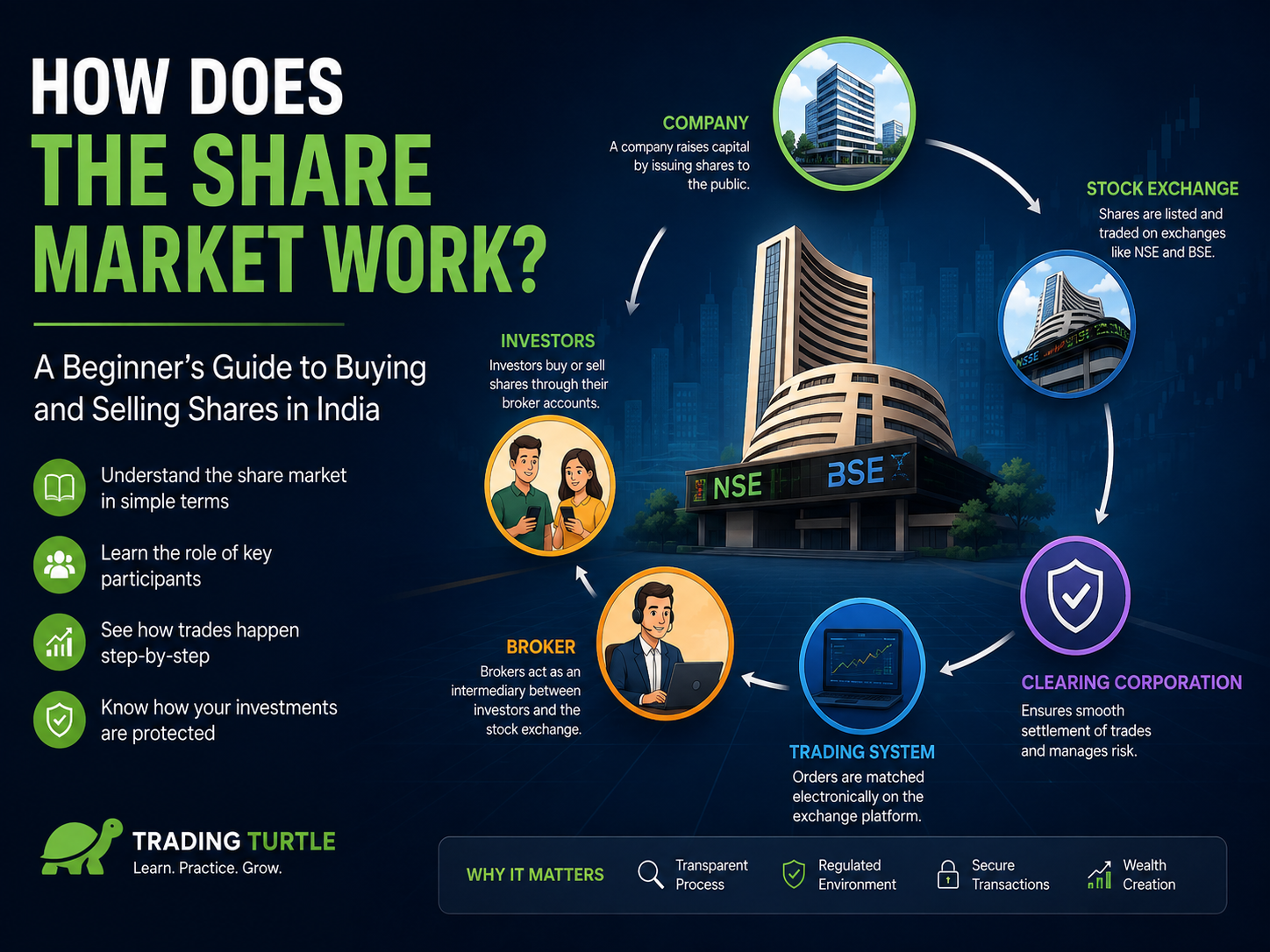
In India, this process involves companies, investors, stock brokers, exchanges, clearing corporations, depositories and the securities-market regulator.
Educational disclaimer: This article is for educational purposes only and does not provide investment advice, stock recommendations, trading signals or personalised financial guidance. Investing and trading in securities involve risk, including the possibility of losing capital.
At its simplest, the process looks like this:
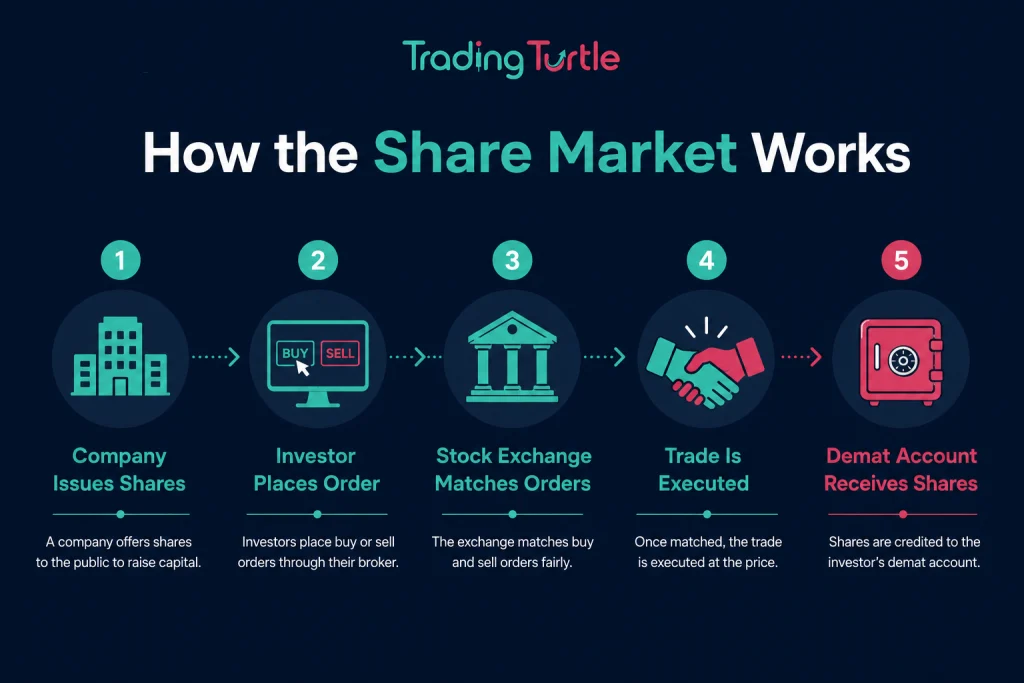
Company issues shares → investor uses a broker → order reaches a stock exchange → buyer and seller are matched → trade is executed → clearing and settlement complete the transaction → securities are held electronically.
The terms share market and stock market are commonly used interchangeably in India. This guide explains how the share market works in India, step by step, without assuming that you already understand market terminology.
Quick Takeaways
- A share represents partial ownership in a company.
- Companies can issue shares to raise capital.
- Once shares are listed, investors can buy and sell them through recognised stock exchanges.
- Retail investors generally access the market through registered stock brokers.
- A trading account is used to place orders, while a Demat account is used to hold securities electronically.
- Stock exchanges match compatible buy and sell orders.
- Clearing and settlement complete the post-trade process.
- Share prices change because buyers and sellers continuously compete at different prices.
- Understanding how the share market works is a foundation for learning order types, liquidity, risk management and stock analysis.
What Is the Share Market?
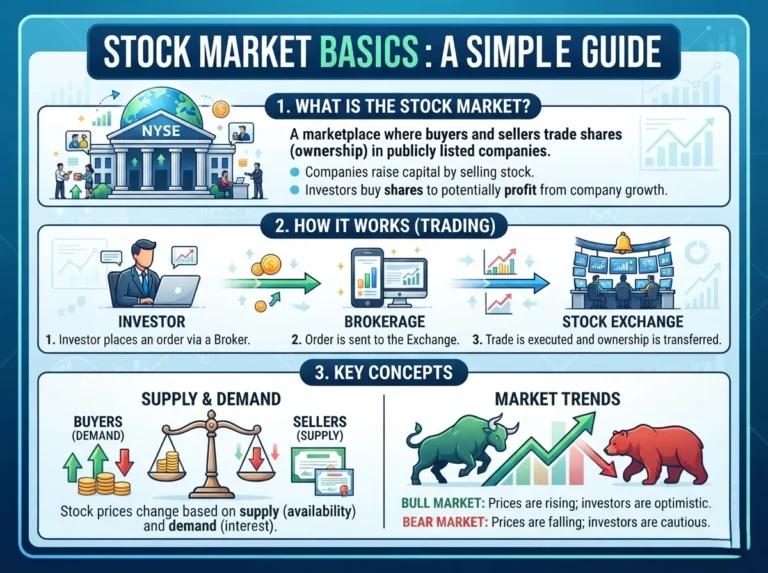
The share market is the organised system through which shares of publicly listed companies can be bought and sold.
A share represents a small ownership interest in a company.
If a company has divided its ownership into many equity shares and you own some of those shares, you have an economic interest in that business.
The share market connects several groups:
- companies that issue securities,
- investors who provide capital,
- traders who buy and sell securities,
- brokers that provide market access,
- stock exchanges that facilitate trading,
- clearing corporations that manage post-trade obligations,
- depositories that support electronic holdings,
- and regulators that oversee the securities market.
To understand how the share market works, it is useful to first separate the primary market from the secondary market.
Why Do Companies Issue Shares?
Companies need money to operate, expand and invest.
A business may need capital to:
- build new facilities,
- develop products,
- expand into new markets,
- acquire another business,
- repay debt,
- improve technology,
- or fund long-term growth.
One way to raise money is borrowing.
Another is issuing equity shares.
When investors purchase newly issued equity, the company can raise capital while investors receive an ownership interest.
This is one of the starting points in understanding how the share market works.
However, companies do not receive money every time their already-listed shares change hands.
That is where the distinction between primary and secondary markets becomes important.
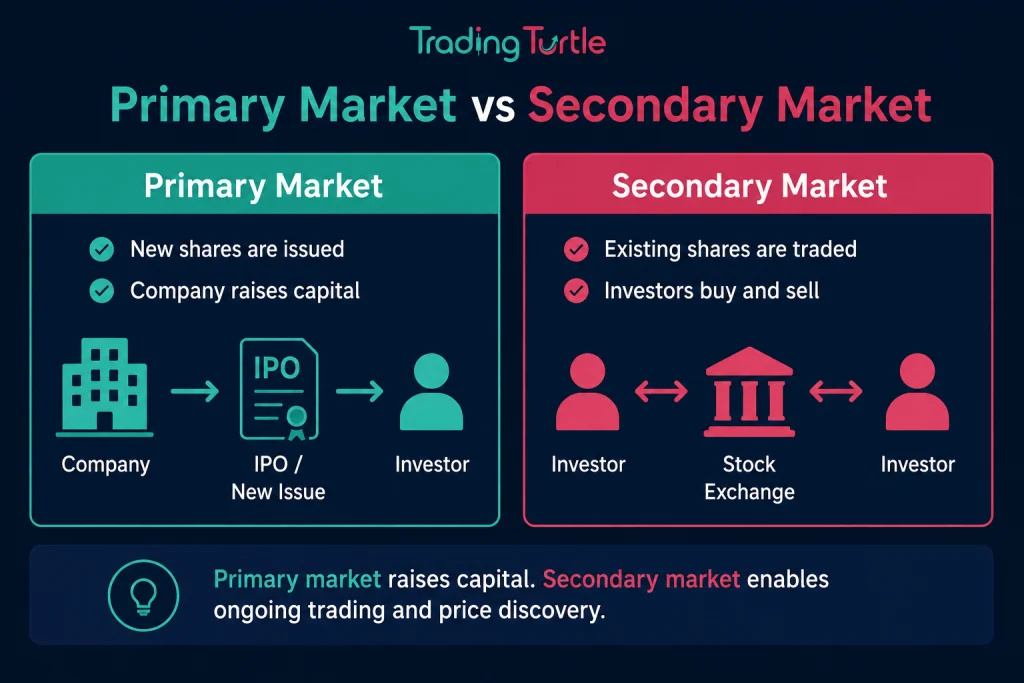
Primary Market vs Secondary Market
What Is the Primary Market?
The primary market is where new securities are issued.
An Initial Public Offering (IPO) is a familiar example.
In a simplified IPO process:
Company → issues shares → investors subscribe → company raises capital
The securities are being offered as part of an issuance rather than simply transferred between existing investors.
What Is the Secondary Market?
After shares are listed and available for normal trading, they can be bought and sold between market participants.
This is the secondary market.
The simplified flow becomes:
Investor A ↔ Stock Exchange ↔ Investor B
This distinction is essential when learning how the share market works, because the company does not normally receive the purchase money every time one investor buys its already-listed shares from another investor.
Most everyday trading activity that beginners see on stock-market apps happens in the secondary market.
How Does the Share Market Work in India? Step by Step
The easiest way to understand how the share market works is to follow the journey of a typical share transaction.
Step 1: A Company Lists Its Shares
Before shares can normally trade on an exchange, the securities need to meet the applicable listing and regulatory requirements.
Once listed, eligible shares can trade through recognised stock exchanges.
Two major stock exchanges in India are:
- National Stock Exchange of India (NSE)
- BSE Ltd.
These exchanges provide the electronic infrastructure through which buy and sell orders interact.
The exchange itself is not simply a shop holding stocks for sale.
It provides an organised marketplace where market participants can submit orders and trades can occur.
Step 2: The Investor Uses a Stock Broker
Another important part of understanding how the share market works is recognising that retail investors generally do not connect directly to an exchange’s trading engine.
Instead, investors normally use a stock broker.
A broker acts as an intermediary that provides access to the securities market.
Through a broker’s trading platform, an investor can generally:
- view market prices,
- search for listed securities,
- place buy and sell orders,
- track transactions,
- review holdings,
- and access account information.
SEBI maintains an official database of registered stock brokers and other recognised intermediaries. As of August 2026, its equity-segment register contained thousands of broker records, so investors should verify the specific intermediary they intend to use rather than assuming registration from branding alone.
Trading Account vs Demat Account
Beginners commonly confuse these two accounts.
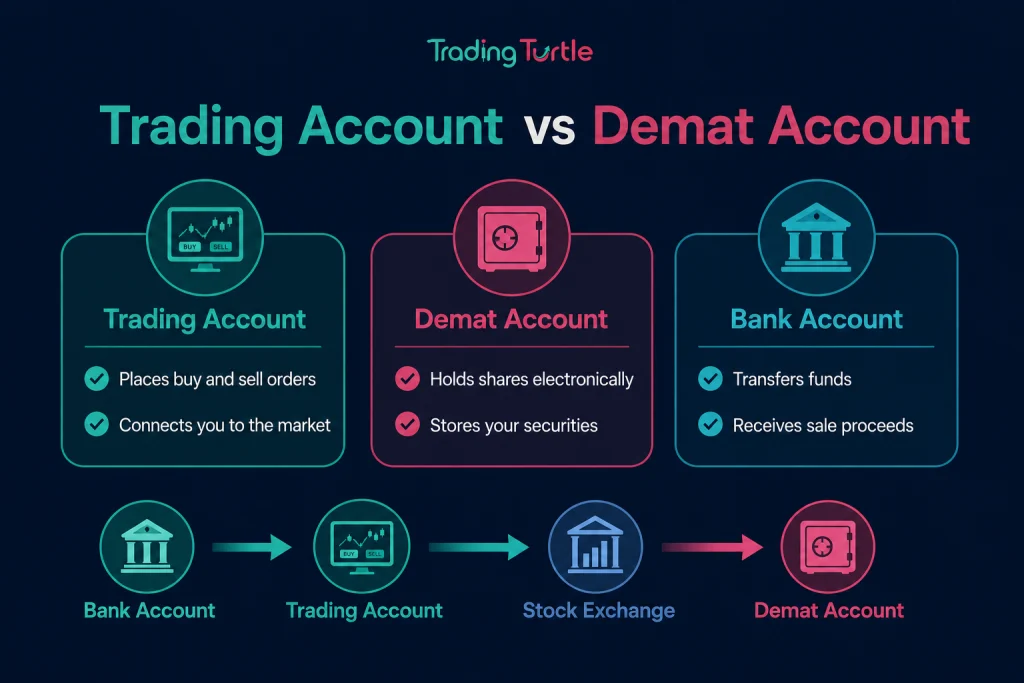
Trading Account
A trading account is used to place orders in the market.
You can think of it as the transaction interface between the investor and the market through the broker.
Demat Account
A Demat account is used to hold eligible securities electronically.
“Demat” refers to dematerialised securities, meaning the holdings are maintained electronically rather than through traditional physical certificates.
A useful way to remember the difference is:
| Account | Main Role |
|---|---|
| Trading account | Places buy and sell orders |
| Demat account | Holds securities electronically |
| Bank account | Handles money connected with transactions |
Understanding these roles makes the share market much easier to follow because trading and holding securities are related but separate functions.
Step 3: The Investor Places an Order
Suppose a hypothetical company called ABC Ltd. is trading around ₹500 per share.
An investor wants to buy 10 shares.
The investor opens the broker’s trading platform and enters an order.
At this stage, they usually need to choose:
- the company,
- buy or sell,
- number of shares,
- and the order type.
Two important order types are:
- market orders
- limit orders
The detailed mechanics belong in our separate guide to market orders vs limit orders, but the difference matters when learning how the share market works.
A market order generally prioritises execution at available prices.
A limit order specifies a price condition and may remain unexecuted if the market does not reach an acceptable price.
Step 4: The Order Reaches the Stock Exchange
Once the investor submits an order, the broker routes it into the appropriate market infrastructure.
The exchange receives buy and sell orders from participants.
A simplified order book might look like this:
| Buyers | Price | Sellers |
|---|---|---|
| 50 shares wanted | ₹499.90 | |
| 100 shares wanted | ₹499.80 | |
| ₹500.00 | 60 shares offered | |
| ₹500.10 | 150 shares offered |
The highest price currently offered by a buyer is known as the bid.
The lowest price at which a seller is currently willing to sell is the ask or offer.
In this example:
Best bid = ₹499.90
Best ask = ₹500.00
The difference is the bid-ask spread:
₹500.00 − ₹499.90 = ₹0.10
Our separate guide on the bid-ask spread explains this concept in more detail.
Step 5: Buyers and Sellers Are Matched
The order-matching process sits at the centre of how the share market works on a day-to-day basis.
The exchange receives orders from buyers and sellers and matches compatible instructions according to the applicable trading rules.
Suppose a seller is willing to sell shares at ₹500.
Another investor submits a compatible buy order.
The exchange’s electronic trading system can match those orders.
A trade is created.
There is not necessarily a person manually deciding which buyer trades with which seller.
Modern exchanges use electronic systems to process and match orders.
Step 6: The Trade Is Executed
Once compatible orders meet, the trade can be executed.
The broker’s platform may quickly show:
Executed
or
Completed
But execution is not the final stage of the entire transaction.
This distinction is another important part of understanding how the share market works.
A trade can be executed first and then proceed through clearing and settlement.
Step 7: Clearing Determines the Obligations
After a trade is executed, the market infrastructure must determine what each side owes.
For example:
The buyer
must provide the required funds and receive securities.
The seller
must provide the securities and receive the corresponding funds.
The clearing process determines these obligations.
Clearing corporations play an important role in managing the post-trade process and reducing settlement-related counterparty risk.
Step 8: Settlement Completes the Transaction
Settlement is where the obligations created by the trade are completed.
In practical terms, this involves the transfer of:
- securities to the buyer,
- and funds to the seller,
through the applicable market infrastructure.
NSE Clearing currently operates T+1 and T+0 rolling settlement cycles. Its official settlement-cycle documentation states that T+1 transactions settle on the following applicable working day, while T+0 provides same-day settlement for eligible transactions under the relevant framework.
The important beginner lesson is not to memorise every operational deadline.
It is to understand that:
trade execution and trade settlement are not the same event.
Example: How Does the Share Market Work When You Buy a Stock?
A simple hypothetical example makes the process easier to understand.
Suppose Priya wants to buy 10 shares of ABC Ltd.
The shares are trading around ₹500.
1. Priya already has the required accounts
She has:
- a bank account,
- trading access through her broker,
- and a Demat account.
2. Priya opens her broker’s platform
She finds ABC Ltd.
3. She places an order for 10 shares
Her broker routes the order toward the exchange.
4. The exchange receives the order
The trading system checks available sell orders.
5. A compatible seller is available
Priya’s order is matched according to the relevant conditions.
6. The trade executes
Her broker reports that the transaction has been executed.
7. Clearing and settlement follow
The necessary fund and securities obligations are processed.
8. The shares are reflected through the Demat system
After the applicable settlement process is completed, Priya’s securities are held electronically.
That is how the share market works from the perspective of a typical retail purchase.
Who Decides the Price of a Share?
A common beginner misconception is that the stock exchange simply decides what a company’s share price should be.
Normally, market prices emerge through interaction between buyers and sellers.
Suppose many investors want to buy ABC Ltd., but relatively few sellers are willing to sell at the current price.
Buyers may offer higher prices to attract sellers.
That can push the traded price higher.
The reverse can happen when sellers become more aggressive and buyer demand weakens.
Understanding this helps answer another part of how the share market works:
The exchange facilitates the market, but supply and demand among participants drive transactions at changing prices.
What Makes Buyers and Sellers Change Their Prices?
Investors constantly reassess companies and market conditions.
Their decisions may be influenced by:
- company revenue,
- profits,
- debt,
- management decisions,
- new products,
- industry conditions,
- economic growth,
- inflation,
- interest rates,
- government policies,
- global markets,
- valuations,
- investor sentiment,
- and unexpected news.
Two investors can interpret exactly the same information differently.
One may believe a stock is undervalued.
Another may believe the same stock is overpriced.
That disagreement is part of what creates a market.
What Is Price Discovery?
Price discovery is the process through which buyers and sellers interact and a market price emerges.
Suppose buyers are willing to pay:
₹499.50
₹499.70
₹499.90
while sellers are asking:
₹500.00
₹500.20
₹500.50
As trading continues, new information and new orders constantly change these prices.
This is another reason the share market cannot be explained only by saying “people buy stocks.”
The market continuously processes different expectations through prices and orders.
Importantly, the current market price does not guarantee that a company is fairly valued.
It simply reflects where transactions are currently taking place.
What Is Liquidity and Why Does It Matter?
Liquidity is another important concept when learning how the share market works, because a price shown on a trading screen does not necessarily mean any quantity can be bought or sold at exactly that price.
Liquidity describes how easily an asset can generally be traded without creating a large price impact.
A highly liquid stock may have:
- many active buyers,
- many active sellers,
- substantial trading activity,
- tighter bid-ask spreads,
- and greater market depth.
A less-liquid stock may have:
- fewer orders,
- wider spreads,
- lower market depth,
- and greater difficulty executing larger trades near the expected price.
Our separate guide to liquidity in trading explains this concept in more detail.
What Is Slippage?
Slippage occurs when the actual execution price differs from the price a trader expected.
Consider this simplified example.
A share is displayed near ₹500.
A trader submits a large market buy order.
But only a small number of shares are available around ₹500.
The next available sellers may be asking:
₹500.10
₹500.25
₹500.50
If the order consumes liquidity at several price levels, the trader’s average execution price may be higher than ₹500.
Understanding slippage is another practical reason beginners should learn how the share market works before actively trading.
The displayed price alone does not describe the entire market.
Who Makes the Share Market Work?
To fully understand how the share market works, beginners should know the roles of the major participants.
Retail Investors
Retail investors are individuals investing or trading their own money.
They may participate for:
- long-term investing,
- portfolio building,
- swing trading,
- short-term trading,
- or other financial goals.
Institutional Investors
Institutional participants can include:
- mutual funds,
- insurance companies,
- pension funds,
- asset managers,
- foreign portfolio investors,
- and other large organisations.
Their transactions may be considerably larger than typical retail orders.
Listed Companies
Listed companies are the businesses whose eligible securities trade on exchanges.
Their financial performance, disclosures and future expectations can affect investor demand for their shares.
Stock Brokers
Brokers provide investors with access to the market.
They connect customers to trading infrastructure and facilitate order placement.
Investors should verify the status of intermediaries using official regulatory resources. SEBI provides a searchable recognised-intermediary database.
Stock Exchanges
Stock exchanges provide the organised electronic marketplace where orders are submitted and trades can occur.
NSE and BSE are two major examples in India.
Clearing Corporations
Clearing corporations handle important post-trade functions, including calculating settlement obligations.
They are a critical part of the infrastructure behind the share market, even though retail investors rarely interact with them directly.
Depositories
Depositories support the electronic holding and transfer of securities.
For most beginners, the visible result is that securities appear in a Demat account rather than as paper certificates.
SEBI
The Securities and Exchange Board of India (SEBI) regulates India’s securities market.
Its official intermediary databases allow investors to verify stock brokers and other registered market participants.
What Are NSE and BSE?
Two names beginners encounter frequently are NSE and BSE.
NSE
The National Stock Exchange of India is a major Indian stock exchange.
One of its best-known benchmark indices is the NIFTY 50.
BSE
BSE Ltd. (Formerly Bombay Stock Exchange) is another major Indian stock exchange.
Its best-known benchmark index is the SENSEX.
NSE and BSE therefore form an important part of understanding how the share market works in India, but they are only parts of a larger system that includes brokers, clearing corporations, depositories and regulators.
Our article on NIFTY 50 vs SENSEX explains how the two benchmark indices differ.
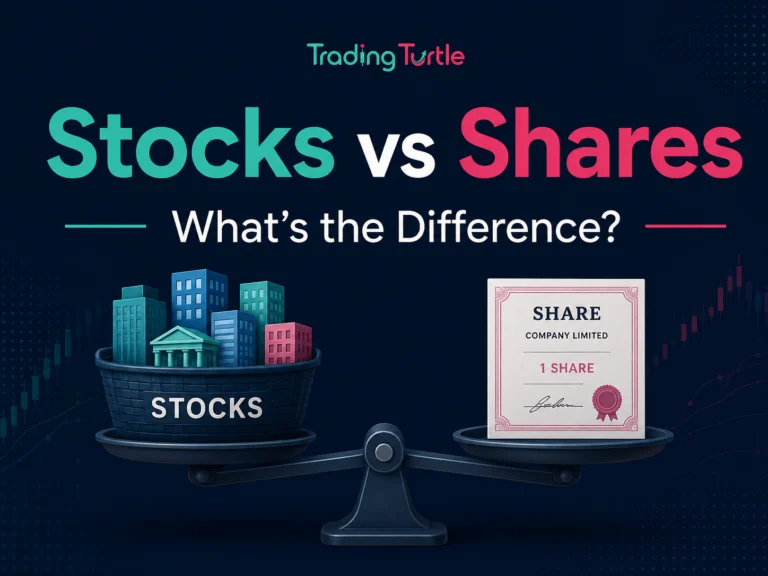
Is the Share Market the Same as the Stock Market?
For most beginner-level discussions in India, the terms share market and stock market are used to describe essentially the same broad system.
A person asking:
“how does the share market work?”
and someone asking:
“how does the stock market work?”
are usually looking for very similar information.
The word share refers specifically to units of ownership in a company, while “stock market” is widely used as the broader market term.
For beginners, the practical distinction is usually less important than understanding how the overall market operates.
How Does the Share Market Work for a Beginner Buying Their First Shares?
From the investor’s side, understanding how the share market works can be reduced to a practical sequence.
A beginner generally needs to:
- Understand what shares represent.
- Choose an appropriately registered intermediary.
- Complete the required account-opening and verification process.
- Have the necessary trading, Demat and banking arrangements.
- Research the security being considered.
- Choose the order type.
- Decide the quantity.
- Place the order.
- Check whether the order executes.
- Understand the settlement process.
- Monitor the position and associated risk.
This is a description of how market participation works, not a recommendation to buy any security.
What Costs Are Involved in Buying and Selling Shares?
Share-market transactions can involve several types of costs.
Depending on the transaction and intermediary, these may include:
- brokerage,
- exchange transaction charges,
- securities transaction tax,
- GST,
- stamp duty,
- depository-related charges,
- and other applicable costs.
Fees and tax rules can change.
Beginners should therefore check the current official fee schedule and broker charges rather than relying on old screenshots or outdated articles.
These costs are another practical element of how the share market works, because the difference between buying and selling prices is not the only factor affecting the result of a transaction.
Investing vs Trading in the Share Market
Learning how the share market works does not automatically mean deciding whether to become an investor or an active trader.
Both use the same underlying market infrastructure, but they may have very different goals.
Investing
Investing generally focuses on longer holding periods.
An investor may evaluate:
- business quality,
- revenue and earnings,
- balance-sheet strength,
- valuation,
- competitive position,
- management,
- and long-term prospects.
Trading
Trading generally focuses more on shorter-term price behaviour.
A trader may examine:
- trends,
- support and resistance,
- momentum,
- liquidity,
- volatility,
- price structure,
- and risk-to-reward.
Our guide to types of trading explains several common trading styles.
Neither investing nor trading is risk-free.
Common Beginner Mistakes
Understanding how the share market works can prevent several mistakes that occur when beginners focus only on price movements.
1. Buying a Stock Because Everyone Is Talking About It
Popularity does not guarantee quality or future returns.
A widely discussed stock can still:
- be overvalued,
- have weak fundamentals,
- experience large corrections,
- or perform poorly.
2. Assuming a Rising Price Must Keep Rising
Rapid price increases often attract attention.
But past price movement alone does not guarantee future direction.
3. Ignoring Order Types
Beginners who do not understand market and limit orders may experience unexpected execution prices or orders that remain unfilled.
4. Ignoring Liquidity
A stock can show an attractive price but still be difficult to trade efficiently if liquidity is poor.
5. Ignoring the Bid-Ask Spread
The buying price and selling price may not be identical.
That difference can become especially important in less-liquid securities.
6. Investing Too Much in One Position
A good idea can still fail.
Putting too much capital into one stock can make a normal market decline disproportionately damaging.
Our article on position sizing in trading explains how trade size affects risk.
7. Following Unverified Tips
Beginners should be cautious about:
- guaranteed-return promises,
- “sure-shot” tips,
- anonymous Telegram calls,
- social-media rumours,
- and claims of guaranteed multibaggers.
A regulated market does not eliminate scams outside the exchange system.
How Does Risk Management Fit Into the Share Market?
Risk management is part of understanding how the share market works, not something that should be learned only after losses occur.
Before entering a position, an investor or trader should understand:
- how much capital is being committed,
- what could cause the investment thesis to fail,
- how volatile the stock is,
- whether the stock is liquid,
- and what proportion of the overall portfolio is exposed.
For active trading, additional concepts may include:
- stop-loss orders,
- risk per trade,
- position sizing,
- and maximum acceptable loss.
Our risk management in trading guide covers these concepts in greater depth.
Does a Stop-Loss Guarantee Your Exit Price?
No.
A stop-loss can be a useful risk-management tool, but it does not guarantee execution at exactly the intended price under every market condition.
Possible reasons include:
- price gaps,
- sudden volatility,
- low liquidity,
- or rapidly changing order books.
This is another example of why understanding how the share market works matters before using trading tools mechanically.
Our dedicated guide explains stop-loss orders, their types and common limitations.
Does the Stock Exchange Hold Your Shares?
The stock exchange primarily facilitates trading.
It is not simply a personal vault where retail investors’ securities remain.
Eligible securities are held electronically through the depository and Demat-account system.
A beginner can remember the structure like this:
Exchange → facilitates trading
Broker → provides retail market access
Demat account → holds securities electronically
This separation makes the market structure much easier to understand.
Does Your Broker Own Your Shares?
The broker’s role in providing trading access should not be confused with the investor’s ownership interest in securities held through the applicable Demat structure.
The market contains several separate entities because trading, clearing, settlement and custody are different functions.
Beginners should read their broker and Depository Participant documentation carefully rather than assuming that the trading app itself is the owner or custodian of everything in the account.
Can Share Prices Fall to Zero?
Equity investing carries genuine risk.
A company’s shares can lose a substantial portion of their value, and under severe circumstances an equity investment can become nearly or completely worthless.
Buying shares does not guarantee:
- capital protection,
- future dividends,
- recovery of the purchase price,
- or positive returns.
That is why understanding how the share market works should include learning about risk, not only how to place a buy order.
Is the Share Market Safe?
This question needs two separate answers.
Is the Indian securities market regulated?
Yes. India has a formal securities-market structure involving SEBI, stock exchanges, clearing corporations, depositories and registered intermediaries.
Does regulation make investing risk-free?
No.
A regulated market can still experience:
- price declines,
- volatility,
- company failures,
- fraud attempts,
- poor investment decisions,
- and financial losses.
Regulation helps establish rules and market infrastructure.
It does not guarantee investment returns.
How Can Beginners Learn the Share Market Properly?
Once a beginner understands how the share market works, the next goal should be learning market mechanics and risk rather than immediately searching for the next stock to buy.
A sensible learning order is:
Step 1: Understand Market Structure
Learn:
- what shares are,
- what exchanges do,
- what a broker does,
- and how Demat accounts work.
Step 2: Understand Trade Execution
Learn:
- market orders,
- limit orders,
- bid and ask,
- bid-ask spread,
- liquidity,
- and slippage.
Step 3: Understand Risk
Learn:
- position sizing,
- stop-losses,
- diversification,
- volatility,
- and capital exposure.
Step 4: Learn Analysis
Only after understanding the mechanics should beginners move deeper into:
- company analysis,
- technical analysis,
- trends,
- support and resistance,
- and trading strategies.
Step 5: Practise Before Increasing Risk
Beginners can use:
- watchlists,
- trade journals,
- hypothetical examples,
- and paper trading
to practise decision-making.
Paper trading does not reproduce every psychological and execution challenge of live markets, but it can help beginners learn the workflow.
The Complete Share Market Flow
So, how does the share market work from beginning to end?
A simplified flow is:
1. Company
Issues or has listed shares.
↓
2. Investor
Chooses to buy or sell.
↓
3. Broker
Receives the investor’s order.
↓
4. Stock Exchange
Receives market orders and attempts to match compatible buyers and sellers.
↓
5. Trade Execution
A transaction occurs when applicable order conditions are met.
↓
6. Clearing
Obligations between the parties are calculated.
↓
7. Settlement
Funds and securities are transferred according to the applicable settlement cycle.
↓
8. Demat System
The investor’s securities are held electronically.
This sequence is the simplest practical explanation of how the share market works in India.
Key Takeaways: How Does the Share Market Work?
So, how does the share market work in practical terms?
Companies can issue shares to raise capital. Once eligible securities are listed, investors can buy and sell those shares through recognised stock exchanges.
Retail investors generally access the market through registered stock brokers.
When an investor places an order, the broker routes that instruction into the market. Compatible buy and sell orders can then be matched electronically by the exchange’s trading system.
After the trade is executed, clearing determines the obligations created by the transaction and settlement completes the transfer of securities and funds.
The securities are then held electronically through the Demat system.
The complete process can be remembered as:
Company → shares → investor → broker → stock exchange → order matching → clearing → settlement → Demat account
Understanding how the share market works also means understanding why prices change.
Share prices are not fixed by the exchange. They move as buyers and sellers continuously change what they are willing to pay or accept based on company performance, expectations, economic conditions, news and market sentiment.
For beginners, learning how the share market works is more useful than immediately trying to predict which stock will rise next.
– Frequently Asked Questions (FAQs)
The share market is an electronic marketplace where investors buy and sell shares through registered brokers. Exchanges match compatible buy and sell orders, after which clearing and settlement transfer money and securities between the parties.
When you place a buy order, your broker sends it to an exchange. If a compatible sell order is available, the exchange matches the orders and executes the trade. Clearing and settlement then transfer the shares to your Demat account and the money to the seller, subject to applicable settlement rules.
The Indian share market operates through a regulated market infrastructure involving investors, stock brokers, recognised stock exchanges, clearing corporations, depositories and SEBI. Retail investors generally access exchange trading through registered brokers.
In everyday Indian usage, share market and stock market are commonly used interchangeably. Both usually refer to the marketplace where publicly listed shares are bought and sold.
After a buy order executes, the transaction goes through clearing and settlement. Under NSE’s current framework, T+1 rolling settlement remains in place alongside T+0 settlement for eligible transactions.
Retail investors generally access exchange trading through registered stock brokers. SEBI maintains an official database where investors can verify recognised intermediaries and equity-segment brokers.
Share prices emerge from interactions between buyers and sellers. Company results, market expectations, economic conditions, news, liquidity and investor sentiment can influence the prices participants are willing to accept.
No. Shares can rise or fall in value, and investors can lose some or all of the money committed to an investment.