How to Choose a SEBI-Registered Stock Broker in India: 10 Checks Before You Open an Account


If you are choosing a stock broker in India, start by confirming the legal entity in SEBI’s intermediary records. Then compare the full cost—not just brokerage—along with the broker’s depository arrangement, platform reliability, order tools, reports, security controls, support and grievance process. The right broker is the one that fits how you actually invest or trade, not the one with the loudest offer.
Education-only disclaimer: This article is for educational purposes only and is not personalised investment, legal or financial advice. Broker fees, features, memberships and regulatory details can change. Verify the current information directly with the broker, stock exchange and SEBI before opening or funding an account.
Key takeaways
- Verify the broker’s registered legal entity and relevant exchange memberships before opening an account.
- Treat low brokerage as one factor, not the whole decision.
- Understand who acts as the depository participant and where your securities are held.
- Compare the platform around your real workflow: long-term investing, occasional trading or active trading.
- Look at contract notes, reports, support and complaint routes before you need them.
- SEBI registration is essential, but it is not a guarantee of investment returns or flawless service.
- Avoid choosing a stock broker in India solely because of referral rewards, app-store popularity or social-media recommendations.
What does a stock broker actually do?
A stock broker in India is a regulated intermediary that gives investors access to recognised securities markets. In practical terms, the broker receives your buy or sell instruction, routes the order to the relevant exchange and maintains the trading-account records associated with those transactions.
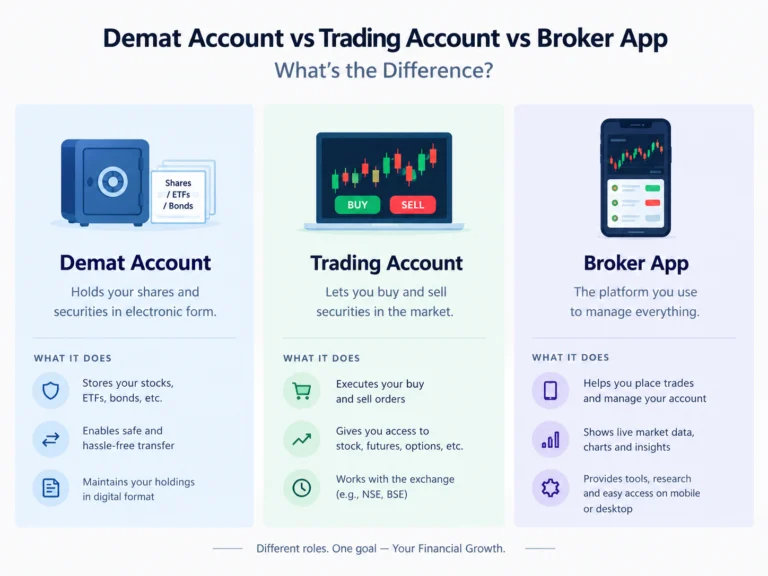
That role is different from the role of the depository. Your eligible securities are held electronically in a demat account through a depository participant connected to a depository such as NSDL or CDSL. The same company may provide both brokerage and DP services, which is why the two relationships can feel like one account inside an app.
If you are still building the foundation, understanding how to invest in stocks first makes broker comparisons easier. A stock broker in India gives you market access; it does not replace the need to understand what you are buying, how orders work or how much risk you are taking.
The practical question is therefore not simply, “Which broker is cheapest?” It is, “Which stock broker in India gives me a regulated, understandable and reasonably priced way to do the things I actually need?”
Check 1: Verify that you are dealing with a SEBI-registered broker
This is the first check when comparing a stock broker in India because everything else comes after it.
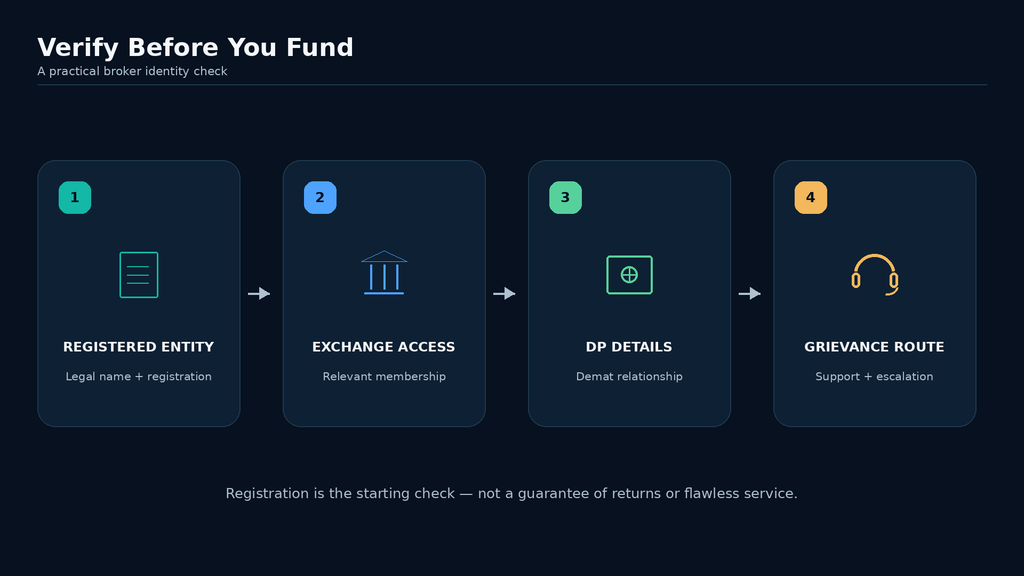
SEBI maintains searchable records of recognised intermediaries, including registered stock brokers in the equity and derivative segments. Before opening an account, search the broker’s legal name or registration number in the SEBI recognised intermediaries database.
Do not rely only on a familiar app name. A brand and the legal entity behind that brand may not be identical. The registration record helps you confirm:
- the registered entity name;
- the registration number;
- the relevant segment;
- the exchange relationship shown in the record;
- whether the registration is current.
SEBI also advises investors not to deal with unregistered brokers or other unregistered intermediaries. That sounds obvious, but scam apps and impersonation pages often borrow the name, logo or visual style of legitimate financial firms.
What SEBI registration does—and does not—tell you
Registration tells you that the intermediary is operating within the applicable securities-market framework for the registered activity. It gives you a regulated trail and access to formal complaint mechanisms.
It does not mean every trade will be profitable, the platform will never have an outage, customer support will always be fast or every product offered through the app is suitable for you.
When evaluating a stock broker in India, treat registration as the minimum entry requirement—not a quality score.
Check 2: Confirm exchange memberships and the products you actually need
A broker can be registered for different market segments and connected to different exchanges. If you only plan to buy cash-market shares for long-term delivery, your needs are relatively simple. If you intend to trade equity derivatives, currency or commodities, the relevant memberships and product access matter more.
For any stock broker in India, check the current disclosures and exchange membership information rather than assuming that every feature shown in a promotional screenshot is available to every client.
For a beginner, it is often useful to keep the first account simpler than the marketing page suggests. You do not need to enable every derivative or leveraged product simply because the broker supports it.
A stock broker in India that offers twenty advanced features is not automatically a better first choice than one that handles your basic investing workflow clearly.
Check 3: Understand the demat account and depository relationship
For delivery-based share investing, choosing a stock broker in India is closely tied to the demat setup.
A demat account holds eligible securities in electronic form. The account is opened through a depository participant, commonly called a DP, that is connected to a depository such as NSDL or CDSL.
Many modern brokers bundle the trading and demat setup into one onboarding flow. The app may show your orders, holdings, funds and statements on the same screen. Underneath that interface, however, the functions are still different.
Before choosing a stock broker in India, check:
- which entity acts as the DP;
- whether it is connected to NSDL or CDSL;
- the annual maintenance charge, if any;
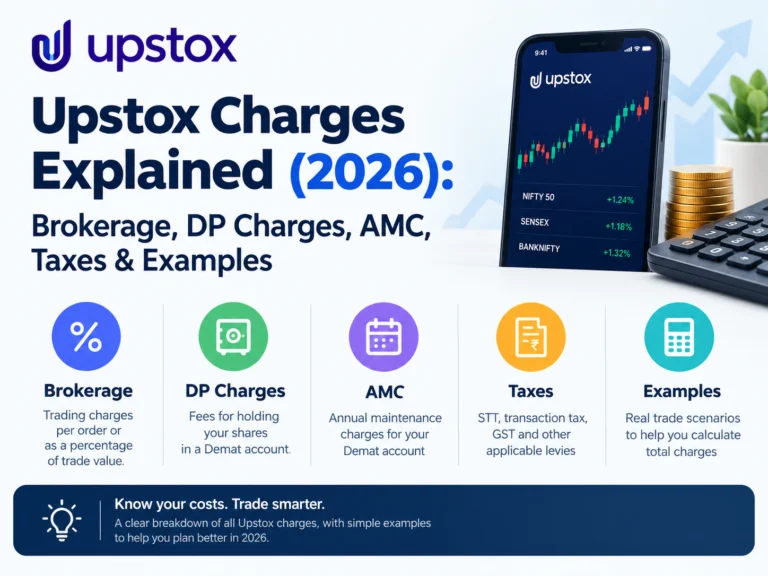
- the DP charge when securities are debited from the demat account;
- the process for authorising delivery sales;
- how you access depository statements independently of the broker app.
This matters because a “zero brokerage” message can distract from demat-related costs. A long-term investor who makes only a few purchases may care more about account maintenance, DP charges and record quality than an intraday trader does.
The separate article in this folder, Demat Account vs Trading Account vs Broker App, explains these layers in detail.
Check 4: Compare the complete cost, not the headline brokerage
This is where comparisons of a stock broker in India often go wrong.
A stock broker in India may advertise ₹0 brokerage for one product or a flat amount per executed order, but the final contract note can still include charges that do not belong to the broker.
Depending on the segment and transaction, costs can include:
- brokerage;
- securities transaction tax or commodities transaction tax;
- exchange transaction charges;
- SEBI turnover fees;
- GST on applicable service charges;
- stamp duty;
- DP charges on eligible demat debits;
- annual maintenance charges;
- call-and-trade or assisted-order charges;
- auto-square-off charges;
- pledge or unpledge fees;
- interest if you use margin or maintain a debit balance.
A good comparison separates broker charges from statutory, exchange and depository charges. Otherwise, a fee table can make one broker look dramatically cheaper when the difference is actually much smaller.
Build your own cost example
Use the way you expect to trade.
If you are a delivery investor, model:
- one purchase;
- one later sale;
- DP charges on the sale;
- annual account costs.
If you trade intraday, model:
- your average order value;
- the number of executed orders;
- brokerage on both sides where applicable;
- taxes and exchange charges;
- the effect of frequent turnover.
And remember that trading friction is not limited to explicit fees. The bid-ask spread can affect the effective price you pay or receive even though it does not appear as “brokerage.”
Check 5: Match the broker to how you actually invest or trade
There is no useful way to compare a stock broker in India without a use case.
A long-term investor who buys a few shares or ETFs each month may care about:
- easy fund transfers;
- clean holdings and tax reports;
- demat statements;
- simple order placement;
- low ongoing account costs;
- dependable support.
An active trader may care more about:
- web and mobile stability;
- fast order modification;
- advanced order types;
- charts and watchlists;
- position and margin information;
- keyboard shortcuts or multi-chart layouts;
- API access;
- order history and downloadable reports.
Someone who is still learning may value clarity over feature density.
Before opening a stock broker in India, write down the five tasks you expect to perform most often. Then compare brokers against those tasks. This prevents you from paying for complexity you do not use or choosing a simplified app that later feels restrictive.
Check 6: Test the trading platform and order workflow
The app supplied by a stock broker in India is the part you see every day, so usability matters. But “easy to use” is not the same as “good.”
The platform should help you understand what you are doing before the order is sent.
At minimum, check whether you can clearly identify:
- the exchange and instrument;
- quantity;
- order type;
- price;
- product type;
- estimated funds or margin requirement;
- order status;
- open positions;
- holdings;
- pending orders;
- completed trades.
Understanding market orders and limit orders is especially important. A clean-looking buy button does not remove the difference between prioritising immediate execution and controlling price.
Do a low-stakes platform test
Before moving significant funds, explore the app or web platform with no urgency.
Can you find a contract note? Can you download the ledger? Can you locate your DP information? Is the support route obvious? Can you cancel or modify an order without hunting through menus?
If a stock broker in India feels confusing when nothing is going wrong, it may feel worse during a volatile market session.
Check 7: Review the reports, contract notes and statements
A stock broker in India is not just an order-entry screen. It is also part of your financial record keeping.
SEBI’s investor guidance tells investors to insist on valid contract notes and keep records of account statements, payments and applicable charges. These documents become important when you need to reconcile a trade, calculate costs, prepare records for tax work or raise a dispute.
Before choosing a stock broker in India, see whether the reporting section gives you easy access to:
- contract notes;
- trade book;
- order book;
- funds ledger;
- holdings;
- realised and unrealised P&L reports;
- tax-oriented reports where offered;
- downloadable statements.
Do not judge this only by screenshots. If possible, check the broker’s help documentation to see how reports are generated and how long historical documents remain available online.
A beautiful app with poor records is still a weak tool.
Check 8: Examine security and account controls
No stock broker in India can remove cyber risk completely, but the account should provide sensible security controls.
Look for current information on:
- multi-factor or two-factor authentication;
- login alerts;
- device/session management;
- password or PIN reset procedures;
- transaction authorisation for demat sales;
- withdrawal controls;
- verified communication channels.
Also consider your own behaviour. Do not share trading passwords, OTPs or remote-access control with another person. Be suspicious of unsolicited messages asking you to install an app, join a “VIP trading group” or move funds to an account that does not match the broker’s official instructions.
When evaluating a stock broker in India, security is partly about the broker’s systems and partly about whether the workflow makes suspicious activity easier to notice.
Check 9: Check support, complaints and the formal redressal path
When choosing a stock broker in India, many people think about customer support only after something goes wrong.
Test it before that.
Look for:
- in-app support;
- ticketing;
- email;
- phone support where available;
- published escalation contacts;
- grievance officer details;
- typical help-centre quality.
Then understand the regulated route.
SEBI’s SCORES complaint platform allows investors to lodge grievances concerning SEBI-regulated entities after first taking the grievance up with the entity concerned. SCORES also provides tracking and review stages.
That does not mean a broker with a complaint record is automatically bad. Large firms naturally serve more customers, and raw complaint counts without context can be misleading. What matters is that you know where complaints are recorded, how the intermediary responds and how unresolved issues can be escalated.
For a stock broker in India, a visible grievance process is more useful than a generic promise of “24/7 care.”
Check 10: Read the account terms before you fund it
The onboarding process for a stock broker in India can make it tempting to tap through documents quickly. Resist that.
Read the tariff sheet and account terms, especially the sections dealing with:
- brokerage;
- annual maintenance;
- DP charges;
- assisted orders;
- auto square-off;
- pledging;
- margin or funded products;
- interest on debit balances;
- account closure;
- modification charges;
- data/communication preferences.
If a broker introduces a premium plan, subscription or special pricing tier, check whether the rate you saw in an advertisement is conditional on that plan.
A stock broker in India can change charges within the applicable framework and terms. Save or download the tariff that applied when you opened the account, then compare it with later updates if your costs change.
Discount broker vs full-service broker: which model fits you?
The old distinction between “discount” and “full-service” brokers is less clean than it once was because many low-cost brokers now offer research, APIs and advanced platforms, while traditional brokers have improved their digital products.
Still, the comparison is useful.
| Factor | Discount-style broker | Full-service-style broker |
|---|---|---|
| Pricing | Often flat or lower transaction brokerage | May use higher or percentage-based pricing depending on plan |
| Platform | Usually digital-first | Digital plus broader relationship/service options |
| Research | Varies; may be self-directed | Often a larger research/advisory offering |
| Branch support | Usually limited | More likely to have branches or relationship managers |
| Best fit | Cost-conscious, self-directed users | Users who value service/research and accept the cost |
Do not assume one model of stock broker in India is automatically better.
If you are self-directed and comfortable researching investments, a low-cost stock broker in India may be enough. If you value branch support, relationship assistance or bundled research, paying more can be reasonable—provided you understand exactly what you receive.
A practical scorecard for choosing a stock broker in India
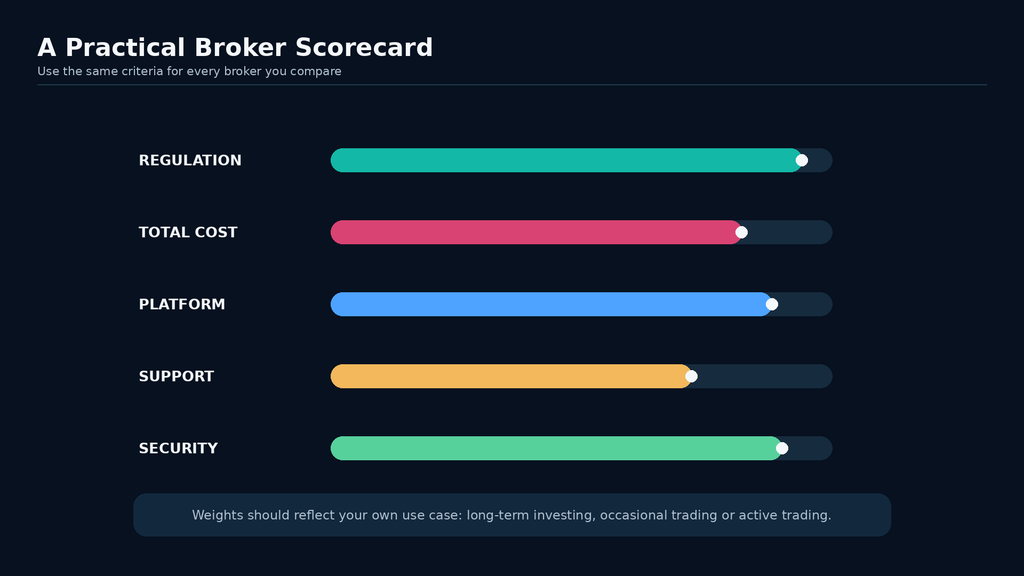
Instead of ranking brokers by reputation, score each candidate against the same criteria.
Use a simple 1-to-5 scale:
| Criterion | Weight | What to check |
|---|---|---|
| Registration & transparency | 20% | SEBI record, exchange membership, legal-entity clarity, disclosures |
| Total cost | 20% | Brokerage, AMC, DP, service fees, statutory costs |
| Platform & order workflow | 20% | Stability, order types, reports, web/mobile usability |
| Support & grievance route | 15% | Help channels, escalation, complaint process |
| Demat/DP experience | 10% | Depository relationship, statements, authorisation, DP fees |
| Security controls | 10% | Authentication, alerts, withdrawal/account controls |
| Product fit | 5% | Markets and tools you genuinely need |
Example
Suppose Broker A is slightly cheaper but scores poorly on reporting and support. Broker B costs a little more but gives you clearer records, a workflow you understand and a support system you have tested.
For a long-term investor making a few trades a month, Broker B may be the more practical choice even if Broker A wins the brokerage comparison by a small amount.
That is why “lowest fee” and “best stock broker in India for me” are not always the same answer.
Common mistakes when choosing a broker
1. Opening an account because of a temporary reward
A joining offer is temporary. You may use the account for years.
2. Looking only at brokerage
DP charges, AMC, taxes, exchange fees and paid services can matter more than expected.
3. Enabling every segment
Futures and options are not beginner features simply because they are one tap away.
4. Ignoring the legal entity
Verify the registered entity and do not assume a familiar-looking app is legitimate.
5. Treating a high app rating as due diligence
Ratings can help identify patterns, but they are not a substitute for regulatory, fee and account checks.
6. Funding the account before testing the workflow
Learn where reports, support, orders and security settings are while the stakes are low.
7. Confusing platform tools with investment quality
A sophisticated charting interface does not make an investment safer or a trading strategy more profitable. Good tools help execution; they do not create an edge by themselves.
Who should choose simplicity over advanced features?
If this is your first stock broker in India, simplicity can be an advantage.
You should be able to understand:
- where your money is;
- where your securities are;
- what type of order you are placing;
- what you will be charged;
- what happens after the order executes;
- where to find the record;
- who to contact if something is wrong.
Advanced charts, options analytics and APIs can be useful later. They should not distract from those fundamentals.
A simple account that you understand is more useful than a feature-rich account that encourages activity you are not ready for.
Conclusion
Choosing a stock broker in India is easier when you stop looking for a universal winner.
For any stock broker in India, start with the legal entity and SEBI registration. Then compare the complete cost, depository relationship, platform workflow, reports, security, support and product fit. Test the basic experience before you fund the account heavily, and keep copies of the tariff and important records.
The best outcome is not an app with the most features. It is a broker relationship you understand well enough to know what you are paying, where your assets are, how your orders work and what to do if something goes wrong.
If you are still building the basics, stock market fundamentals and a clear risk-management process are more important than choosing between two similar broker apps.
Frequently Asked Questions (FAQs)
Search the broker’s registered legal name or registration number in SEBI’s recognised intermediaries database. Then cross-check the broker’s official website and relevant exchange membership disclosures. Do not rely only on an app name, social-media profile or advertisement.
SEBI registration is an essential regulatory requirement, but “safe” is too broad to guarantee. Registration does not prevent market losses, operational problems, cyber incidents or service complaints. Verify the registration, understand the account structure and use appropriate security practices.
There is no permanent answer because pricing and plans change, and “lowest” depends on what you trade. Compare brokerage alongside DP charges, AMC, statutory taxes, exchange charges and any service fees that apply to your expected workflow.
Both matter, but their importance depends on your activity. A long-term investor may accept a small cost difference for better reporting and support, while a high-frequency trader may be more sensitive to repeated per-order costs and platform execution workflow.
For holding eligible delivery-based securities electronically, you need a demat account through a depository participant. Many brokers open trading and demat accounts together. Derivative positions work differently because they are contracts rather than delivery holdings.
Yes. Investors can open another broker account and, where required, transfer eligible demat holdings through the applicable depository process. Check account-closure, off-market transfer and DP charges before moving.
A discount broker can suit a self-directed beginner, but the label alone does not determine quality. Compare the regulated entity, total charges, interface, reports, support and the products you genuinely need.
First raise the issue through the broker’s official grievance process and keep written records. If it remains unresolved, use the applicable exchange or SEBI grievance channels. SEBI’s SCORES platform provides a formal online route for complaints concerning regulated securities-market entities.