Upstox Charges Explained (2026): Brokerage, DP Charges, AMC, Taxes & Examples

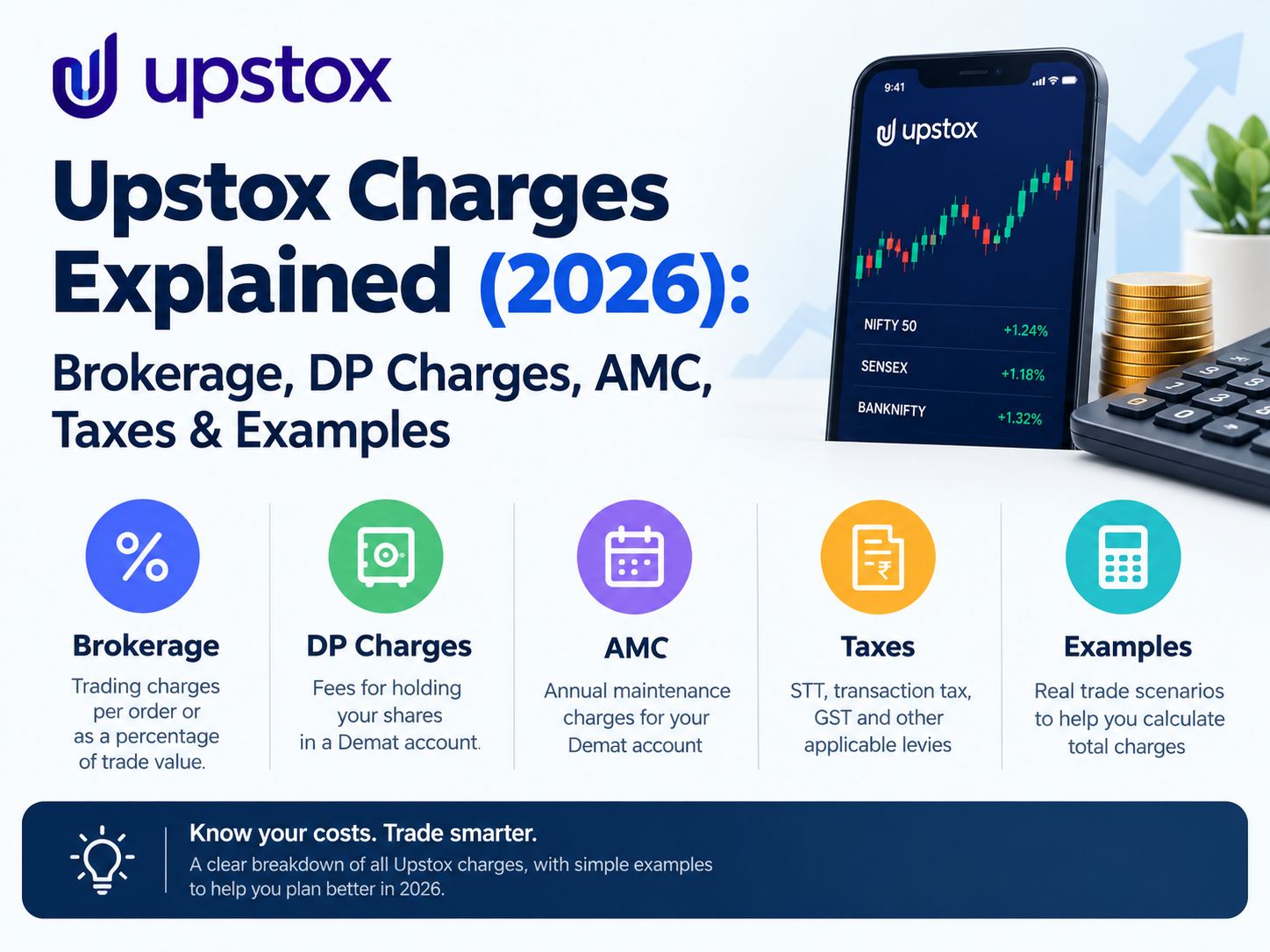
The main Upstox charges for equity are brokerage of ₹20 per executed delivery order, ₹20 or 0.1% for intraday (whichever is lower), ₹20 or 0.05% for equity futures (whichever is lower), and ₹20 per equity-options order. Delivery sales can also attract a ₹20 DP charge per scrip per day, while statutory and exchange charges apply separately.
Education-only disclaimer: This article explains publicly listed fees for educational purposes. It is not personalised investment, trading, tax or legal advice. Broker tariffs, exchange fees and government levies can change. Recheck Upstox’s official pricing page and your contract note before relying on any figure.
Key takeaways
- Upstox charges are not limited to brokerage. Taxes, exchange transaction charges, SEBI fees, GST, stamp duty and DP charges can also apply.
- Equity delivery brokerage is currently listed at ₹20 per executed order.
- Equity intraday brokerage is ₹20 per executed order or 0.1%, whichever is lower.
- Equity futures brokerage is ₹20 per executed order or 0.05%, whichever is lower.
- Equity options brokerage is listed at a flat ₹20 per executed order.
- Delivery sell transactions can attract a ₹20 DP charge per scrip per day, plus applicable GST.
- Upstox currently lists ₹0 AMC for the first year for newly onboarded users and ₹300 + GST for non-BSDA users thereafter.
- Statutory rates and exchange charges are date-sensitive; verify them again before publication or trading.
Upstox charges at a glance
The easiest way to understand Upstox charges is to divide them into three buckets. This keeps Upstox charges from being confused with taxes and exchange levies:
- charges set by Upstox, such as brokerage, DP fees and some account/service charges;
- exchange and regulatory charges, which are not simply retained as brokerage;
- government taxes and duties, such as STT, GST and stamp duty.
That distinction matters because a ₹20 brokerage figure is not the same thing as a ₹20 total transaction cost.
The table below uses the rates published on Upstox’s official brokerage charges page and was checked on 4 September 2026.
| Cost item | Equity delivery | Equity intraday | Equity futures | Equity options |
|---|---|---|---|---|
| Brokerage | ₹20 per executed order | ₹20 or 0.1%, whichever is lower | ₹20 or 0.05%, whichever is lower | ₹20 per executed order |
| DP charge | ₹20 per scrip per day on sell | None | None | None |
| STT/CTT from 1 Apr 2026 | 0.1% buy + sell | 0.025% sell | 0.05% sell | 0.15% sell on premium; exercised option sales also have specific treatment |
| NSE transaction charge from 1 Mar 2026 | 0.00307% buy + sell | 0.00307% buy + sell | 0.00183% buy + sell | 0.03553% on premium |
| SEBI charge | ₹10/crore | ₹10/crore | ₹10/crore | ₹10/crore |
| Stamp duty | 0.015% buy | 0.003% buy | 0.002% buy | 0.003% buy |
| GST | 18% on applicable service/transaction components | 18% on applicable components | 18% on applicable components | 18% on applicable components |
BSE transaction charges can differ by scrip group or segment, so the worked examples below use NSE rates for clarity.
Upstox brokerage charges by segment
Equity delivery
Current Upstox charges list equity delivery brokerage at ₹20 per executed order. For delivery investors, Upstox charges should therefore be evaluated across both brokerage and demat-related costs.
That means a delivery purchase is not “zero brokerage” under the published standard schedule used for this article. If you buy shares in one executed order, the brokerage line is ₹20. When you later sell in another executed order, another ₹20 brokerage charge applies.
The sale can also trigger a DP charge because securities are being debited from your demat account.
Equity intraday
For equity intraday, Upstox charges are listed as ₹20 per executed order or 0.1% of the order value, whichever is lower. The effective Upstox charges for a round trip still include taxes and exchange fees on top of that brokerage.
For a small trade, 0.1% can be below ₹20. For a larger order, brokerage reaches the ₹20 cap.
A buy and a sell are separate executed orders, so a round trip can involve brokerage on both sides.
Equity futures
For equity futures, the published brokerage is ₹20 per executed order or 0.05%, whichever is lower. In other words, Upstox charges for futures cannot be read from the brokerage line without the sell-side STT and exchange charges.
The notional contract value can be much larger than the cash you post as margin, which is one reason derivatives traders should not judge risk from brokerage alone. If you trade futures, position sizing and total exposure matter far more than saving a few rupees of transaction cost.
Equity options
For equity options, current Upstox charges list a flat ₹20 per executed order.
Options costs can be confusing because some taxes and exchange charges use option premium rather than the underlying notional value. Exercise-related tax treatment can also differ from a simple buy-and-sell premium transaction.
For that reason, use the live calculator or contract note for a precise options-cost estimate rather than applying equity-delivery percentages to an options trade.
Upstox DP charges: the cost delivery investors often miss
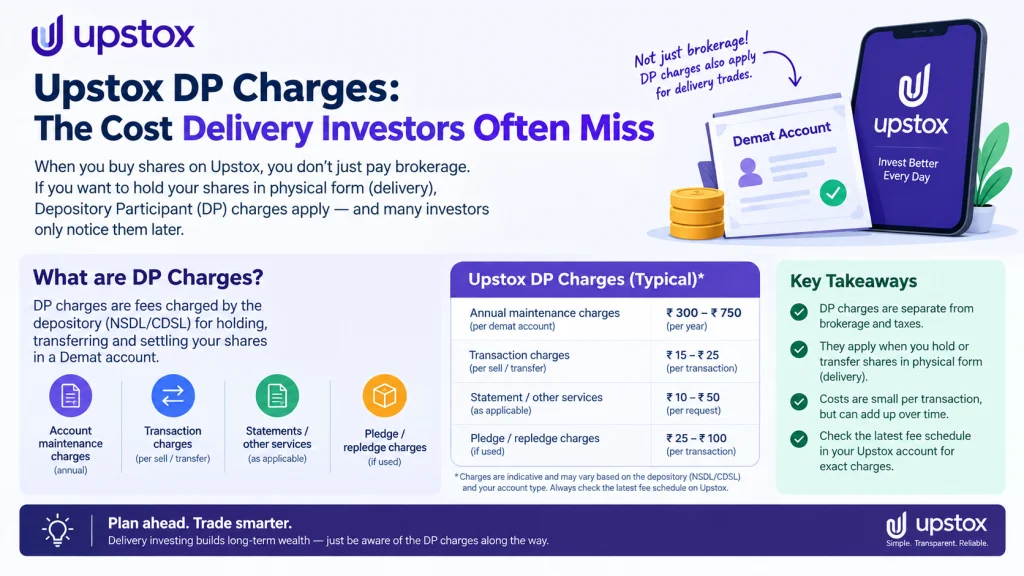
The DP charge is one of the most important Upstox charges to understand if you buy shares for delivery. It is also one of the Upstox charges most likely to surprise someone who looked only at the order brokerage.
Upstox currently lists a ₹20 DP charge per scrip per day, on sell, for equity delivery. The official pricing page breaks that amount between CDSL and Upstox and shows GST as applicable.
The key words are per scrip per day.
If you sell shares of one company in multiple sell orders on the same day, the DP-charge treatment is tied to the scrip/day rather than simply charging ₹20 for every sell order. If you sell multiple different securities, each scrip can attract its own DP charge.
Intraday equity, futures and options do not involve a delivery debit from your demat account in the same way, so the standard DP charge shown on the pricing table does not apply to those segments.
This is a good example of why comparing only brokerage can mislead a delivery investor.
Affiliate disclosure: Some links on this page may be affiliate or referral links. If you open an account through them, Trading Turtle may earn a commission at no additional cost to you. This does not influence the fees shown, the worked examples or our editorial conclusions.
Upstox AMC and account-related costs
At the time of verification, Upstox’s charges page states:
- ₹0 AMC for newly onboarded customers in the first year;
- ₹300 + GST AMC for non-BSDA users after the first year;
- BSDA pricing is subject to the applicable Basic Services Demat Account framework and should be checked against the current Upstox terms.
Upstox charges can also include fees for optional or exceptional services—for example, assisted orders, auto square-off, pledging, account modifications, instant withdrawals or off-market transfers.
Those ancillary fees can change and may depend on plan or service type. They are deliberately not mixed into the core trade examples below. If you expect to use one of these services regularly, check the current tariff sheet before opening the account.
Government and exchange charges are separate from brokerage
A broker does not control every amount on the contract note. Several amounts that appear beside Upstox charges are statutory or exchange levies rather than broker pricing.
STT/CTT
For the equity segments in this guide, Upstox’s current schedule shows the rates applicable from 1 April 2026:
- equity delivery: 0.1% on buy and sell;
- equity intraday: 0.025% on the sell side;
- equity futures: 0.05% on the sell side;
- equity options: 0.15% on the sell side on premium, with specific treatment for exercised options.
These rates can materially exceed the brokerage on some transactions.
GST
GST is currently shown at 18% on applicable brokerage, exchange transaction, demat and related service components.
Do not calculate GST as 18% of the entire share value. It is applied to the relevant taxable service/charge base.
Stamp duty
The current rates shown by Upstox are:
- delivery: 0.015% on the buy side;
- intraday: 0.003% on the buy side;
- futures: 0.002% on the buy side;
- options: 0.003% on the buy side.
Exchange transaction charges
For NSE, Upstox’s current page lists transaction charges from 1 March 2026 at:
- equity delivery/intraday: 0.00307% per trade on buy and sell;
- equity futures: 0.00183% per trade on buy and sell;
- equity options: 0.03553% on premium.
BSE rates can differ.
SEBI turnover fees
The listed SEBI charge is ₹10 per crore of turnover.
When you add these items together, Upstox charges become a combination of broker fees plus market-wide taxes and levies—not a single brokerage number.
Worked example 1: equity delivery buy and later sell
Suppose an investor:
- buys shares worth ₹50,000 on NSE;
- later sells the same holding for ₹55,000;
- sells one scrip on one day;
- uses two executed orders: one buy and one sell.
This is an educational illustration using the published rates above. It excludes tiny IPFT/rounding differences and assumes the rates remain unchanged between the two trades.
Approximate cost
| Component | Approx. cost |
|---|---|
| Brokerage | ₹40.00 |
| STT | ₹105.00 |
| NSE transaction charges | ₹3.22 |
| SEBI charges | ₹0.11 |
| Stamp duty | ₹7.50 |
| DP charge | ₹20.00 |
| GST on applicable brokerage/transaction/DP components | ~₹11.38 |
| Approximate total | ~₹187.21 |
The important point is not the exact paise. It is the composition.
Only ₹40 of this approximate ₹187 total is brokerage. Most of the rest comes from taxes, market charges and the delivery DP debit.
This is why Upstox charges cannot be judged from the ₹20-per-order line alone.
Worked example 2: equity intraday round trip
Now assume a trader:
- buys ₹1,00,000 of shares intraday on NSE;
- sells ₹1,00,000 on the same day;
- uses one executed buy order and one executed sell order.
At this order size, 0.1% would be ₹100 per side, so the ₹20-per-order cap applies.
Approximate cost
| Component | Approx. cost |
|---|---|
| Brokerage | ₹40.00 |
| STT (sell side) | ₹25.00 |
| NSE transaction charges | ₹6.14 |
| SEBI charges | ₹0.20 |
| Stamp duty (buy side) | ₹3.00 |
| GST on applicable brokerage/transaction components | ~₹8.31 |
| DP charge | ₹0 |
| Approximate total | ~₹82.65 |
Again, the actual contract note can differ slightly because of rounding, exchange-specific items or rate changes.
If you trade frequently, small costs repeat. The bid-ask spread and slippage can create additional trading friction even though they are not listed as Upstox charges.
Worked example 3: equity futures round trip
For a simple futures illustration, assume:
- buy-side contract turnover of ₹2,00,000;
- sell-side contract turnover of ₹2,00,000;
- one executed order each side;
- NSE rates;
- no additional service fees.
At 0.05% of ₹2,00,000, percentage brokerage would be ₹100, so the ₹20 cap applies on each side.
Approximate cost
| Component | Approx. cost |
|---|---|
| Brokerage | ₹40.00 |
| STT (sell side) | ₹100.00 |
| NSE transaction charges | ₹7.32 |
| SEBI charges | ₹0.40 |
| Stamp duty (buy side) | ₹4.00 |
| GST on applicable brokerage/transaction components | ~₹8.52 |
| Approximate total | ~₹160.24 |
This example is not a reason to trade futures. The contract’s market exposure and loss potential matter much more than the transaction cost. Derivatives can move against you quickly, and leverage can magnify losses.
Why your actual contract note may differ from these examples
Worked examples are useful, but they are not invoices. Actual Upstox charges depend on the exact order, segment, exchange and tariff in force when the trade executes.
Your actual Upstox charges can differ because of:
- order value;
- number of executed orders;
- exchange used;
- segment;
- whether the order is delivery or intraday;
- option premium;
- whether an option is exercised;
- DP debits;
- rounding;
- tariff changes;
- special service or plan charges;
- regulatory or tax changes.
The safest habit is to review the contract note after a real transaction and compare it with the broker’s current tariff.
If the figure looks unfamiliar, separate the brokerage line from statutory and exchange charges before concluding that the broker has charged an unexpected fee.
Costs that are not part of the standard brokerage headline
The core Upstox charges table does not tell you every possible cost you could ever incur.
Depending on what you do, other fees can apply for services such as:
- call-and-trade or assisted orders;
- auto square-off;
- pledging/unpledging securities;
- margin-related borrowing or interest;
- negative ledger balances;
- off-market transfers;
- dematerialisation/rematerialisation;
- account modifications;
- instant withdrawal services;
- subscription or premium plans.
The official Upstox page contains a longer list of service charges. Some values have changed over time or can differ by plan, so this article does not freeze every ancillary fee into a permanent table.
If one of those services matters to your use case, verify that specific fee before acting.
How to use the Upstox brokerage calculator properly
Upstox provides an official brokerage calculator that can estimate brokerage and other charges for a selected trade.
Use it as a planning tool, not as a substitute for the contract note.
A sensible process is:
- choose the correct segment;
- enter a realistic quantity and price;
- inspect the brokerage line;
- expand the tax/charge breakdown;
- compare the result with the latest pricing page;
- after a real trade, reconcile the estimate with your contract note.
This is particularly useful for options, where premium-based charges can make mental calculations less intuitive.
The calculator also reinforces the main lesson of this guide: Upstox charges are made up of more than the advertised brokerage.
Do Upstox charges make it a low-cost broker?
“Low cost” depends on behaviour.
A long-term investor who places a small number of delivery orders may notice the ₹20 delivery brokerage and DP charge more than an active intraday trader does.
An active trader may care about the ₹20 cap because transaction frequency can multiply brokerage quickly.
A derivatives trader should focus first on product risk, margin and exposure rather than treating cheap execution as a reason to trade more.
So the pricing can be competitive for some workflows without being the lowest possible cost for every person.
This article is intentionally about Upstox charges, not a full Upstox review. Platform quality, support experience, research, product coverage and suitability need a broader evaluation than a fee table can provide.
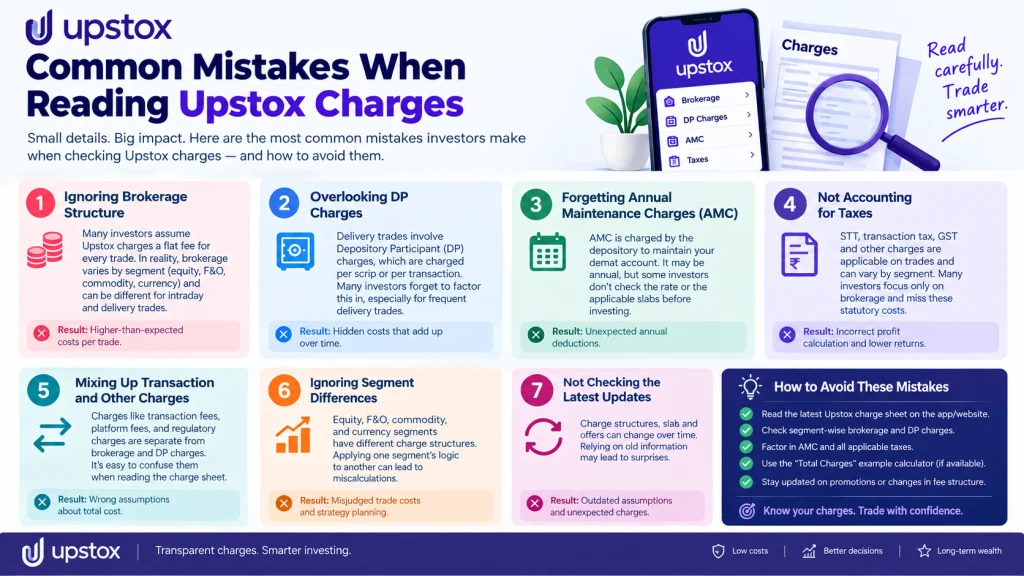
Common mistakes when reading Upstox charges
Mistake 1: Assuming ₹20 is the total cost of the trade
It is the brokerage cap/rate for specified segments, not a promise that the final contract-note cost will be ₹20.
Mistake 2: Forgetting the DP charge on delivery sells
Delivery investors often notice this only after the first sale.
Mistake 3: Comparing brokers using one sample trade
A broker that looks cheaper for a ₹10,000 delivery order may not produce the same relative result for an active intraday workflow.
Mistake 4: Ignoring statutory charges because every broker has them
Even if a charge is market-wide, it still affects your break-even point and net return.
Mistake 5: Treating the brokerage calculator as a permanent tariff
Calculators use current assumptions. Rates can change.
Mistake 6: Trading more because brokerage looks small
Low transaction cost does not reduce market risk. A poor trade is still a poor trade.
Conclusion
The clearest way to understand Upstox charges is to stop treating brokerage as the whole bill.
Brokerage is only one layer of Upstox charges. Depending on the trade, your final cost can also include STT, exchange charges, SEBI turnover fees, GST, stamp duty and, for delivery sells, a DP charge.
For a delivery investor, the DP and AMC structure deserves attention. For an intraday trader, repeated brokerage and turnover-based charges matter. For derivatives traders, transaction costs are secondary to leverage, margin and loss risk.
Use the official calculator for estimates, check your contract note after execution and revisit the tariff whenever Upstox or market-wide charges change.
Before placing any live order, understanding market orders and limit orders and maintaining a sensible risk-management process will matter more than saving a few
– Frequently Asked Questions (FAQs)
At the time of verification, Upstox lists equity delivery brokerage at ₹20 per executed order. Delivery trades can also attract STT, exchange transaction charges, SEBI fees, GST, stamp duty and a ₹20 DP charge per scrip per day when securities are sold from demat.
Not under the standard pricing schedule verified for this article. Current Upstox charges list ₹20 per executed equity-delivery order. Always recheck the live pricing page because tariffs can change.
Equity intraday brokerage is currently ₹20 per executed order or 0.1%, whichever is lower. STT applies on the sell side, while transaction charges, SEBI fees, GST and stamp duty can also apply.
The official pricing page currently lists a ₹20 DP charge per scrip per day on eligible equity-delivery sells, plus applicable GST treatment. It is not charged in the same way for intraday equity or derivative positions.
Upstox currently states ₹0 AMC for newly onboarded customers in the first year and ₹300 + GST for non-BSDA users after that. BSDA users should check the applicable current conditions and tariff.
Brokerage is calculated per executed order. For a standard equity-delivery round trip with one buy and one later sell, that can mean ₹20 brokerage on the buy order and ₹20 on the sell order under the current schedule. Other charges also apply.
No. The current fee schedule shows GST at 18% on applicable brokerage and specified transaction/demat/service charges, not as 18% of the entire share value.
Differences can come from exchange selection, exact turnover, rounding, DP charges, additional service charges, rate changes or a different product/transaction structure. Use the contract note as the final record and compare each line with the latest tariff.
Use Upstox’s official brokerage-charges page and brokerage calculator. Recheck them immediately before publication or before relying on a worked example for a real transaction.