Tokenized Treasury Funds: The Risks Behind Onchain Yield

Putting a Treasury-related investment on a blockchain changes how ownership can be recorded and transferred. It does not automatically turn the investment into a bank deposit, remove redemption conditions or make every wallet eligible to hold it.
This analysis examines tokenized Treasury funds and the risks behind onchain yield. The central question is what the investor actually holds: a direct security, a fund share, a contractual claim or another structure with its own rules.
Analysis date: 15 November 2026. This is a product-evaluation framework, not a recommendation or statement of eligibility for Indian residents. Examples are hypothetical, and individual offerings must be assessed using their current documents.
Table of Contents
- Start with the legal claim, not the token symbol
- The asset and the delivery mechanism are different layers
- Yield must be defined before it is compared
- Blockchain transfer is not the same as cash redemption
- Permissioning can be a product feature
- Operational risks sit beside portfolio risks
- Currency exposure can dominate a modest yield
- Do not confuse collateral use with safety
- A research checklist before comparing products
- Frequently asked questions
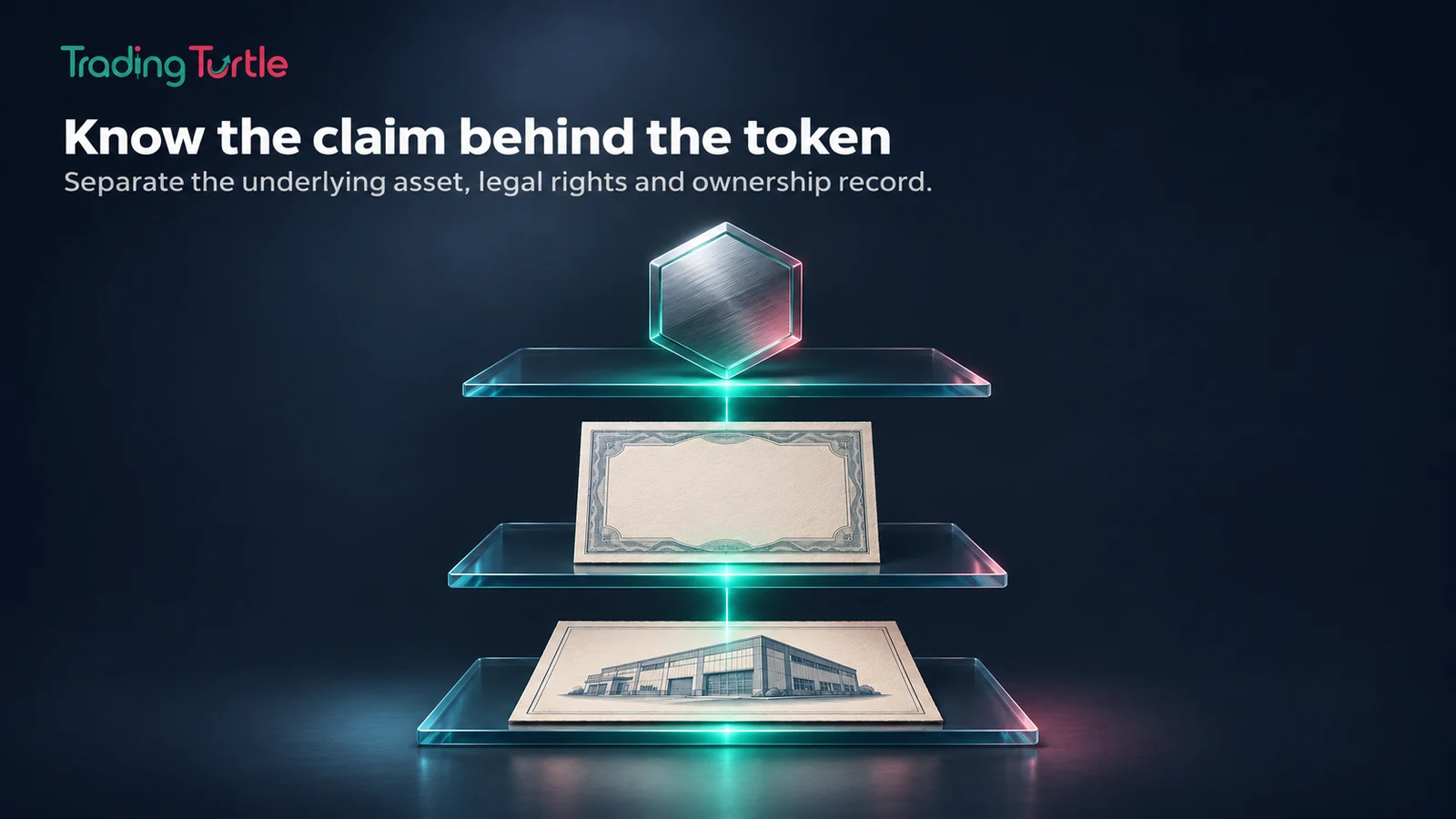
Start with the legal claim, not the token symbol
“Tokenized Treasury” is a broad label. It can describe different arrangements involving government securities, fund shares or claims linked to a portfolio. Similar labels do not establish identical rights.
The first document to find is the prospectus, offering memorandum or equivalent governing material. Identify the issuer, the instrument, the underlying assets and who maintains the authoritative ownership record. A token’s visibility in a wallet is not a substitute for that legal description.
For a concrete example of disclosure, Franklin Templeton’s OnChain US Government Money Fund prospectus describes a government money market fund with blockchain-integrated share recordkeeping. It warns that losses are possible and that the investment is not a bank account or government-insured deposit.
That example is useful precisely because it shows the importance of reading a real document. It should not be generalised into a description of every tokenized product or treated as a recommendation of the named fund.
The asset and the delivery mechanism are different layers
The underlying portfolio determines much of the economic exposure. The token and associated systems determine parts of the ownership, transfer and access experience. Both layers deserve analysis.
A well-chosen asset can still be delivered through an inconvenient or vulnerable process. A polished blockchain interface can also represent an asset with risks that a user does not understand. Neither technology nor asset quality excuses skipping the other layer.
For illustration, imagine two products holding similar short-duration securities. One has a clear redemption process and accessible documentation; the other has unclear ownership rights and an uncertain withdrawal route. Similar portfolio descriptions would not make the products equivalent.
Readers unfamiliar with the technology can begin with Trading Turtle’s What Is Blockchain? guide. The financial assessment still begins with the rights attached to the instrument.
Yield must be defined before it is compared
A quoted yield may refer to a recent annualised measure, a distribution rate, an estimate or another calculation. It may be before or after selected expenses. Comparing two percentages without their definitions can create a false impression of value.
Ask which period the figure covers and whether it is historical or forward-looking. Identify management charges, platform fees, transaction costs and currency-conversion costs that may affect the investor’s result. Do not assume every cost appears inside a prominent headline yield.
Suppose a hypothetical investment produces a gross annual return of 4% before a 0.5% annual expense and other costs. On $1,000, the simple difference is $35 before those additional costs and any compounding or tax effects. That illustration is not a promised yield or a current quote for any product.
For a small position, a fixed transaction charge can matter disproportionately. A $5 entry cost and $5 exit cost consume 1% of a $1,000 position, but only 0.1% of a $10,000 position. These arithmetic examples show why net outcomes matter more than a headline rate.
Blockchain transfer is not the same as cash redemption
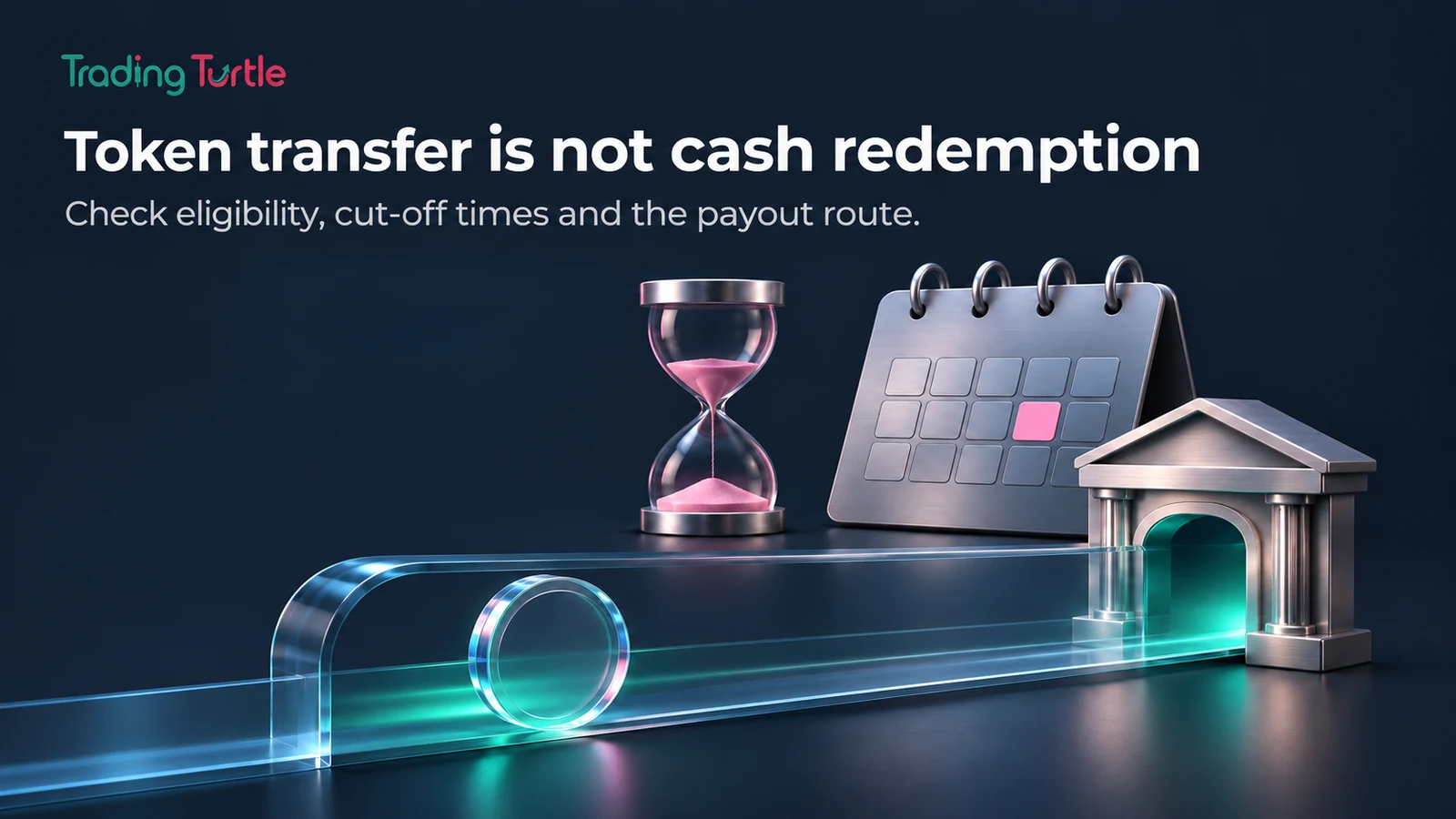
Transferring a token to another permitted holder and redeeming an investment for money are different processes. The first changes who holds the instrument; the second depends on the product’s redemption arrangements and the route through which money is delivered.
The BIS discussion of tokenised money market funds highlights permissioned holding arrangements and risks associated with liquidity and operations. Its analysis is a reminder to examine how a product behaves when investors want to exit.
For any specific offering, check eligible redemption days, cut-off times, minimums, settlement arrangements and the asset delivered on redemption. A blockchain can operate continuously while the surrounding financial process follows a narrower schedule.
It is also important to distinguish an available buyer from a guaranteed exit price. A secondary market may be thin or restricted. A token transfer feature does not establish that someone will buy the holding at the desired value when cash is urgently needed.
Permissioning can be a product feature
Some tokenized instruments restrict who can hold or receive them. Eligibility checks and allowlists can be part of the design, rather than a temporary inconvenience. The exact rules depend on the product and jurisdiction.
That matters when evaluating the common claim that blockchain assets are universally accessible. A public network does not require every financial instrument on that network to be open to every wallet or person.
Read how the issuer handles a transfer to an ineligible destination, an ownership-record error or an account problem. Identify the support and recovery process. Do not assume the same rules that apply to an unrestricted crypto token apply to a regulated fund share.
These considerations also make custody analysis more specific. Controlling a wallet key may not be the only condition needed to exercise rights under the product. The legal record and administrative arrangements can remain essential.
Operational risks sit beside portfolio risks
The Franklin prospectus discusses blockchain-related operational risks, including technical failures and transaction-recording problems. It also describes administrative control over the share record. Those disclosures should be read in the context of that specific fund.
More generally, a reader should map the organisations and systems involved: issuer, investment manager, custodian, transfer agent, wallet service, platform and payment route, where applicable. The actual list depends on the structure.
Then ask what happens if one component stops working. Can ownership still be verified? Who can correct an error? How are customers informed? Does a recovery procedure exist outside the ordinary interface?
This is not a reason to assume failure. It is a way to evaluate resilience before access becomes urgent. Trading Turtle’s exchange withdrawal-risk analysis explains why an asset’s value and a user’s ability to access it should be assessed separately.
Currency exposure can dominate a modest yield
An Indian reader evaluating a dollar-denominated product must consider the currency in which future spending will occur. A return quoted in dollars is not automatically the same return in rupees.
For a simplified hypothetical example, an investor converts ₹83,000 into $1,000 at ₹83 per dollar. If the investment becomes $1,040 and the conversion rate on exit is ₹80, the result is ₹83,200 before costs and tax. A 4% dollar increase would correspond to roughly 0.24% in rupees in this example.
If the exchange rate instead moved the other way, it could increase the rupee result. Neither outcome is predicted here. The point is that currency exposure can be larger than the yield being compared.
Eligibility, remittance rules and taxation also depend on the investor and product. These require current, jurisdiction-specific advice where necessary; a blockchain interface does not remove those obligations.
Do not confuse collateral use with safety
A tokenized instrument may be discussed as collateral in another financial application. That adds a second set of terms to evaluate: valuation, borrowing limits, liquidation rules, counterparty arrangements and software risk.
The underlying asset’s perceived quality does not make borrowing against it risk-free. A modest price deviation, a change in collateral rules or an operational problem can matter when leverage is involved.
For illustration, placing an investment inside a lending arrangement changes the investor’s position from simply holding an asset to holding it alongside a borrowing obligation. The analysis must cover both sides and the process connecting them.
Avoid presenting this additional use as free extra yield. It is another strategy with costs and risks, and may not be available or suitable for a particular reader.
A research checklist before comparing products
Identify the legal instrument and issuer. Read the current portfolio policy and risk section. Define the yield measure and list every cost that can be verified. Record the currency of the investment and the currency of the intended spending need.
Check eligibility and transfer restrictions. Map the redemption process, cut-off times and payment route. Find the procedure for a lost device, erroneous transfer or service interruption before assuming a wallet alone supplies a complete recovery plan.
Finally, compare the product with alternatives that serve the same purpose. An emergency reserve, a short-term investment and collateral for a leveraged position are different objectives. A feature that is attractive for one purpose may add unnecessary complexity to another.
The best comparison explains both benefits and trade-offs. Tokenization can improve parts of the ownership and transfer experience, but an investment remains a bundle of legal, financial and operational arrangements.
Frequently asked questions
Is a tokenized Treasury fund the same as holding a Treasury directly?
Not necessarily. The investor may hold a fund share or another claim. Read the governing document to identify the instrument, underlying assets and rights on redemption.
Does tokenization make the investment risk-free?
No. Portfolio, interest-rate, liquidity, currency and operational risks can remain. Blockchain technology changes parts of the delivery process without guaranteeing capital or access.
Can every wallet hold a tokenized fund?
No. Eligibility checks and transfer restrictions may apply. Network accessibility and financial-product eligibility are separate questions that must be checked for the actual offering.
Does 24-hour token transfer mean 24-hour bank withdrawals?
No. Transfers and redemptions are different processes. The governing terms determine when and how an investment can be redeemed and what the investor receives.
Sources and method: Franklin OnChain US Government Money Fund prospectus, BIS work on tokenised money market funds and tokenisation risks, reviewed 15 November 2026. Numerical examples are hypothetical. No current yield, eligibility assurance or investment recommendation is provided.