Stock Trading Strategies for Beginners: Trend, Swing and Risk-First Approaches

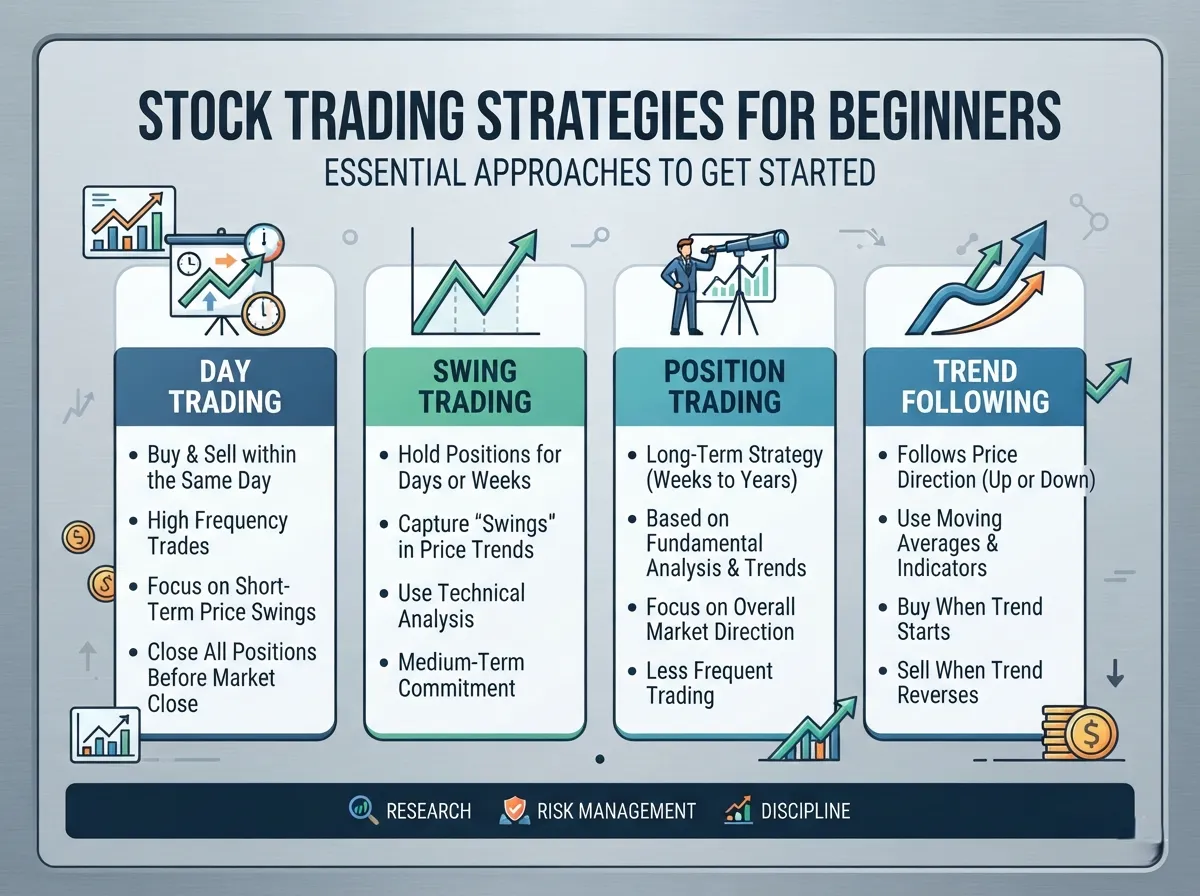
Stock trading strategies for beginners should focus first on risk, process and learning, not on finding a secret pattern or a guaranteed profitable technique. A strategy is more than an entry rule—it is the combination of market selection, time frame, position sizing, stop-loss placement, exit logic and review habits.
In India, the stock market offers many opportunities for investors and traders, but it also carries significant risks, including market risk, company-specific risk, liquidity risk and derivatives risk. SEBI’s investor material emphasises that investors should understand risk and use regulated intermediaries.
This guide introduces stock trading strategies for beginners, including basic trend following, swing trading and risk-first rules. It is written with India’s NSE and BSE context in mind, while remaining useful for global readers.
Education-only disclaimer: This article is for educational purposes only. It does not provide personalised investment advice, trade calls, stock tips, price targets or a recommendation to buy or sell any security. Stock trading involves risk, including the risk of loss of capital.
What a stock trading strategy is
A stock trading strategy is a repeatable set of rules that define when to enter, how much to risk, when to exit and how to review trades. It is not a single indicator or a one-time chart setup.
Strategy vs one-off trade idea
A one-off trade idea might rely on a single pattern or news headline without a clear framework. A strategy defines:
- Market universe (for example, liquid NSE-listed large-cap stocks).
- Time frame (daily, hourly, intraday).
- Entry conditions.
- Stop-loss placement.
- Position size and risk per trade.
- Exit rules.
- Review and improvement process.
Without these elements, it is difficult to know whether a result came from a repeatable edge or from luck.
Why beginners need a strategy
Beginners who trade without a defined strategy may react to every price movement, change rules after each loss or follow tips without understanding risk. A structured strategy helps reduce impulsive decisions and makes it possible to evaluate performance.
SEBI’s investor education material stresses safe investing, risk awareness and understanding of products before participation. A strategy is one part of that understanding for active traders.
Risk-first principles for beginners
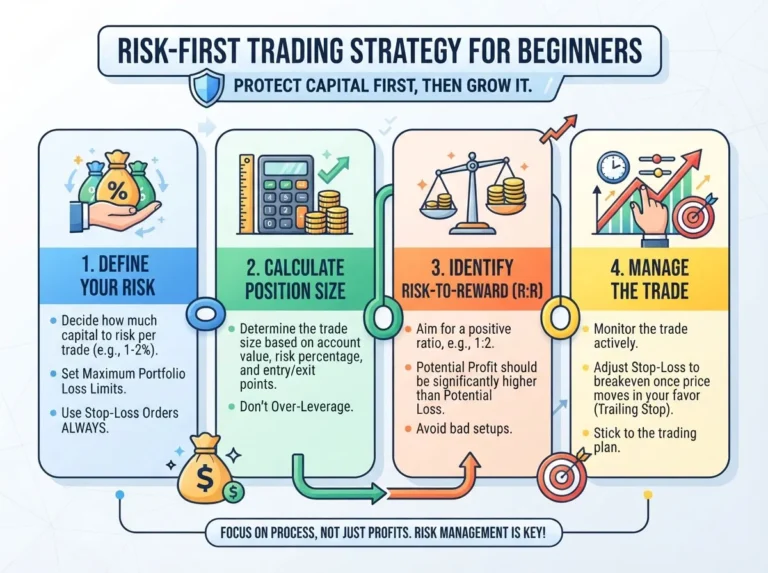
The most important stock trading strategies for beginners start from risk control rather than from the search for high returns.
Capital at risk
Decide how much capital is genuinely available for trading. This should be money the trader can afford to lose without disrupting essential financial responsibilities. Trading with borrowed funds or essential savings can create severe stress and risk.
Maximum loss per trade
Set a maximum planned loss per trade as a small percentage of account equity (for example, 0.5% to 1%). This figure is not a recommendation; it is a risk framework that many educational resources use to illustrate controlled exposure.
The SEBI overview of key risks describes market, volatility and other risks, reinforcing the importance of understanding downside before chasing potential upside.
No strategy without a stop-loss
Any trading strategy for beginners should include a clear stop-loss level or other defined invalidation point. Without it, losses can become uncontrolled and decisions may be driven by hope rather than by analysis.
Core building blocks of a strategy
Before choosing a specific stock trading strategy, beginners should understand the building blocks that most sensible strategies share.
Time frame
The time frame is the primary lens through which price is analysed. Common examples include:
- Long-term position trading: weeks to months.
- Swing trading: days to weeks.
- Intraday trading: minutes to hours.
Different time frames require different risk assumptions, attention levels and cost considerations.
Market universe
Choosing a clear universe narrows focus and helps avoid chasing every symbol that appears on social media or in the news. Examples:
- Liquid large-cap Indian stocks.
- Broad ETFs.
- Select sector indices.
A strategy applied to thinly traded small caps carries different execution and liquidity risks than one applied to liquid large caps.
Entry, stop and target
A basic strategy defines:
- When to enter (for example, after a pullback in an uptrend).
- Where to place the stop-loss.
- How to take profits (target-based, trailing stop, or a mix).
These rules help turn chart reading into decisions instead of impressions.
Trend-following stock trading strategies
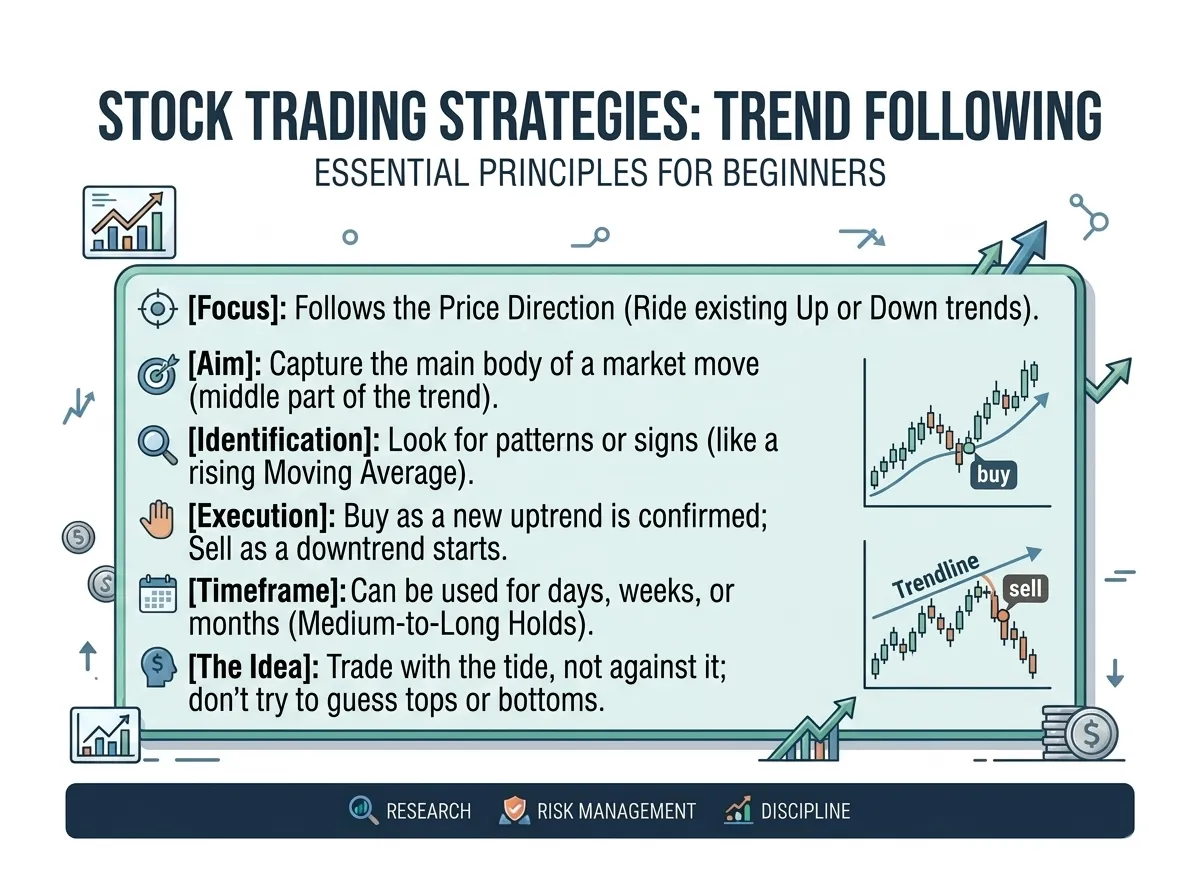
Trend-following strategies attempt to align trades with the direction of the prevailing price trend.
Identifying an uptrend or downtrend
A simple way to identify an uptrend is to look for higher swing highs and higher swing lows over a selected time frame. A downtrend is the opposite. Moving averages and trendlines can help visualise this structure but do not replace price analysis.
Beginners can reinforce this understanding by studying educational explanations of trend concepts from reliable sources or courses.
Basic trend-following approach
A basic long-side trend strategy might include rules such as:
- Trade only stocks in a clear uptrend.
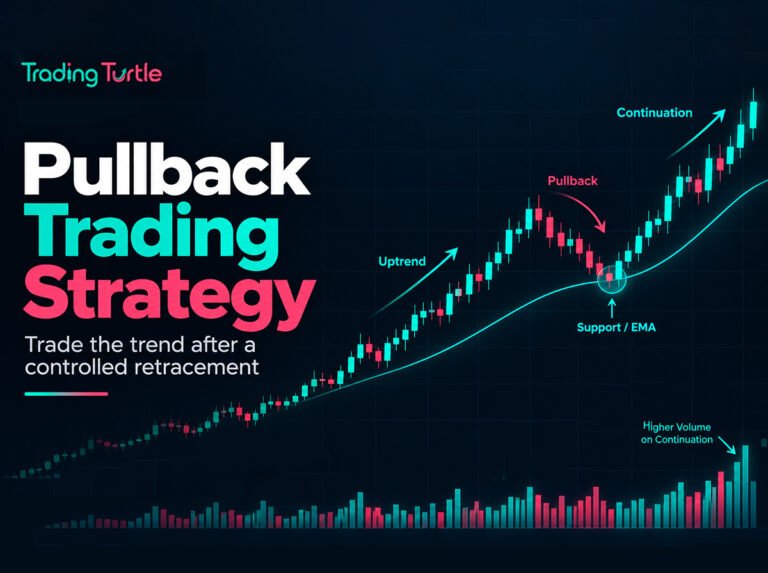
- Enter on pullbacks toward a support area or moving-average zone.
- Place the stop-loss below recent swing lows or a well-defined support region.
- Risk a small, consistent fraction of capital per trade.
- Exit when price breaks the structure that defined the trend or when momentum weakens.
This approach does not eliminate losses. It simply defines how the trader attempts to participate in directional moves.
Swing trading strategies for stocks
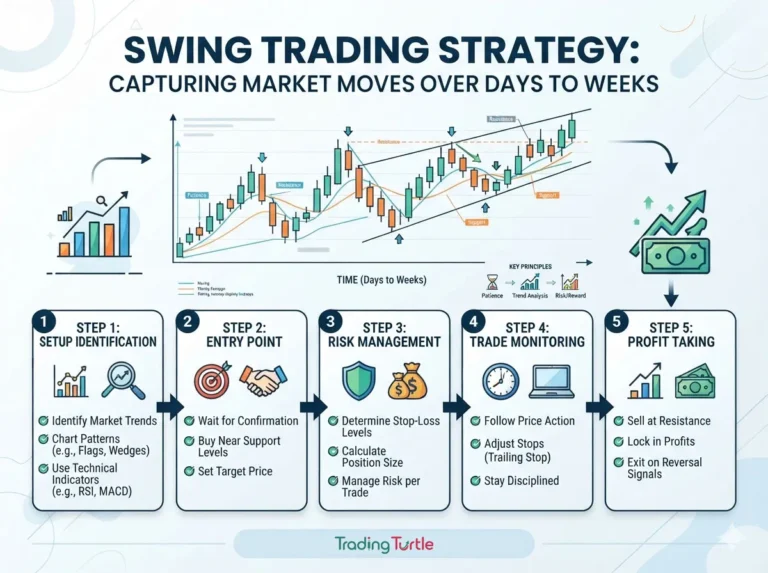
Swing trading strategies focus on capturing medium-term price swings within a trend or range.
What swing trading involves
Swing trading typically involves holding positions for several days to a few weeks. Traders look for:
- Swings from support to resistance in a range.
- Swings from pullback to trend continuation in an uptrend or downtrend.
Time frames commonly used include daily charts for setup identification, with shorter intraday charts for fine-tuning entries.
Common swing trading ideas
Examples of structured swing-trading ideas include:
- Trend pullback: Buying an uptrending stock after a pullback to support, aiming to ride the next swing higher.
- Breakout and retest: Entering after price breaks a key resistance and then retests that level from above.
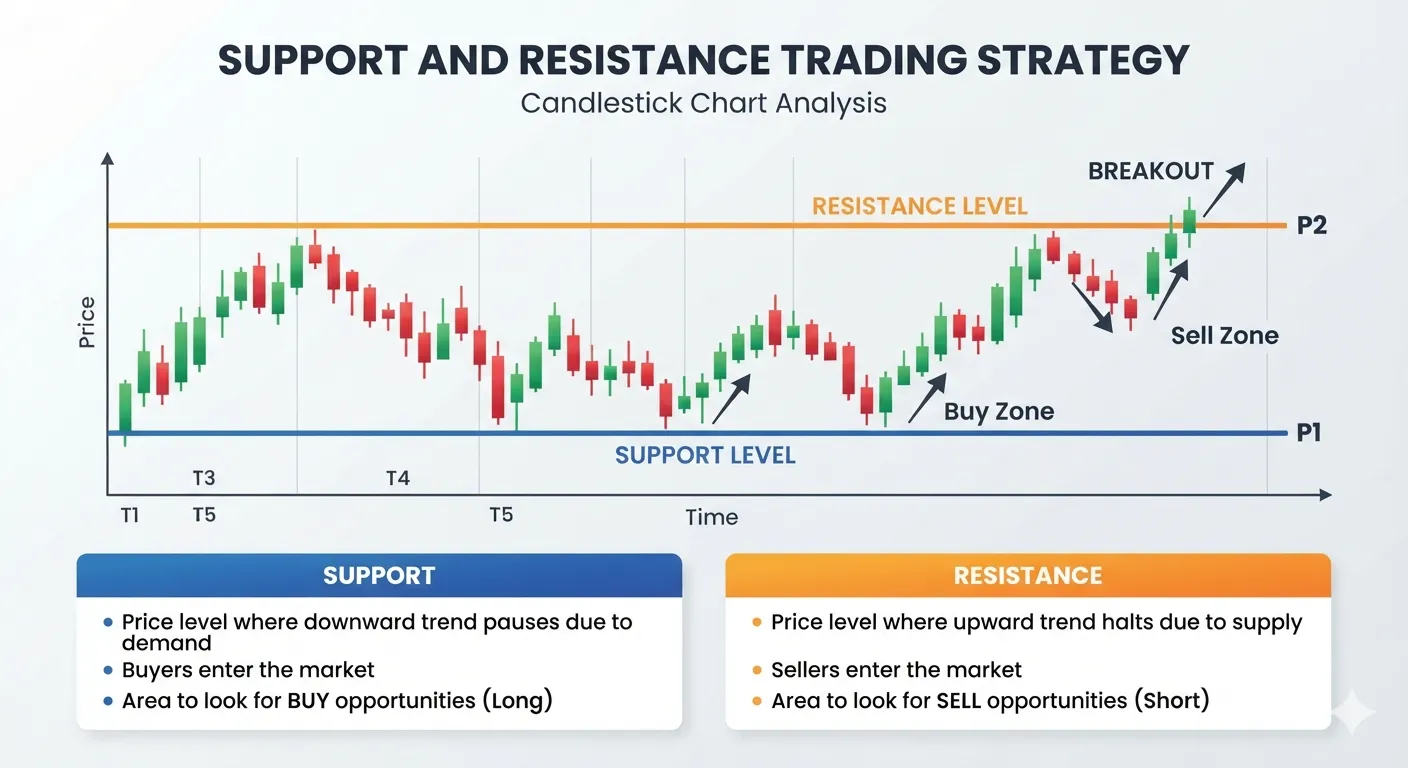
- Range trading: Buying near support in a clearly defined range and selling near resistance, with stops beyond the range boundaries.
Each idea must still be paired with risk rules, position sizing and a clear exit process.
Support, resistance and candlestick context
Support and resistance are reference areas where price has previously paused, reversed or consolidated. Many stock trading strategies incorporate these levels into their entry and exit logic.
Support and resistance basics
- Support: A price area where buying interest has previously appeared, preventing further declines.
- Resistance: A price area where selling interest or profit-taking has previously appeared, limiting advances.
These areas are not exact lines. They are zones that may be tested multiple times and can change as market conditions evolve.
Candlestick context
Candlestick patterns provide visual context for how price moved within a given period. For example, long lower shadows near support may suggest buying interest after intraperiod selling, while strong bearish candles near resistance may suggest selling pressure.
Candlestick analysis should be used as context, not as a standalone predictive tool. A single pattern should not override risk rules or lead to outsized positions.
For readers who need more depth on candlestick basics, studying a dedicated candlestick pattern guide on the site can be useful.
Intraday trading considerations
Intraday trading strategies involve opening and closing positions within the same day. They can be demanding and are not necessary for every beginner.
Higher demands on attention and execution
Intraday strategies require the trader to:
- Monitor markets actively during trading hours.
- Understand fast execution, spreads and slippage.
- Manage multiple decisions under time pressure.
Costs can also be higher because more trades are placed, and intraday leverage may be available but can magnify losses quickly.
Why caution is warranted
Regulators and investor-education resources warn that frequent trading and day trading can involve substantial losses. The SEC publication “Day Trading: Your Dollars at Risk” is U.S.-focused but illustrates general risks such as high costs, leverage and emotional pressure.
Beginners may be better served by learning swing or position trading first, developing risk habits and then deciding whether intraday trading fits their goals and capacity.
Order types and execution
Execution quality can significantly affect the outcome of any stock trading strategy. Understanding order types is therefore part of beginner education.
Market orders
Market orders aim to execute quickly at the best available price. They are simple but can result in slippage if there is sudden movement or limited liquidity. Traders should be aware that a market order may not fill at the last seen price.
Limit orders
Limit orders specify the maximum price a buyer is willing to pay or the minimum price a seller is willing to accept. They offer more control but may not be filled if the market does not reach the specified price.
For more detail on how these order types differ in practice, it is helpful to study a structured explanation of market orders, limit orders and their pros and cons.
Bid-ask spread and liquidity
The bid-ask spread is the difference between the highest current buying price and the lowest current selling price. In a highly liquid stock, the spread may be narrow; in a thinly traded stock, it may be wide.
Execution choices should account for this spread and for available order-book depth, because both affect cost and slippage.
Position sizing and risk management
Position sizing is the process of deciding how many shares to buy or sell in a trade so that the planned loss stays within a defined limit. It is central to risk-first stock trading strategies for beginners.
Basic position-sizing idea
A simple approach is:
- Decide a maximum risk per trade (for example, 1% of account equity).
- Calculate the rupee amount that this represents.
- Determine the distance between the entry price and stop-loss.
- Divide the risk amount by that distance to find a quantity that fits the risk.
This framework is educational. Each trader must adapt it to their own situation, costs and instrument choice.
Overall risk management
Risk management also includes:
- Limiting the number of open trades.
- Avoiding oversized positions.
- Considering correlation between holdings.
- Understanding product features, including derivatives and leverage.
SEBI’s investor education initiatives highlight diversification and risk education as core investor-protection themes.
Psychology and discipline
Even a well-designed stock trading strategy for beginners can fail if discipline is weak. Trading decisions are made under uncertainty, and emotions can strongly influence behaviour.
Common behavioural challenges
- Exiting winners too early due to fear of losing unrealised gains.
- Holding losers too long due to hope of a reversal.
- Increasing size after a winning streak without adjusting risk analysis.
- Changing strategy rules after a few losses without structured review.
Building discipline
Helpful practices include:
- Writing rules down before trading.
- Keeping a journal of trades, including reasons and emotions.
- Reviewing both winning and losing trades for rule adherence.
- Avoiding trading when angry, exhausted or under external pressure.
These habits do not make outcomes certain, but they can reduce avoidable errors.
A simple, practical starter framework
Beginners who want a structured stock trading strategy can combine several of the concepts above into a simple, risk-focused plan.
Framework outline
- Market universe: Liquid large-cap stocks on NSE or BSE.
- Time frame: Daily charts for swing trading.
- Trend filter: Trade only in the direction of the prevailing trend.
- Setup: Enter after a pullback to a support area within an uptrend.
- Stop-loss: Place a stop below recent swing lows or clear support.
- Risk per trade: Fixed small percentage of account equity.
- Position size: Calculated from risk per trade and stop-loss distance.
- Exit: Use a target based on recent swing highs or a trailing stop.
- Journal: Record every trade and review weekly.
Educational emphasis
This framework is an example for learning purposes, not a recommendation or guarantee. The goal is to illustrate how rules can be combined into a coherent process, which can then be tested, measured and refined.
Common mistakes to avoid
Beginners often encounter similar pitfalls when they first explore stock trading strategies.
Chasing tips and rumours
Following unverified tips or social-media calls without understanding business fundamentals, risk or position size can lead to uncontrolled losses.
Overtrading
Placing many trades without clear setups or rules can quickly increase costs and emotional stress.
Ignoring costs
Brokerage, taxes, exchange charges and other costs can significantly affect net results, especially for active strategies.
Using leverage without understanding it
Borrowing funds or using derivatives can magnify both gains and losses. Without a clear understanding of margin, contract terms and risk, leverage can be hazardous.
No review process
Failing to review trades means mistakes are repeated. Journals and periodic reviews help distinguish between strategy issues and execution issues.
Key takeaways
- Stock trading strategies for beginners should be risk-first, not profit-first.
- A strategy includes time frame, market universe, entry rules, stop-loss, position size and exit plan.
- Trend-following and swing trading are common structured approaches for stocks.
- Execution, costs, liquidity and slippage affect outcomes and should be understood.
- Risk management and discipline are as important as chart-reading skills.
- Educational resources from regulators and market-education institutions can support safer learning.
– Frequently Asked Questions (FAQs)
There is no single “best” strategy for all beginners. A simple, risk-focused swing or trend strategy on liquid stocks, with clear rules and small position sizes, is often easier to learn than complex or highly leveraged approaches. This is an educational perspective, not a personalised recommendation.
No. Derivatives and leverage are not mandatory parts of stock trading strategies for beginners. They can increase risk and complexity. Beginners may focus first on understanding cash-market trading, risk and costs.
No. Markets involve uncertainty, and even well-designed strategies can experience losses or prolonged drawdowns. Risk management, discipline and realistic expectations are essential.
Risk per trade helps control the size of potential losses and keeps individual trades from damaging the account disproportionately. It is a key part of strategy design.
Official investor-education resources, such as SEBI’s materials on securities-market risk and safe investing, provide general guidance on types of risk and basic precautions.[web:66][web:2]