How Base Blockchain Works: Under the Hood of Coinbase’s Layer 2

Ethereum is the undisputed king of decentralized finance and smart contract execution. It is highly secure, globally distributed, and virtually tamper-proof. However, running a decentralized global computer comes with a massive trade-off: processing every single transaction on a single network is historically slow and prohibitively expensive.
To scale the onchain economy to the next billion users, the computational heavy lifting had to be moved elsewhere—without sacrificing the underlying security that makes Ethereum valuable in the first place.
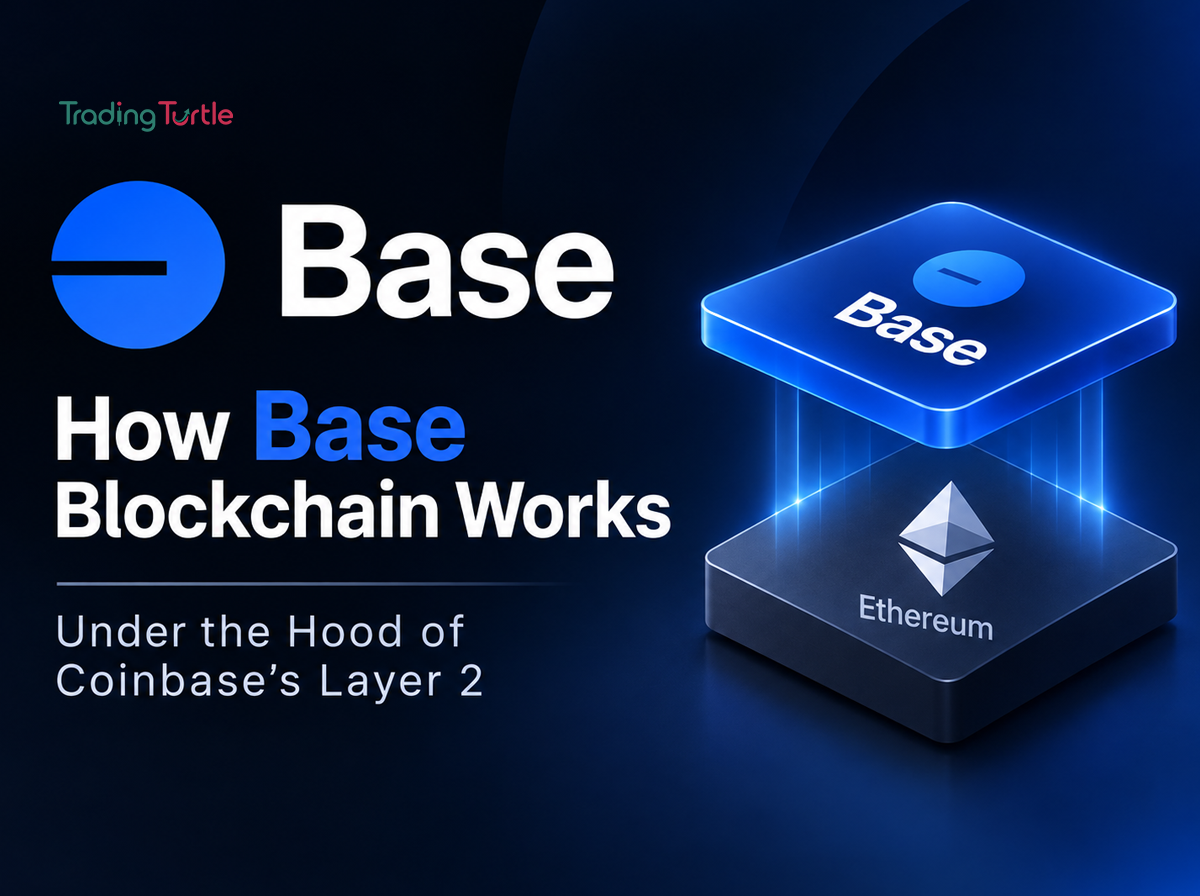
Incubated by Coinbase, the Base network was engineered to solve this exact problem. But to truly appreciate this technological leap, we have to look closely at the underlying architecture. When people ask how Base blockchain works, they are often surprised to learn that it does not operate as an independent, standalone blockchain with its own validators, complex consensus mechanisms, or speculative native tokens.
Instead, Base functions as a highly optimized, high-performance execution layer built directly on top of Ethereum. It batches thousands of transactions off-chain, mathematically compresses the data, and anchors the final indisputable results back to the Ethereum mainnet.
In this comprehensive guide, we will break down exactly how Base blockchain works. We will explore the mechanics of optimistic rollups, trace the exact lifecycle of a transaction from your wallet to final settlement, dive deep into the role of the sequencer, and examine the cryptographic proofs that keep billions of dollars in user funds safe.
Grab a cup of coffee. Whether you are a retail investor, a curious developer, or an institutional analyst, this is your ultimate deep dive into the engine room of modern onchain finance.
Educational Disclaimer: This content is for educational purposes only and is not financial or investment advice. Cryptocurrency markets carry significant risk. Trading Turtle and its authors are not registered financial advisors. Always do your own research (DYOR) before investing.
1. The Core Engine: Optimistic Rollups Explained
If you want to understand how Base blockchain works, you must first understand the concept of a “Rollup,” and more specifically, an “Optimistic Rollup.”
The Restaurant Analogy
Imagine a wildly popular, bustling restaurant. The head chef (Ethereum Layer 1) is incredibly skilled and meticulous, but there is a bottleneck: the chef insists on personally walking out to the dining room, taking every single order, ringing it up at the cash register, and then walking back to the kitchen to cook it. When only ten people are in the restaurant, this works fine. When a thousand people show up, the kitchen grinds to a complete halt, and the price of getting a meal (gas fees) skyrockets as people bid for the chef’s attention.
An optimistic rollup changes the operational model. Instead of the chef doing everything, a team of fast-moving waiters (Base Layer 2) takes all the orders at the tables, tallies them up, and hands the chef one single, consolidated, highly organized ticket. The chef only has to look at the final ticket and execute it.

The Technical Reality of Rollups
In blockchain terms, how Base blockchain works mirrors this exact logic:
- The “Rollup” Mechanism: Base collects (or “rolls up”) thousands of individual user transactions—such as token swaps, NFT mints, and smart contract deployments—into a single compressed batch of data.
- Off-Chain Execution: Instead of forcing Ethereum’s global network of thousands of nodes to calculate the math for every swap, Base handles the computational execution on its own high-speed servers off-chain.
- The “Optimistic” Assumption: Base assumes that all the transactions in the batch are mathematically valid by default (“optimistically”). This assumption is what allows the network to process transactions at lightning speed.
- The Dispute Window: Instead of cryptographically proving every transaction immediately (which is slow and expensive), Base posts the finalized data to Ethereum and leaves a 7-day “challenge window.” During this week, independent network monitors can check the math. If someone finds a fraudulent transaction, they can dispute it.
This optimistic mechanism is the foundational secret to how Base blockchain works. It allows the network to offer sub-second confirmation times and transaction fees that cost fractions of a cent, all while seamlessly inheriting the multi-billion-dollar economic security of the Ethereum mainnet.
2. The Transaction Lifecycle: A Step-by-Step Breakdown
To truly grasp the mechanics of how Base blockchain works, we need to follow the data. When you connect your wallet and click “Swap” or “Send” on a decentralized application running on Base, a highly orchestrated sequence of events triggers in the background.
Here is the exact step-by-step lifecycle of a transaction as it flows from your device to permanent settlement on Ethereum.
Phase 1: User Initiation and the RPC Node
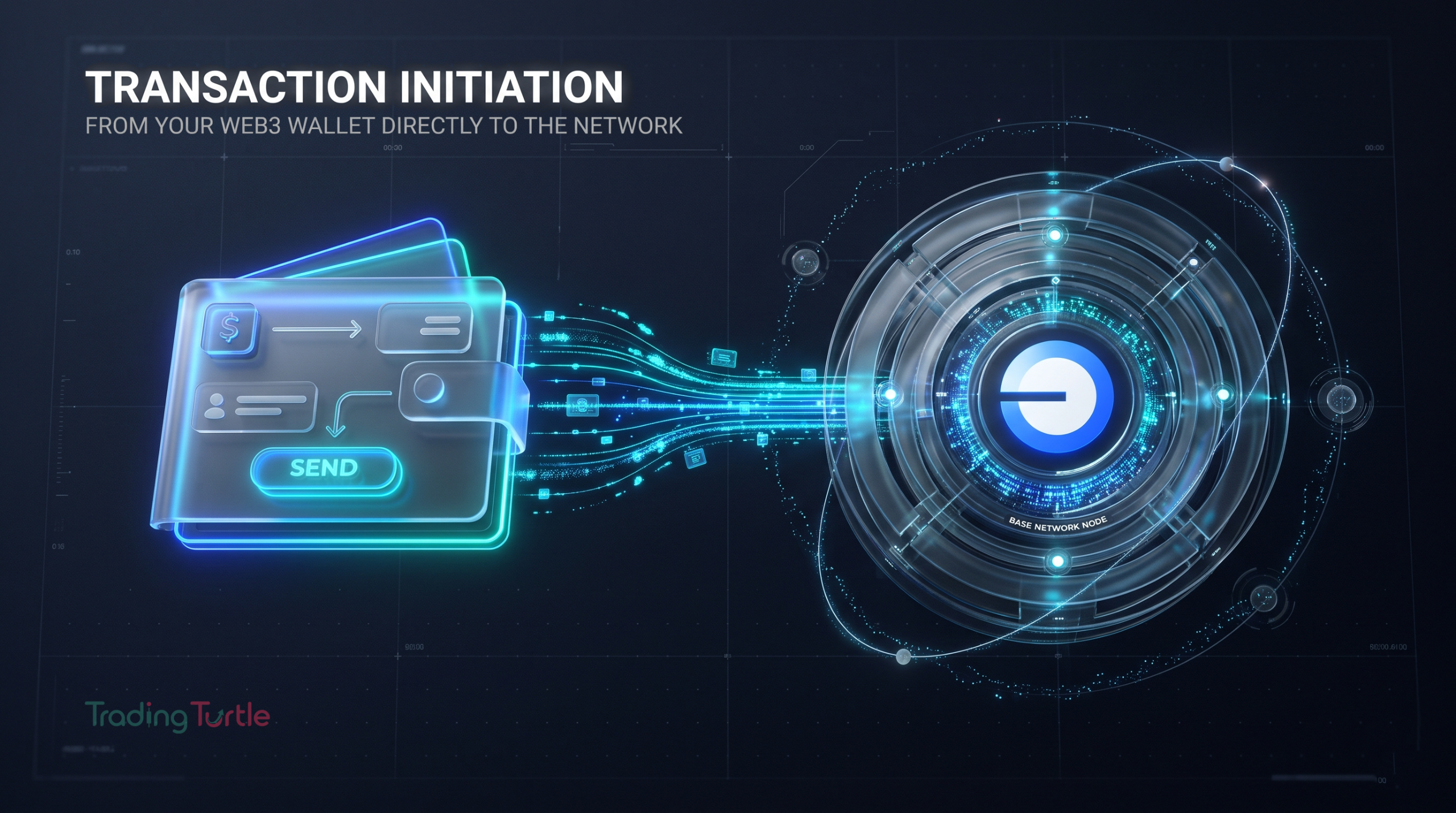
Everything starts with you, the user. You initiate a transaction using a Web3 interface, such as Coinbase Wallet, MetaMask, or Trust Wallet.
- Because Base is fully “EVM-equivalent” (Ethereum Virtual Machine equivalent), the transaction format you generate is identical to a standard Ethereum transaction.
- Your wallet cryptographically signs the request using your private key and broadcasts it to a Base RPC (Remote Procedure Call) node. The RPC node acts as the front door, accepting your transaction and passing it into the network’s internal processing queue.
Phase 2: The Sequencer Takes Control
Once the RPC node receives your transaction, it instantly routes it to the Sequencer. Understanding the sequencer is arguably the most important part of understanding how Base blockchain works.
- The sequencer is the air traffic controller for the Base network. Currently operated by the Base core engineering team, the sequencer’s job is to collect incoming transactions, organize them into a specific, chronological order, and prepare them for execution.
- Because Base currently uses a single trusted sequencer, there is no chaotic “mempool” where predatory bots can easily manipulate your transaction order (a practice known as MEV, or Miner Extractable Value, which plagues Layer 1 blockchains).
- The sequencer provides a “soft confirmation.” Within roughly 1 to 2 seconds, the sequencer gives your wallet a receipt saying, “I have received your transaction, and I promise to execute it in this exact order.” This is why Base feels as fast as a traditional Web2 application.
Phase 3: State Execution (Updating the Ledger)
With the transactions ordered, the sequencer passes the batch to the execution engine. Base uses op-geth, a minimally modified version of Ethereum’s premier execution software.
- The execution engine calculates the new “state” of the network. For example, if your transaction was sending 100 USDC to a friend, the execution engine mathematically deducts 100 USDC from your address balance and adds 100 USDC to your friend’s address balance.
- It does this for thousands of transactions per second, constantly updating the massive digital ledger that records everyone’s balances.
Phase 4: Data Availability (Anchoring to Ethereum L1)
If Base kept all this data on its own private servers, it would just be a traditional centralized database. To remain a secure blockchain, Base must periodically publish the receipts of what happened back to the Ethereum mainnet.
- Every few minutes, the Base sequencer compresses the batch of executed transactions and attaches it to an Ethereum Layer 1 block as a data blob.
- This blob contains all the raw transaction data. It serves as a public, immutable backup. If the Base sequencer servers were to explode and go offline tomorrow, any independent developer in the world could download these data blobs from Ethereum and mathematically reconstruct the exact, down-to-the-cent state of the entire Base network.
Phase 5: Settlement and the Fault Proof Window
Once the data blob is anchored to Ethereum, the transaction is safely recorded. However, because Base relies on an optimistic rollup architecture, the final, irreversible “settlement” is subject to a 7-day dispute window.
- Independent nodes called Verifiers constantly monitor the data Base posts to Ethereum.
- If a verifier detects that the Base sequencer made a mathematical error, processed a double-spend, or tried to slip in an invalid transaction, they can issue a Fault Proof.
- When a fault proof is triggered, the dispute is re-executed step-by-step on the Ethereum mainnet. If the fault proof is proven valid, the fraudulent transaction is instantly reverted, the state is corrected, and the sequencer is penalized.
- Once the 7-day window closes without any disputes, the transaction achieves full finality. It is permanently etched into Ethereum’s history, never to be altered.

3. Deep Dive: The Economics of Data Blobs (EIP-4844)
If you are researching how Base blockchain works, you will inevitably encounter the question: If Base uses Ethereum for security, why do transactions cost $0.01 on Base and $5.00 to $50.00 on Ethereum?
The answer lies in a revolutionary upgrade to the Ethereum network known as EIP-4844, or Proto-Danksharding, which introduced “Data Blobs.”
The Old Way: Expensive Calldata
Prior to early 2024, Layer 2 networks had a major cost problem. To post their transaction batches to Ethereum, they had to use a storage space called calldata. Ethereum processed this calldata as if it were permanent, highly valuable smart contract logic. This meant rollups were paying premium prices to store data on Ethereum forever, and those costs were passed down to users. Even on a Layer 2, a swap might cost $0.50 to $1.00.
The New Way: Temporary Data Blobs
Understanding how Base blockchain works today means understanding Blobs. EIP-4844 introduced a new type of transaction space on Ethereum dedicated entirely to Layer 2 networks.
- Instead of storing data permanently, Base now posts its transaction batches into Blobs.
- Blobs are large, cheap, temporary chunks of data attached to Ethereum blocks. They are stored by Ethereum nodes for roughly 18 days—just long enough to cover the 7-day dispute window required by optimistic rollups. After 18 days, the blobs are safely discarded by the mainnet to prevent blockchain bloat.
- Because the data is temporary and separated from Ethereum’s main execution gas market, the cost to post data plummeted by over 90%.
The Math of Micro-Fees
Base splits the incredibly low cost of posting a data blob among thousands of users. If it costs the sequencer $1.00 to post a blob to Ethereum, and that blob contains 5,000 Base transactions, the actual cost passed on to each user is $0.0002. This economic architecture is the core reason why microtransactions, high-frequency trading, and consumer social apps are finally viable onchain.

4. The OP Stack: The Standardized Blueprint
Base is not a proprietary, closed-source system. When analyzing how Base blockchain works from a software engineering perspective, we must look at its foundation: the OP Stack.
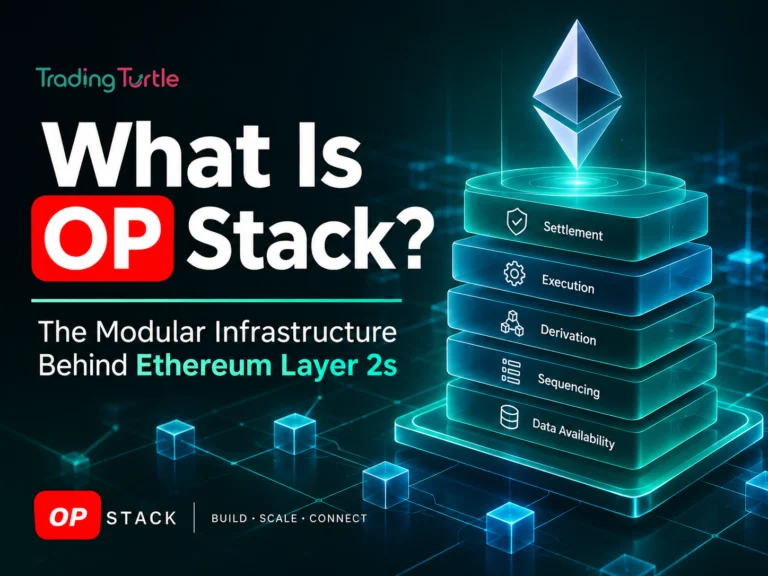
As we detailed in our previous guide, What Is OP Stack?, the Optimism Collective created an open-source, standardized software development suite for building Layer 2 blockchains. Coinbase chose to build Base using this exact blueprint.
Why This Matters for How Base Works
By utilizing the OP Stack, Base operates as a modular network. It consists of decoupled layers (a data layer, a sequencing layer, an execution layer, and a settlement layer). Because these layers are standardized:
- Developer Parity: Code written for Ethereum or Optimism works flawlessly on Base without modification.
- Shared Upgrades: When Coinbase engineers invent a faster way to process transactions on the sequencer, they push that code to the public OP Stack repository. This means Base, OP Mainnet, and other OP Stack chains all upgrade together.
- The Superchain Vision: Because Base shares the exact same codebase and security model as other OP Stack networks, they are forming an interconnected web known as the Superchain. In the near future, moving assets between Base and another Superchain network will be as instant and seamless as navigating between tabs in a web browser.
5. The Bridging Mechanism: Moving Money Across Layers
A blockchain is only as useful as the capital it holds. Because Base is a distinct Layer 2 network, assets do not just “float” over from Ethereum; they must be cryptographically bridged. Understanding the mechanics of the Base Bridge is a critical component of knowing how Base blockchain works.
When you want to move assets from Ethereum to Base, a precise, smart-contract-driven lock-and-mint process takes place.
The Deposit Flow (Ethereum to Base)
- The Lock: You send 1 ETH from your Ethereum wallet to the official Base Bridge smart contract located on the Ethereum Layer 1 network.
- The Escrow: The Ethereum smart contract securely locks that 1 ETH in an unspendable escrow vault.
- The Message: The smart contract sends a cryptographic message across the layers, signaling to the Base network that funds have been secured on Layer 1.
- The Mint: The Base network intercepts this message and automatically “mints” (creates) an exact 1:1 equivalent representation of that asset on Layer 2. You receive 1 “Base ETH” in your wallet, ready to be used in high-speed, low-cost applications.
The Withdrawal Flow (Base to Ethereum)
When you are ready to cash out and move your funds back to the Ethereum mainnet, the process reverses, but with a critical caveat.
- The Burn: You initiate a withdrawal on Base. The network takes your Layer 2 tokens and “burns” (destroys) them, removing them from circulation.
- The Wait: The network sends a message to the Ethereum smart contract asking it to unlock your original funds. However, because of the optimistic rollup architecture we discussed earlier, standard withdrawals must wait for the 7-day dispute window to close. The Ethereum contract will not release the funds until it is mathematically certain the withdrawal is valid and unchallenged.
- The Release: After 7 days, the Ethereum smart contract unlocks your original 1 ETH and sends it to your Layer 1 wallet.
Note on Instant Bridging: While the official native bridge requires a 7-day wait for withdrawals, retail users rarely experience this delay. Third-party liquidity protocols (like Across or Stargate) maintain pools of capital on both layers. They will instantly advance you the funds on Ethereum for a tiny fee (usually pennies) and wait out the 7-day period themselves, removing the friction from the user experience.

6. Security Architecture: Can Base Be Hacked?
No exploration of how Base blockchain works is complete without addressing security, risk, and decentralization. Investors and institutions need to know if the network is safe, if user funds can be frozen, or if the chain can be compromised.
Inherited L1 Security
The primary security guarantee of Base is that it does not rely on its own small set of validators. If an attacker wanted to alter the transaction history of Base and steal funds, they would not just have to hack Base’s servers—they would have to successfully launch a 51% attack against the entire Ethereum mainnet, which would cost tens of billions of dollars and is practically impossible. Base’s final state is secured by Ethereum’s immense economic wall.
The Centralization Nuance (The Sequencer)
Currently, there is a trade-off in how Base blockchain works. To guarantee uptime, eliminate front-running, and ensure smooth performance during its initial growth phase, Coinbase operates the sole sequencer for the network.
- The Benefit: Transactions are insanely fast and reliable.
- The Risk: It represents a centralized single point of failure. If Coinbase’s sequencer servers experience an outage, transaction processing on Base pauses.
It is crucial to note that the sequencer cannot steal your funds or forge your signature. It only has the power to order transactions or temporarily delay them. Coinbase and the Optimism Collective have a strict technical roadmap to decentralize the sequencer set in the coming years, distributing block production across a global network of independent nodes.
The Ultimate Fail-Safe: Escape Hatches
What happens if the Base sequencer goes offline permanently, or if Coinbase is forced by a regulatory body to censor a specific user’s transactions? Are those funds trapped forever?
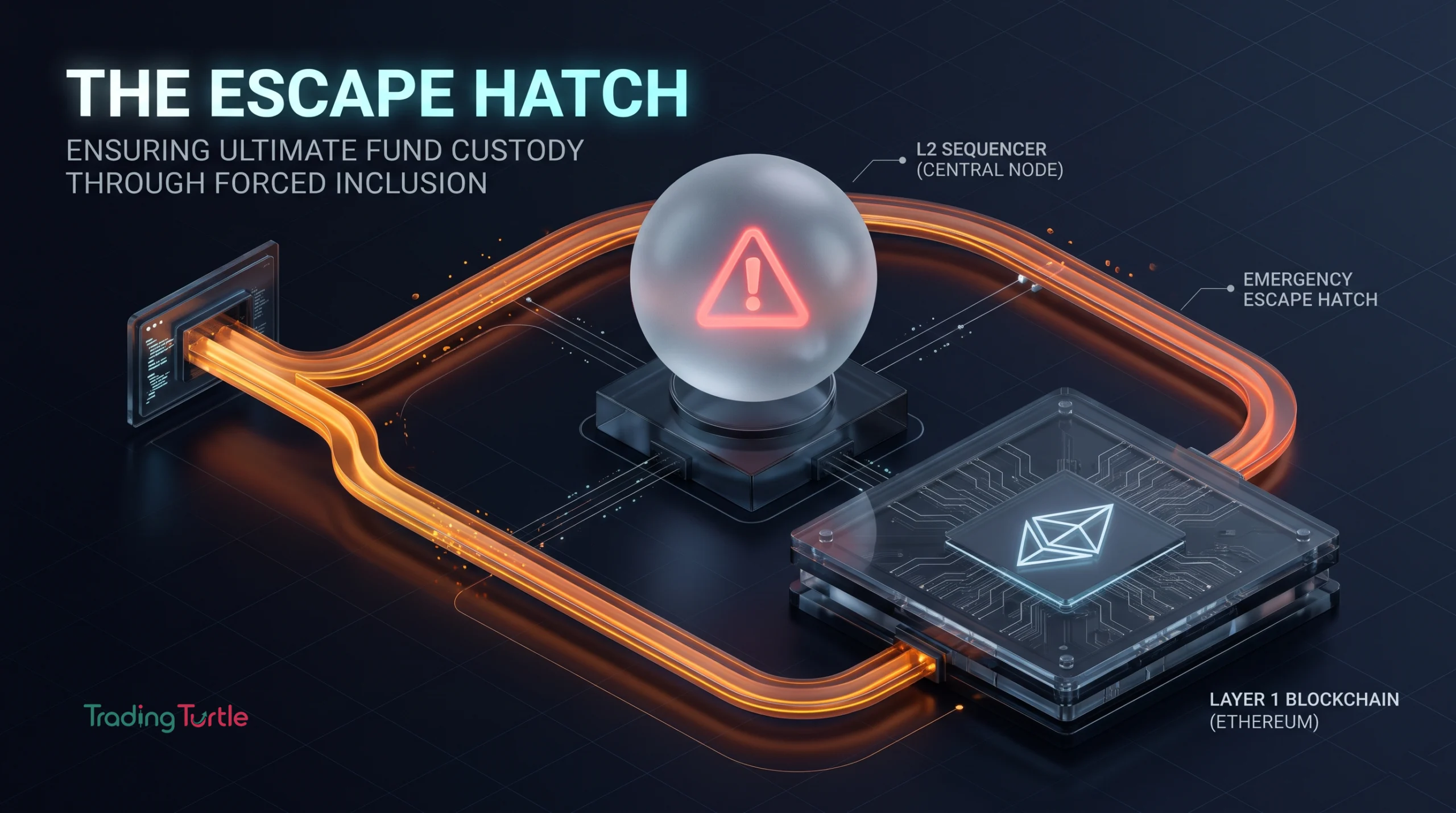
No. The architecture of the OP Stack includes a brilliant fail-safe known as “Forced Inclusion” or an Escape Hatch.
If a user is being censored by the Layer 2 sequencer, they can submit their transaction directly to the Base smart contract on the Ethereum Layer 1 network. The smart contract will force the Layer 2 network to process the transaction. If the sequencer ignores it, the sequencer is mathematically penalized, and the state is updated anyway. This ensures that Base retains the ultimate Web3 guarantee: self-custody. User funds can never be permanently frozen by a centralized entity.
Audits and Enterprise Backing
Beyond the cryptography, how Base blockchain works is bolstered by its institutional backing. The smart contracts governing the Base bridge and the OP Stack have undergone rigorous, continuous audits by top-tier Web3 security firms like OpenZeppelin and Trail of Bits. Furthermore, the network is monitored 24/7 by Coinbase’s internal enterprise security teams, adding an unprecedented layer of traditional cybersecurity to the decentralized framework.
7. The Future of the Network
When you strip away the complex cryptography and look purely at how Base blockchain works, you realize it is a highly optimized execution environment designed for one thing: scale.
By stripping away the heavy burdens of global consensus, validator management, and permanent data storage—and delegating those massive responsibilities to Ethereum—Base achieves the speed and cost-efficiency of a centralized cloud database while maintaining the self-custodial guarantees of a blockchain.
This architectural elegance is exactly why institutional finance, major consumer brands, and millions of retail users are migrating to Base. They receive the scale required for mainstream applications while resting securely on Ethereum’s immutable ledger.
As Coinbase continues to integrate Base directly into its consumer applications, providing seamless on-ramps for over 100 million verified users, the underlying mechanics we have explored today will quietly power the next era of the internet economy.
Frequently Asked Questions (FAQs)
No. Base does not have a native network token (there is no “BASE” coin). Gas fees on the Base network are paid using standard Ether (ETH). Any token claiming to be the official Base token is a scam. Coinbase has explicitly stated they have no plans to launch a token for the network.
Not automatically. A 1:2 setup offers twice the planned reward per unit of risk, but it may reach the tarTransaction execution happens off-chain on Base’s dedicated sequencer nodes, but the compressed receipt data is periodically stored on the Ethereum Layer 1 blockchain. Following the Dencun upgrade, this data is stored in cost-effective, temporary “data blobs” (EIP-4844) to keep fees low.get less often. Judge the complete strategy, not the ratio alone.
Because Base operates as an optimistic rollup, it relies on a 7-day challenge window to ensure the sequencer processes transactions honestly. During this window, any network monitor can mathematically dispute a transaction. Standard bridge withdrawals must wait for this 7-day window to close before funds are fully released on Ethereum to guarantee security. (Note: third-party bridges bypass this for users by advancing the liquidity).
Ethereum requires thousands of independent nodes around the world to reach a consensus on every single transaction, which takes time. Base uses a single, highly performant sequencer to order and execute transactions instantly, providing sub-second confirmation receipts to users off-chain before batching them securely to Ethereum.
Yes. Because of how Base blockchain works, it inherits the economic security of the Ethereum blockchain. It is built on the battle-tested, heavily audited OP Stack framework and is backed by Coinbase’s world-class, enterprise-grade security infrastructure. Furthermore, cryptographic escape hatches ensure users always maintain ultimate custody of their funds.